Basel Banking Standards Vs Bitcoin: Strategy CEO Blasts 1,250% Risk Weight

bitcoinistPublished on 2026-02-21Last updated on 2026-02-21

Abstract

Strategy CEO Phong Le and other industry experts are criticizing the Basel banking standards' treatment of Bitcoin, which assigns it a 1,250% risk weight. This classification makes it prohibitively expensive for regulated banks to hold or custody Bitcoin, as they must set aside $1 in capital for every $1 of exposure. In contrast, assets like cash, physical gold, and U.S. Treasuries carry a 0% risk weight. Critics argue this is a major policy error that misprices risk, discourages bank involvement in digital assets, and pushes activity toward riskier non-bank or offshore entities. They call for a review of these rules, especially if the U.S. aims to become a global crypto leader.

Strategy CEO Phong Le is calling for a rethink of how banks are required to capital-charge bitcoin exposure under Basel-style rules, arguing that current risk-weighting treatment materially shapes whether regulated institutions can engage with digital assets at all.

The catalyst was a chart shared on X that labels bitcoin “unsecured crypto exposure” with a “typical risk weight” of 1,250% under an “Illustrative Basel III-Style” standardized approach, alongside 0% weights for cash, physical gold, and US Treasuries.

A Capital Penalty For Bank Bitcoin Exposure

Le framed the issue as structural rather than political, pointing to the way global capital rules flow into national bank regulation. “The Basel Accords set global bank capital standards and risk-weighting rules for assets. These frameworks materially shape how banks engage with digital assets, including bitcoin,” he wrote. “They are developed by the Basel Committee of central banks and regulators across 28 jurisdictions — the US is just one.”

He tied that directly to Washington’s stated ambitions for crypto leadership. “If the US wants to be the Crypto Capital of the World, our implementation of Basel capital treatment deserves careful review,” Le said.

Jeff Walton, who posted the image Le quoted, summarized the contrast in blunt numbers: “Basel III Risk weights for assets: Gold: 0% Public equity: 300% Bitcoin: 1,250%,” adding that if the US wants to be a “crypto capitol,” “the banking regulations need to change,” because “Risk is mispriced.”

The chart itself presents a ladder of “typical” risk weights across asset classes. Cash and central bank reserves sit at 0%, physical gold at 0%, and sovereign debt such as US Treasuries (USD, U.S. bank) also at 0%. Investment-grade corporate debt is shown in a 20–75% range, unrated corporate debt at 100%, high-yield at 150%, public equity at 250–300%, and private equity at 400%+. Bitcoin is set apart at 1,250%.
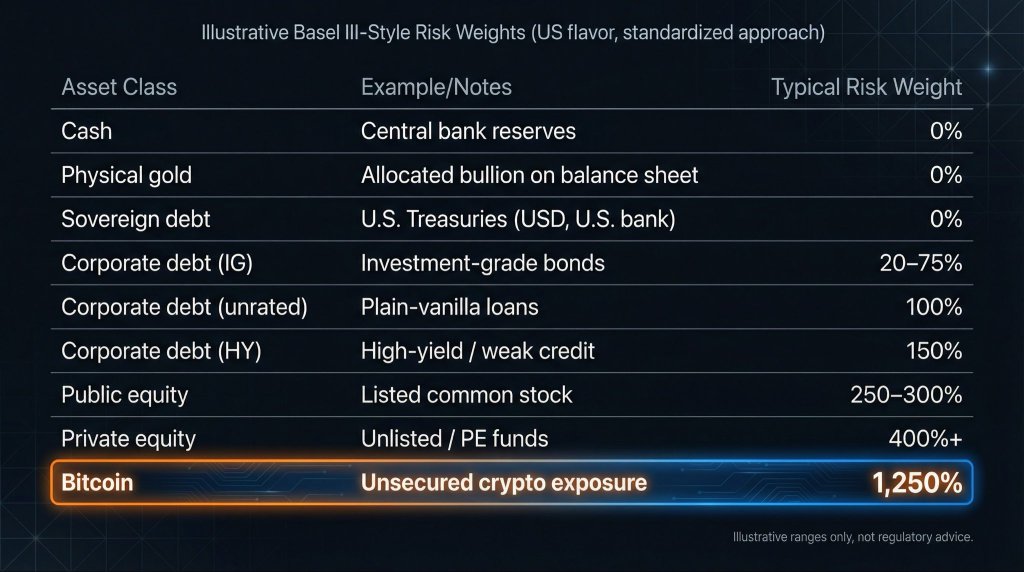
Basel III-style risk weights | Source: X @PunterJeff

Conner Brown, Head of Strategy at the Bitcoin Policy Institute, argued that the practical effect is to make bank intermediation of bitcoin prohibitively expensive. “It’s hard to overstate how bad of a policy error this is,” he wrote. “Banks are required to set aside capital based on how risky regulators think an asset is. The higher the ‘risk weight,’ the more expensive it is for a bank to hold.”

Brown described the 1,250% figure as translating into a one-for-one capital requirement relative to exposure. In his words, bitcoin’s treatment “means banks must hold $1 in capital for every $1 of Bitcoin exposure,” while gold is treated “the same as cash” with “essentially no capital cost.”

He also pushed back on the premise that bitcoin should be penalized relative to legacy assets, pointing to operational traits he sees as favorable for risk management and market functioning, including continuous trading, fast auditability of holdings, fixed supply, rapid global settlement, and transparent pricing. The result, he argued, is that regulators have effectively discouraged banks from offering custody and related services that corporates and individuals might prefer inside the regulated perimeter.

Brown said the knock-on effects extend beyond bank balance sheets to competitiveness. He argued the framework diverts activity toward “non-bank entities and offshore jurisdictions,” which he characterized as carrying higher risks, and warned that failing to adjust the approach could leave US institutions at a disadvantage globally.

At press time, Bitcoin traded at $67,857.
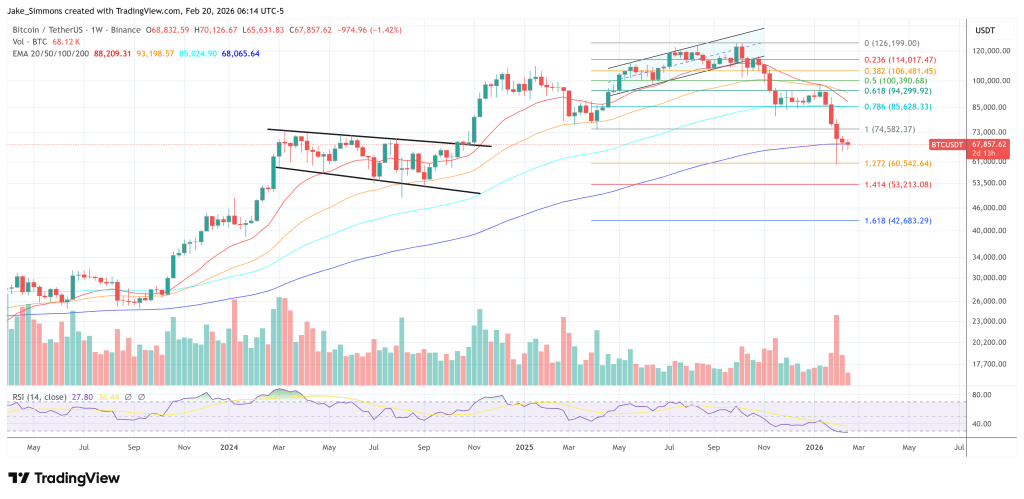
Bitcoin must stay above the 200-week EMA, 1-week chart | Source: BTCUSDT on TradingView.com

Related Questions

QWhat is the main argument made by Strategy CEO Phong Le regarding Basel banking standards and bitcoin?

APhong Le argues that the current Basel-style risk-weighting rules, which assign a 1,250% risk weight to bitcoin, structurally and materially shape whether regulated banks can engage with digital assets at all, and calls for a careful review of this capital treatment if the US wants to be the global crypto leader.

QAccording to the chart shared on X, what are the risk weights assigned to physical gold and US Treasuries under the illustrative Basel III-style framework?

AAccording to the chart, both physical gold and US Treasuries are assigned a 0% risk weight under the illustrative Basel III-style framework.

QWhat practical effect does a 1,250% risk weight have on a bank's capital requirement for holding bitcoin?

AA 1,250% risk weight means that for every $1 of bitcoin exposure, a bank is required to hold $1 in capital, making it prohibitively expensive for banks to hold bitcoin on their balance sheets.

QWhat reasons does Conner Brown give for arguing that bitcoin's high risk weight is a policy error?

AConner Brown argues it's a policy error because bitcoin has favorable operational traits for risk management, including continuous trading, fast auditability of holdings, fixed supply, rapid global settlement, and transparent pricing, which are not reflected in its punitive risk weighting.

QWhat broader consequence does the article suggest the current Basel framework has for the US crypto industry?

AThe article suggests that the current framework diverts crypto activity to non-bank entities and offshore jurisdictions, which may carry higher risks, and could leave US institutions at a competitive disadvantage globally.

Related Reads

Single-Day Plunge of 30%, Arthur Hayes Suddenly Liquidates: Why Did ZEC Get Exploded by Security Issues?

On June 5th, Zcash founder Zooko Wilcox disclosed a critical soundness vulnerability in the project's latest Orchard privacy pool. This flaw, found in the elliptic curve multiplication constraints, could allow an attacker to create unlimited counterfeit ZEC within the shielded pool, with transactions appearing valid. The vulnerability was discovered in late May by security researcher Taylor Hornby, who utilized Anthropic's new Opus 4.8 AI model for a targeted audit. The Zcash ecosystem had already performed an emergency network upgrade to patch the issue. However, the detailed disclosure triggered severe market panic, causing ZEC's price to plummet over 30% in a single day. Notably, prominent investor Arthur Hayes announced he had sold his entire ZEC position following the news. The incident starkly challenges the "technological trust" narrative central to privacy coins. Despite years of top-tier cryptographic audits, the bug persisted until uncovered with advanced AI-assisted research. This highlights the growing gap between theoretical perfection and practical implementation in privacy technology. The event serves as a industry-wide warning: in an AI-driven security landscape, the assumption that "undiscovered equals safe" is obsolete. It underscores the urgent need for continuous, proactive security practices combining AI audits, formal verification, and rapid response mechanisms.

foresightnews_api46m ago

Single-Day Plunge of 30%, Arthur Hayes Suddenly Liquidates: Why Did ZEC Get Exploded by Security Issues?

foresightnews_api46m ago

Breaking the Curse of DeFi Cascading Liquidations, Vitalik Proposes a New Solution

**Vitalik Buterin Proposes New DeFi Design to Eliminate Forced Liquidations** Ethereum co-founder Vitalik Buterin has published a proposal for a new decentralized finance (DeFi) architecture aimed at removing the automatic liquidation mechanisms prevalent in current lending protocols. The core idea involves creating synthetic assets using options as building blocks, fundamentally avoiding the抵押借贷结构 that triggers forced sell-offs. The proposal responds to a recurring flaw in DeFi: during sharp market downturns, mass自动清算 of under-collateralized positions can exacerbate price declines, creating systemic selling pressure and market instability, as evidenced by recent crypto market volatility. Buterin's model would split an asset like 1 ETH into two option-like derivatives, P and N, pegged to a price index with a set strike price and expiration. At expiry, an oracle determines the settlement price to allocate the underlying ETH between P and N holders. This design eliminates the "cliff" of instant liquidation. Instead, a position's value would gradually drift from its target peg if not actively rebalanced by the user, transferring the rebalancing decision from the protocol to the user or automated tools. A key advantage is the reduced reliance on high-frequency, real-time oracle price feeds, which are vulnerable to manipulation and errors in current systems. The delayed settlement in the options model allows for more robust, fault-tolerant oracle designs. However, significant challenges remain for practical adoption. High transaction costs (slippage) from frequent rebalancing on automated market makers (AMMs) could erode user funds. The model may not be suitable for stablecoins requiring a strict 1:1 dollar peg, as it inherently allows for value drift. Success would depend on developing new liquidity provisioning models and deep markets for these synthetic assets. The proposal represents a fundamental rethinking of DeFi risk management, challenging the industry to explore alternatives to被动集中平仓 rather than merely optimizing existing liquidation processes. It remains a theoretical framework awaiting implementation and testing by development teams.

foresightnews_api49m ago

Breaking the Curse of DeFi Cascading Liquidations, Vitalik Proposes a New Solution

foresightnews_api49m ago

Bitcoin's Decline Marks the Transformation of Crypto

Title: The Decline of Bitcoin Marks the Transformation of Crypto While Bitcoin's price recently fell below $70,000, down approximately 45% from its peak, the broader crypto industry is not following it into decline. Instead, crypto is maturing and evolving beyond its dependence on Bitcoin's price movements. Two of Bitcoin's core functions are being usurped. First, AI has captured its role as the primary speculative asset. AI, with its tangible revenue, explosive demand, and massive capital inflows ($700-830 billion in 2024), is siphoning off the speculative "hot money" that once drove Bitcoin. It also contributes to a sustained high-interest-rate environment, further tightening liquidity for assets like Bitcoin. Second, dollar-pegged stablecoins like USDC and USDT have replaced Bitcoin as the crypto market's foundational currency and primary on/off-ramp. Most trading pairs and on-chain transactions are now settled in stablecoins, severing the historical link where all capital inflows had to pass through Bitcoin first. This decoupling allows projects to thrive based on their own fundamentals rather than Bitcoin's price. Examples include Hyperliquid, an on-chain derivatives exchange with annual revenues of $8-13 billion, and prediction market platform Polymarket, valued at $200 billion with $3.65 billion in annual fees. These projects are evaluated on traditional metrics like revenue and user growth. New opportunities are emerging, particularly around privacy. Privacy coins like Zcash (ZEC) are seeing surging demand, while infrastructure like NEAR enables private, cross-chain asset transfers without requiring users to hold a specific token—privacy becomes a universal service layer. In this new paradigm, stablecoins are the universal cash, various project tokens represent equity, and privacy-enabled cross-chain coordination layers (like NEAR) act as the critical infrastructure connecting a fragmented, multi-chain ecosystem. Bitcoin is now just one asset among many. The era where the entire crypto market moved in lockstep with Bitcoin is over. The industry's health should now be judged by project fundamentals—real revenue, active users, and tokenomics that capture value—and the development of the underlying infrastructure enabling a mature, dollar-denominated crypto economy.

foresightnews_api52m ago

Bitcoin's Decline Marks the Transformation of Crypto

foresightnews_api52m ago

Lightspark CEO: In Ten Years, Bitcoin Will Be as Invisible as TCP/IP, Yet Power Trillions in Daily Transactions

A decade from now, Bitcoin will function like TCP/IP — invisible yet foundational, supporting trillions in daily transactions globally, according to Lightspark CEO David Marcus. In this future, a coffee shop in Lagos receives instant payment, a manufacturer in São Paulo settles an invoice with a supplier in Ho Chi Minh City, and a freelancer in Bangalore gets paid weekly from an Austin startup — all via Bitcoin's settlement layer, with none of the parties consciously interacting with it. This vision parallels the adoption of open protocols: first driven by necessity where existing systems fail, then scaling rapidly as tools mature and economic benefits become clear. The structural shift begins with wallets. Modern non-custodial wallets, like Spark, allow users to hold dollars, local currency, and Bitcoin in a single address, seamlessly switching between them. This eliminates friction and revolutionizes global custody, moving significant deposits to user-controlled keys not by ideology, but by superior utility. As a result, Bitcoin becomes the default savings layer for billions, as its fixed supply and appreciating value make it a rational choice for savers holding it alongside stablecoins in their everyday wallets. Businesses follow a similar path, from small companies in emerging markets to multinational corporations, holding Bitcoin alongside operational stablecoins. The latest trend is direct Bitcoin transactions for commerce. When both parties hold Bitcoin, transacting in it becomes the simplest option — no conversions, no intermediary currency. This starts in niche areas like high-value B2B settlements but grows as infrastructure makes sending Bitcoin as easy as stablecoins. An accelerating force is AI agents. By 2036, AI agents conducting commerce on behalf of individuals and firms will increasingly choose Bitcoin for settlement. Optimizing for speed, finality, and minimal counterparty risk across jurisdictions, they find Bitcoin's global, neutral, and programmable network ideal for netting and settling obligations. Thus, Bitcoin is becoming the native currency for machine commerce, just as it has become a native savings asset for humans. The global monetary system is being rebuilt from the protocol layer: open infrastructure, default self-custody, Bitcoin settling everything underneath, with stablecoins as the interface. Most users won't think about Bitcoin when they transact — and they won't need to.

foresightnews_api56m ago

Lightspark CEO: In Ten Years, Bitcoin Will Be as Invisible as TCP/IP, Yet Power Trillions in Daily Transactions

foresightnews_api56m ago

Trading

Spot
Futures

Hot Articles

What is $BITCOIN

DIGITAL GOLD ($BITCOIN): A Comprehensive Analysis Introduction to DIGITAL GOLD ($BITCOIN) DIGITAL GOLD ($BITCOIN) is a blockchain-based project operating on the Solana network, which aims to combine the characteristics of traditional precious metals with the innovation of decentralized technologies. While it shares a name with Bitcoin, often referred to as “digital gold” due to its perception as a store of value, DIGITAL GOLD is a separate token designed to create a unique ecosystem within the Web3 landscape. Its goal is to position itself as a viable alternative digital asset, although specifics regarding its applications and functionalities are still developing. What is DIGITAL GOLD ($BITCOIN)? DIGITAL GOLD ($BITCOIN) is a cryptocurrency token explicitly designed for use on the Solana blockchain. In contrast to Bitcoin, which provides a widely recognized value storage role, this token appears to focus on broader applications and characteristics. Notable aspects include: Blockchain Infrastructure: The token is built on the Solana blockchain, known for its capacity to handle high-speed and low-cost transactions. Supply Dynamics: DIGITAL GOLD has a maximum supply capped at 100 quadrillion tokens (100P $BITCOIN), although details regarding its circulating supply are currently undisclosed. Utility: While precise functionalities are not explicitly outlined, there are indications that the token could be utilized for various applications, potentially involving decentralized applications (dApps) or asset tokenization strategies. Who is the Creator of DIGITAL GOLD ($BITCOIN)? At present, the identity of the creators and development team behind DIGITAL GOLD ($BITCOIN) remains unknown. This situation is typical among many innovative projects within the blockchain space, particularly those aligning with decentralized finance and meme coin phenomena. While such anonymity may foster a community-driven culture, it intensifies concerns about governance and accountability. Who are the Investors of DIGITAL GOLD ($BITCOIN)? The available information indicates that DIGITAL GOLD ($BITCOIN) does not have any known institutional backers or prominent venture capital investments. The project seems to operate on a peer-to-peer model focused on community support and adoption rather than traditional funding routes. Its activity and liquidity are primarily situated on decentralized exchanges (DEXs), such as PumpSwap, rather than established centralized trading platforms, further highlighting its grassroots approach. How DIGITAL GOLD ($BITCOIN) Works The operational mechanics of DIGITAL GOLD ($BITCOIN) can be elaborated on based on its blockchain design and network attributes: Consensus Mechanism: By leveraging Solana’s unique proof-of-history (PoH) combined with a proof-of-stake (PoS) model, the project ensures efficient transaction validation contributing to the network's high performance. Tokenomics: While specific deflationary mechanisms have not been extensively detailed, the vast maximum token supply implies that it may cater to microtransactions or niche use cases that are still to be defined. Interoperability: There exists the potential for integration with Solana’s broader ecosystem, including various decentralized finance (DeFi) platforms. However, the details regarding specific integrations remain unspecified. Timeline of Key Events Here is a timeline that highlights significant milestones concerning DIGITAL GOLD ($BITCOIN): 2023: The initial deployment of the token occurs on the Solana blockchain, marked by its contract address. 2024: DIGITAL GOLD gains visibility as it becomes available for trading on decentralized exchanges like PumpSwap, allowing users to trade it against SOL. 2025: The project witnesses sporadic trading activity and potential interest in community-led engagements, although no noteworthy partnerships or technical advancements have been documented as of yet. Critical Analysis Strengths Scalability: The underlying Solana infrastructure supports high transaction volumes, which could enhance the utility of $BITCOIN in various transaction scenarios. Accessibility: The potential low trading price per token could attract retail investors, facilitating wider participation due to fractional ownership opportunities. Risks Lack of Transparency: The absence of publicly known backers, developers, or an audit process may yield skepticism regarding the project's sustainability and trustworthiness. Market Volatility: The trading activity is heavily reliant on speculative behavior, which can result in significant price volatility and uncertainty for investors. Conclusion DIGITAL GOLD ($BITCOIN) emerges as an intriguing yet ambiguous project within the rapidly evolving Solana ecosystem. While it attempts to leverage the “digital gold” narrative, its departure from Bitcoin's established role as a store of value underscores the need for a clearer differentiation of its intended utility and governance structure. Future acceptance and adoption will likely depend on addressing the current opacity and defining its operational and economic strategies more explicitly. Note: This report encompasses synthesised information available as of October 2023, and developments may have transpired beyond the research period.

363 Total ViewsPublished 2025.05.13Updated 2025.05.13

What is $BITCOIN

Discussions

Welcome to the HTX Community. Here, you can stay informed about the latest platform developments and gain access to professional market insights. Users' opinions on the price of BTC (BTC) are presented below.

活动图片















