Bankless Founder: By 2026, Tokens Will Finally Be Treated as 'Equity'

marsbitPublished on 2026-02-03Last updated on 2026-02-03

Abstract

Bankless co-founder David Hoffman argues that most tokens are treated poorly compared to equity, leading to low market valuations. However, 2026 marks a shift with innovative token distribution models. MegaETH locks 53% of its MEGA tokens in a KPI-based program, where tokens unlock only if specific growth targets—like TVL, decentralization progress, and performance metrics—are met. This aligns dilution with actual ecosystem growth and distributes new tokens to long-term stakers, reducing sell pressure. Meanwhile, Cap protocol replaces traditional airdrops with a "stabledrop," distributing stablecoins (cUSD) instead of governance tokens to users. Those seeking CAP tokens must participate in a public sale, ensuring holders are committed investors. These models move away from indiscriminate token distribution toward targeted, conditional mechanisms that reward genuine participation and long-term alignment, potentially improving token value and holder quality.

Author: David Hoffman

Compiled by: Deep Tide TechFlow

Deep Tide Introduction: Are most tokens garbage? Bankless co-founder David Hoffman points out that historically, teams have treated tokens far less seriously than equity, and the market has responded to this through token prices.

But 2026 saw a turning point:

MegaETH locked 53% of its tokens in a KPI plan, which only unlocks upon achieving growth targets;

The Cap protocol replaced governance token airdrops with stablecoin airdrops, allowing only real investors to obtain CAP through token sales.

These innovative strategies are ending the era of "spray-and-pray" token distribution, shifting towards precise, conditional allocation mechanisms.

Full text as follows:

The crypto industry has a "good coins problem".

Most tokens are garbage.

Most tokens are not treated with the same legal and strategic seriousness as equity by their teams. Because teams have historically not given tokens the same respect as equity in traditional companies, the market has reflected this in token prices.

Today I want to share two sets of data that make me optimistic about the state of tokens in 2026 and beyond:

  1. MegaETH's KPI Plan
  2. Cap's Stablecoin Airdrop (Stabledrop)

Conditional Token Supply

MegaETH has locked 53% of the total MEGA token supply in a "KPI Plan". The logic is: if MegaETH does not achieve its KPIs (Key Performance Indicators), these tokens will not unlock.

Therefore, in a pessimistic scenario where the ecosystem does not grow, at least no additional tokens flood the market to dilute holders. MEGA tokens only enter the market when the MegaETH ecosystem actually achieves growth (as defined by the KPIs).

The KPIs for this plan are divided into 4 scoreboards:

  1. Ecosystem Growth (TVL, USDM supply)
  2. MegaETH Decentralization (L2Beat stage progress)
  3. MegaETH Performance (IBRL)
  4. Ethereum Decentralization

Thus, in theory, as MegaETH achieves its KPI targets, the value of MegaETH should grow correspondingly, mitigating the negative price impact of MEGA dilution on the market.
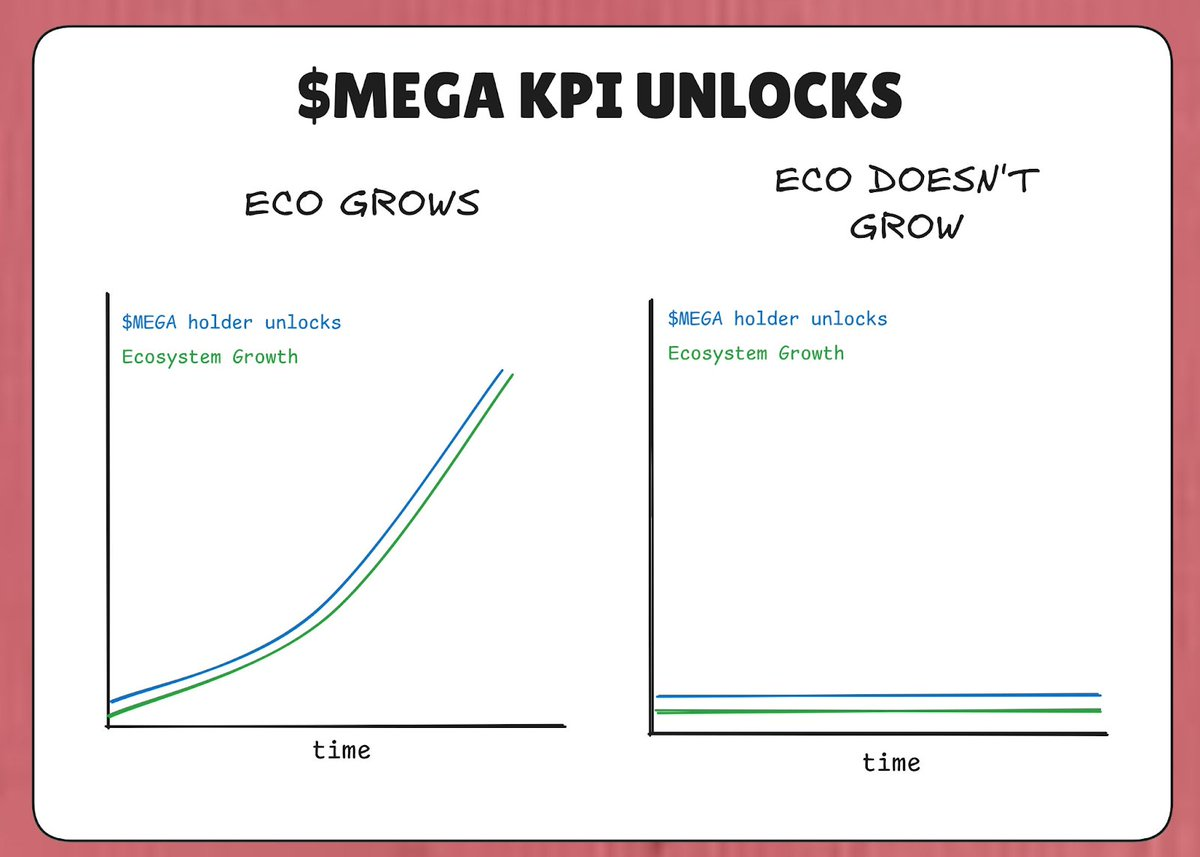
This strategy is very similar to Tesla's "pay for performance" compensation philosophy for Elon Musk. In 2018, Tesla granted Musk an equity compensation package that vested in tranches, only payable if Tesla simultaneously achieved increasing market capitalization targets and revenue targets. Elon Musk only gets paid if Tesla's revenue grows AND its market capitalization grows.

MegaETH is trying to transplant the same logic into its tokenomics. "More supply" is not a given—it's something the protocol must earn by scoring real points on meaningful scoreboards.

Unlike Musk's Tesla benchmarks, I don't see anything in Namik's KPI targets about MEGA market cap as a KPI target—perhaps for legal reasons. But as a public MEGA investor, this KPI is very interesting to me. 👀

Who Gets the Unlock Matters

Another interesting factor of this KPI plan is: who gets the MEGA when KPIs are met. According to Namik's tweet, the recipients of the unlocked MEGA are those who stake MEGA into the locking contract.

Those who lock more MEGA for longer periods receive a larger share of the 53% MEGA tokens entering the market.
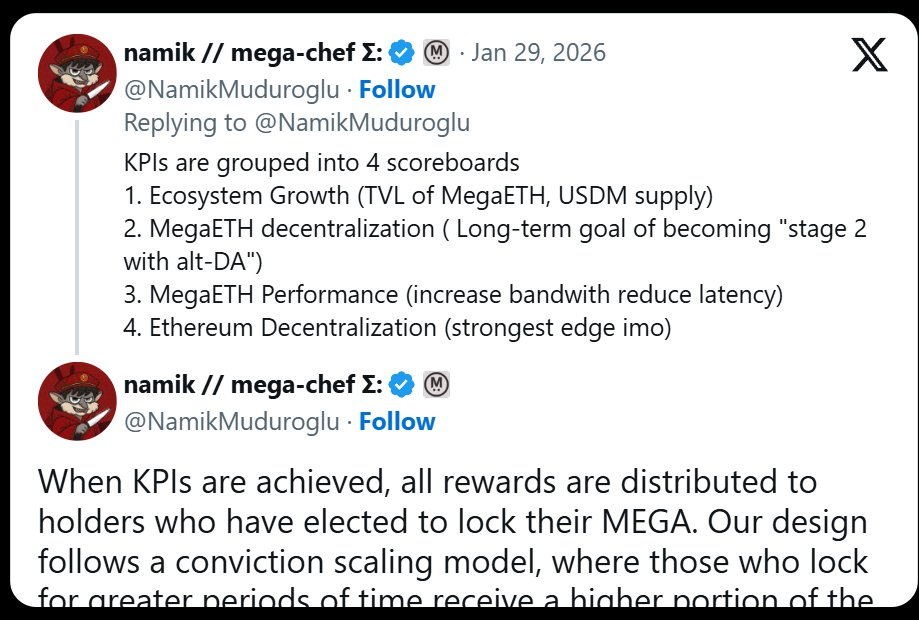
The logic behind this is simple: allocate MEGA dilution to those who have already proven themselves as MEGA holders and are interested in holding more MEGA—those least likely to become MEGA sellers.

Alignment and Trade-offs

It's worth emphasizing that this also introduces risks. We have seen historical cases where similar structures went seriously wrong. Look at this excerpt from Cobie's article: "(content)"
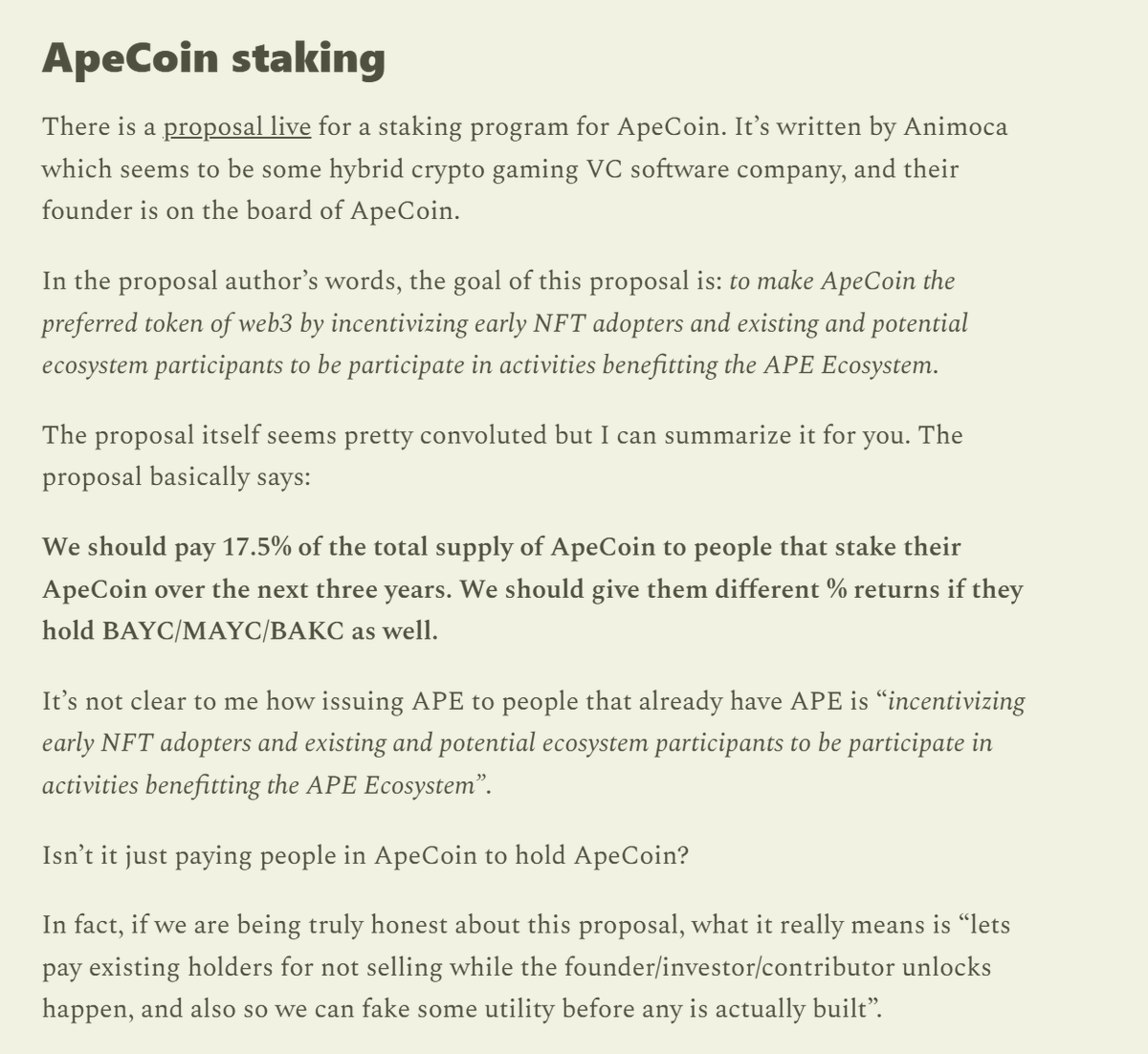
If you are a token pessimist, a crypto nihilist, or just bearish, this alignment problem is what you worry about.

Or, from the same article: "Staking mechanisms should be designed to support the goals of the ecosystem"
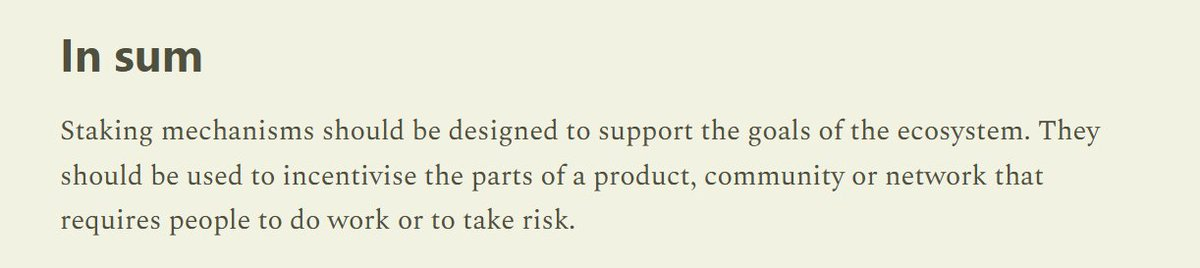
Locking token dilution behind KPIs that should actually reflect growth in the value of the MegaETH ecosystem is a much better mechanism than any vanilla staking mechanism we saw in the 2020-2022 liquidity mining era. In that era, tokens were being issued regardless of the team's fundamental progress or ecosystem growth.

Therefore, the net effect is that MEGA dilution is:

  • Conditionally constrained by corresponding MegaETH ecosystem growth
  • Diluted into the hands of those least likely to sell MEGA

This does not guarantee that MEGA value will rise as a result—the market will do what the market wants. But it is an effective and honest attempt to fix a core underlying problem that seems to plague the entire crypto token industrial complex.

Treating Tokens as Equity

Historically, teams have been "spraying and praying" their tokens across the ecosystem. Airdrops, mining rewards, grants, etc.—teams would not engage in these activities if they were distributing something truly valuable.

Because teams distributed tokens like worthless governance tokens, the market priced them as worthless governance tokens.

You can see the same philosophy in MegaETH's stance on CEX listings after Binance opened MEGA token futures on its platform (historically Binance's attempt to extort teams):
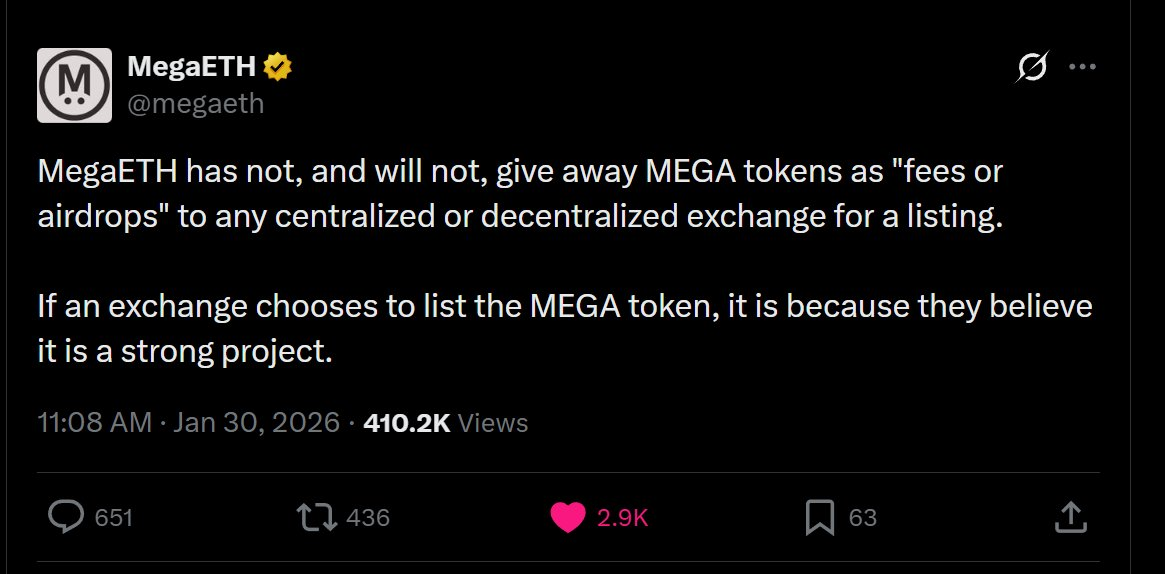
Hopefully, teams will start being more selective with their token distribution. If teams start treating their tokens as precious, perhaps the market will respond in kind.

Cap's Stablecoin Airdrop

The stablecoin protocol Cap introduced a "stablecoin airdrop" (stabledrop) instead of a traditional airdrop. Instead of airdropping the native governance token CAP, they distributed the native stablecoin cUSD to users who earned Cap points.

This approach rewards points farmers with real value, thus fulfilling the social contract. Users who deposited USDC into Cap's supply side accepted smart contract risk and opportunity cost, and the stablecoin airdrop compensated them accordingly.

For those who want CAP itself, Cap is conducting a token sale via a Uniswap CCA. Anyone seeking CAP tokens must become a real investor and commit real capital.

Filtering for Committed Holders

The combination of a stablecoin airdrop plus a token sale filters for committed holders. A traditional CAP airdrop would flow to speculative farmers likely to sell immediately. By requiring a capital investment through the token sale, Cap ensures CAP flows to participants willing to accept full downside risk for upside potential—a group more likely to hold long-term.

The theory is that this structure gives CAP a higher probability of success by creating a concentrated holder base aligned with the protocol's long-term vision, rather than a less precise airdrop mechanism that puts tokens into the hands of those focused solely on short-term profits.

Watch this video:

https://x.com/DeFiDave22/status/2013641379038081113

Token Design is Maturing

Protocols are getting smarter and more precise with their token distribution mechanisms. No more shotgun spray-and-pray token issuance—MegaETH and Cap are choosing to be highly selective about who gets their tokens.

"Optimizing for distribution" is no longer the thing—perhaps a toxic hangover from the Gensler era. Instead, these two teams are optimizing for concentration to provide a stronger foundational holder base.

I hope that as more apps launch in 2026, they can observe and learn from these strategies, and even improve upon them, so the "good coins problem" is no longer a problem, and we are left with only "good coins".


Related Questions

QWhat is the 'good coins problem' mentioned in the article, and why does it exist?

AThe 'good coins problem' refers to the issue that most tokens are considered garbage because they haven't been treated with the same legal and strategic seriousness as equity by teams. Historically, teams did not respect tokens as much as equity in traditional companies, and the market reflected this through token prices.

QHow does MegaETH's KPI plan work to conditionally unlock its tokens?

AMegaETH locks 53% of its MEGA tokens in a 'KPI plan,' where tokens only unlock if specific Key Performance Indicators are met. These KPIs include ecosystem growth (TVL, USDM supply), MegaETH decentralization (L2Beat stage progress), MegaETH performance (IBRL), and Ethereum decentralization. This ensures tokens enter the market only when real growth occurs, reducing dilution for holders.

QWhat is Cap Protocol's 'stabledrop' and how does it differ from traditional airdrops?

ACap Protocol's 'stabledrop' distributes its native stablecoin cUSD to users who earned Cap points, instead of airdropping the governance token CAP. This rewards users with real value for their participation. Those who want CAP tokens must become real investors by purchasing them through a Uniswap CCA token sale, ensuring committed holders.

QWhy does the article suggest that token design is evolving towards more selective distribution mechanisms?

AToken design is evolving because teams like MegaETH and Cap are moving away from 'spray-and-pray' distribution methods (e.g., indiscriminate airdrops) to highly selective mechanisms. These strategies, such as KPI-based unlocks and stabledrops, aim to distribute tokens only to committed holders, aligning incentives and creating a stronger base for long-term success.

QHow does MegaETH's approach to token distribution resemble Elon Musk's Tesla compensation plan?

AMegaETH's KPI plan is similar to Elon Musk's Tesla compensation philosophy, where Musk's equity grants vested only when Tesla achieved increasing market cap and revenue targets. Similarly, MegaETH's tokens unlock only when the protocol meets specific growth and performance KPIs, tying token issuance to tangible ecosystem progress.

Related Reads

Dialogue with a Macro Analyst: AI Drains All Liquidity from U.S. Stocks, $40K Bitcoin is the True Bottom

In a recent discussion, macro strategist Luke Groman, founder of FFT LC, presented a sobering analysis of current markets. He argues that while the S&P 500 hits new highs, this is largely driven by just seven AI stocks, which are "sucking all the oxygen and liquidity out of the room." Bitcoin, which he calls the "last working smoke alarm for liquidity," is signaling trouble, having entered a difficult period. Groman explains that the AI boom is fueled by accounting practices that front-load revenue, creating an illusion of high profits while cash is being depleted. He warns this cycle could reverse sharply when construction slows. His base case is that stocks will rise in dollar terms but fall significantly when measured in gold or Bitcoin, highlighting that long-term US Treasury futures have already lost 90% of their value against gold over the past decade. He points to major structural risks, including China's dominance in rare earths—a small commodity market underpinning trillions in tech stock value—and the prolonged closure of the Strait of Hormuz, which he calls a "Suez Moment" for the US. This, combined with a shift towards a "no ticky, no washy" proof-of-work system for settling trade (using gold, not trust), signals deeper systemic distrust. Regarding US debt, Groman notes that historically, all 58 countries that reached a 130% debt-to-GDP ratio defaulted, primarily through inflation. The US crossed this threshold in 2020. He also highlights a contradiction in the AI narrative: if it's as transformative as claimed, it must destroy white-collar jobs, threatening half of US tax revenue—a reality at odds with the "no job loss" messaging from tech leaders. On Bitcoin, Groman sold most of his position near the top and hasn't fully re-entered. Citing technical analysis from Northstar Bad Charts, he suggests a potential bottom around $40,000 could materialize in Q3 or Q4. He concludes that while he may be labeled a doomsayer, his view is simply realistic, grounded in historical precedents and current macro pressures.

marsbit15m ago

Dialogue with a Macro Analyst: AI Drains All Liquidity from U.S. Stocks, $40K Bitcoin is the True Bottom

marsbit15m ago

Apple's Desired On-Device AI Sees a Dark Horse Emerge: The First Cognitive Model is Born, 4B Matches GPT-5.4

A Chinese company, Tomorrow's Journey (Nextie), has introduced what it is calling the industry's first "cognitive model" for edge devices. Named New Journey Alpha, this 4-billion-parameter model reportedly matches the performance of trillion-parameter giants like GPT-5.4 in group intelligence tasks such as debate and collective decision-making. The development follows Andrej Karpathy's vision of stripping vast factual knowledge from large language models to retain only a smaller "cognitive core" capable of reasoning, planning, and knowing its own limits. This approach directly addresses the soaring computational costs and token expenses hindering AI's widespread deployment, as highlighted by incidents like Amazon shutting down an internal AI tool due to prohibitive costs. Trained via reinforcement learning on a corpus of academic papers from 1800-2020 to enhance generalization, the model enables three key advancements: 1) Improved decision quality in multi-agent systems, 2) Drastically reduced compute costs, allowing for cost-effective cloud or on-device (e.g., MacBook) deployment, and 3) The feasibility of "proactive" AI agents that act autonomously without user prompts, unlocking new commercial possibilities beyond today's reactive models. Built by the former Microsoft Xiaoice team—known for creating a 3.6B model that outperformed a 65B Llama model—the company is now focusing on the multi-agent systems sector, a field gaining significant investor interest. The model's economic impact is profound; by achieving high-level performance with minimal parameters, it fundamentally alters the cost structure of AI services, challenging the prevailing model of ever-larger parameter counts.

marsbit3h ago

Apple's Desired On-Device AI Sees a Dark Horse Emerge: The First Cognitive Model is Born, 4B Matches GPT-5.4

marsbit3h ago

Trading

Spot
Futures

Hot Articles

How to Buy AR

Welcome to HTX.com! We've made purchasing Arweave (AR) simple and convenient. Follow our step-by-step guide to embark on your crypto journey.Step 1: Create Your HTX AccountUse your email or phone number to sign up for a free account on HTX. Experience a hassle-free registration journey and unlock all features.Get My AccountStep 2: Go to Buy Crypto and Choose Your Payment MethodCredit/Debit Card: Use your Visa or Mastercard to buy Arweave (AR) instantly.Balance: Use funds from your HTX account balance to trade seamlessly.Third Parties: We've added popular payment methods such as Google Pay and Apple Pay to enhance convenience.P2P: Trade directly with other users on HTX.Over-the-Counter (OTC): We offer tailor-made services and competitive exchange rates for traders.Step 3: Store Your Arweave (AR)After purchasing your Arweave (AR), store it in your HTX account. Alternatively, you can send it elsewhere via blockchain transfer or use it to trade other cryptocurrencies.Step 4: Trade Arweave (AR)Easily trade Arweave (AR) on HTX's spot market. Simply access your account, select your trading pair, execute your trades, and monitor in real-time. We offer a user-friendly experience for both beginners and seasoned traders.

10.9k Total ViewsPublished 2024.03.29Updated 2026.06.02

How to Buy AR

Discussions

Welcome to the HTX Community. Here, you can stay informed about the latest platform developments and gain access to professional market insights. Users' opinions on the price of AR (AR) are presented below.

活动图片












