Arthur Hayes' Latest Long-Form: The AI Bubble Represents the Biggest Opportunity

链捕手Published on 2026-05-12Last updated on 2026-05-12

Abstract

Arthur Hayes argues that the AI investment boom, driven by massive government and corporate capital expenditure (CAPEX) for geopolitical and technological supremacy, represents a historic opportunity for cryptocurrency. He believes the unprecedented money printing by central banks (especially the US and China) to fund this AI arms race, combined with inflationary pressures from global conflict and a shift away from "just-in-time" global supply chains, creates a perfect environment for Bitcoin and crypto assets to thrive. Hayes predicts Bitcoin will surge past $126,000, fueled by this liquidity. He identifies two potential triggers for an AI bubble collapse: a massive, failed AI-related IPO/merger or a political shift against AI and inflation during the 2028 US election. Until then, he advocates aggressive investment in Bitcoin and specific altcoins like NEAR, Hyperliquid ($HYPE), and Zcash ($ZEC), viewing the current period as a prime bullish phase.

Original Title: The Butterfly Touch
Original Author: Arthur Hayes, Co-founder of BitMEX
Original Translation: BitpushNews


AI Optimism
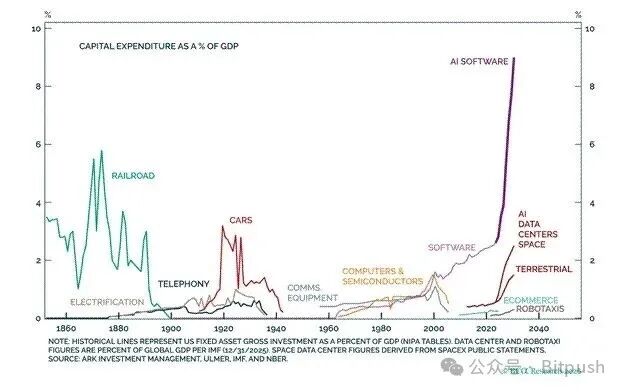
The capital expenditure (CAPEX) supporting AI model training and inference is unprecedented in human history. Many believe this investment in intelligence will create value for humanity unlike any previous technological build-out. I agree; however, as humans, we always tend to overdo things. In this universe, positive infinity and perfection are unattainable. Therefore, in anticipating a machine intelligence-driven future, we are likely to overbuild.

AI advocates invoke nationalism as a reason for lavish spending, but patriotism shouldn't come with a price tag... Both the US and China believe that AI and technological supremacy are crucial to their territorial survival.

Tech moguls are also more than happy to sell them horror stories: what will happen to this country if the other side gains a first-mover advantage in machine intelligence supremacy. Objectively, both leaders have witnessed first-hand how the proliferation of AI and drones leads to victory and are true believers. Therefore, they will ensure the primary economic and military goal is to build the most efficient machine intelligence further within their borders.
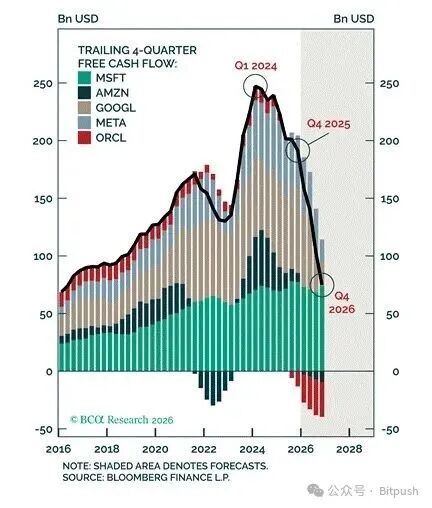
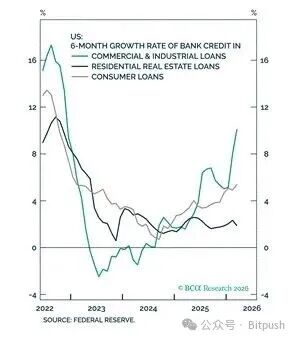
In the US, most AI CAPEX to date has come from the operating cash flows of the most profitable software companies. But given the scale of current and future spending, additional financing through credit channels is still needed.
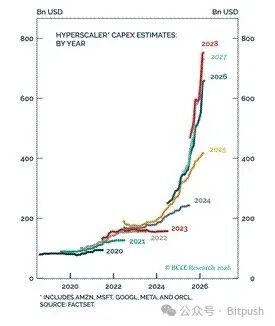
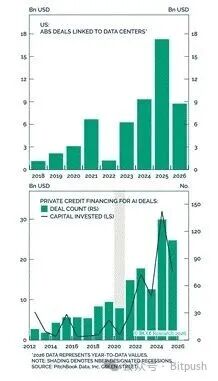
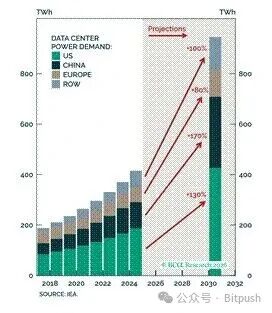
In China, banks are slowing funding for real estate and shifting to fund the tech sector. Beyond data-center-related spending, both the US and China are also continuously investing in increasing power supply.
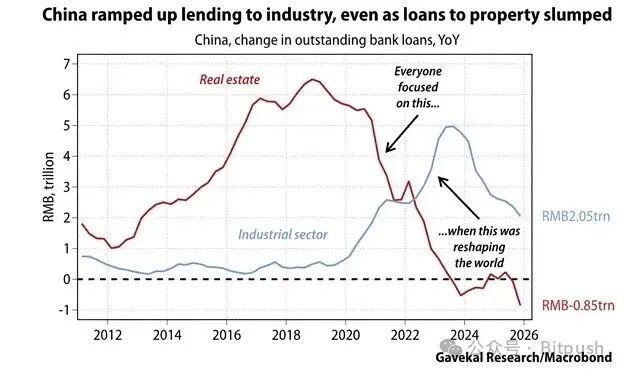
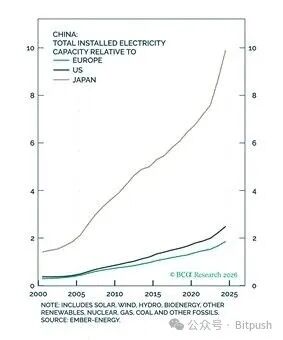
That is, central banks are all creating more fiat currency, easing financial conditions.
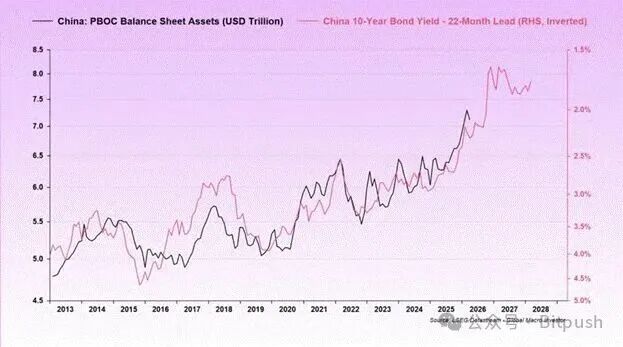
The combination of political will (to win the AI race) and financial will (funding the build-out by printing money and lending) creates a perfect environment for cryptocurrency.There will be far more fiat currency units tomorrow than today, and the rate of change is accelerating due to surging AI and electrification spending. As the unit cost of intelligence declines and the complexity of tasks AI performs increases, it means computational power consumption grows exponentially; this is the essence of the "Jevons Paradox."

There is also the "Red Queen Effect": as competitors improve model efficiency, a company's invested AI CAPEX quickly becomes obsolete. This leads to a race to increase spending further to create better models to beat the opponent, while also rendering the opponent's hundreds of billions (soon trillions) of dollars outdated. Therefore, unless hindered by exogenous market events, AI CAPEX spending will expand infinitely.

When Will the Party End?

I believe two events will occur almost simultaneously and change the perception of the necessity of spending trillions on building AI.

Market Indigestion:The occurrence of a massive, financially irresponsible AI-related IPO or massive merger that the market cannot stomach. This will sober the market from its mania phase, leading people to question whether machine intelligence is truly worth that much money.

Political Wind Shift:The 2028 US presidential election. The rise in raw material, labor, and especially electricity prices due to massive AI build-out is unpopular in many regions. Moreover, 90% of Americans do not hold significant amounts of stocks and thus cannot benefit from soaring stock prices. Politically, it's very easy to campaign by being anti-AI, focusing on the value of human labor, and curbing inflation.

But at this moment, USD and CNY liquidity will continue to rise. Bitcoin and cryptocurrency will benefit.

Every Nation for Itself

Trump bombs Iran, completely unconcerned about the war's impact on the global economy. Or perhaps he is, but the assumption that this year's "special military operation" would be a quick victory has proven overly optimistic. The US has God-given cheap energy (fossil fuels) and fertile farmland. Things might get more expensive, but even with a partial closure of the Strait of Hormuz, Americans won't starve—unless politicians decide to spend money on Fallujah instead of food stamps.

But the people of Europe, Africa, and much of Asia are less fortunate. Unfortunately, the political elites of these countries mistakenly believe that US politicians will consider their plight of lacking food and energy when deciding whether to start another war that threatens the flow of basic commodities. Trusting the US, these countries have stored their surpluses in USD-denominated financial assets instead of building pipelines, trade routes, or stockpiling essentials.

Marco Papic of BCA Research put it best:

"The entire globe—literally—is connected for US hegemony... Why is Germany's defense insufficient against Russia? Because... the US. Why do most Gulf states have almost no energy transport infrastructure avoiding the Strait of Hormuz? Because... the US. Why is global manufacturing concentrated in China? Because... the US."

Unable to obtain fertilizer or fuel, the investment decisions of these countries will undergo a dramatic shift. It makes no sense to hold US Treasuries or S&P 500 ETFs when you can't get food and energy due to a war you didn't participate in. To compensate for these deficits, sovereign nations will increasingly liquidate USD assets on the margin in the future, investing instead in infrastructure, defense, and physical commodities.
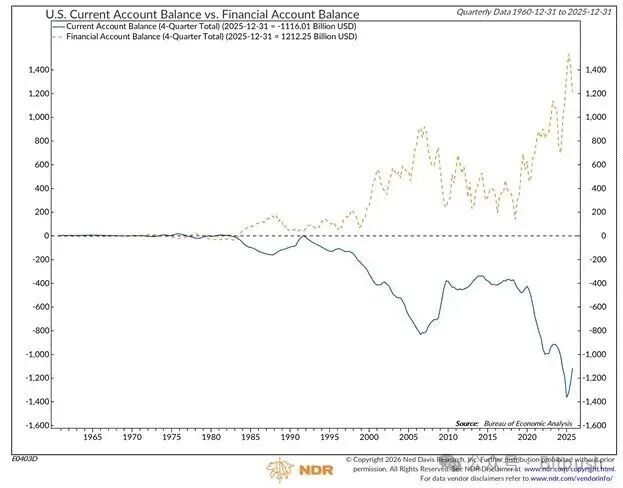
This is a problem for US financial markets because foreign holdings are substantial.If left unchecked, the slow liquidation of USD assets will cause markets to fall. US Treasury Secretary Bessent and other policymakers understand this. They have two countermeasures: encourage the use of USD swap lines or amend bank regulations.

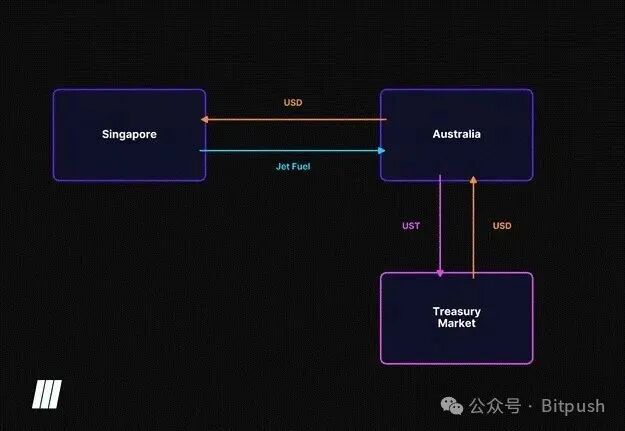
"Bad" Australia:Sell US Treasuries to buy jet fuel.
"Good" Australia: Borrow USD from the Federal Reserve to buy jet fuel.
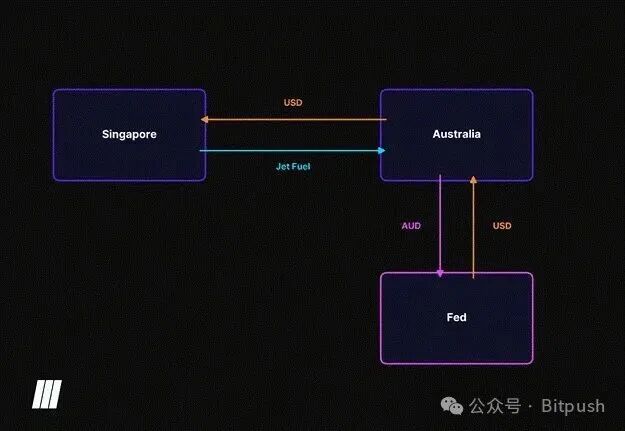
If US markets need more momentum to offset sovereign selling, regulations can be loosened to allow banks to hold more US Treasuries and stocks. Relaxing eSLR (enhanced Supplementary Leverage Ratio) related capital requirements is a move in this direction.
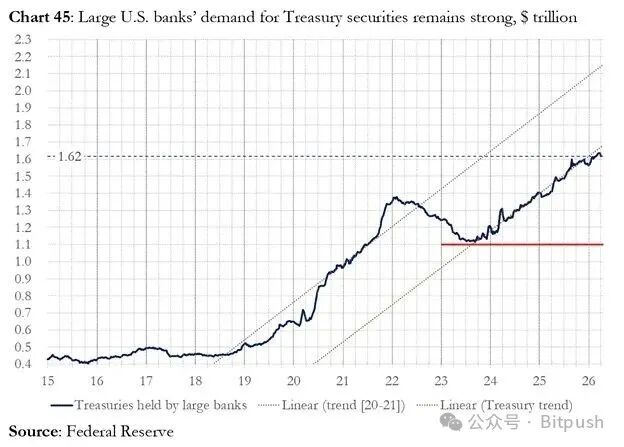
Since the establishment of the petrodollar system in the 1970s, storing surplus savings in USD assets has been "best practice." But today, holding USD assets no longer guarantees you a ship of fertilizer or oil. "Just-in-time" is dead, "Just-in-case" lives. This is a structural trend that will last for decades. This means monetary policymakers must keep financial conditions accommodative to fill the void left by foreigners putting savings into physical infrastructure rather than "ethereal USD financial assets."

Higher + Longer

War is inflationary, and the US-Iran conflict is no exception. AI CAPEX and infrastructure building are excuses to increase lending. Politicians support money printing out of real and perceived necessity. This is why Bitcoin has outperformed other major risk assets like gold and US tech stocks since February 28th.
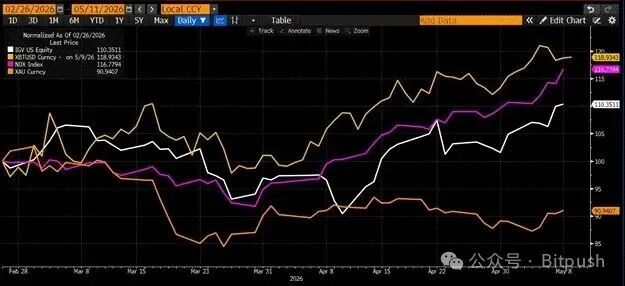
With trillions of USD and CNY yet to be created backing it, Bitcoin, which bottomed at $60,000 earlier this year, returning to $126,000 is a foregone conclusion. Many naysayers have refused to participate in this rally because Bitcoin has underperformed tech stocks and gold over the past 24 months. They don't understand why Bitcoin remains effective as a hedge against money printing. But it will demonstrate extreme sensitivity to fiat liquidity expansion. I expect the rally to intensify, and when it breaks through $90,000 and many call option sellers are forced to cover, the upward trajectory will become explosive.

I don't know how high Bitcoin can go, but I will adjust Maelstrom's portfolio risk to maximum unless something drastic changes. By the November midterm elections, the US political stance towards AI and inflation could become quite negative, which might be a small speed bump on the ascent.

But remember: High oil prices don't hurt Trump as much as people think. MAGA is destined to lose in California (where energy policy results in the highest gas prices in the US), but $100 crude and infrastructure rebuilding in Venezuela and the Middle East will benefit the oil & gas industries in states where Trump supporters live. As long as money can be stuffed into the pockets of ordinary Americans, Trump still has time to win re-election. So, blast off baby, S&P 500 to 10,000!

It's time to play with Altcoins (Shitcoins). Besides Hyperliquid ($HYPE) and Zcash ($ZEC) which we are already heavily invested in, my next favorite is $NEAR. My next article will explain our thesis: why the "privacy narrative" combined with "Near Intents" will create positive cash flow for the protocol. This will completely reverse the token's sluggish price performance and create a massive catch-up opportunity, propelling it quickly towards its all-time high from years ago.

It's a bull market; close your eyes, press the buy button. There will be a time to sell, but it is not now. Don't screw it up, let's go crazy together.


Related Questions

QAccording to Arthur Hayes, why is the combination of political will to win the AI race and financial capacity through money printing and lending creating a perfect environment for cryptocurrencies?

AAccording to Arthur Hayes, the combination of political will (to win the AI race) and financial will (funding the buildout via money printing and lending) creates a perfect environment for cryptocurrencies because it leads to a massive increase in fiat currency units. With AI and electrification spending skyrocketing, the rate of change is accelerating. More fiat units chasing assets, including cryptocurrencies, alongside structural factors weakening traditional dollar assets, benefits crypto as a hedge against monetary debasement.

QWhat are the two events that Hayes believes will change the perception about the necessity of spending trillions on AI, and when might one of them occur?

AThe two events are: 1) Market indigestion: A massively irresponsible AI-related IPO or mega-merger that the market cannot stomach, leading to a sobering up from the mania. 2) Political pivot: Specifically, the 2028 US election, where politicians could easily campaign on an anti-AI, pro-human labor, anti-inflation platform as the costs of AI buildout (like higher electricity prices) become unpopular with the majority who do not benefit from stock gains.

QHow does Hayes describe the 'Jevons Paradox' and the 'Red Queen Effect' in the context of AI capital expenditure?

AHayes describes the 'Jevons Paradox' as the phenomenon where, as the cost per unit of intelligence falls and the complexity of tasks AI can perform increases, the consumption of compute power grows exponentially. The 'Red Queen Effect' refers to the competitive dynamic where a company's AI CAPEX is rapidly devalued as rivals improve model efficiency, leading to an arms race of ever-increasing spending to build better models and render competitors' investments obsolete, thus fueling infinite expansion of AI CAPEX.

QWhat is Hayes's price prediction for Bitcoin and what key level does he identify for a potential explosive move?

AHayes predicts that Bitcoin, backed by trillions of yet-to-be-created dollars and yuan, is destined to return to $126,000. He expects the rally to intensify and become explosive when it breaks through $90,000, a level where many call option sellers would be forced to cover their positions.

QBesides Bitcoin, which specific altcoins does Hayes mention his fund, Maelstrom, is heavily invested in, and which one does he plan to discuss in his next article?

AHayes mentions that Maelstrom is already heavily invested in Hyperliquid ($HYPE) and Zcash ($ZEC). He states that his next favorite altcoin is $NEAR, and his following article will explain the thesis on how the 'privacy narrative' combined with 'Near Intents' could create positive cash flow for the protocol and lead to a significant catch-up rally.

Related Reads

AI PC Battle: Bet on the Toll Booth, Not the Camp

**Title:** The AI PC Battle: Don't Bet on Sides, Bet on the Tollbooth **Summary:** The AI PC competition is moving beyond simple "x86 vs. Arm" narratives. The core investment thesis should focus on identifying which players can sustain margins, cash flow, and pricing power throughout the upgrade cycle, rather than backing a particular architecture. The opportunity is analyzed in three layers: 1. **The Advanced Foundry Tollbooth:** TSMC is positioned to collect "tolls" regardless of which chip designer wins, due to its dominant ~70% share in advanced semiconductor manufacturing, which is essential for high-end AI PC chips. 2. **Compute & Platform Spillover:** AMD represents an offensive in the x86 CPU+GPU space, while NVIDIA leverages its GPU and CUDA software stack dominance. Both benefit from the demand for increased local AI compute. 3. **Architecture Diffusion & Turnaround Plays:** ARM and Intel offer potential for significant upside (elasticity), but investments here require stricter discipline due to higher execution risks and competitive challenges. The industry is transitioning from concept to shipment validation. While short-term forecasts for AI PC adoption have been revised down slightly due to tariffs and procurement delays, the long-term trend towards AI becoming a standard PC feature remains intact. The key driver for upgrade cycles will be whether compelling enterprise applications (e.g., privacy-sensitive computing, low-latency inference) emerge beyond consumer-focused features like meeting summarization. Investment strategy should prioritize companies with platform-level advantages and recurring revenue streams. TSMC offers high certainty as the foundational tollbooth. AMD presents a strong offensive play within the established ecosystem. ARM and Intel are higher-risk, higher-potential-reward turnaround bets. The report cautions against chasing short-term hype and emphasizes a disciplined, long-term approach focused on buying ecosystem strength and cash-flow certainty after market enthusiasm subsides. **Key Risks:** Underwhelming AI PC applications slowing upgrade cycles; slow improvement in Windows on Arm compatibility; macro/tariff impacts on PC demand; potential advanced node supply-demand mismatches affecting TSMC; high overall AI sector valuations making stocks vulnerable to a risk-off shift in markets.

marsbit3m ago

AI PC Battle: Bet on the Toll Booth, Not the Camp

marsbit3m ago

Ten-Thousand-Word Analysis: From $10 to $290, MRVL Wins the Entire AI Era by 'Not Making GPUs'

Marvell Technology's stock price surged from under $10 in 2016 to a record $290 in June 2026, fueled not by making GPUs, but by dominating AI infrastructure connectivity. This analysis argues the market misvalues MRVL as merely a smaller Broadcom in custom AI chips, overlooking its true, unique position. Marvell's core strength lies in enabling high-speed data flow for AI clusters through three interconnected businesses. First, it holds a commanding ~70% market share in high-speed optical DSPs (essential for data center light modules), a deep-moat business with accelerating growth. Second, its custom AI chip design business serves hyperscalers like AWS, Microsoft, and Google, with a significant revenue pipeline despite lower margins. Third, stable cash flows come from Ethernet switch chips and enterprise storage controllers. Together, they form a full-stack "AI data movement" platform. CEO Matt Murphy's transformative leadership since 2016, involving strategic divestments, key acquisitions (like Inphi for optical DSPs), and securing long-term agreements with major cloud providers, repositioned the company. A pivotal $2 billion strategic investment from NVIDIA in 2026 underscored Marvell's critical role in the AI ecosystem, particularly through collaborations like NVLink Fusion. While Marvell faces risks—including client concentration (losing the Amazon Trainium3 design), lower-margin business mix, competitive threats, insider selling, and complex supply chains—its fundamentals remain strong. The optical interconnect moat is widening with the acquisition of Celestial AI (photonics fabric), and financial metrics show accelerating revenue growth and operating leverage. With a PEG ratio suggesting undervaluation relative to its growth, the thesis is that the market undervalues Marvell's monopolistic position in AI "plumbing" while overemphasizing its competitive custom chip segment. The story transcends investing, symbolizing how in any complex system—from the internet to AI—the value of "connection" ultimately surpasses that of individual "nodes."

marsbit33m ago

Ten-Thousand-Word Analysis: From $10 to $290, MRVL Wins the Entire AI Era by 'Not Making GPUs'

marsbit33m ago

AI Relay Stations Spark Heated Debate on Zhihu: Behind Cheap Tokens, What Are Users Really Worried About?

A discussion on Zhihu about "AI relay stations" shifted the niche developer topic of "cheap tokens" into broader user awareness. Users moved beyond simply questioning the legitimacy of these services to focus on practical concerns: Where do cheap tokens truly come from? Is the model being accessed the real one? Can relay stations see prompts, code, and API keys? For occasional users, are the risks worth it? The core debate centered less on price and more on trust. A primary worry is model authenticity—the risk of "model swapping," where users paying for a premium model might be routed to a cheaper one, creating an information asymmetry. Others argued that cost comparisons matter; while cheaper than official pay-as-you-go APIs, relay stations may not be the lowest-cost option versus subscriptions, domestic models, or free tiers, making user needs assessment crucial. Speculation about token sources ranged from legitimate bulk discounts to gray-area methods like account sharing or exploiting regional pricing. This opacity makes risk assessment difficult for users. Data security emerged as a critical concern, especially for enterprise use. When processing sensitive information like code, contracts, or client data, the inability to verify a relay station's data handling, retention, or access policies poses significant compliance and confidentiality risks. The evolving consensus suggests relay stations can be used cautiously for low-sensitivity, disposable tasks (e.g., summarizing public info, simple translation). However, they should not be the default for sensitive, professional, or production workflows involving proprietary data, Agents, or automated systems. Recommendations include avoiding large prepayments, not relying on a single service, using test prompts to monitor quality, anonymizing data where possible, and keeping official channels as backups. Ultimately, the discussion framed tokens not just as a billing unit but as a measure of real cost encompassing price, model integrity, data security, and service stability. The popularity of relay stations highlights user demand for affordable access, but the debate underscores a key trade-off: the savings from cheap tokens may come at the price of trust, transparency, and control over one's data and AI experience.

marsbit1h ago

AI Relay Stations Spark Heated Debate on Zhihu: Behind Cheap Tokens, What Are Users Really Worried About?

marsbit1h ago

In-Depth Research Report on TradFi: The Convergence Wave of Crypto and Traditional Finance

In 2026, the crypto industry is undergoing a profound infrastructure-level transformation—TradFi assets are migrating on-chain at an unprecedented pace. According to CoinGecko's Q1 2026 report, the total value locked (TVL) of tokenized real-world assets (RWA) has surpassed $31 billion, a nearly 4x increase from $7.8 billion at the beginning of 2025, with the sector’s aggregate market capitalization reaching $19.3 billion. Among these, the market cap of tokenized stocks surged from $2 million to $486 million, with Q1 spot trading volume reaching $15.1 billion—a single quarter already surpassing the entire second half of 2025. RWA perpetual contract Q1 trading volume reached a staggering $524.8 billion, far exceeding the $313 billion for all of 2025. Meanwhile, BlackRock's BUIDL fund has reached $2.3 billion in scale and has filed for two new tokenized funds, signaling that the world's largest asset manager's tokenization strategy is evolving from pilot to product suite expansion. HTX, as a core participant in the crypto exchange sector, officially launched TradFi perpetual futures products including NVDA, AAPL, MSFT, META, and SPY in 2026, enabling crypto users to gain 24/7 trading access to core U.S. equities. Boston Consulting Group predicts that global tokenized asset scale could reach $16 trillion by 2030, while McKinsey offers a conservative estimate of approximately $2 trillion. The on-chain migration of TradFi assets is no longer a "future narrative" but a structural transformation unfolding in real time, as crypto exchanges evolve from single crypto asset trading platforms toward "multi-asset-class trading infrastructure."

HTX Learn1h ago

In-Depth Research Report on TradFi: The Convergence Wave of Crypto and Traditional Finance

HTX Learn1h ago

Trading

Spot
Futures

Hot Articles

Discussions

Welcome to the HTX Community. Here, you can stay informed about the latest platform developments and gain access to professional market insights. Users' opinions on the price of AI (AI) are presented below.

活动图片