Author: Artemis Analytics
Compiled by: Deep Tide TechFlow
Deep Tide Intro: Figma's stock price plunged 17% after earnings, but analysts believe the market is wrong—with the rise of product engineers and AI agents taking over design workflows, Figma's TAM (Total Addressable Market) is much larger than Wall Street expects. This is no longer just a story of "selling a few more designer seats," but a fundamental change in the underlying way software is produced.
On August 5, 2026, Figma (NYSE ticker: $FIG) released its Q2 '26 earnings report. A quick recap:
- Revenue $370.1 million (up 48% year-over-year)
- Net Dollar Retention Rate 136%
- GAAP Gross Profit $309.6 million; GAAP Gross Margin 84%
- GAAP Net Loss $112.2 million, primarily driven by stock-based compensation costs of $147.6 million
- 15,964 paid customers with annual contract value over $10,000 (up 34% year-over-year)
- 1,635 paid customers with annual contract value over $100,000 (up 46% year-over-year)
The numbers are strong, but Figma's stock fell 17% post-earnings. I was curious about what happened. After digging deeper, I realized:
I believe Figma will become the design layer for all software creators and AI agents.
Before AI, the workflow was simple:
Designer → Figma → Engineer → Code → Software
Now the workflow has become:
Designer / Engineer / PM / Product Engineer / AI Agent
↓
Figma / Design System
↓
Software
Three points support my view.
1. The Rise of the Product Engineer
The term "product engineer" was popularized by people like Sherif Mansour, Jean-Michel Lemieux, and Gergely Orosz, shaping our understanding of this role today.
What is a Product Engineer?
A product engineer is someone who writes code, understands customer pain points, and helps shape the product.
AI has made software development easier. As the cost of writing code decreases, engineers are taking on more product and design work. These boundaries are blurring.
I think this is important for Figma because historically, engineering teams have always been much larger than design teams. For one of Figma's largest customers, engineer seats now outnumber designer seats, and this will become more common in the future.
I wondered if people were searching for "product engineer." Google Trends confirmed my suspicion. The term has been searched significantly over the past few years.
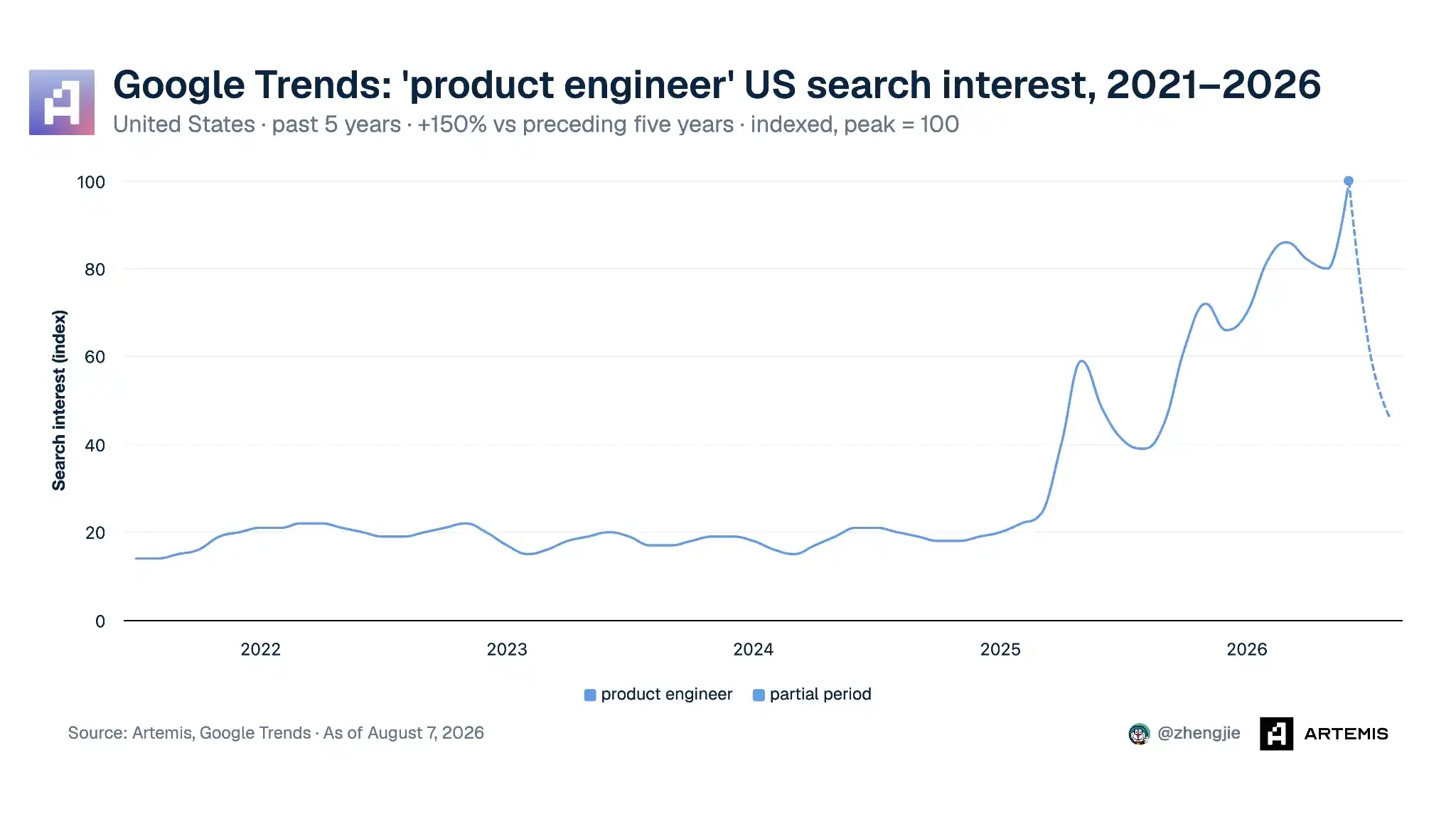
If this trend continues, I believe product engineers will become one of Figma's key growth drivers.
2. Every Employee Will Have an Agent (Figma Agent)
In 2026, everyone is talking about AI agents. Figma's next expansion frontier is from humans to agents.
Traditional SaaS monetization is straightforward:
Cost per seat ✕ Number of seats
I believe in an agentified world, every employee will have one or more agents working on their behalf. These agents will help iterate on products (editing components, turning designs into code). These operations will naturally consume inference and compute resources.
The future SaaS business model will look like this:
(Cost per seat ✕ Number of seats) + (Consumed credits ✕ Cost per credit)
I believe Figma will continue to charge for people using the product (seats) and also charge for the work done through the product (agents).
3. Margin Expansion
AI is expensive. Compute and inference are costs for every company wanting to enable AI.
When Figma launched Figma Make, gross margins dropped from 90% to 80% because inference became part of the cost of revenue. In Q2 '26, non-GAAP gross margin rebounded to 85% as Figma began charging for AI usage via credits.
What I (and everyone on Wall Street) thought would become a cost for Figma has instead turned into an additional revenue stream.
I genuinely believe that as Figma continues to charge for its suite of AI products (Figma Make, Figma Agent, Figma Weave, and Figma MCP), their margins will continue to expand.
Will AI Tools Like Claude/OpenAI Replace Figma?
The biggest risk to this thesis is that these AI tools become so good that the entire "design-to-code" workflow collapses. If users can describe a product's look and feel in natural language and have it delivered end-to-end, Figma could be done.
Mitigating factors: I think this is far from reality (or won't happen in the near term). Figma already has customers. Customers are familiar with the current tools and have built workflows around them. Furthermore, years of design systems are already embedded within Figma, which is a huge moat.
Why Is the Market Pricing Wrong?
Figma's stock price is down 80% since its first-day close (July 31, 2025, at $115.50).
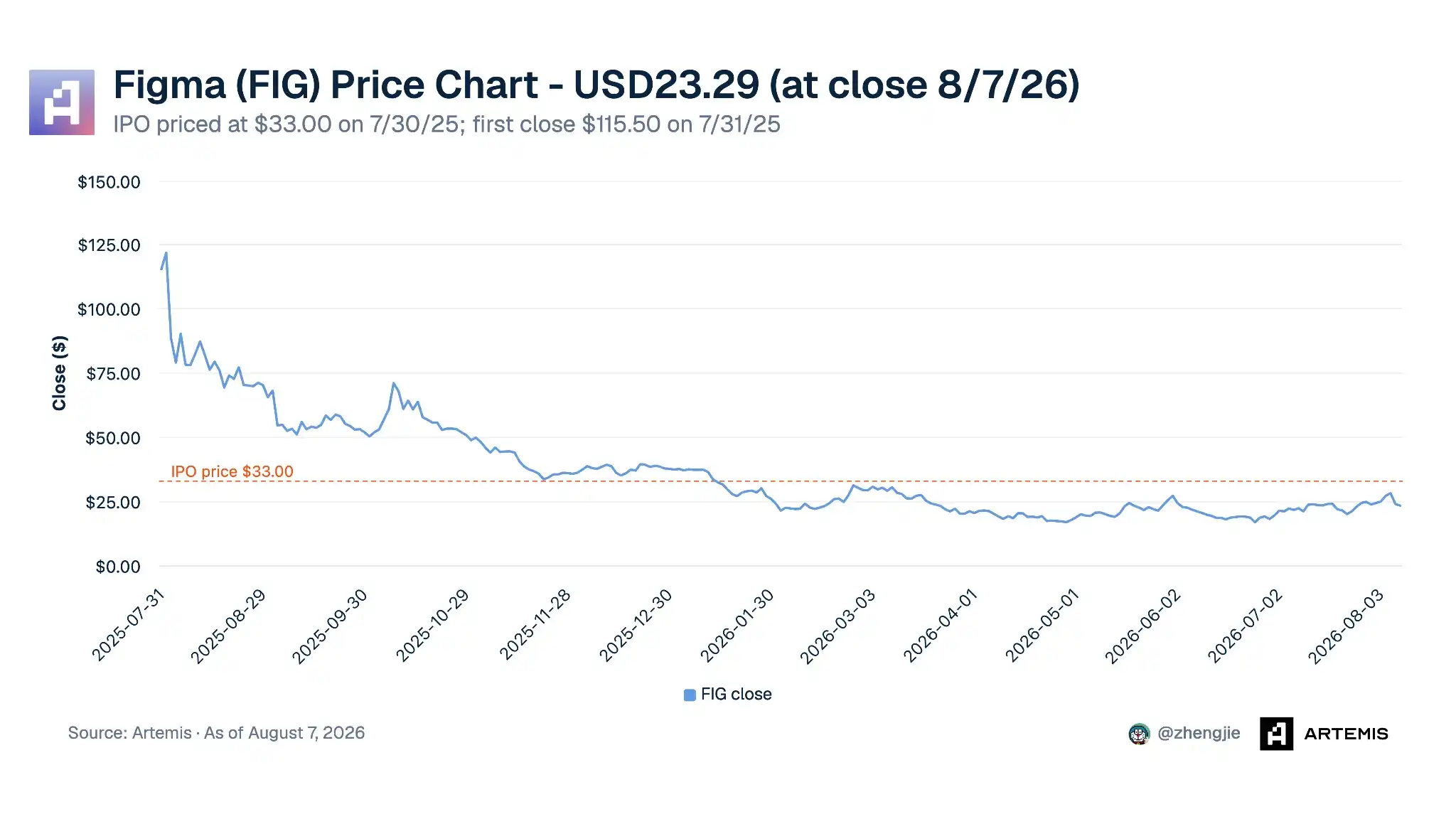
In my view, three things illustrate that Figma is mispriced:
Q2 '26 revenue continues to grow 40% year-over-year (meaning even with the explosion of Claude tools, people are still using Figma)
NRR (Net Revenue Retention) is 136% (seat expansion remains high, and the market is extremely pessimistic about software stocks)
Trading at an EV/ARR of 7.3x, near historical lows (not cheap, but reasonable considering Figma's growth rate)
The market still treats Figma as a software company serving designers.
I think this misses the bigger opportunity.
As role boundaries continue to blur (new roles emerging: product engineers) and agents help build software, Figma has the opportunity to become the de facto design layer that connects everyone.
The bull narrative is no longer just more designers paying for more seats:
More creators using Figma
More agents operating through Figma
More AI usage monetized on top of this
When this happens, Figma's TAM will be much larger than the market is pricing in today.