Analyst Reveals The Chances Of Bitcoin Price Crashing Again

bitcoinistPublished on 2026-04-18Last updated on 2026-04-18

Abstract

Analyst Sykodelic argues that the probability of Bitcoin experiencing another significant price crash has substantially decreased. This conclusion is based on a key technical indicator: the weekly Relative Strength Index (RSI) has broken above a descending trendline after falling to historic lows in Q1 2026, a rare event that has only occurred three times in Bitcoin's history. This bullish RSI breakout suggests the chances of Bitcoin revisiting new price lows are now very slim. This technical signal is supported by multiple converging bottom indicators and broader market data. Bitcoin exchange reserves have dropped to seven-year lows, while large investors are accumulating over $2 billion worth of BTC. Furthermore, spot Bitcoin ETFs have seen strong net inflows in March and April 2026. Despite this optimistic outlook, the analyst emphasizes the importance of watching how Bitcoin closes the current week. At the time of writing, Bitcoin is trading around $75,818.

Bitcoin’s recent price behavior has kept traders split between those expecting another leg down and those calling that a bottom is already in. That tension is now feeding different technical analyses, with one analyst arguing that the probability of a deeper crash has dropped significantly based on long-term signals.

Chance Of Bitcoin Making New Lows Is Very Small

Bitcoin has spent months testing the patience of its holders since its all-time high of $126,000 in 2025. According to crypto analyst Sykodelic, there is a compelling case that the drawdown is done and that the probability of Bitcoin revisiting new lows at this point has dropped massively.

Sykodelic’s rationale leans heavily on the behavior of the Relative Strength Index (RSI) on the weekly candlestick timeframe chart. According to his analysis posted on X, Bitcoin has just printed a powerful bullish break on the weekly RSI, and what makes this particular reading extraordinary is not just where it bounced from but how low it got before doing so.
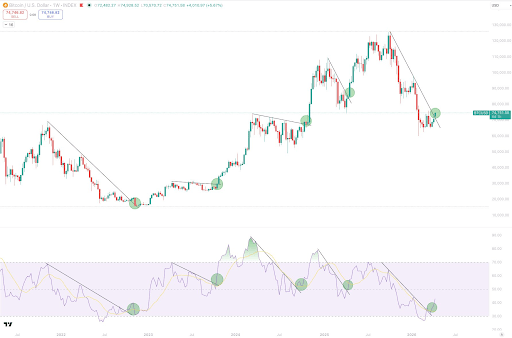
Source: Chart from Sykodelic on X

The weekly RSI has only fallen below 30 on three occasions in BTC’s history, with the most recent being Q1 2026. However, the RSI is now back into the normal zone, and it has broken above a descending trendline that touches lower highs. According to the analyst, this scenario means that the probabilities are now very slim for new lows of any kind.

The Bottom Signals Have Stacked Up

The RSI break did not arrive on its own. Sykodelic noted that multiple bottom indicators have converged simultaneously, a convergence he described as reaching a very high degree. According to him, about 12 important bottom indicators have fired, and Bitcoin is showing it here.

The broader data support his reading. Bitcoin exchange reserves have fallen to seven-year lows while whale wallets are now accumulating more than $2 billion worth of Bitcoin, their highest in over two months. Spot Bitcoin ETFs have recorded $954.05 million in net inflows so far in April, following a $1.32 billion inflow in March, which was the first positive month since October 2025.

Looking at the chart Sykodelic shared, the weekly price structure shows BTC breaking out of a descending trendline above $70,000, a pattern visible across both the price candles and the RSI panel below. Previous breakouts in 2022, 2023, and early 2025 were characterized by a similar RSI breakout of a descending trendline.

All of this contributes to a market environment where downside continuation becomes harder to sustain. Despite his conviction, Sykodelic stopped short of declaring an unconditional all-clear. The most important thing now is seeing how BTC closes the week. At the time of writing, Bitcoin is trading at $75,818, up by 1.4% in the past 24 hours.

BTC trading at $75,675 on the 1D chart | Source: BTCUSDT on Tradingview.com

Related Questions

QWhat is the main argument presented by analyst Sykodelic regarding Bitcoin's price crash probability?

ASykodelic argues that the probability of Bitcoin revisiting new lows has dropped massively, based on a powerful bullish break on the weekly RSI and the convergence of multiple bottom indicators.

QHow many times has Bitcoin's weekly RSI fallen below 30 in its history according to the analysis?

AThe weekly RSI has fallen below 30 on three occasions in Bitcoin's history, with the most recent being Q1 2026.

QWhat are some of the broader market data points that support the analyst's bullish reading?

ABitcoin exchange reserves have fallen to seven-year lows, whale wallets are accumulating over $2 billion worth of Bitcoin (their highest in over two months), and spot Bitcoin ETFs recorded significant net inflows in March and April.

QWhat key price level did Bitcoin break out of according to the weekly price structure chart?

ABitcoin broke out of a descending trendline above $70,000, a pattern visible in both the price candles and the RSI panel.

QWhat is the most important thing to watch now, according to Sykodelic, despite his conviction?

AThe most important thing now is seeing how Bitcoin closes the week, as the analyst stopped short of declaring an unconditional all-clear.

Related Reads

Anthropic's IPO Launch: Commercial Miracle or Valuation Bubble?

Anthropic has confidentially filed for an IPO, led by Morgan Stanley and Goldman Sachs, potentially going public by October. Following its latest $650 billion funding round, its pre-IPO valuation stands at $965 billion, with projections reaching up to $2 trillion at listing, which would make it the highest-valued private company ever. The article, written by Fu Sheng, addresses skepticism that this represents an AI bubble akin to the 2000 dot-com crash. It argues the current situation differs fundamentally. Unlike the internet bubble era, which relied on speculative narratives with little revenue, Anthropic's valuation is backed by unprecedented, measurable financial performance. Key data points include: * **Revenue Growth:** ARR skyrocketed from $10 billion in early 2025 to $470 billion by May 2026, targeting $100 billion by year-end—a growth curve unmatched in business history. * **Profitability:** It achieved operating profitability in Q2 2026 with an estimated $5.6 billion profit. * **Efficiency:** With ~3,000 employees and ~$470 billion ARR, its revenue per employee exceeds $10 million. Products like Claude Code, launched less than a year ago, already generate $25 billion in annualized revenue. * **Enterprise Adoption:** It boasts a strong enterprise client base, with 8 of the Fortune 10 and over 1,000 large firms spending over $1 million annually on Claude. The valuation is framed using a traditional SaaS model (e.g., a 10x Price-to-Sales multiple on $100 billion revenue). The author contends the core question for analysts has shifted from "How big could this be?" to "How much is it earning and will earn next quarter?" The discussion extends beyond Anthropic to a broader paradigm shift: the transition from a "carbon-based" to a "silicon-based" economy. Companies are increasingly prioritizing investment in compute and AI capabilities over human resources, as these directly scale productivity and competitive advantage. Anthropic's IPO is thus positioned not just as a corporate milestone, but as a price anchor for this new economic era.

链捕手1h ago

Anthropic's IPO Launch: Commercial Miracle or Valuation Bubble?

链捕手1h ago

Near Returns to the AI Stage: Transformation into a Public Chain Due to 'Payroll Difficulties,' Agent and Privacy Emerge as New Growth Narratives

NEAR Returns to AI Origins: From Payroll Struggles to Blockchain, Now Focusing on AI Agents and Privacy NEAR Protocol's journey began not with grand blockchain ambitions, but from a practical hurdle: its AI startup founders, including Transformer paper co-author Illia Polosukhin, couldn't efficiently pay international developers in 2017. This led them to pivot and build a high-performance, scalable blockchain. After years navigating various crypto narratives like sharding and cross-chain interoperability, NEAR is now leveraging its AI roots to re-enter the AI arena. A key driver is its "NEAR Intents" layer, which abstracts complex cross-chain transactions. Users simply state their goal (e.g., swap BTC for ETH), and a solver network finds the optimal route. This system has processed over $20B in cross-chain volume, generating significant fee revenue. A major growth area is private transactions via "Confidential Intents/Swaps," which hide trade details until settlement to protect against MEV and front-running. Remarkably, private swaps recently accounted for over 40% of NEAR's transaction volume, highlighting strong demand but also potential regulatory scrutiny. With its AI-founder pedigree, NEAR is positioning itself at the intersection of blockchain, AI agents, and privacy, aiming to become infrastructure for the emerging agent economy while navigating the challenges of its rapid adoption.

marsbit4h ago

Near Returns to the AI Stage: Transformation into a Public Chain Due to 'Payroll Difficulties,' Agent and Privacy Emerge as New Growth Narratives

marsbit4h ago

From Ethereum to AI's 'CROPS': What Exactly is This Set of 'Slow Variables' That Vitalik Repeatedly Emphasizes?

In recent discussions, Vitalik Buterin has frequently emphasized the concept of "CROPS," a framework defining core values for Ethereum's development. CROPS stands for Censorship Resistance, Capture Resistance, Open Source, Privacy, and Security. Initially outlined in the Ethereum Foundation's "EF Mandate," it represents a commitment to user sovereignty, ensuring that the network resists external control, remains open, protects privacy, and prioritizes security. The relevance of CROPS extends beyond Ethereum's foundational principles, becoming crucial in the context of AI integration. As AI agents begin handling wallet operations and automated transactions, the risk increases that users may cede control over their digital assets, privacy, and intentions to centralized AI service providers. A "CROPS AI" would therefore emphasize local execution where possible, privacy-preserving remote model calls (e.g., using zero-knowledge proofs), and transparent, verifiable processes to maintain user agency. Vitalik highlights a significant convergence between "CROPS Ethereum access layer" and "CROPS AI." Both address the same fundamental challenge: how users can access powerful services—be it blockchain data via RPCs or AI models—without exposing sensitive information or relinquishing ultimate control. This intersection points toward a future digital entry point that is more private, secure, and user-controlled. Ultimately, CROPS is not merely an abstract ideal but a practical guidepost. It steers development—from protocol resilience and wallet design to AI agent safety—towards a future where users retain self-sovereignty even as digital systems grow more complex and powerful. In an era of accelerating AI adoption, these "slow variables" of censorship resistance, openness, privacy, and security may define Ethereum's enduring value.

marsbit4h ago

From Ethereum to AI's 'CROPS': What Exactly is This Set of 'Slow Variables' That Vitalik Repeatedly Emphasizes?

marsbit4h ago

Trading

Spot
Futures

Hot Articles

What is $BITCOIN

DIGITAL GOLD ($BITCOIN): A Comprehensive Analysis Introduction to DIGITAL GOLD ($BITCOIN) DIGITAL GOLD ($BITCOIN) is a blockchain-based project operating on the Solana network, which aims to combine the characteristics of traditional precious metals with the innovation of decentralized technologies. While it shares a name with Bitcoin, often referred to as “digital gold” due to its perception as a store of value, DIGITAL GOLD is a separate token designed to create a unique ecosystem within the Web3 landscape. Its goal is to position itself as a viable alternative digital asset, although specifics regarding its applications and functionalities are still developing. What is DIGITAL GOLD ($BITCOIN)? DIGITAL GOLD ($BITCOIN) is a cryptocurrency token explicitly designed for use on the Solana blockchain. In contrast to Bitcoin, which provides a widely recognized value storage role, this token appears to focus on broader applications and characteristics. Notable aspects include: Blockchain Infrastructure: The token is built on the Solana blockchain, known for its capacity to handle high-speed and low-cost transactions. Supply Dynamics: DIGITAL GOLD has a maximum supply capped at 100 quadrillion tokens (100P $BITCOIN), although details regarding its circulating supply are currently undisclosed. Utility: While precise functionalities are not explicitly outlined, there are indications that the token could be utilized for various applications, potentially involving decentralized applications (dApps) or asset tokenization strategies. Who is the Creator of DIGITAL GOLD ($BITCOIN)? At present, the identity of the creators and development team behind DIGITAL GOLD ($BITCOIN) remains unknown. This situation is typical among many innovative projects within the blockchain space, particularly those aligning with decentralized finance and meme coin phenomena. While such anonymity may foster a community-driven culture, it intensifies concerns about governance and accountability. Who are the Investors of DIGITAL GOLD ($BITCOIN)? The available information indicates that DIGITAL GOLD ($BITCOIN) does not have any known institutional backers or prominent venture capital investments. The project seems to operate on a peer-to-peer model focused on community support and adoption rather than traditional funding routes. Its activity and liquidity are primarily situated on decentralized exchanges (DEXs), such as PumpSwap, rather than established centralized trading platforms, further highlighting its grassroots approach. How DIGITAL GOLD ($BITCOIN) Works The operational mechanics of DIGITAL GOLD ($BITCOIN) can be elaborated on based on its blockchain design and network attributes: Consensus Mechanism: By leveraging Solana’s unique proof-of-history (PoH) combined with a proof-of-stake (PoS) model, the project ensures efficient transaction validation contributing to the network's high performance. Tokenomics: While specific deflationary mechanisms have not been extensively detailed, the vast maximum token supply implies that it may cater to microtransactions or niche use cases that are still to be defined. Interoperability: There exists the potential for integration with Solana’s broader ecosystem, including various decentralized finance (DeFi) platforms. However, the details regarding specific integrations remain unspecified. Timeline of Key Events Here is a timeline that highlights significant milestones concerning DIGITAL GOLD ($BITCOIN): 2023: The initial deployment of the token occurs on the Solana blockchain, marked by its contract address. 2024: DIGITAL GOLD gains visibility as it becomes available for trading on decentralized exchanges like PumpSwap, allowing users to trade it against SOL. 2025: The project witnesses sporadic trading activity and potential interest in community-led engagements, although no noteworthy partnerships or technical advancements have been documented as of yet. Critical Analysis Strengths Scalability: The underlying Solana infrastructure supports high transaction volumes, which could enhance the utility of $BITCOIN in various transaction scenarios. Accessibility: The potential low trading price per token could attract retail investors, facilitating wider participation due to fractional ownership opportunities. Risks Lack of Transparency: The absence of publicly known backers, developers, or an audit process may yield skepticism regarding the project's sustainability and trustworthiness. Market Volatility: The trading activity is heavily reliant on speculative behavior, which can result in significant price volatility and uncertainty for investors. Conclusion DIGITAL GOLD ($BITCOIN) emerges as an intriguing yet ambiguous project within the rapidly evolving Solana ecosystem. While it attempts to leverage the “digital gold” narrative, its departure from Bitcoin's established role as a store of value underscores the need for a clearer differentiation of its intended utility and governance structure. Future acceptance and adoption will likely depend on addressing the current opacity and defining its operational and economic strategies more explicitly. Note: This report encompasses synthesised information available as of October 2023, and developments may have transpired beyond the research period.

363 Total ViewsPublished 2025.05.13Updated 2025.05.13

What is $BITCOIN

Discussions

Welcome to the HTX Community. Here, you can stay informed about the latest platform developments and gain access to professional market insights. Users' opinions on the price of BTC (BTC) are presented below.

活动图片















