AI's Deceptive Perfection: How Can Crypto Users Defend Against New Scams?

Foresight NewsPublished on 2026-06-08Last updated on 2026-06-08

Abstract

AI-generated content is making cryptocurrency scams more sophisticated and harder to detect. Previously, users could spot phishing attempts through poor grammar and spelling errors. Now, AI tools allow scammers to produce flawless, professional-looking emails, websites, and social media posts, often personalized using stolen user data. This shift poses unique risks in crypto, where transactions are irreversible and self-custody wallets can be compromised by a single malicious authorization. The article advises a shift from relying on visual cues to adopting rigorous verification as the primary defense. Key recommendations include: manually checking website URLs against official sources, scrutinizing wallet permissions before approving transactions, verifying smart contract addresses directly from project websites or block explorers, and being wary of unsolicited "urgent" messages from impersonated customer support. The core message is that in the AI era, a polished appearance is no guarantee of safety; every link, request, and interaction must be independently verified before any action is taken.


Author: Dilip Kumar Patairya

Compiled by: Chopper, Foresight News


In the past, cybersecurity education often taught simple methods to identify scams: watch for spelling errors, awkward phrasing, and abnormal formatting. In early phishing attacks, this approach was indeed effective. Scam emails were often hastily written, poorly translated, and full of obvious flaws. Over time, people began to view clumsy writing as a red flag.


The emergence of artificial intelligence has completely changed this landscape.


Using advanced AI tools, fraudsters can quickly produce fluent emails, realistic customer service chats, professional-looking websites, and highly deceptive social media content. Scammers no longer need strong writing skills to create convincing traps. In the crypto space, where a single click to authorize a transaction can lead to instant asset loss, this shift presents entirely new security risks.


Today, the threat no longer comes from information riddled with errors. Instead, well-written, seemingly legitimate scam content is more likely to lower people's guard.


As AI technology continues to evolve, the mindset of crypto users regarding security must also change. Rather than obsessing over whether information itself seems suspicious, it's better to verify each operational request through independent channels.
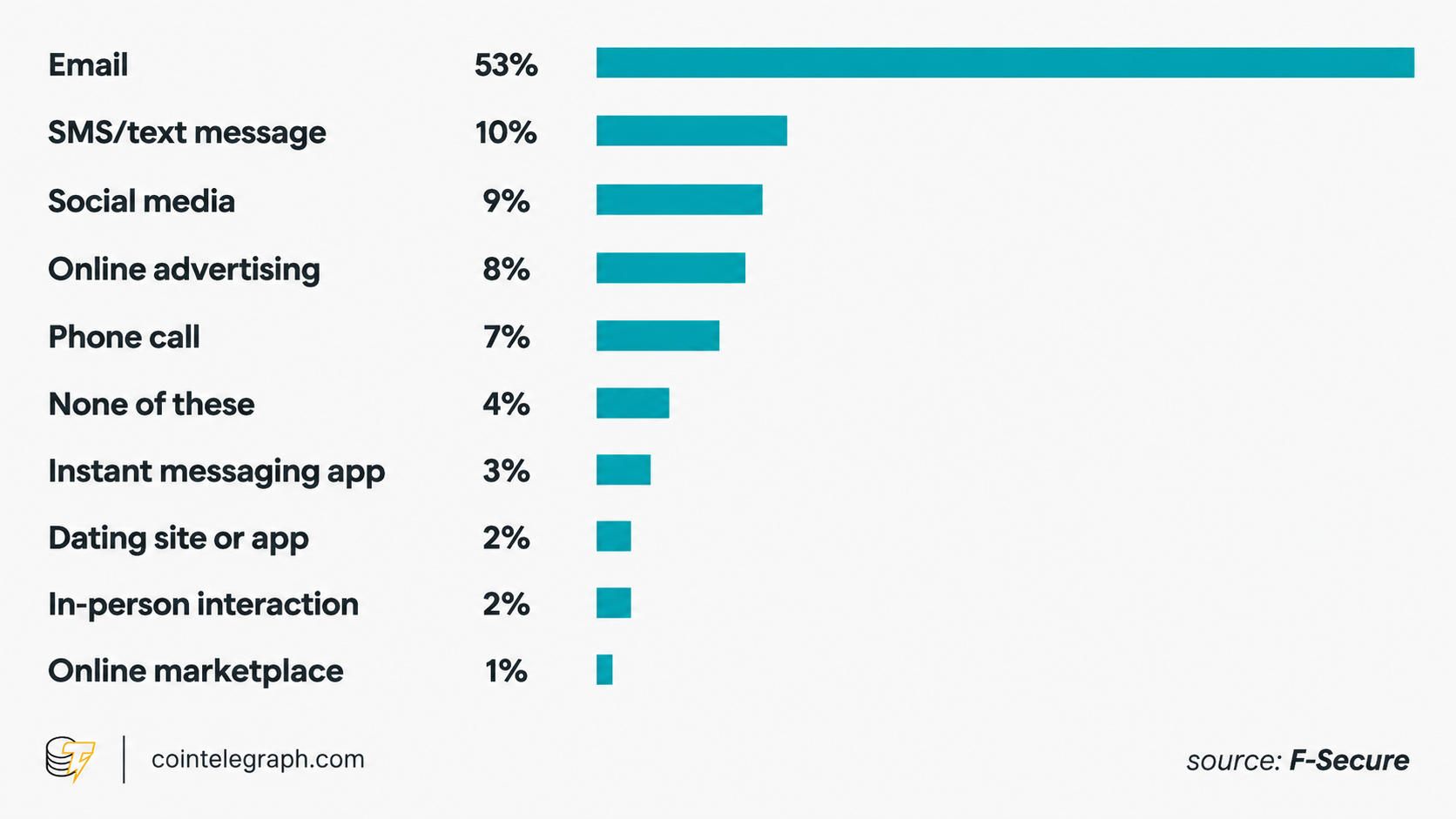

Common Scam Channels


Why Text Authentication Used to Work


Early phishing scams focused on casting a wide net, prioritizing quantity over content quality. Scammers sent out mass messages, hoping just a few people would bite.


Since most scam operations were based overseas or used simple translation tools, the sent information often contained grammatical errors, awkward expressions, and messy formatting. Users gradually learned to treat these details as warning signs.


Various cybersecurity awareness campaigns also popularized a series of basic identification techniques:


  • Check if the text contains spelling mistakes.
  • Avoid messages with poor grammar.
  • Be wary of strange or unusual phrasing.
  • Watch for abnormal formatting.


These small tricks could quickly filter out crudely made scam content.


However, this was never a foolproof defense method, serving only as a reminder. But over time, many people began to assume that professional, fluent writing equated to trustworthy content. The widespread adoption of AI has completely shattered this ingrained perception.


AI tools can generate well-formatted and eloquently phrased phishing content in bulk. Relying on spotting textual errors to prevent scams is becoming increasingly unreliable.


How AI Upgrades Scam Tactics


Large language models can generate natural, fluent text in multiple languages, allowing fraudsters to fabricate various types of false content:


  • Falsify customer service chat logs
  • Produce sophisticated phishing emails
  • Impersonate legitimate exchange notifications
  • Write highly enticing investment pitches
  • Post realistic Telegram group announcements
  • Create customized fake wallet recovery guides


Simultaneously, AI also assists in implementing precise targeted attacks. Scammers use data breach information and user data from platforms like LinkedIn, X, Discord, and Telegram to tailor scam narratives.


Information received by users might mention these details:


  • Tokens you recently purchased
  • Your exchange account information
  • The wallet service provider you are using
  • Decentralized Finance (DeFi) platforms you've interacted with
  • Customer service questions you've asked in public channels


Highly customized content significantly increases the credibility of scams.


Furthermore, AI image generation and voice cloning technologies make identity impersonation much easier. Forging executive videos, simulating customer service voices, and replicating brand visual elements can now be achieved effortlessly.


Unique Risks Faced by Crypto Users


The security logic of crypto assets is fundamentally different from traditional banking. In traditional finance, if you encounter a mistaken transfer or scam, you can usually contact your bank, payment institution, or risk control team to recover the funds. However, once a crypto transaction is confirmed on the blockchain, it is essentially irreversible.


Self-custody wallets also expand the attack surface. Scammers may not need to steal passwords or private keys; often, simply tricking users into authorizing malicious transactions or granting high-risk wallet permissions is enough to succeed.


This means that even if users never leak their seed phrase, well-crafted scam interfaces still pose a significant risk.


Common scam forms in the crypto space include:


  • Fake airdrop claim websites
  • Counterfeit NFT minting events
  • Impersonated exchange login pages
  • Inducement to connect to malicious wallets
  • Pop-ups prompting authorization of malicious tokens
  • Fake staking or mining interfaces
  • Impersonation of official customer support
  • High-imitation accounts registered on platforms like Telegram and Discord


With the help of AI, such scams can be produced in bulk while maintaining high fidelity in content and interface design.


Core Verification Methods Users Should Master


Facing increasingly realistic scams, crypto users can no longer rely on superficial judgment; verification must become the primary rule.


1) Scrutinize the Domain Name Carefully


A website's appearance can be copied, but the URL is difficult to replicate perfectly. Fraudulent domains commonly use these tricks: adding extra characters, inserting random hyphens, using look-alike symbols, tampering with subdomains, choosing obscure top-level domains.


Even if the page looks identical to a legitimate platform, do not trust it based solely on logos and visual effects. Recommended practices include:


  • Manually type the URLs of commonly used platforms.
  • For wallets and exchanges, prioritize using saved bookmarks.
  • Always verify the domain name before connecting a wallet.
  • Avoid clicking links in unfamiliar messages or promotional content.


A beautiful page does not equate to a legitimate website.


2) Prioritize Links from Official Channels


Fake announcements, impersonated influencer accounts, and scam accounts are common vectors for spreading scams. Fraudulent links primarily spread through: Telegram groups, Discord channels, X (formerly Twitter) comment sections, paid search ads, fake customer service messages.


Always confirm that links originate from the project's official website or officially announced channels. Cross-referencing information across multiple official accounts can further reduce risk.


Be highly vigilant when receiving unsolicited private messages claiming your account has an urgent issue.
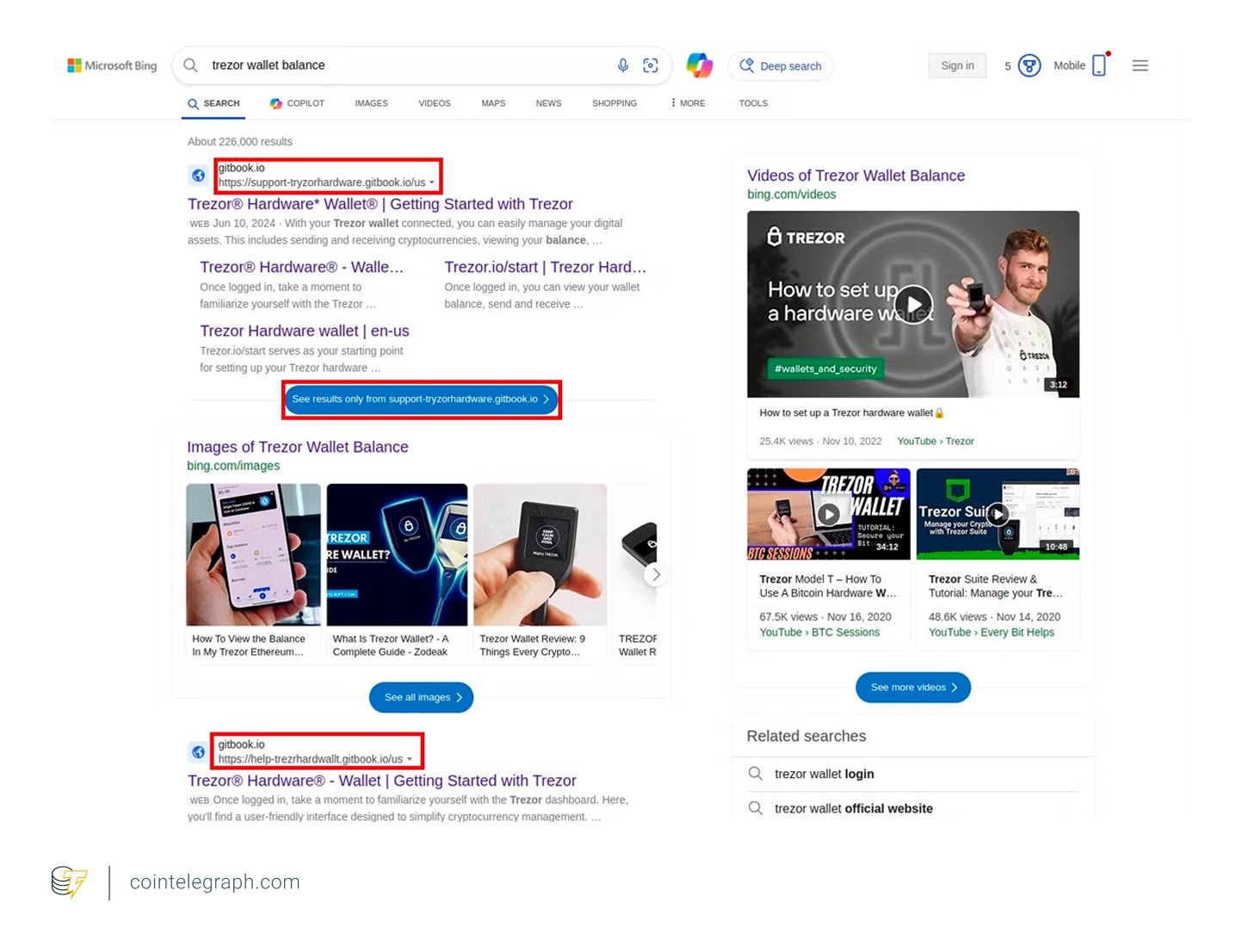

Malicious Trezor Balance Check Link Found in Bing Search


3) Understand Wallet Permissions Before Authorizing


Many users have the misconception that any request popping up from their wallet must be safe. Especially when faced with professional-looking websites, people often casually click confirm, overlooking permission details.


Wallet interactions involve various operation types: connecting a wallet, signing messages, authorizing token transfers, granting general permissions, triggering smart contract interactions, etc.


Among these, unlimited approvals carry the highest risk, allowing malicious contracts to transfer your assets arbitrarily in the future. Before approving, always verify that the token types, allowed transfer amounts, the requesting contract address, and the operation details match your expectations.


Even if a website looks flawless, it might trigger high-risk wallet operations.


4) Verify All Details Before Signing a Transaction


AI scams often exploit a sense of urgency to rush users into quick confirmation. Before signing any transaction, meticulously check the recipient address, token amount, selected blockchain, contract interaction information, fee structure, and approval scope.


If a page is labeled "Claim Reward" but requests unlimited token permissions, or labeled "Wallet Verification" but initiates an asset transfer, stop immediately and investigate the risk.


Once transaction details deviate from expectations, do not proceed.


Many wallet scams begin when users publicly complain about account issues on social media. Scammers monitor such posts and then impersonate customer support via private messages.


5) Verify Contract Addresses, Don't Blindly Trust Token Names


Scammers can copy token names and icons to create high-imitation fake tokens. A token that appears to be named "USDT" or "ETH Earnings" might be issued by a completely unrelated entity.


Verification method: Confirm the token's corresponding contract address through the project's official website, legitimate blockchain explorers, officially published materials, or mainstream exchange information. As AI scams become more convincing, relying solely on token names and icons to judge authenticity is increasingly risky.


6) Be Wary of Unsolicited Customer Service Private Messages


Impersonating official customer support remains a prevalent scam method in the crypto space. Scammers monitor users' help-seeking comments on social platforms, then send private messages posing as staff. They may induce users to perform wallet "verification," ask for seed phrases, send malicious links, recommend remote control tools, or guide users to complete dangerous authorizations.


Legitimate official customer support almost never initiates private contact first. Platforms will also never ask for private keys or seed phrases. If you encounter a problem, proactively contact support through official channels. Do not respond to unsolicited private messages.


7) Urgent Pressure is Often a Sign of a Scam


Even the most professionally crafted scams often use psychological pressure to create urgency. Common narratives include: "Your wallet has been hacked," "Tokens are about to expire, claim now," "Account will be suspended soon," "KYC failed," "Security update required immediately."


Such tactics can cloud judgment. The more someone pressures you to act immediately, the more you should slow down and verify carefully.


A simple rule for crypto security: Whenever you're asked to act on your wallet immediately, pause and calmly verify first.


Polished Appearance No Longer Equals Security


Today's scam websites can accurately replicate brand logos, color schemes, page layouts, and writing styles. AI can also help create high-fidelity FAQ pages, fake customer service replies, impersonated news articles, and complete new user onboarding flows and promotional copy.


Judging a platform's trustworthiness based on visual appeal alone is no longer possible. Attackers only need to catch a user off guard for a moment to execute irreversible asset theft.


The core of security protection remains verification: check the domain name, inspect the contract, review wallet requests, confirm support identities, clarify transaction purposes. A beautifully designed interface does not equate to trustworthiness.


Crypto Security Has Evolved into a Battle of Verification


AI hasn't created entirely new scam models; it has simply significantly upgraded the presentation and disguise of traditional scam techniques. In the past, people relied on surface characteristics to identify risks but neglected the act of verification itself. This mindset can lead to massive losses in the crypto industry.


Behind a perfectly phrased paragraph, a malicious link might lurk. Within a seemingly professional customer service reply, instructions to authorize asset transfers could be hidden. A convincingly realistic website might also request high-risk permissions.


The core takeaway is simple: fluent copy, exquisite interfaces, and familiar brand imagery cannot serve as security credentials. Faced with every link, every wallet pop-up, every customer service message: verify first, then act.


Related Questions

QHow has the use of AI by scammers fundamentally changed the nature of phishing attacks in the cryptocurrency space?

AAI has shifted phishing attacks from relying on easily identifiable signs like poor grammar, spelling errors, and awkward phrasing to generating highly polished, fluent, and contextually convincing content. This makes scams appear legitimate and professional, breaking users' long-held association of sloppy text with danger.

QWhat are some of the unique risks cryptocurrency users face compared to traditional banking users, especially in the context of AI-enhanced scams?

ACryptocurrency transactions are irreversible once confirmed on the blockchain, unlike traditional banking where chargebacks are often possible. AI can create convincing fake websites and interfaces that trick users into signing malicious transactions or granting unlimited token approvals, leading to instant asset loss even if seed phrases are never shared.

QAccording to the article, what is the most critical principle for crypto users to adopt for security in the age of AI scams?

AThe core principle is 'verification before action.' Users must move beyond judging content by its polished appearance and instead rigorously verify every request through independent channels. This includes checking domains, contract addresses, wallet permissions, and the identity of support personnel.

QWhat are three specific verification methods the article recommends for crypto users to protect themselves?

A1) Carefully verify website URLs and domain names, avoiding links from unknown sources. 2) Always check the details of any wallet transaction or signature request before approving, especially the token permissions and recipient addresses. 3) Verify token authenticity by checking the official contract address, not just the name or logo, and be wary of unsolicited private messages from 'support staff.'

QWhy is a sense of urgency often a red flag in potential crypto scams, even if the communication looks professional?

AScammers use urgency (e.g., claims of a hacked wallet, expiring tokens, or account suspension) to create psychological pressure and short-circuit a user's normal verification process. The article advises that the more a message pressures you to act immediately, the more you should slow down and perform thorough checks.

Related Reads

For the First Time, Pure Human Video Pretrained VLA for Dexterous Manipulation: Deployable with Minimal Fine-Tuning Data

For the first time, a purely human-video-pretrained Vision-Language-Action (VLA) model for dexterous manipulation requires only a small amount of data for fine-tuning to achieve successful real-world deployment. Achieving human-level dexterous manipulation remains a core challenge in robotics. While multi-fingered hands offer hardware potential, Visual-Language-Action (VLA) models lag behind due to the high cost of collecting diverse, high-quality robot data. A novel framework, VITRA, developed by Microsoft Research Asia and Tsinghua University, addresses this by automatically transforming massive, unlabeled real-world human activity videos into a structured V-L-A training dataset. Key innovations include precise 3D hand motion annotation from monocular video, atomic action segmentation based on hand-speed minima, and automated instruction generation using VLMs combined with 3D trajectory visualization. This process created a massive dataset of 1 million clips. Pretrained exclusively on this human video data, the VLA model (combining a VLM backbone with a Diffusion Transformer action expert) demonstrates strong zero-shot hand motion prediction in unseen environments. Crucially, it requires minimal fine-tuning (~1.2k demonstrations) on real robot data to achieve high-success-rate dexterous manipulation tasks like grasping, placing, pouring, and sweeping on hardware like the Realman robot with the XHAND1 dexterous hand. The model shows exceptional generalization to novel objects and environments. The research also observes promising scaling behavior, where performance improves with more pretraining data, paving the way for more generalized embodied intelligence.

marsbit10m ago

For the First Time, Pure Human Video Pretrained VLA for Dexterous Manipulation: Deployable with Minimal Fine-Tuning Data

marsbit10m ago

Bitcoin Monthly Chart Adjustment Structure Established, HYPE Entry Opportunity Emerges | Exclusive Analysis

Bitcoin Monthly Correction Structure Confirmed, HYPE Entry Opportunity Emerges | Guest Analysis Last week's analysis correctly identified that the $60,000 level for Bitcoin was an intermediate point, not the bottom of the current correction. This was validated on June 5th when the price broke below this key support, dropping to around $59,100. The monthly-level a-b-c three-wave corrective structure from the October 2025 high of $126,200 is now fully established, with the market currently in the c-wave decline phase. The cumulative adjustment time is less than 35 days, indicating the structure is far from complete. This week's focus will be tracking the rebound's strength and resistance performance. The two key resistance zones of $65,000 and $69,500~$70,500 will be crucial observation points for determining the subsequent trend. For HYPE, last week's top warning signal was also validated, with the price falling up to 27% from its $75.87 high. The token has now entered a support zone, presenting a potential short-term entry opportunity. From a strategic standpoint, the medium-term outlook remains bearish, awaiting optimal timing to add short positions upon a rebound. **Key Trading Views Summary:** * **BTC:** The analysis maintains a bearish medium-term bias. Strategy involves building short positions on rebounds towards $65,000 or the $69,500~$70,500 resistance area. A break below the $59,000-$60,000 support could trigger additional short entries. Short-term trading (30% capital) focuses on range-bound opportunities. * **HYPE:** Following a confirmed correction from the $75.87 high, the short-term strategy shifts to "buying on dips." Consider light long positions (under 30%仓位) if the price finds support and shows stabilization signals in the $55-$57 or deeper $47-$49 support zones, contingent on confirming technical signals. The key resistance to watch is the $62.5-$64.57 area. **Risk Management Reminder:** Always set an initial stop-loss immediately upon opening a position. Move the stop-loss to breakeven upon achieving 1% profit, and subsequently trail it to lock in gains. Market conditions change rapidly; this analysis is for informational purposes only and not investment advice.

marsbit1h ago

Bitcoin Monthly Chart Adjustment Structure Established, HYPE Entry Opportunity Emerges | Exclusive Analysis

marsbit1h ago

Trading

Spot
Futures

Hot Articles

What is SONIC

Sonic: Pioneering the Future of Gaming in Web3 Introduction to Sonic In the ever-evolving landscape of Web3, the gaming industry stands out as one of the most dynamic and promising sectors. At the forefront of this revolution is Sonic, a project designed to amplify the gaming ecosystem on the Solana blockchain. Leveraging cutting-edge technology, Sonic aims to deliver an unparalleled gaming experience by efficiently processing millions of requests per second, ensuring that players enjoy seamless gameplay while maintaining low transaction costs. This article delves into the intricate details of Sonic, exploring its creators, funding sources, operational mechanics, and the timeline of significant events that have shaped its journey. What is Sonic? Sonic is an innovative layer-2 network that operates atop the Solana blockchain, specifically tailored to enhance the existing Solana gaming ecosystem. It accomplishes this through a customised, VM-agnostic game engine paired with a HyperGrid interpreter, facilitating sovereign game economies that roll up back to the Solana platform. The primary goals of Sonic include: Enhanced Gaming Experiences: Sonic is committed to offering lightning-fast on-chain gameplay, allowing players and developers to engage with games at previously unattainable speeds. Atomic Interoperability: This feature enables transactions to be executed within Sonic without the need to redeploy Solana programmes and accounts. This makes the process more efficient and directly benefits from Solana Layer1 services and liquidity. Seamless Deployment: Sonic allows developers to write for Ethereum Virtual Machine (EVM) based systems and execute them on Solana’s SVM infrastructure. This interoperability is crucial for attracting a broader range of dApps and decentralised applications to the platform. Support for Developers: By offering native composable gaming primitives and extensible data types - dining within the Entity-Component-System (ECS) framework - game creators can craft intricate business logic with ease. Overall, Sonic's unique approach not only caters to players but also provides an accessible and low-cost environment for developers to innovate and thrive. Creator of Sonic The information regarding the creator of Sonic is somewhat ambiguous. However, it is known that Sonic's SVM is owned by the company Mirror World. The absence of detailed information about the individuals behind Sonic reflects a common trend in several Web3 projects, where collective efforts and partnerships often overshadow individual contributions. Investors of Sonic Sonic has garnered considerable attention and support from various investors within the crypto and gaming sectors. Notably, the project raised an impressive $12 million during its Series A funding round. The round was led by BITKRAFT Ventures, with other notable investors including Galaxy, Okx Ventures, Interactive, Big Brain Holdings, and Mirana. This financial backing signifies the confidence that investment foundations have in Sonic’s potential to revolutionise the Web3 gaming landscape, further validating its innovative approaches and technologies. How Does Sonic Work? Sonic utilises the HyperGrid framework, a sophisticated parallel processing mechanism that enhances its scalability and customisability. Here are the core features that set Sonic apart: Lightning Speed at Low Costs: Sonic offers one of the fastest on-chain gaming experiences compared to other Layer-1 solutions, powered by the scalability of Solana’s virtual machine (SVM). Atomic Interoperability: Sonic enables transaction execution without redeployment of Solana programmes and accounts, effectively streamlining the interaction between users and the blockchain. EVM Compatibility: Developers can effortlessly migrate decentralised applications from EVM chains to the Solana environment using Sonic’s HyperGrid interpreter, increasing the accessibility and integration of various dApps. Ecosystem Support for Developers: By exposing native composable gaming primitives, Sonic facilitates a sandbox-like environment where developers can experiment and implement business logic, greatly enhancing the overall development experience. Monetisation Infrastructure: Sonic natively supports growth and monetisation efforts, providing frameworks for traffic generation, payments, and settlements, thereby ensuring that gaming projects are not only viable but also sustainable financially. Timeline of Sonic The evolution of Sonic has been marked by several key milestones. Below is a brief timeline highlighting critical events in the project's history: 2022: The Sonic cryptocurrency was officially launched, marking the beginning of its journey in the Web3 gaming arena. 2024: June: Sonic SVM successfully raised $12 million in a Series A funding round. This investment allowed Sonic to further develop its platform and expand its offerings. August: The launch of the Sonic Odyssey testnet provided users with the first opportunity to engage with the platform, offering interactive activities such as collecting rings—a nod to gaming nostalgia. October: SonicX, an innovative crypto game integrated with Solana, made its debut on TikTok, capturing the attention of over 120,000 users within a short span. This integration illustrated Sonic’s commitment to reaching a broader, global audience and showcased the potential of blockchain gaming. Key Points Sonic SVM is a revolutionary layer-2 network on Solana explicitly designed to enhance the GameFi landscape, demonstrating great potential for future development. HyperGrid Framework empowers Sonic by introducing horizontal scaling capabilities, ensuring that the network can handle the demands of Web3 gaming. Integration with Social Platforms: The successful launch of SonicX on TikTok displays Sonic’s strategy to leverage social media platforms to engage users, exponentially increasing the exposure and reach of its projects. Investment Confidence: The substantial funding from BITKRAFT Ventures, among others, emphasizes the robust backing Sonic has, paving the way for its ambitious future. In conclusion, Sonic encapsulates the essence of Web3 gaming innovation, striking a balance between cutting-edge technology, developer-centric tools, and community engagement. As the project continues to evolve, it is poised to redefine the gaming landscape, making it a notable entity for gamers and developers alike. As Sonic moves forward, it will undoubtedly attract greater interest and participation, solidifying its place within the broader narrative of blockchain gaming.

1.6k Total ViewsPublished 2024.04.04Updated 2024.12.03

What is SONIC

What is $S$

Understanding SPERO: A Comprehensive Overview Introduction to SPERO As the landscape of innovation continues to evolve, the emergence of web3 technologies and cryptocurrency projects plays a pivotal role in shaping the digital future. One project that has garnered attention in this dynamic field is SPERO, denoted as SPERO,$$s$. This article aims to gather and present detailed information about SPERO, to help enthusiasts and investors understand its foundations, objectives, and innovations within the web3 and crypto domains. What is SPERO,$$s$? SPERO,$$s$ is a unique project within the crypto space that seeks to leverage the principles of decentralisation and blockchain technology to create an ecosystem that promotes engagement, utility, and financial inclusion. The project is tailored to facilitate peer-to-peer interactions in new ways, providing users with innovative financial solutions and services. At its core, SPERO,$$s$ aims to empower individuals by providing tools and platforms that enhance user experience in the cryptocurrency space. This includes enabling more flexible transaction methods, fostering community-driven initiatives, and creating pathways for financial opportunities through decentralised applications (dApps). The underlying vision of SPERO,$$s$ revolves around inclusiveness, aiming to bridge gaps within traditional finance while harnessing the benefits of blockchain technology. Who is the Creator of SPERO,$$s$? The identity of the creator of SPERO,$$s$ remains somewhat obscure, as there are limited publicly available resources providing detailed background information on its founder(s). This lack of transparency can stem from the project's commitment to decentralisation—an ethos that many web3 projects share, prioritising collective contributions over individual recognition. By centring discussions around the community and its collective goals, SPERO,$$s$ embodies the essence of empowerment without singling out specific individuals. As such, understanding the ethos and mission of SPERO remains more important than identifying a singular creator. Who are the Investors of SPERO,$$s$? SPERO,$$s$ is supported by a diverse array of investors ranging from venture capitalists to angel investors dedicated to fostering innovation in the crypto sector. The focus of these investors generally aligns with SPERO's mission—prioritising projects that promise societal technological advancement, financial inclusivity, and decentralised governance. These investor foundations are typically interested in projects that not only offer innovative products but also contribute positively to the blockchain community and its ecosystems. The backing from these investors reinforces SPERO,$$s$ as a noteworthy contender in the rapidly evolving domain of crypto projects. How Does SPERO,$$s$ Work? SPERO,$$s$ employs a multi-faceted framework that distinguishes it from conventional cryptocurrency projects. Here are some of the key features that underline its uniqueness and innovation: Decentralised Governance: SPERO,$$s$ integrates decentralised governance models, empowering users to participate actively in decision-making processes regarding the project’s future. This approach fosters a sense of ownership and accountability among community members. Token Utility: SPERO,$$s$ utilises its own cryptocurrency token, designed to serve various functions within the ecosystem. These tokens enable transactions, rewards, and the facilitation of services offered on the platform, enhancing overall engagement and utility. Layered Architecture: The technical architecture of SPERO,$$s$ supports modularity and scalability, allowing for seamless integration of additional features and applications as the project evolves. This adaptability is paramount for sustaining relevance in the ever-changing crypto landscape. Community Engagement: The project emphasises community-driven initiatives, employing mechanisms that incentivise collaboration and feedback. By nurturing a strong community, SPERO,$$s$ can better address user needs and adapt to market trends. Focus on Inclusion: By offering low transaction fees and user-friendly interfaces, SPERO,$$s$ aims to attract a diverse user base, including individuals who may not previously have engaged in the crypto space. This commitment to inclusion aligns with its overarching mission of empowerment through accessibility. Timeline of SPERO,$$s$ Understanding a project's history provides crucial insights into its development trajectory and milestones. Below is a suggested timeline mapping significant events in the evolution of SPERO,$$s$: Conceptualisation and Ideation Phase: The initial ideas forming the basis of SPERO,$$s$ were conceived, aligning closely with the principles of decentralisation and community focus within the blockchain industry. Launch of Project Whitepaper: Following the conceptual phase, a comprehensive whitepaper detailing the vision, goals, and technological infrastructure of SPERO,$$s$ was released to garner community interest and feedback. Community Building and Early Engagements: Active outreach efforts were made to build a community of early adopters and potential investors, facilitating discussions around the project’s goals and garnering support. Token Generation Event: SPERO,$$s$ conducted a token generation event (TGE) to distribute its native tokens to early supporters and establish initial liquidity within the ecosystem. Launch of Initial dApp: The first decentralised application (dApp) associated with SPERO,$$s$ went live, allowing users to engage with the platform's core functionalities. Ongoing Development and Partnerships: Continuous updates and enhancements to the project's offerings, including strategic partnerships with other players in the blockchain space, have shaped SPERO,$$s$ into a competitive and evolving player in the crypto market. Conclusion SPERO,$$s$ stands as a testament to the potential of web3 and cryptocurrency to revolutionise financial systems and empower individuals. With a commitment to decentralised governance, community engagement, and innovatively designed functionalities, it paves the way toward a more inclusive financial landscape. As with any investment in the rapidly evolving crypto space, potential investors and users are encouraged to research thoroughly and engage thoughtfully with the ongoing developments within SPERO,$$s$. The project showcases the innovative spirit of the crypto industry, inviting further exploration into its myriad possibilities. While the journey of SPERO,$$s$ is still unfolding, its foundational principles may indeed influence the future of how we interact with technology, finance, and each other in interconnected digital ecosystems.

54 Total ViewsPublished 2024.12.17Updated 2024.12.17

What is $S$

What is AGENT S

Agent S: The Future of Autonomous Interaction in Web3 Introduction In the ever-evolving landscape of Web3 and cryptocurrency, innovations are constantly redefining how individuals interact with digital platforms. One such pioneering project, Agent S, promises to revolutionise human-computer interaction through its open agentic framework. By paving the way for autonomous interactions, Agent S aims to simplify complex tasks, offering transformative applications in artificial intelligence (AI). This detailed exploration will delve into the project's intricacies, its unique features, and the implications for the cryptocurrency domain. What is Agent S? Agent S stands as a groundbreaking open agentic framework, specifically designed to tackle three fundamental challenges in the automation of computer tasks: Acquiring Domain-Specific Knowledge: The framework intelligently learns from various external knowledge sources and internal experiences. This dual approach empowers it to build a rich repository of domain-specific knowledge, enhancing its performance in task execution. Planning Over Long Task Horizons: Agent S employs experience-augmented hierarchical planning, a strategic approach that facilitates efficient breakdown and execution of intricate tasks. This feature significantly enhances its ability to manage multiple subtasks efficiently and effectively. Handling Dynamic, Non-Uniform Interfaces: The project introduces the Agent-Computer Interface (ACI), an innovative solution that enhances the interaction between agents and users. Utilizing Multimodal Large Language Models (MLLMs), Agent S can navigate and manipulate diverse graphical user interfaces seamlessly. Through these pioneering features, Agent S provides a robust framework that addresses the complexities involved in automating human interaction with machines, setting the stage for myriad applications in AI and beyond. Who is the Creator of Agent S? While the concept of Agent S is fundamentally innovative, specific information about its creator remains elusive. The creator is currently unknown, which highlights either the nascent stage of the project or the strategic choice to keep founding members under wraps. Regardless of anonymity, the focus remains on the framework's capabilities and potential. Who are the Investors of Agent S? As Agent S is relatively new in the cryptographic ecosystem, detailed information regarding its investors and financial backers is not explicitly documented. The lack of publicly available insights into the investment foundations or organisations supporting the project raises questions about its funding structure and development roadmap. Understanding the backing is crucial for gauging the project's sustainability and potential market impact. How Does Agent S Work? At the core of Agent S lies cutting-edge technology that enables it to function effectively in diverse settings. Its operational model is built around several key features: Human-like Computer Interaction: The framework offers advanced AI planning, striving to make interactions with computers more intuitive. By mimicking human behaviour in tasks execution, it promises to elevate user experiences. Narrative Memory: Employed to leverage high-level experiences, Agent S utilises narrative memory to keep track of task histories, thereby enhancing its decision-making processes. Episodic Memory: This feature provides users with step-by-step guidance, allowing the framework to offer contextual support as tasks unfold. Support for OpenACI: With the ability to run locally, Agent S allows users to maintain control over their interactions and workflows, aligning with the decentralised ethos of Web3. Easy Integration with External APIs: Its versatility and compatibility with various AI platforms ensure that Agent S can fit seamlessly into existing technological ecosystems, making it an appealing choice for developers and organisations. These functionalities collectively contribute to Agent S's unique position within the crypto space, as it automates complex, multi-step tasks with minimal human intervention. As the project evolves, its potential applications in Web3 could redefine how digital interactions unfold. Timeline of Agent S The development and milestones of Agent S can be encapsulated in a timeline that highlights its significant events: September 27, 2024: The concept of Agent S was launched in a comprehensive research paper titled “An Open Agentic Framework that Uses Computers Like a Human,” showcasing the groundwork for the project. October 10, 2024: The research paper was made publicly available on arXiv, offering an in-depth exploration of the framework and its performance evaluation based on the OSWorld benchmark. October 12, 2024: A video presentation was released, providing a visual insight into the capabilities and features of Agent S, further engaging potential users and investors. These markers in the timeline not only illustrate the progress of Agent S but also indicate its commitment to transparency and community engagement. Key Points About Agent S As the Agent S framework continues to evolve, several key attributes stand out, underscoring its innovative nature and potential: Innovative Framework: Designed to provide an intuitive use of computers akin to human interaction, Agent S brings a novel approach to task automation. Autonomous Interaction: The ability to interact autonomously with computers through GUI signifies a leap towards more intelligent and efficient computing solutions. Complex Task Automation: With its robust methodology, it can automate complex, multi-step tasks, making processes faster and less error-prone. Continuous Improvement: The learning mechanisms enable Agent S to improve from past experiences, continually enhancing its performance and efficacy. Versatility: Its adaptability across different operating environments like OSWorld and WindowsAgentArena ensures that it can serve a broad range of applications. As Agent S positions itself in the Web3 and crypto landscape, its potential to enhance interaction capabilities and automate processes signifies a significant advancement in AI technologies. Through its innovative framework, Agent S exemplifies the future of digital interactions, promising a more seamless and efficient experience for users across various industries. Conclusion Agent S represents a bold leap forward in the marriage of AI and Web3, with the capacity to redefine how we interact with technology. While still in its early stages, the possibilities for its application are vast and compelling. Through its comprehensive framework addressing critical challenges, Agent S aims to bring autonomous interactions to the forefront of the digital experience. As we move deeper into the realms of cryptocurrency and decentralisation, projects like Agent S will undoubtedly play a crucial role in shaping the future of technology and human-computer collaboration.

717 Total ViewsPublished 2025.01.14Updated 2025.01.14

What is AGENT S

Discussions

Welcome to the HTX Community. Here, you can stay informed about the latest platform developments and gain access to professional market insights. Users' opinions on the price of S (S) are presented below.

活动图片