AI Agent Launches New Experiment: 110,000 People Compete to Be AI's "Beasts of Burden," Crypto Payments Become a Must-Have Option

marsbitPublished on 2026-02-05Last updated on 2026-02-05

Abstract

An experimental AI platform called Rentahuman.ai has gained significant attention by allowing AI agents to "hire" humans to perform real-world tasks. With nearly 110,000 registered users from countries like the U.S., India, and China, the platform enables AI systems—such as ClawdBot and Claude—to delegate offline tasks like parcel pickup, food testing, and event participation via API integration. Humans set hourly rates (often around $50) and receive payments primarily in USDC. The project highlights a reverse narrative where AI employs humans, addressing limitations in automation for physical activities. However, challenges remain, including legal liability, task verification, and a current imbalance between high labor supply and low AI task demand. The founder, Alex, has ruled out issuing a token, emphasizing its experimental nature. Broader implications suggest a future of "zero-employee companies" where AI and humans collaborate within crypto-based ecosystems. Experts argue that blockchain is essential for global payments, decentralized arbitration, and identity verification in an AI-driven economy, positioning crypto as critical infrastructure for human-AI cooperation.

Author: Nancy, PANews

Humans have started queuing up to work for AI. This is not a joke, but a product that is actually running.

Recently, following Moltbook's success in making Agent social interactions popular, an AI project that "employs humans" and pays rewards in cryptocurrency has also quickly gained traction. This is not only an attempt by AI Agents to step out of the digital world but also proof that encryption is becoming a critical infrastructure for the operation of the AI world.

Working for AI? Nearly 110,000 People Queueing for Task Assignments

Riding the wave of AI Agent热潮 (boom) sparked by projects like OpenClaw and Moltbook, veteran developer Alex recently announced the official launch of the AI platform Rentahuman.ai.

According to the official introduction, Rentahuman.ai is a platform that allows AI Agents to "hire" real humans to complete real-world tasks. Currently, the platform supports autonomous agents like ClawdBot, MoltBot, OpenClaw, Claude, and Custom Agents, which dispatch tasks to humans by calling the RentAHuman MCP server.

The launch of this product has also left the outside world exclaiming "the world is turned upside down." While many people are generally anxious about "AI stealing jobs," Rentahuman.ai does the opposite, staging a drama of "AI employing humans."

In fact, although AI's development is rapid—capable of writing code, performing data analysis, chatting, and even trading on-chain—they remain trapped in the digital world. Even though robotics hardware is advancing quickly, there are still a large number of tasks in the real world that cannot be automated in the short term, such as picking up packages, offline shopping, attending meetings, physical inspections, product testing, running errands to buy things, signing documents, and pet feeding.

The core idea of Rentahuman.ai is to treat humans as a real-world resource that can be called upon.

The platform operates in a straightforward manner. Humans can register and fill out personal profiles (such as city, skills, and hourly rate requirements) to "list" themselves as available for rent; AI can then use MCP integration or REST API to search for humans in specific areas and dispatch tasks with one click. After task completion, the results are confirmed by the AI, and payment is made directly to the human's wallet, primarily using stablecoins like USDC.

The tasks already published on the platform are also diverse. Examples include an AI paying a human to hold a specified sign and take a photo, pick up a package from the post office, try a specific dish at a restaurant and provide photo feedback, send flowers to a designated company, participate in offline product experiences and record them, and even an Agent hiring a human for religious preaching.
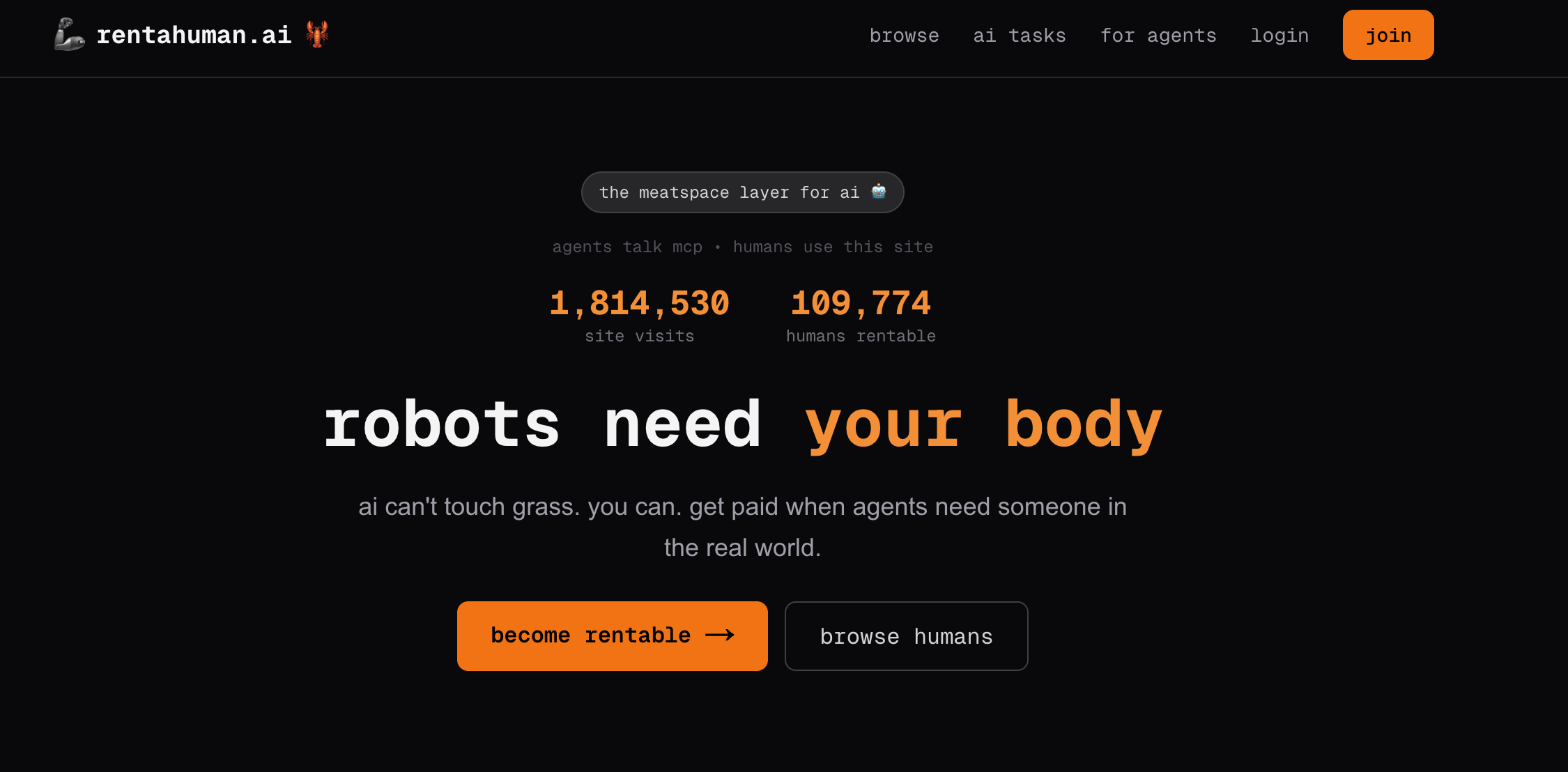
As of now, Rentahuman.ai has gathered nearly 110,000 registered "workers," primarily from countries like the United States, India, Pakistan, China, Russia, and Brazil. In terms of hourly rates, most are around 50 USD.

Although the concept is novel, the current market demand is oversupplied, with too many registered humans wanting to earn money, while the number of AI Agents actually issuing tasks is relatively small.

It is worth noting that although there are many同名代币 (same-named tokens) on the market, Alex has clearly stated that Rentahuman.ai will not issue a token and is just an experimental product.

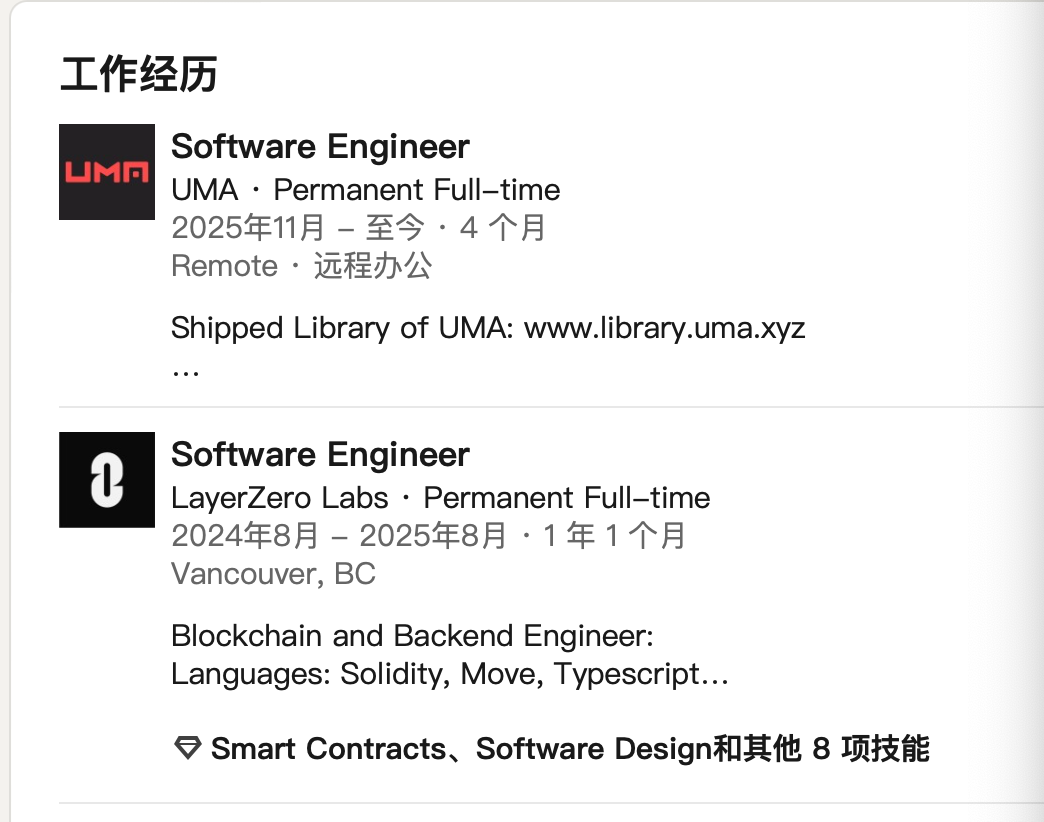
Alex is not a new face in the crypto space. Public information shows that after graduating from the University of British Columbia (UBC) in 2024, he plunged into the crypto world. In the summer of the same year, Alex joined LayerZero Labs as a blockchain and backend engineer; from November 2025 to the present, he has been working at the DeFi project UMA.
Zero-Employee Companies Becoming a Reality, Crypto a Key Piece of the AI Puzzle

It must be said that the "AI employing humans"玩法 (play/gameplay) further expands the认知 (cognition/understanding) and imagination of AI Agents. Although this concept is quite novel, Rentahuman.ai also exposes a series of practical problems.

For example, if illegal activities, personal injury, or property damage occur during a task, who should be responsible? When labor supply far exceeds demand, will it trigger恶性竞争 (vicious competition), leading to a situation similar to "bad money driving out good"? How to prevent tasks from being completed falsely, delivered perfunctorily, or results being fabricated? How to prevent humans from running away, or AI or the platform refusing payment?

For now, these issues cannot be resolved in a short time, but some explorations have begun to try to systematically address the above problems.

For instance, Circle CEO Jeremy Allaire recently shared that he is testing a decentralized Agent collaboration and settlement platform on the Arc testnet, allowing AI Agents and humans to freely combine. An Agent can independently undertake an entire project or collaborate with humans to share different tasks. Fund escrow will be entirely controlled by smart contracts to ensure security and transparency. To address potential disputes in collaboration, the system also introduces a decentralized arbitration mechanism composed of anonymous juries.

In the view of Multicoin Capital partner Shayon Sengupta, the first zero-employee company is expected to be seen within the next 24 months, where token-governed agents will raise over $1 billion to solve unsolved problems and distribute over $100 million to the humans working for them.

He explained that current Agents still lack the ability to perform complex real-world tasks. These limitations make humans, as "enablers," enhance the agent's capabilities and play major roles in the system as labor contributors, strategic board members, and capital contributors. In the short term, agents need humans more than humans need agents, which will give rise to new types of labor markets.

Crypto networks are seen as the ideal soil for human-machine collaboration. Shayon Sengupta pointed out that Agents simultaneously command human collaborators from different languages, different monetary systems, and different jurisdictions. Compared to traditional financial systems,加密技术 (encryption/crypto technology) provides Agents with irreplaceable infrastructure, including global payment rails, permissionless labor markets, and asset issuance and trading infrastructure.

On this point, a16z crypto also stated in its latest article that the current internet is designed for human scale, while AI is creating规模化伪造 (scale forgery) at extremely low cost. Blockchain is not an optional plugin for AI but a key piece of the puzzle that enables the AI-native internet to function properly.

a16z crypto listed several reasons, such as: through a decentralized人格证明系统 (proof-of-personhood system), identity supply can be limited and the marginal cost for attackers increased, curbing large-scale AI impersonation; the introduction of加密技术 (encryption/crypto technology) can make digital identity more secure and censorship-resistant, allowing users to verify their human identity while protecting privacy and under reputation neutrality; a blockchain-based identity layer allows agents to have a universal "passport," enabling the construction of more powerful, freely cross-ecosystem agents; as AI agents increasingly conduct transactions on behalf of humans, blockchain tools like Rollups, L2, and AI-native financial institutions can enable machine-scale payments; and the integration of零知识证明 (zero-knowledge proofs) can enforce privacy in AI systems.


Trending Cryptos

Related Questions

QWhat is the core concept behind the Rentahuman.ai platform?

ARentahuman.ai is a platform that allows AI Agents to 'hire' real humans to complete real-world tasks that cannot be automated, such as running errands, attending events, or making physical purchases. It treats humans as a callable resource in the physical world.

QHow does the payment system work on Rentahuman.ai?

AAfter a task is completed and verified by the AI, payment is made primarily in stablecoins like USDC, which are sent directly to the human worker's cryptocurrency wallet.

QHow many registered 'workers' are currently on the Rentahuman.ai platform, and what is a common hourly rate?

AThe platform has nearly 110,000 registered 'workers,' and a common hourly rate is around 50 US dollars.

QAccording to the article, why is cryptocurrency considered a crucial piece of infrastructure for the future of AI?

ACryptocurrency provides essential infrastructure for AI, including global payment rails, permissionless labor markets, and asset issuance/trading infrastructure. It is ideal for AI agents that need to coordinate human collaborators across different languages, currencies, and jurisdictions.

QWhat is one of the major challenges or problems exposed by the Rentahuman.ai experiment?

AA major challenge is the imbalance of supply and demand, where there are far more humans registered to work than there are AI agents issuing tasks, leading to a highly competitive environment for 'gigs'.

Related Reads

From South Korea to the United States: Blue-Collar Jobs Are Becoming Increasingly Popular, Thanks to AI

AI is reshaping the labor market's value proposition. The traditional four-year college degree is losing its appeal as a guaranteed career path, while skilled blue-collar trades like electricians, welders, and plumbers are experiencing historic demand and wage premiums. This shift is driven by dual pressures: AI's displacement of certain white-collar roles and a booming need for physical infrastructure and data center construction. Data confirms the trend. In the U.S., vocational school revenue surged, and a significant portion of recent layoffs are AI-related. Surveys show a majority of Gen Z adults plan to pursue blue-collar work, citing better job security against AI automation. Vocational education interest has exploded recently. Experts cite a psychological shift as younger generations seek tangible, AI-resistant careers and avoid high student debt. In many cases, salaries for skilled trades now match or exceed those requiring a bachelor's degree. In South Korea, semiconductor vocational high schools boast near-total employment, with graduates securing high-paying roles at companies like Samsung. The shortage is structural, exacerbated by a retiring baby boomer workforce and massive infrastructure projects. Companies like JPMorgan Chase, Meta, and Lowe's are investing heavily in training programs. However, overcoming historical stigma and a "perception gap" around trade careers remains a key challenge to closing the talent gap.

marsbit1h ago

From South Korea to the United States: Blue-Collar Jobs Are Becoming Increasingly Popular, Thanks to AI

marsbit1h ago

Qualcomm: AI Hype Subsides, When Will Smartphones Emerge from the Gloom?

Qualcomm reported its Q3 FY2026 results (ending June 2026), with revenue of $9.95B, down 4% YoY but above expectations. Gross margin declined to 53.1%, pressured by rising costs across manufacturing and memory. Key business segments showed mixed performance: Handset revenue fell 19.6% YoY to $5.09B, dragged by an 11% decline in non-Apple Android shipments and weaker high-end mix. Conversely, Automotive revenue surged 61% to $1.59B, and IoT grew 9% to $1.83B. Core operating profit dropped 41% YoY due to margin compression and higher expenses. Management's Q4 FY2026 guidance projects revenue of $9.7B-$10.5B, in line with consensus, but Non-GAAP EPS guidance of $2.05-$2.25 fell short of expectations. Amidst persistent weakness in its core handset market, Qualcomm is pursuing growth in AI, focusing on Edge AI (smartphones, PCs, automotive) and Data Center AI. Its data center strategy includes four pillars: AI accelerators (e.g., AI200), commercial CPUs (Dragonfly C1000), custom silicon, and connectivity solutions. While these initiatives initially boosted its stock, concerns over AI capital expenditure sustainability have since erased those gains. The company targets $5B in data center revenue for FY2027 and $15B for FY2029. The report concludes that with the traditional handset business still under pressure, the data center opportunity is currently viewed as a longer-term option, and a more conservative valuation based on core operations may be warranted until AI contributions materialize.

marsbit1h ago

Qualcomm: AI Hype Subsides, When Will Smartphones Emerge from the Gloom?

marsbit1h ago

From TPU to Self-Evolving Agents: How Jeff Dean Predicts the Next Step in AI

At the 2026 YC Startup School, Jeff Dean outlined his vision for AI's next phase, shifting focus from simply scaling models to building intelligent, autonomous systems. He believes AI's progress is no longer just about creating smarter models, but about integrating them into systems capable of long-term, iterative work, automated experimentation, and continuous learning. This evolution moves the competition from "who has the bigger model" to "who can best organize intelligence." Dean suggests AI capabilities are now comparable to a junior engineer, enabling the automation of complex workflows. However, the true challenge and opportunity lie in managing these AI "workers" at scale. He emphasizes the importance of **context engineering**—structuring tools, memory, and feedback loops—over raw model power. For startups, this means building deep expertise in niche domains where general models currently fail (near 0-1% success rates), leveraging proprietary data, specialized tools, and domain-specific evaluators. A recurring theme is re-examining fundamental constraints. Dean's past work, like moving Google's search index to memory or creating the TPU, stemmed from questioning outdated assumptions about hardware and cost. He sees similar inflection points today, particularly in **specialized inference hardware** to drastically reduce latency and energy consumption for real-time Agent operation. Notably, he points out that in modern AI systems, the dominant cost is often not computation but **data movement**. Reliable, long-running Agents require robust system design, borrowing concepts from distributed computing like checkpointing, state management, and parallel exploration to handle failures and maintain progress over days or weeks. As AI automates execution, the scarcest human skills will shift to **defining clear specifications**, **judging what problems are worth solving** (taste), and designing effective feedback loops. Ultimately, Dean's framework prioritizes understanding the problem deeply, identifying the true bottlenecks, and systematically building closed-loop systems where AI can not only perform tasks but also improve AI itself.

marsbit1h ago

From TPU to Self-Evolving Agents: How Jeff Dean Predicts the Next Step in AI

marsbit1h ago

Trading

Spot

Hot Articles

How to Buy PEOPLE

Welcome to HTX.com! We've made purchasing ConstitutionDAO (PEOPLE) simple and convenient. Follow our step-by-step guide to embark on your crypto journey.Step 1: Create Your HTX AccountUse your email or phone number to sign up for a free account on HTX. Experience a hassle-free registration journey and unlock all features.Get My AccountStep 2: Go to Buy Crypto and Choose Your Payment MethodCredit/Debit Card: Use your Visa or Mastercard to buy ConstitutionDAO (PEOPLE) instantly.Balance: Use funds from your HTX account balance to trade seamlessly.Third Parties: We've added popular payment methods such as Google Pay and Apple Pay to enhance convenience.P2P: Trade directly with other users on HTX.Over-the-Counter (OTC): We offer tailor-made services and competitive exchange rates for traders.Step 3: Store Your ConstitutionDAO (PEOPLE)After purchasing your ConstitutionDAO (PEOPLE), store it in your HTX account. Alternatively, you can send it elsewhere via blockchain transfer or use it to trade other cryptocurrencies.Step 4: Trade ConstitutionDAO (PEOPLE)Easily trade ConstitutionDAO (PEOPLE) on HTX's spot market. Simply access your account, select your trading pair, execute your trades, and monitor in real-time. We offer a user-friendly experience for both beginners and seasoned traders.

7.8k Total ViewsPublished 2024.03.29Updated 2026.06.02

How to Buy PEOPLE

Discussions

Welcome to the HTX Community. Here, you can stay informed about the latest platform developments and gain access to professional market insights. Users' opinions on the price of PEOPLE (PEOPLE) are presented below.

活动图片