After a Three-Year Hiatus, Peking University Alumna Lilian Weng's Latest Long-Form Article Goes Viral

marsbitPublished on 2026-06-26Last updated on 2026-06-26

Abstract

After a three-year hiatus, OpenAI alum and renowned AI researcher Lilian Weng has published a comprehensive blog post analyzing the "Scaling Laws" that have guided multi-billion dollar investments in large language models. Her post, "Scaling Laws, Carefully," reveals these foundational laws to be more fragile than widely assumed. She dissects a key discrepancy between OpenAI's 2020 conclusion (favoring larger models) and DeepMind's 2022 Chinchilla finding (advocating balanced growth of model size and data), tracing it to differences in parameter counting and experimental scale. Furthermore, Weng highlights a critical methodological bug in the influential Chinchilla paper, discovered in 2024, where a loss function averaging error caused premature optimizer termination. The analysis also underscores a fundamental limitation: the laws assume infinite, unique training data, a premise collapsing as high-quality text data is exhausted by 2026-2028. This scarcity is driving the industry toward alternatives like reinforcement learning, test-time computation, and synthetic data. Weng concludes that the future of AI depends not just on more compute, but on rigorously understanding and refining these scaling principles.

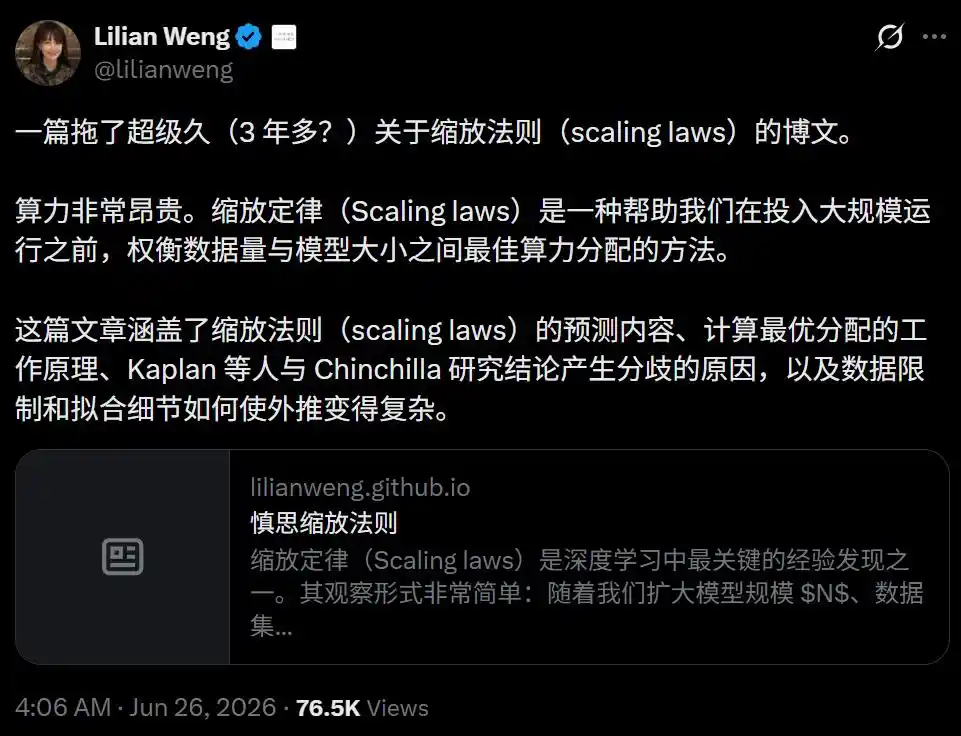
Lilian Weng has finally published a blog post after a three-year hiatus.

Just moments ago, a long-form article by former OpenAI Vice President Lilian Weng, delayed for over three years, went viral.

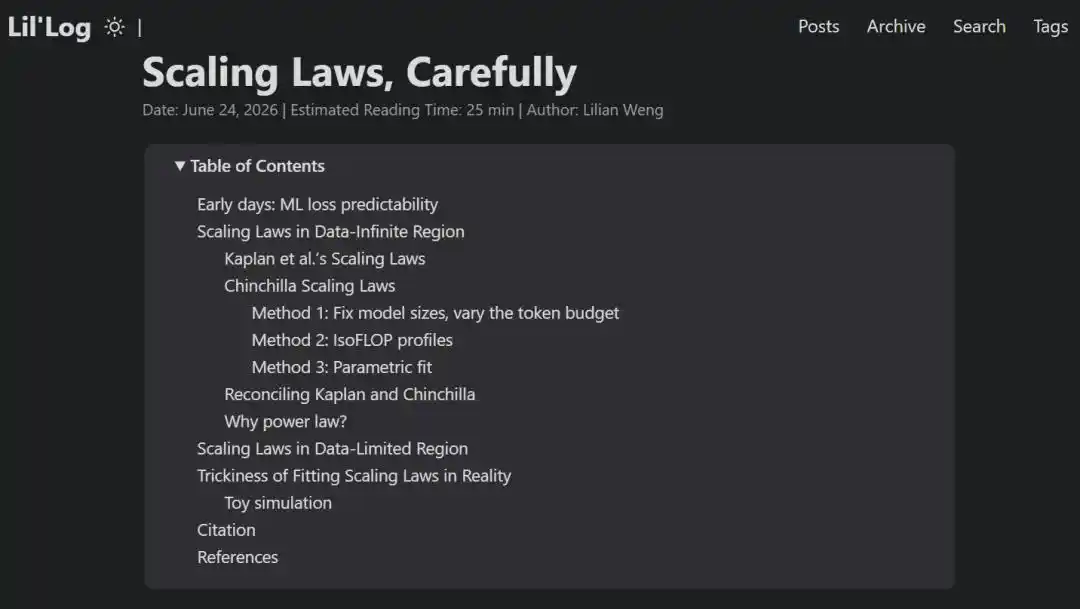
In this blog post titled "Scaling Laws, Carefully," she deconstructs Scaling Laws from start to finish—

The law on which the AI industry has bet tens of billions of dollars is far more fragile than anyone imagined.
One-Minute Summary: What This 10,000-Word Article Says

A single formula has governed the entire industry for five years. Scaling Laws state that "increasing model size, feeding more data, and scaling up compute will improve performance at a fixed rate." It turned AI from alchemy into a calculable business, indirectly directing the flow of hundreds of billions of dollars.

OpenAI and DeepMind gave opposite answers. For the same question of "how to allocate compute budget," OpenAI in 2020 said models should scale faster than data, while DeepMind in 2022 said both should scale proportionally. It was later discovered that the root of the divergence was a difference in parameter accounting plus insufficient experimental scale.

Even the winner's formula has bugs. DeepMind's optimal allocation ratio, copied industry-wide for two years, was found in 2024 during a line-by-line reproduction: the loss function used mean instead of sum, causing the optimizer to stop prematurely, and the output parameters were not the true optimum.

Applying patterns from small models to predict large models requires great caution. This curve was fitted on relatively small models; when extrapolated to trillion-parameter scale, a rounding difference can cause conclusions to diverge significantly. The blog includes an interactive simulator—drag the sliders to see it with your own eyes.

There's an even more fundamental issue: data is running out. The formula assumes infinite data supply, but high-quality text is finite. This is why the entire industry is collectively shifting towards reinforcement learning, test-time computation, and synthetic data.
One Straight Line, Hundreds of Billions of Dollars

As is well known, the core of Scaling Laws can be simply summarized in one sentence—

The larger the model, the more data, the more compute, the better the performance. And this "better" is not random; it follows precise mathematical laws.

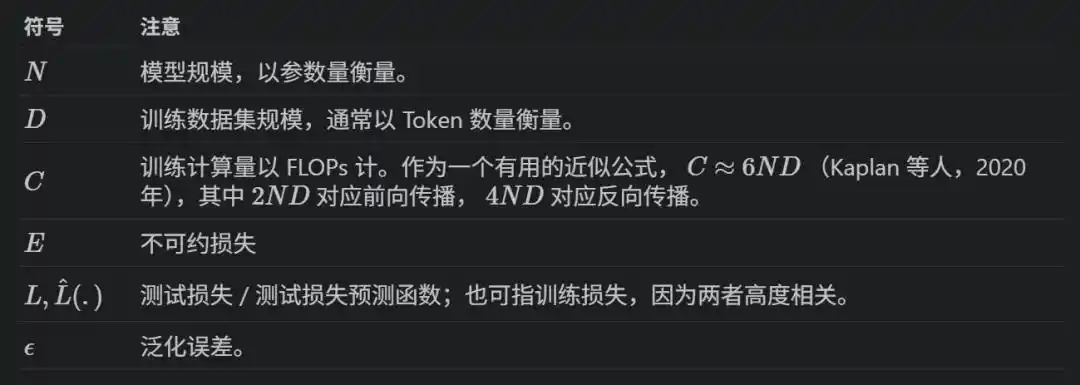
Plotting training loss on a log-log scale shows it decreases in a straight line as model parameter count N, data volume D, and compute C increase.

Written as a formula: L(x) = E + A/x^α, where x can be N, D, or C; E is the theoretical optimal loss (the entropy of the data itself); A and α are fitted constants.

Training a model with N parameters on D tokens requires total compute C ≈ 6ND—2ND for forward pass, 4ND for backward pass.

This straight line means performance gains are predictable.

Run a few small models first, fit the straight line, extrapolate to the right, and you can estimate the performance of a large model. No need to actually spend hundreds of millions training the large model to know if it works.
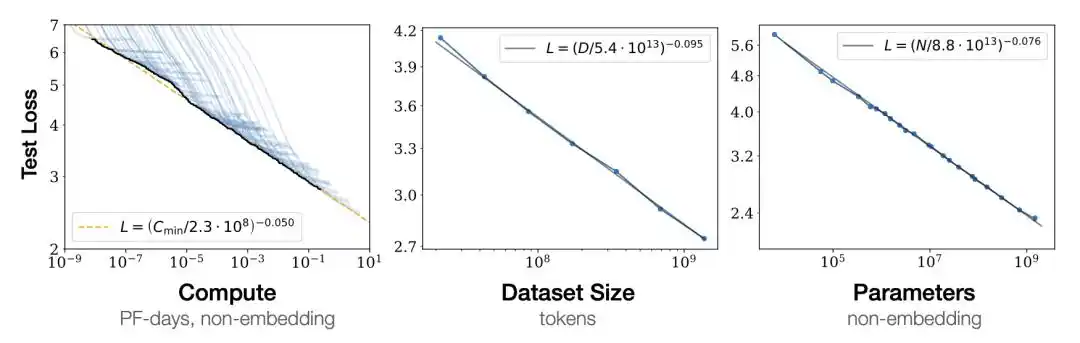
Before this, deep learning was often ridiculed as "alchemy"—knowing what works, but not why.

In 2020, OpenAI's Kaplan published this power law, pulling alchemy into the realm of "predictability" for the first time.

This is the confidence behind all large model companies' massive investments.

But on the most critical advice the formula gives—how to allocate compute budget between model and data—OpenAI and DeepMind gave opposite answers.

The Same Problem

OpenAI and DeepMind Produced Opposite Answers

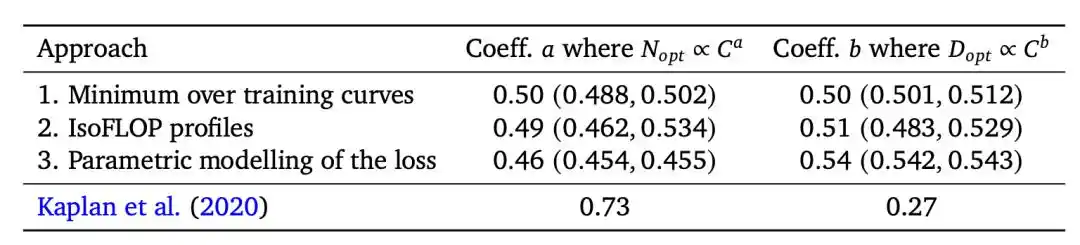
The conclusion reached by OpenAI's Kaplan team in 2020 was: optimal model size N_opt ∝ C^0.73.

Translated: if compute increases 10x, allocate 5.5x to model and 1.8x to data—models should scale much faster than data.
This directly guided GPT-3's training plan.

A 175-billion parameter model was fed only 300 billion tokens (a token is the smallest unit of text processed by a model, roughly 1-2 tokens per word).

By later standards, this was severely undertrained.

In 2022, DeepMind's Chinchilla team reached the opposite conclusion: N_opt ∝ C^0.50, models and data should scale proportionally.

Engineers later distilled it into an oft-quoted number: optimal token-to-parameter ratio is roughly 20:1.

Then DeepMind staged a head-to-head match.

Their Gopher: 280B parameters with 300B tokens. Chinchilla: 70B parameters with 1.4T tokens. Both models used the same compute.

Chinchilla dominated completely.
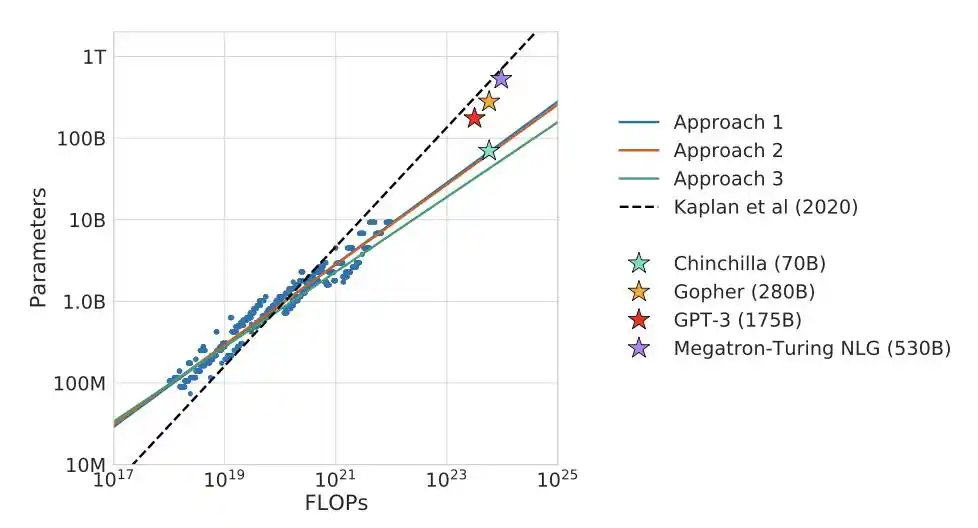
A smaller, well-fed model beat a larger, starved opponent.

Industry consensus flipped: from "scale up models" to "most models are undertrained."

0.73 vs 0.50, opposite answers to the same problem, would have you allocate your compute budget in two completely different directions.

The Reason Turned Out to be an "Accounting Problem"

In 2024, two researchers published a reconciliation paper in the top-tier machine learning journal TMLR, tracing this divergence to its root.

The conclusion is laughable.

First reason: they counted parameters differently.

Models have a type of parameter layer called embedding, responsible for converting text into numerical vectors the model understands. In small models, this layer constitutes a large proportion of total parameters—maybe one-third for models with tens of millions of parameters.

Kaplan excluded embedding when counting parameters; Chinchilla included it.

This single difference in parameter accounting was enough to distort the final fitted power-law exponent.

They gave a concise correction formula: N = N_\E + ω·N_\E^(1/3), where N_\E is parameter count without embedding, ω is a constant. For small models, the second term is large, embedding influence significant; as models grow larger, the second term approaches zero, and the two counting methods converge.

Second reason: Kaplan's experimental scale was too small.

Kaplan's largest tested model was only 1.5B parameters, while Chinchilla's experiments scanned up to over 16B. In log-log coordinates, tiny fitting deviations are magnified dramatically during extrapolation.

Using unified parameter accounting, they rederived Chinchilla's formula and discovered a key pattern—

The power-law exponent changes with compute scale. Within Kaplan's small-scale experimental range, the exponent was indeed close to 0.73; but as scale increased, the exponent converged to 0.50.
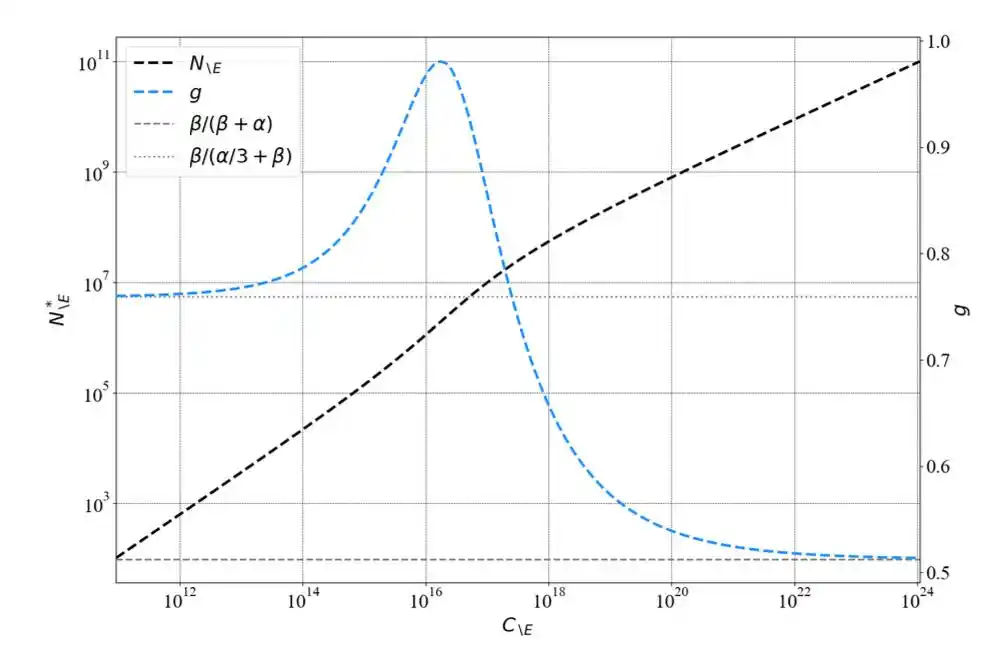
Kaplan wasn't "wrong"; he was correct within his experimental scope.

But he extrapolated a locally valid rule into a global conclusion.

An accounting issue of how to count parameters, plus insufficient experimental scale, led two top teams to give opposite resource allocation advice.

The entire industry adjusted training recipes based on this conclusion for two years.

Even the Winner Has Bugs

Kaplan was corrected by Chinchilla—that's the standard narrative everyone knows.

But Weng took a step further—Chinchilla's own methodology also has problems.

The Chinchilla paper used three independent methods to cross-validate its conclusion:

Method 1: Vary data volume with fixed model size

Method 2: Plot iso-compute curves (IsoFLOP profiles)

Method 3: Directly fit parameters to the loss formula L(N,D) = E + A/N^α + B/D^β

Three paths pointing to the same conclusion, seeming very robust.
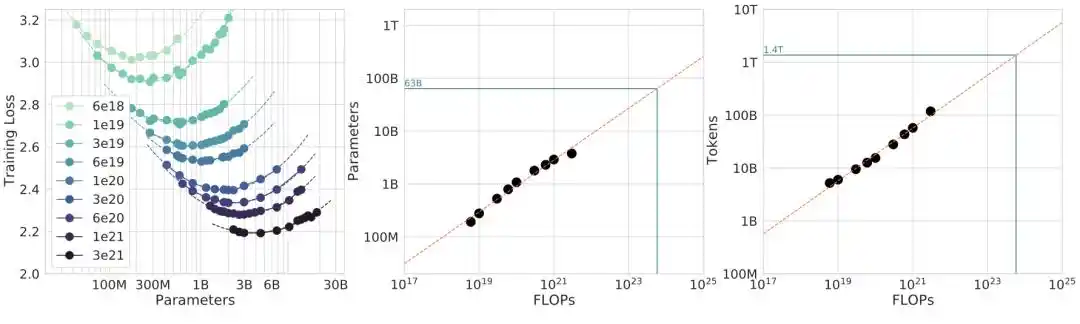
Method 3's mathematical derivation is especially elegant: Optimizing L(N,D) under constraint C ≈ 6ND yields a closed-form solution N_opt ∝ (C/6)^(β/(α+β)). When α ≈ β, the exponent is approximately 0.5, meaning models and data scale proportionally. That's the mathematical origin of 0.50.

In 2024, a team from AI research institute Epoch AI manually extracted raw data points from Chinchilla's paper charts and reran the fitting for Method 3.

Two bugs, each more astonishing than the last.

Bug 1: The loss function used mean instead of sum.

When fitting these five parameters, Chinchilla needed to minimize the gap between predicted loss and actual loss.

The complete optimization objective: min Σ Huber_δ(log L̂(Nᵢ,Dᵢ) − log Lᵢ), where Huber Loss is an outlier-insensitive loss function (δ = 10⁻³), paired with the L-BFGS-B optimizer to search for the optimum.

The problem lies in a detail: they took the mean (average) of Huber Loss per sample, not the sum. Averaging over a few hundred samples compressed the loss value to an extremely small magnitude.

The L-BFGS-B optimizer has a built-in convergence criterion. It stops automatically when the loss value is sufficiently small. Seeing such a tiny value, it mistakenly assumed convergence and stopped.

The optimizer never finished running. The output parameters were not the true optimum.

Bug 2: Key parameters were only kept to two decimal places.

In the Chinchilla paper, two core exponents controlling the power-law shape were retained only to two decimal places.

It seems like harmless rounding.

But when deriving other constants from these rough numbers, the error was amplified exponentially. The final confidence intervals were unreasonably narrow—narrow enough to require precision achievable only after over 600,000 experiments, while they actually ran fewer than 500.

A formula revered industry-wide for two years concealed a bug where the loss function didn't finish running.

Weng's blog also includes an interactive simulator with three sliders controlling loss precision, loss noise, and fitting range.

Each adjustment changes the fitted Scaling Law.
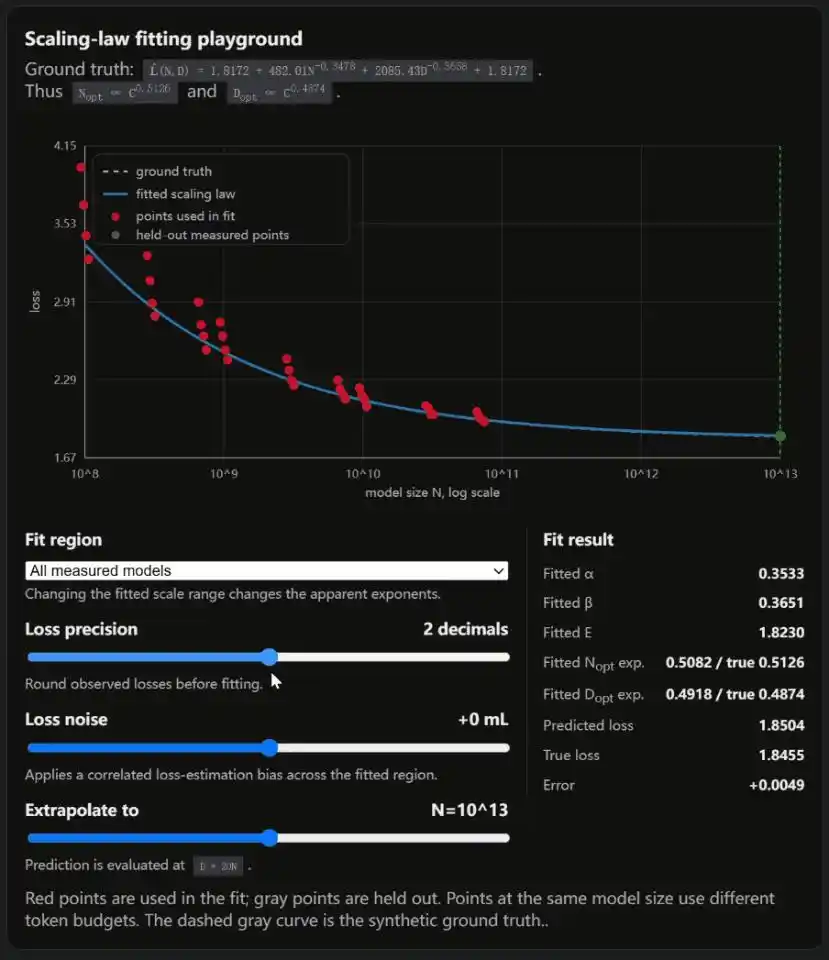
OpenAI's conclusion had local bias; DeepMind's conclusion had methodological flaws. In the AI industry's most important academic debate, both sides had cracks.

Data Is Running Out

The first three sections discussed problems with fitting methods—how to count parameters, how to calculate loss, how many decimal places to keep.

But even if all these problems were fixed, classic Scaling Laws have a more fundamental vulnerability—

They assume each training data point is unique, not repeated, not trained over multiple epochs, presuming you have infinite data.

Reality is, high-quality text data is projected to be exhausted by major labs between 2026 and 2028.

Repeated data training is inevitable; the premise of the classic formula is collapsing.
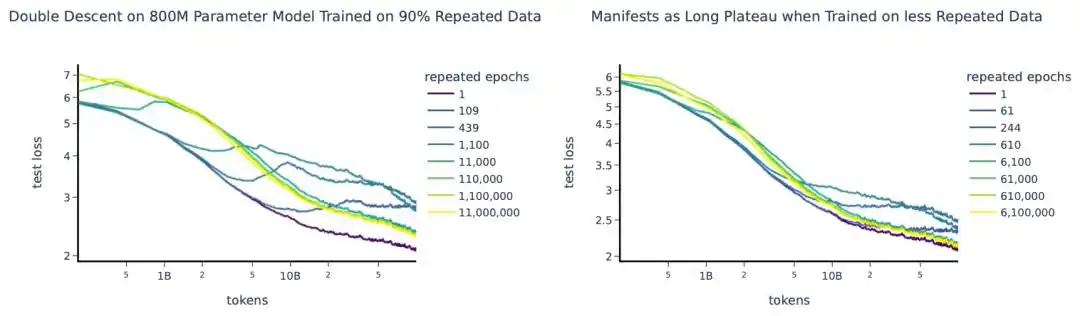
A large-scale experiment in 2023 trained about 400 models, from tens of millions to 9 billion parameters, with up to 1500 epochs of repeated training.

The core idea is to introduce the concept of "effective data volume" to replace actual data volume—

If you have U unique data points repeated R times, the effective data volume is not U×R, but converted via the exponential decay curve D_eff = U·(1 - e^(-R)). The first repetition still learns much new information; by the fifth, tenth repetition, marginal learning gains approach zero.

They also found a counterintuitive conclusion: excess parameters "depreciate" faster than repeated data. Meaning, with limited budget, running more training epochs is more cost-effective than enlarging the model.
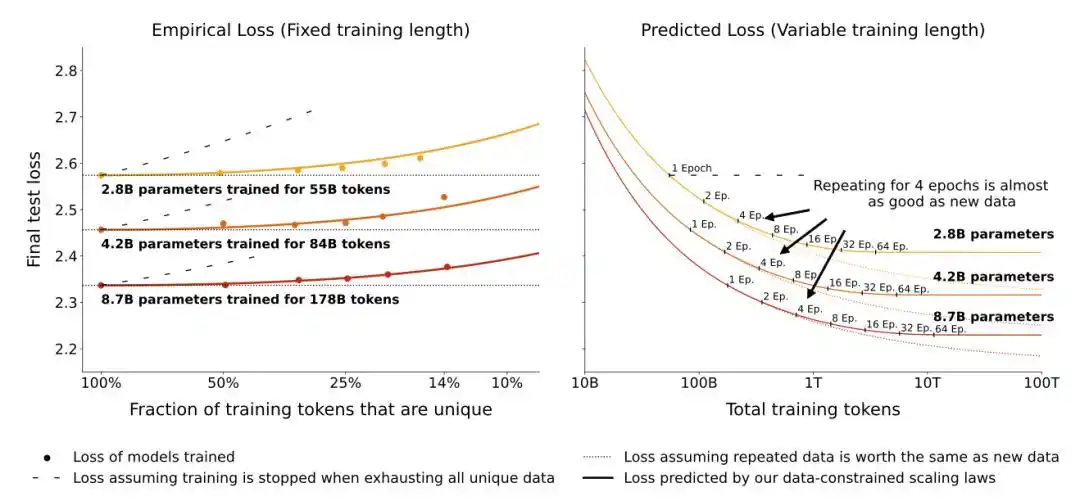
A new paper in May 2026 took a different approach.

They didn't convert to effective data volume; instead, they directly added an explicit overfitting penalty term to the classic loss formula—the more times a model sees the same data, the greater the penalty, and this penalty is tied to model size.

Their complete formula looks like this:

That last red penalty term is key.

R is repetition count, N/U is the ratio of model parameters to unique data volume (how "excessive" the model is relative to data), P, δ, κ are fitted from experiments. More repetitions, larger models, heavier penalty.

The paper's core finding: Large models are more sensitive to data repetition. Training the same data for 10 epochs, a 500M parameter model might still hold up, but a 5B parameter model's performance would degrade much more severely.

Another directly useful engineering finding: Increasing weight decay can significantly alleviate overfitting from repeated training.
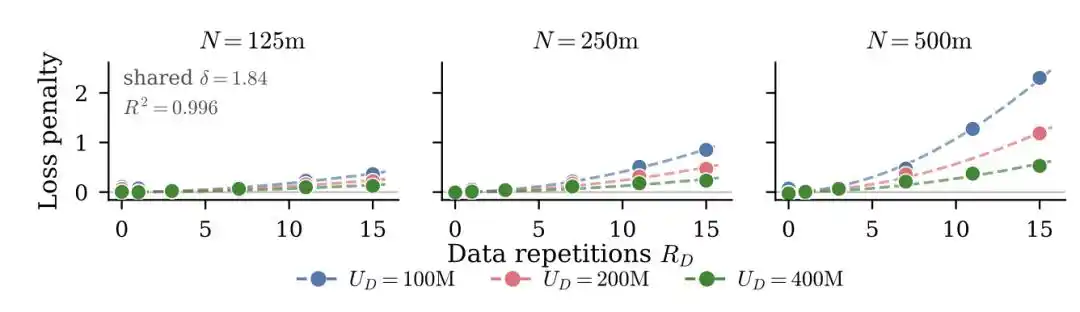
This is also why from 2025 to 2026, the industry's attention collectively shifted to three paths to bypass the data wall—

Reinforcement learning: DeepSeek R1, OpenAI o-series, letting models self-play on verifiable tasks like math and programming to generate training signals.

Test-time computation: Not increasing training cost, letting models "think" a few more steps when answering questions to exchange for better performance.

Synthetic data: Using existing strong models to generate new data to train the next generation.

The subtext of all three paths is the same: The pure "scale-up" power law is no longer sufficient.

From Peking University to OpenAI to Her Own Company

Lilian Weng, undergraduate at Peking University, PhD from Indiana University Bloomington.

Interestingly, her PhD focus wasn't deep learning, but network science and complex systems, studying how information spreads in social networks.

After graduation, she first worked in data science at Dropbox, then at fintech company Affirm, before joining OpenAI in 2018.

At OpenAI, Weng's first project was robotics. She was a core contributor to Dactyl, the robotic hand that learned to solve a Rubik's Cube in two years.

Later, she moved to build the applied research team, and after GPT-4's release, was tasked with forming the Safety Systems team, which grew to over 80 scientists, engineers, and policy experts by the time she left.

In August 2024, her title was elevated to VP of Research and Safety; three months later, she announced her departure.

In 2017, soon after starting deep learning, Weng opened a personal blog called Lil'Log, initially just to organize her study notes.

She once said, "Explaining a concept clearly is the best way to test whether you truly understand it."

Nine years later, she's still writing—reinforcement learning, diffusion models, large model agents, each article starting from foundational principles, dozens of pages long with her own diagrams.

This blog later became one of the most cited personal technical blogs in AI, used directly as textbook material by many universities.

In February 2025, she and former OpenAI CTO Mira Murati founded Thinking Machines Lab, with co-founders including OpenAI co-founder John Schulman, former research VPs Barret Zoph and Luke Metz. a16z led a $2B seed round at a $12B valuation.

And while her company was advancing rapidly, she took time to finish this long-form article on Scaling Laws, delayed for three years.

The ChatGPT, Claude, and Gemini you use every day are all governed by these formulas deciding how to train the next generation.

How good the next-generation AI is won't depend on who has more GPUs, but on who handles these details with greater precision.

References:

https://x.com/lilianweng/status/2070237256070389897?s=20

https://lilianweng.github.io/posts/2026-06-24-scaling-laws/

This article is from WeChat public account "新智元" (New AI Era), author: ASI启示录, editor: Moses

Trending Cryptos

Related Questions

QWhat were the key differences in conclusions between OpenAI's Kaplan and DeepMind's Chinchilla regarding scaling laws and resource allocation?

AOpenAI's Kaplan (2020) concluded that for a given compute budget, the optimal model size should grow faster than the data, with the relationship N_opt ∝ C^0.73. This led to large, data-starved models like GPT-3. DeepMind's Chinchilla (2022) concluded the opposite: N_opt ∝ C^0.50, meaning model and data should scale proportionally. This led to the 'Chinchilla-optimal' 20:1 token-to-parameter ratio, and models trained this way (e.g., Chinchilla itself) outperformed larger, undertrained ones.

QWhat were the two main reasons identified for the contradictory findings between Kaplan and Chinchilla?

AThe contradictions stemmed from two main issues: 1) Parameter Counting: Kaplan excluded embedding parameters from his model size count (N), while Chinchilla included them. This difference in definition significantly affected the fitted scaling law exponent for smaller models. 2) Experimental Scale: Kaplan's experiments used models up to only ~1.5B parameters, while Chinchilla scaled up to ~16B+. The scaling exponent derived from a small-scale range can be misleading when extrapolated to much larger scales, where the exponent converges to a different value.

QWhat major methodological flaw was discovered in the Chinchilla paper years later, and what was its consequence?

AIn 2024, researchers found that Chinchilla's Method 3 (fitting the loss formula L(N, D)) had a critical flaw. The optimization used the mean of the Huber loss across samples instead of the sum. This resulted in a very small loss value, which caused the L-BFGS-B optimizer to stop prematurely, believing it had converged. Consequently, the published parameters were not the true global optimum. Additionally, key parameters were reported with insufficient precision (only 2 decimal places), leading to unrealistically narrow confidence intervals.

QWhat fundamental limitation of classical scaling laws is exposed by the impending exhaustion of high-quality text data?

AClassical scaling laws assume unique, non-repeating training data and an infinite supply of it. This premise is breaking down as high-quality text data is expected to be exhausted by 2026-2028. The industry now faces data repetition, which these original laws do not account for. Performance no longer scales predictably when models are trained on the same data for multiple epochs, leading to diminishing returns and overfitting.

QAccording to the article, what three main research directions is the AI industry pursuing to overcome the data limitation problem for scaling?

ATo bypass the data wall, the industry is focusing on three main research directions: 1) Reinforcement Learning: Using models to generate their own training signals through self-play on verifiable tasks (e.g., DeepSeek R1, OpenAI o-series). 2) Test-Time Computation: Enhancing model performance not during training, but by allowing it to 'think' for more steps (compute) when generating an answer (e.g., chain-of-thought). 3) Synthetic Data: Using existing powerful models to generate new data for training the next generation of models.

Related Reads

Stablecoins Becoming the Next Policy Challenge for the Fed's Walsh Version

Fed Governor Christopher Waller's speech at the June 22 conference on the U.S. dollar's international role signifies a notable policy shift: stablecoins like USDT and USDC are now being formally considered as potential channels for transmitting U.S. dollar liquidity globally. With their combined market cap surpassing $250 billion and high transaction volumes, these digital assets are moving from the periphery of crypto policy to the core of monetary system research. The key concern for policymakers is how stablecoin flows interact with traditional dollar infrastructure. Their growth could affect bank deposits, demand for short-term Treasury securities (like T-bills), and global access to dollars, depending on whether demand originates overseas or substitutes for domestic bank balances. Issuers' reserve management—holding assets in banks, money market funds, or Treasuries—links stablecoin activity directly to these core markets. The Fed's research agenda now examines whether stablecoins, by combining payment and balance-holding functions on digital rails, could complicate monetary policy implementation or transmit liquidity stress to banks. While current Treasury holdings by issuers are under 1% of the total market, their concentrated demand could marginally impact yields, especially during periods of stress. Consequently, stablecoins are evolving from mere crypto trading tools into a private-layer dollar transmission system with public policy implications, prompting closer regulatory scrutiny of their reserve robustness, redemption mechanisms, and systemic integration.

marsbit1h ago

Stablecoins Becoming the Next Policy Challenge for the Fed's Walsh Version

marsbit1h ago

A 380% Soar, Shenzhen’s 100-Billion-Yuan IPO Rings the Bell

HKC Holdings, a major Chinese display panel manufacturer, has successfully listed on the Shenzhen Stock Exchange's main board. The company's shares surged over 380% on its debut, pushing its market capitalization to around 350 billion yuan (formerly reaching 500 billion yuan). Founded by Wang Zhiyong in Shenzhen's Huaqiangbei electronics market nearly three decades ago, HKC evolved from assembling monitors to becoming a global top-tier supplier of semiconductor display panels for TVs, monitors, and smartphones. The IPO marks a significant milestone for HKC and its backers. The company's growth into the capital-intensive panel manufacturing sector was supported through partnerships with state-owned capital from regions like Chongqing, Mianyang, and Chuzhou. Its shareholder list also includes BOE Technology's investment arm. In recent years, HKC reported strong financials, with core panel business contributing over 70% of revenue and clients including Samsung, TCL, and Xiaomi. This listing is seen as part of a broader trend in Shenzhen's evolving tech landscape. Beyond established giants, the city is nurturing clusters of leading companies in specialized sectors like robotics—exemplified by the "Shenzhen Robot Valley"—and storage chips, where a group of firms dubbed the "Storage Five Tigers" has achieved a combined trillion-yuan market valuation. Shenzhen's strategic focus on emerging industries such as AI terminals, low-altitude economy, and humanoid robotics aims to build new industrial depth and foster the next generation of tech champions.

marsbit1h ago

A 380% Soar, Shenzhen’s 100-Billion-Yuan IPO Rings the Bell

marsbit1h ago

Trading

Spot
Futures

Hot Articles

What is SONIC

Sonic: Pioneering the Future of Gaming in Web3 Introduction to Sonic In the ever-evolving landscape of Web3, the gaming industry stands out as one of the most dynamic and promising sectors. At the forefront of this revolution is Sonic, a project designed to amplify the gaming ecosystem on the Solana blockchain. Leveraging cutting-edge technology, Sonic aims to deliver an unparalleled gaming experience by efficiently processing millions of requests per second, ensuring that players enjoy seamless gameplay while maintaining low transaction costs. This article delves into the intricate details of Sonic, exploring its creators, funding sources, operational mechanics, and the timeline of significant events that have shaped its journey. What is Sonic? Sonic is an innovative layer-2 network that operates atop the Solana blockchain, specifically tailored to enhance the existing Solana gaming ecosystem. It accomplishes this through a customised, VM-agnostic game engine paired with a HyperGrid interpreter, facilitating sovereign game economies that roll up back to the Solana platform. The primary goals of Sonic include: Enhanced Gaming Experiences: Sonic is committed to offering lightning-fast on-chain gameplay, allowing players and developers to engage with games at previously unattainable speeds. Atomic Interoperability: This feature enables transactions to be executed within Sonic without the need to redeploy Solana programmes and accounts. This makes the process more efficient and directly benefits from Solana Layer1 services and liquidity. Seamless Deployment: Sonic allows developers to write for Ethereum Virtual Machine (EVM) based systems and execute them on Solana’s SVM infrastructure. This interoperability is crucial for attracting a broader range of dApps and decentralised applications to the platform. Support for Developers: By offering native composable gaming primitives and extensible data types - dining within the Entity-Component-System (ECS) framework - game creators can craft intricate business logic with ease. Overall, Sonic's unique approach not only caters to players but also provides an accessible and low-cost environment for developers to innovate and thrive. Creator of Sonic The information regarding the creator of Sonic is somewhat ambiguous. However, it is known that Sonic's SVM is owned by the company Mirror World. The absence of detailed information about the individuals behind Sonic reflects a common trend in several Web3 projects, where collective efforts and partnerships often overshadow individual contributions. Investors of Sonic Sonic has garnered considerable attention and support from various investors within the crypto and gaming sectors. Notably, the project raised an impressive $12 million during its Series A funding round. The round was led by BITKRAFT Ventures, with other notable investors including Galaxy, Okx Ventures, Interactive, Big Brain Holdings, and Mirana. This financial backing signifies the confidence that investment foundations have in Sonic’s potential to revolutionise the Web3 gaming landscape, further validating its innovative approaches and technologies. How Does Sonic Work? Sonic utilises the HyperGrid framework, a sophisticated parallel processing mechanism that enhances its scalability and customisability. Here are the core features that set Sonic apart: Lightning Speed at Low Costs: Sonic offers one of the fastest on-chain gaming experiences compared to other Layer-1 solutions, powered by the scalability of Solana’s virtual machine (SVM). Atomic Interoperability: Sonic enables transaction execution without redeployment of Solana programmes and accounts, effectively streamlining the interaction between users and the blockchain. EVM Compatibility: Developers can effortlessly migrate decentralised applications from EVM chains to the Solana environment using Sonic’s HyperGrid interpreter, increasing the accessibility and integration of various dApps. Ecosystem Support for Developers: By exposing native composable gaming primitives, Sonic facilitates a sandbox-like environment where developers can experiment and implement business logic, greatly enhancing the overall development experience. Monetisation Infrastructure: Sonic natively supports growth and monetisation efforts, providing frameworks for traffic generation, payments, and settlements, thereby ensuring that gaming projects are not only viable but also sustainable financially. Timeline of Sonic The evolution of Sonic has been marked by several key milestones. Below is a brief timeline highlighting critical events in the project's history: 2022: The Sonic cryptocurrency was officially launched, marking the beginning of its journey in the Web3 gaming arena. 2024: June: Sonic SVM successfully raised $12 million in a Series A funding round. This investment allowed Sonic to further develop its platform and expand its offerings. August: The launch of the Sonic Odyssey testnet provided users with the first opportunity to engage with the platform, offering interactive activities such as collecting rings—a nod to gaming nostalgia. October: SonicX, an innovative crypto game integrated with Solana, made its debut on TikTok, capturing the attention of over 120,000 users within a short span. This integration illustrated Sonic’s commitment to reaching a broader, global audience and showcased the potential of blockchain gaming. Key Points Sonic SVM is a revolutionary layer-2 network on Solana explicitly designed to enhance the GameFi landscape, demonstrating great potential for future development. HyperGrid Framework empowers Sonic by introducing horizontal scaling capabilities, ensuring that the network can handle the demands of Web3 gaming. Integration with Social Platforms: The successful launch of SonicX on TikTok displays Sonic’s strategy to leverage social media platforms to engage users, exponentially increasing the exposure and reach of its projects. Investment Confidence: The substantial funding from BITKRAFT Ventures, among others, emphasizes the robust backing Sonic has, paving the way for its ambitious future. In conclusion, Sonic encapsulates the essence of Web3 gaming innovation, striking a balance between cutting-edge technology, developer-centric tools, and community engagement. As the project continues to evolve, it is poised to redefine the gaming landscape, making it a notable entity for gamers and developers alike. As Sonic moves forward, it will undoubtedly attract greater interest and participation, solidifying its place within the broader narrative of blockchain gaming.

1.7k Total ViewsPublished 2024.04.04Updated 2024.12.03

What is SONIC

What is $S$

Understanding SPERO: A Comprehensive Overview Introduction to SPERO As the landscape of innovation continues to evolve, the emergence of web3 technologies and cryptocurrency projects plays a pivotal role in shaping the digital future. One project that has garnered attention in this dynamic field is SPERO, denoted as SPERO,$$s$. This article aims to gather and present detailed information about SPERO, to help enthusiasts and investors understand its foundations, objectives, and innovations within the web3 and crypto domains. What is SPERO,$$s$? SPERO,$$s$ is a unique project within the crypto space that seeks to leverage the principles of decentralisation and blockchain technology to create an ecosystem that promotes engagement, utility, and financial inclusion. The project is tailored to facilitate peer-to-peer interactions in new ways, providing users with innovative financial solutions and services. At its core, SPERO,$$s$ aims to empower individuals by providing tools and platforms that enhance user experience in the cryptocurrency space. This includes enabling more flexible transaction methods, fostering community-driven initiatives, and creating pathways for financial opportunities through decentralised applications (dApps). The underlying vision of SPERO,$$s$ revolves around inclusiveness, aiming to bridge gaps within traditional finance while harnessing the benefits of blockchain technology. Who is the Creator of SPERO,$$s$? The identity of the creator of SPERO,$$s$ remains somewhat obscure, as there are limited publicly available resources providing detailed background information on its founder(s). This lack of transparency can stem from the project's commitment to decentralisation—an ethos that many web3 projects share, prioritising collective contributions over individual recognition. By centring discussions around the community and its collective goals, SPERO,$$s$ embodies the essence of empowerment without singling out specific individuals. As such, understanding the ethos and mission of SPERO remains more important than identifying a singular creator. Who are the Investors of SPERO,$$s$? SPERO,$$s$ is supported by a diverse array of investors ranging from venture capitalists to angel investors dedicated to fostering innovation in the crypto sector. The focus of these investors generally aligns with SPERO's mission—prioritising projects that promise societal technological advancement, financial inclusivity, and decentralised governance. These investor foundations are typically interested in projects that not only offer innovative products but also contribute positively to the blockchain community and its ecosystems. The backing from these investors reinforces SPERO,$$s$ as a noteworthy contender in the rapidly evolving domain of crypto projects. How Does SPERO,$$s$ Work? SPERO,$$s$ employs a multi-faceted framework that distinguishes it from conventional cryptocurrency projects. Here are some of the key features that underline its uniqueness and innovation: Decentralised Governance: SPERO,$$s$ integrates decentralised governance models, empowering users to participate actively in decision-making processes regarding the project’s future. This approach fosters a sense of ownership and accountability among community members. Token Utility: SPERO,$$s$ utilises its own cryptocurrency token, designed to serve various functions within the ecosystem. These tokens enable transactions, rewards, and the facilitation of services offered on the platform, enhancing overall engagement and utility. Layered Architecture: The technical architecture of SPERO,$$s$ supports modularity and scalability, allowing for seamless integration of additional features and applications as the project evolves. This adaptability is paramount for sustaining relevance in the ever-changing crypto landscape. Community Engagement: The project emphasises community-driven initiatives, employing mechanisms that incentivise collaboration and feedback. By nurturing a strong community, SPERO,$$s$ can better address user needs and adapt to market trends. Focus on Inclusion: By offering low transaction fees and user-friendly interfaces, SPERO,$$s$ aims to attract a diverse user base, including individuals who may not previously have engaged in the crypto space. This commitment to inclusion aligns with its overarching mission of empowerment through accessibility. Timeline of SPERO,$$s$ Understanding a project's history provides crucial insights into its development trajectory and milestones. Below is a suggested timeline mapping significant events in the evolution of SPERO,$$s$: Conceptualisation and Ideation Phase: The initial ideas forming the basis of SPERO,$$s$ were conceived, aligning closely with the principles of decentralisation and community focus within the blockchain industry. Launch of Project Whitepaper: Following the conceptual phase, a comprehensive whitepaper detailing the vision, goals, and technological infrastructure of SPERO,$$s$ was released to garner community interest and feedback. Community Building and Early Engagements: Active outreach efforts were made to build a community of early adopters and potential investors, facilitating discussions around the project’s goals and garnering support. Token Generation Event: SPERO,$$s$ conducted a token generation event (TGE) to distribute its native tokens to early supporters and establish initial liquidity within the ecosystem. Launch of Initial dApp: The first decentralised application (dApp) associated with SPERO,$$s$ went live, allowing users to engage with the platform's core functionalities. Ongoing Development and Partnerships: Continuous updates and enhancements to the project's offerings, including strategic partnerships with other players in the blockchain space, have shaped SPERO,$$s$ into a competitive and evolving player in the crypto market. Conclusion SPERO,$$s$ stands as a testament to the potential of web3 and cryptocurrency to revolutionise financial systems and empower individuals. With a commitment to decentralised governance, community engagement, and innovatively designed functionalities, it paves the way toward a more inclusive financial landscape. As with any investment in the rapidly evolving crypto space, potential investors and users are encouraged to research thoroughly and engage thoughtfully with the ongoing developments within SPERO,$$s$. The project showcases the innovative spirit of the crypto industry, inviting further exploration into its myriad possibilities. While the journey of SPERO,$$s$ is still unfolding, its foundational principles may indeed influence the future of how we interact with technology, finance, and each other in interconnected digital ecosystems.

64 Total ViewsPublished 2024.12.17Updated 2024.12.17

What is $S$

What is AGENT S

Agent S: The Future of Autonomous Interaction in Web3 Introduction In the ever-evolving landscape of Web3 and cryptocurrency, innovations are constantly redefining how individuals interact with digital platforms. One such pioneering project, Agent S, promises to revolutionise human-computer interaction through its open agentic framework. By paving the way for autonomous interactions, Agent S aims to simplify complex tasks, offering transformative applications in artificial intelligence (AI). This detailed exploration will delve into the project's intricacies, its unique features, and the implications for the cryptocurrency domain. What is Agent S? Agent S stands as a groundbreaking open agentic framework, specifically designed to tackle three fundamental challenges in the automation of computer tasks: Acquiring Domain-Specific Knowledge: The framework intelligently learns from various external knowledge sources and internal experiences. This dual approach empowers it to build a rich repository of domain-specific knowledge, enhancing its performance in task execution. Planning Over Long Task Horizons: Agent S employs experience-augmented hierarchical planning, a strategic approach that facilitates efficient breakdown and execution of intricate tasks. This feature significantly enhances its ability to manage multiple subtasks efficiently and effectively. Handling Dynamic, Non-Uniform Interfaces: The project introduces the Agent-Computer Interface (ACI), an innovative solution that enhances the interaction between agents and users. Utilizing Multimodal Large Language Models (MLLMs), Agent S can navigate and manipulate diverse graphical user interfaces seamlessly. Through these pioneering features, Agent S provides a robust framework that addresses the complexities involved in automating human interaction with machines, setting the stage for myriad applications in AI and beyond. Who is the Creator of Agent S? While the concept of Agent S is fundamentally innovative, specific information about its creator remains elusive. The creator is currently unknown, which highlights either the nascent stage of the project or the strategic choice to keep founding members under wraps. Regardless of anonymity, the focus remains on the framework's capabilities and potential. Who are the Investors of Agent S? As Agent S is relatively new in the cryptographic ecosystem, detailed information regarding its investors and financial backers is not explicitly documented. The lack of publicly available insights into the investment foundations or organisations supporting the project raises questions about its funding structure and development roadmap. Understanding the backing is crucial for gauging the project's sustainability and potential market impact. How Does Agent S Work? At the core of Agent S lies cutting-edge technology that enables it to function effectively in diverse settings. Its operational model is built around several key features: Human-like Computer Interaction: The framework offers advanced AI planning, striving to make interactions with computers more intuitive. By mimicking human behaviour in tasks execution, it promises to elevate user experiences. Narrative Memory: Employed to leverage high-level experiences, Agent S utilises narrative memory to keep track of task histories, thereby enhancing its decision-making processes. Episodic Memory: This feature provides users with step-by-step guidance, allowing the framework to offer contextual support as tasks unfold. Support for OpenACI: With the ability to run locally, Agent S allows users to maintain control over their interactions and workflows, aligning with the decentralised ethos of Web3. Easy Integration with External APIs: Its versatility and compatibility with various AI platforms ensure that Agent S can fit seamlessly into existing technological ecosystems, making it an appealing choice for developers and organisations. These functionalities collectively contribute to Agent S's unique position within the crypto space, as it automates complex, multi-step tasks with minimal human intervention. As the project evolves, its potential applications in Web3 could redefine how digital interactions unfold. Timeline of Agent S The development and milestones of Agent S can be encapsulated in a timeline that highlights its significant events: September 27, 2024: The concept of Agent S was launched in a comprehensive research paper titled “An Open Agentic Framework that Uses Computers Like a Human,” showcasing the groundwork for the project. October 10, 2024: The research paper was made publicly available on arXiv, offering an in-depth exploration of the framework and its performance evaluation based on the OSWorld benchmark. October 12, 2024: A video presentation was released, providing a visual insight into the capabilities and features of Agent S, further engaging potential users and investors. These markers in the timeline not only illustrate the progress of Agent S but also indicate its commitment to transparency and community engagement. Key Points About Agent S As the Agent S framework continues to evolve, several key attributes stand out, underscoring its innovative nature and potential: Innovative Framework: Designed to provide an intuitive use of computers akin to human interaction, Agent S brings a novel approach to task automation. Autonomous Interaction: The ability to interact autonomously with computers through GUI signifies a leap towards more intelligent and efficient computing solutions. Complex Task Automation: With its robust methodology, it can automate complex, multi-step tasks, making processes faster and less error-prone. Continuous Improvement: The learning mechanisms enable Agent S to improve from past experiences, continually enhancing its performance and efficacy. Versatility: Its adaptability across different operating environments like OSWorld and WindowsAgentArena ensures that it can serve a broad range of applications. As Agent S positions itself in the Web3 and crypto landscape, its potential to enhance interaction capabilities and automate processes signifies a significant advancement in AI technologies. Through its innovative framework, Agent S exemplifies the future of digital interactions, promising a more seamless and efficient experience for users across various industries. Conclusion Agent S represents a bold leap forward in the marriage of AI and Web3, with the capacity to redefine how we interact with technology. While still in its early stages, the possibilities for its application are vast and compelling. Through its comprehensive framework addressing critical challenges, Agent S aims to bring autonomous interactions to the forefront of the digital experience. As we move deeper into the realms of cryptocurrency and decentralisation, projects like Agent S will undoubtedly play a crucial role in shaping the future of technology and human-computer collaboration.

740 Total ViewsPublished 2025.01.14Updated 2025.01.14

What is AGENT S

Discussions

Welcome to the HTX Community. Here, you can stay informed about the latest platform developments and gain access to professional market insights. Users' opinions on the price of S (S) are presented below.

活动图片