Aave governance vote sparks backlash over rushed escalation

cointelegraphPublished on 2025-12-22Last updated on 2025-12-22

Abstract

A governance vote at Aave has sparked significant backlash after a proposal regarding control of the protocol's brand assets was escalated to a snapshot vote, despite unresolved community discussions. The proposal seeks to transfer ownership of domains, social handles, and other intellectual property to AAVE token holders via a DAO-controlled legal structure. Aave founder Stani Kulechov defended the move, stating the community was ready for a decision after five days of discussion. However, critics, including former Aave Labs CTO Ernesto Boado and Aave Chan Initiative lead Marc Zeller, accused the team of rushing the vote without proper consent or dialogue. Zeller described the action as a "hostile takeover attempt," criticizing the timing during the holiday period, which limited participation and mobilization. The controversy highlights ongoing governance challenges within the DeFi protocol concerning control over proposal escalation and decision-making processes.

A governance vote at decentralized finance (DeFi) lending protocol Aave sparked a backlash from key stakeholders after a proposal on ownership of Aave's brand assets was escalated to a snapshot vote amid unresolved discussion.

The proposal asks the community whether Aave (AAVE) token holders should regain control over the protocol’s brand assets, including domains, social handles, naming rights and other intellectual property through a DAO-controlled legal vehicle.

Aave founder Stani Kulechov said the community was interested in a decision, announcing that the proposal had been moved to a vote.

“We realize the community is very interested in a path forward and is ready to make a decision,” Kulechov wrote.

While Kulechov said it was time for tokenholders to vote, other community members argued that the proposal was pushed to a vote prematurely, bypassing governance norms.
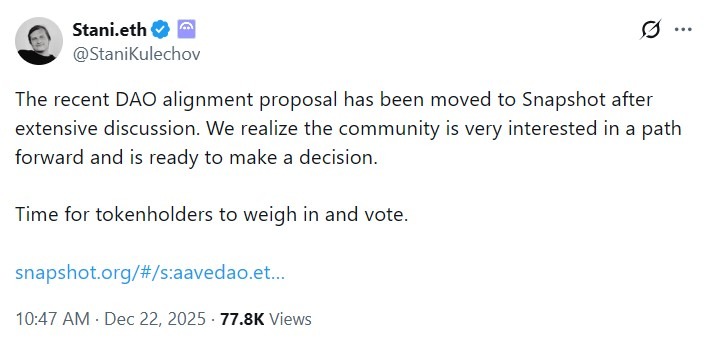
Source: Stani Kulechov

Related: SEC ends probe into Aave after four years, CEO Kulechov says

Aave Labs faces “hostile takeover” accusations

Former Aave Labs chief technology officer Ernesto Boado, whose name appears as the proposal’s author, said the vote was escalated without his consent or knowledge.

“This is not, in ethos, my proposal,” Boado wrote on X, saying that he would not have approved the submission for a vote while community discussion was still ongoing. He said the escalation breaks the code of trust in the community.

Marc Zeller, who leads the Aave Chan Initiative (ACI), said the proposal was “unilaterally escalated” despite unresolved questions from delegates and token holders.

In a public statement, Zeller said that the timing and process choices materially reduced community participation, adding that the ability of late-informed participants to mobilize or redelegate was being limited.

“What started as a push for clarity and a more fair relationship between token holders and the current stewards,” Zeller said, “is now turning into a hostile takeover attempt by Labs.”

Zeller criticized the decision of pushing the vote during the holiday period, which large stakeholders, investors and institutions have flagged as one of the “worst windows” for high-stakes governance votes.

Responding to the criticisms, Kulechov said that the discussion has been going on for five days, with many comments, and claimed that the vote complies with all the requirements.

“People are tired of this discussion and getting into a vote is the best way to resolve, this is governance end of the day,” he wrote.

The dispute highlighted deeper governance questions for Aave, one of the biggest DeFi protocols in the space.

While the proposal focuses on “soft” asset ownership, the backlash underscores how much influence can stem from control over escalation, timing and information flow.

Magazine: Bitcoin whale Metaplanet ‘underwater’ but eyeing more BTC: Asia Express

Related Questions

QWhat is the main reason for the backlash in the Aave governance vote?

AThe backlash occurred because a proposal on ownership of Aave's brand assets was escalated to a snapshot vote prematurely, bypassing governance norms and without resolving ongoing community discussions.

QWho is the author of the controversial proposal, and what was his reaction?

AThe proposal's author is former Aave Labs chief technology officer Ernesto Boado, who stated the vote was escalated without his consent or knowledge, breaking the community's code of trust.

QWhat did Marc Zeller of the Aave Chan Initiative accuse Aave Labs of attempting?

AMarc Zeller accused Aave Labs of attempting a 'hostile takeover' by unilaterally escalating the vote despite unresolved questions and limiting community participation during the holiday period.

QHow did Aave founder Stani Kulechov justify moving the proposal to a vote?

AStani Kulechov claimed the community was tired of the five-day discussion and that moving to a vote was the best way to resolve the issue, asserting it complied with all governance requirements.

QWhat broader governance issue did the dispute highlight for Aave?

AThe dispute highlighted how control over escalation timing and information flow can significantly influence governance outcomes, even for proposals focused on 'soft' asset ownership.

Related Reads

Saylor's Purchase of 1550 Bitcoin Is a Bad Trade

**Title: Saylor's Purchase of 1,550 Bitcoins Was a Bad Trade** The article critically analyzes Strategy's recent move of selling 32 bitcoins followed by a much larger purchase of 1,550 bitcoins. While appearing bullish, the author argues this trade is detrimental to MSTR shareholders. The core argument revolves around the concept of "breakeven modified Net Asset Value (mNAV)," a key metric for Strategy. To increase Bitcoin per share (BPS) for MSTR holders, Strategy must issue new shares at a premium high enough that the funds raised can buy more bitcoin than the bitcoin backing each existing share. Currently, this breakeven mNAV is estimated at 1.30. The recent trade failed on two counts: 1. The shares for the $181 million raise were issued at an mNAV *below* the 1.30 breakeven point. Selling "cheap" shares to buy bitcoin actually *reduces* BPS. 2. Only $101.3 million of the raised funds were used to buy bitcoin; the rest went to boost the company's dollar reserves. The breakeven mNAV calculation assumes *100%* of proceeds are used for bitcoin purchases. Diverting funds, even if mNAV were high, dilutes BPS. The result is an estimated 0.19% decrease in Bitcoin per share for MSTR holders. In exchange, Strategy merely extended its operational runway for its dollar reserves from ~6.3 months to 7 months. The author interprets this as Strategy prioritizing the survival and development of its STRC business over its stated core goal of increasing MSTR's BPS. This constitutes a gamble: if sacrificing MSTR value leads to improved market sentiment and a recovery in STRC's price (and thus mNAV), the whole system could work. If not, Strategy may be forced into a cycle of further diluting MSTR to stay afloat, potentially leading to deferred STRC dividends or corporate decline. The article concludes with a hope for price recovery for Bitcoin, MSTR, and STRC.

Foresight News13m ago

Saylor's Purchase of 1550 Bitcoin Is a Bad Trade

Foresight News13m ago

The AI Bear Market Lasting Two Days Is Over; Why Did Funds Buy Back Storage Stocks First?

After a severe two-day selloff in early June that erased over $1 trillion from U.S. chip stock market value, capital is flowing back first to the memory sector. The correction was not driven by a collapse in AI demand but rather a market reassessment of high expectations. Stocks like Broadcom faced selling pressure despite strong AI revenue guidance, signaling a shift in focus from who has an "AI story" to who can most rapidly translate AI demand into verifiable profits and earnings per share (EPS). Memory companies, such as Micron and SK Hynix, are leading the recovery because their EPS growth is more immediately verifiable. The AI server boom directly increases demand for high-bandwidth memory (HBM) and high-capacity server DRAM, tightening supply and driving up contract prices for conventional DRAM and NAND Flash. This price increase, coupled with a shift to higher-margin products, flows directly into near-term revenue and profitability, as evidenced in recent earnings reports. In contrast, other AI semiconductor segments like GPUs, ASICs, and optical modules, while central to the long-term AI infrastructure story, face longer and less certain paths to EPS validation. Their growth depends more on future product cycles, customer adoption timelines, and capital expenditure plans. The rebound in memory stocks highlights a market preference for assets with shorter, more transparent EPS conversion cycles following the recent de-risking phase. However, this does not negate the potential of other AI hardware segments should they provide clearer near-term order visibility. The episode has raised the validation bar for all AI-related investments.

marsbit13m ago

The AI Bear Market Lasting Two Days Is Over; Why Did Funds Buy Back Storage Stocks First?

marsbit13m ago

Monera Digital|Crypto Market May Report: Four Major Reasons Behind the Accelerated Decline

Monera Digital Crypto Market May Report: Four Key Reasons Behind the Accelerated Decline The crypto market experienced a significant downturn in May, driven by an internal liquidity crisis rather than external macro factors. Bitcoin fell from around $82,850 to $73,674, even as traditional markets rallied in the final week, highlighting a clear "liquidity transmission failure" specific to crypto. Four primary internal factors caused the accelerated sell-off: 1. **Major ETF Outflows:** U.S. spot Bitcoin ETFs saw a net outflow of $2.425 billion for the month, the third-largest monthly withdrawal since their launch. Ethereum ETFs also reversed to net outflows. This turned a key pillar of the bull run into a source of selling pressure. 2. **Holder Capitulation:** On-chain data showed textbook "surrender" patterns. The Short-Term Holder MVRV ratio fell below 1.0, indicating this cohort is now in aggregate loss. The Net Unrealized Profit/Loss (NUPL) metric also deteriorated significantly. 3. **Contagious Negative Sentiment:** The Coinbase Premium Index, which shows U.S. institutional buying/selling pressure, turned deeply negative for most of the month. This confirmed the ETF outflows and reflected a strategic shift away from crypto toward assets like U.S. Treasuries. 4. **Leverage Unwinding and Psychological Breaks:** Despite the downturn, futures open interest initially grew, signaling leveraged positioning. This culminated in a sharp deleveraging event with $307 million in long liquidations. Furthermore, the price broke below the critical $75K-$76K support zone, which is both a key gamma option level and the approximate average cost basis for major public companies holding Bitcoin, turning them from potential buyers into potential sellers. The report concludes that the market's pricing power has shifted from macro narratives to internal liquidation. While Bitcoin's 200-week moving average quantile has entered a historical "value zone" at 10.2%, this indicates a deep bear market reset is underway, not an immediate reversal. A sustainable recovery will require both a genuine improvement in the macro liquidity environment and clear signs of renewed on-chain demand, such as ETF inflows resuming and the Coinbase Premium turning positive. Until then, discipline and capital preservation are paramount.

marsbit24m ago

Monera Digital|Crypto Market May Report: Four Major Reasons Behind the Accelerated Decline

marsbit24m ago

Trading

Spot
Futures

Hot Articles

How to Buy AAVE

Welcome to HTX.com! We've made purchasing Aave Protocol (AAVE) simple and convenient. Follow our step-by-step guide to embark on your crypto journey.Step 1: Create Your HTX AccountUse your email or phone number to sign up for a free account on HTX. Experience a hassle-free registration journey and unlock all features.Get My AccountStep 2: Go to Buy Crypto and Choose Your Payment MethodCredit/Debit Card: Use your Visa or Mastercard to buy Aave Protocol (AAVE) instantly.Balance: Use funds from your HTX account balance to trade seamlessly.Third Parties: We've added popular payment methods such as Google Pay and Apple Pay to enhance convenience.P2P: Trade directly with other users on HTX.Over-the-Counter (OTC): We offer tailor-made services and competitive exchange rates for traders.Step 3: Store Your Aave Protocol (AAVE)After purchasing your Aave Protocol (AAVE), store it in your HTX account. Alternatively, you can send it elsewhere via blockchain transfer or use it to trade other cryptocurrencies.Step 4: Trade Aave Protocol (AAVE)Easily trade Aave Protocol (AAVE) on HTX's spot market. Simply access your account, select your trading pair, execute your trades, and monitor in real-time. We offer a user-friendly experience for both beginners and seasoned traders.

5.4k Total ViewsPublished 2024.03.29Updated 2026.06.02

How to Buy AAVE

Discussions

Welcome to the HTX Community. Here, you can stay informed about the latest platform developments and gain access to professional market insights. Users' opinions on the price of AAVE (AAVE) are presented below.

活动图片