a16z Weekly Chart: Tech Giants Rely on 'Side Hustle' Investments for Income, Great AI Products Can Sell Out in a Day

marsbitPublished on 2026-05-09Last updated on 2026-05-09

Abstract

a16z Weekly Charts: Four Counterintuitive Signals in Tech 1. **Super Platforms' "Other Income"**: Amazon and Google recorded exceptionally high "other income" in Q1, largely from unrealized gains in their private investment portfolios (e.g., Amazon's Anthropic stake). This contributed to over one-third of their net profit, far above the historical 5-10%. The broader trend shows tech capital expenditure is now the primary driver of US GDP growth, accounting for 55% of all business investment. 2. **AI-Generated eBook Proliferation**: Since ChatGPT's launch, monthly eBook releases on Amazon have tripled to over 300,000, flooding the platform with AI-generated content. However, research indicates this has also increased the volume of "decent" books, providing a net gain in consumer surplus by 2025. AI tools have particularly boosted productivity for established authors. 3. **Call Center Jobs Defy AI Replacement**: Contrary to predictions, call center employment in the Philippines has grown steadily from 1.15 million in 2016 to 1.9 million in 2025, with further growth projected. In the US, customer service job postings are outperforming the overall market. The key reason: the full cost of voice AI agents remains roughly equal to human agents (~$92 vs. ~$90 per day). Cases like Klarna show initial replacement can lead to quality issues and re-hiring. 4. **Rapid Adoption of AI Mobile Apps**: AI app downloads, revenue, and user time spent on mobile nearly doubled year-over-year i...

Author: a16z New Media

Compiled by: Deep Tide TechFlow

Deep Tide Intro: This week's a16z Chart covers four topics: Super platforms recorded unusually high 'Other Income' from private investments in Q1; AI-generated eBooks are flooding the market, but the volume of quality content is also growing; Employment in Filipino call centers is rising against the trend, as voice AI costs still haven't caught up with human labor; Mobile AI app downloads, revenue, and usage time have all doubled, with Codex's single-day installs surpassing Claude Code. Four charts, four counter-intuitive signals.

'Other Income': The VC Business of Tech Giants

Profit growth in the public markets is already exaggerated, and Wall Street expects it to be even higher this year.

But beneath the profit figures lies an uncommon detail: not all of the super platforms' income comes from their main businesses. In Q1, 'Other Income' accounted for a surprisingly large portion of net profit.
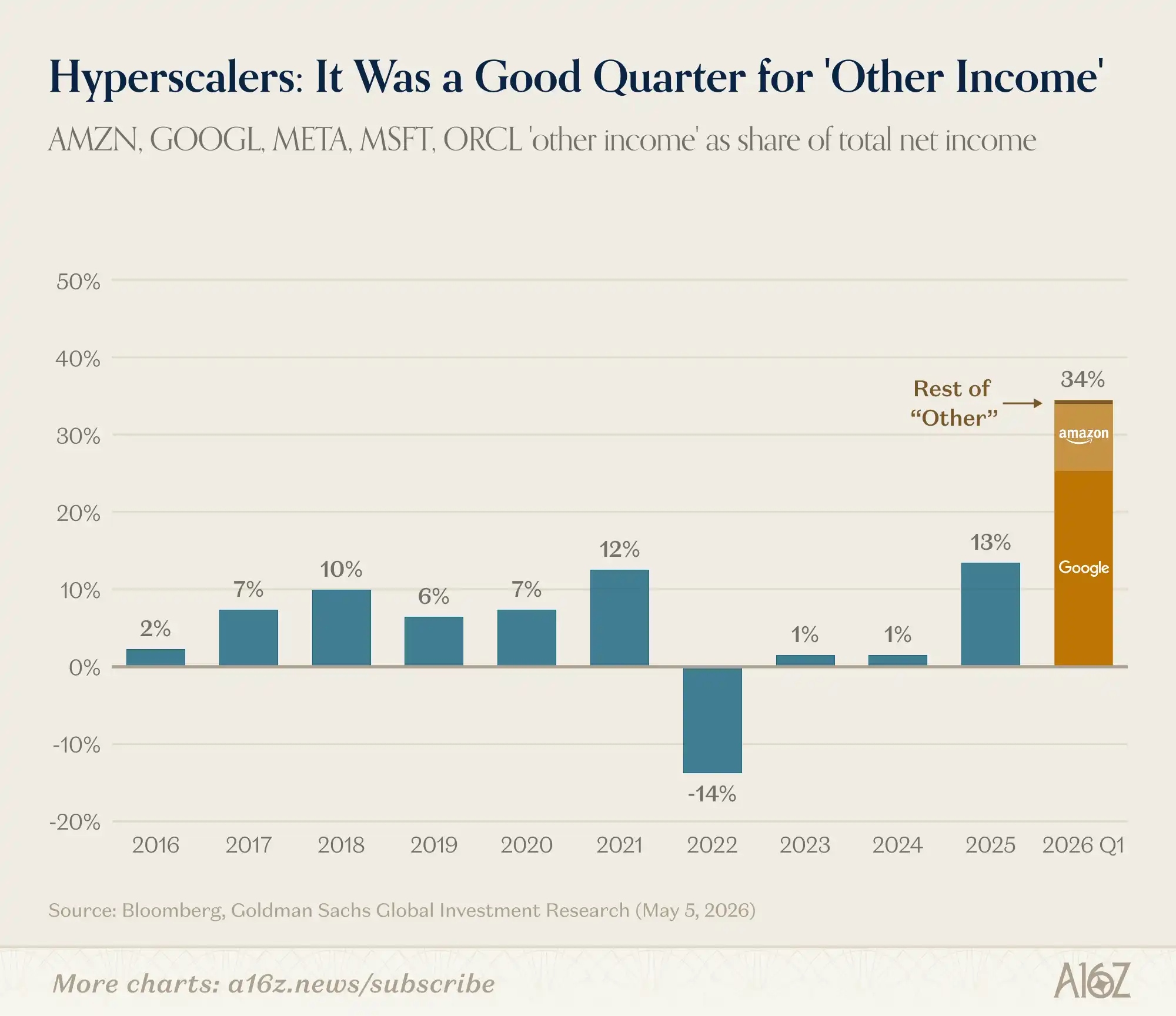
Chart Note: Super platforms' 'Other Income' as a percentage of net profit, exceeding one-third in Q1, historically around 5%-10%.

In Q1, 'Other Income' accounted for over one-third of net profit, historically this figure has been around 5% to 10%.

Where does this money come from? Primarily from private investment returns of Amazon and Google, totaling about $53 billion. Alphabet's CFO stated on the earnings call that 'other income and expense was $37.7 billion, primarily from unrealized gains on non-marketable equity investments'; Amazon disclosed a $15.6 billion net gain from its Anthropic investment in its 10-Q.

In a nutshell: Super platforms are doing pretty well as venture capitalists.

But tech investing is no longer just a game for giants. KKR estimates show that tech-related capital expenditure is currently the only category of capital expenditure driving GDP growth:
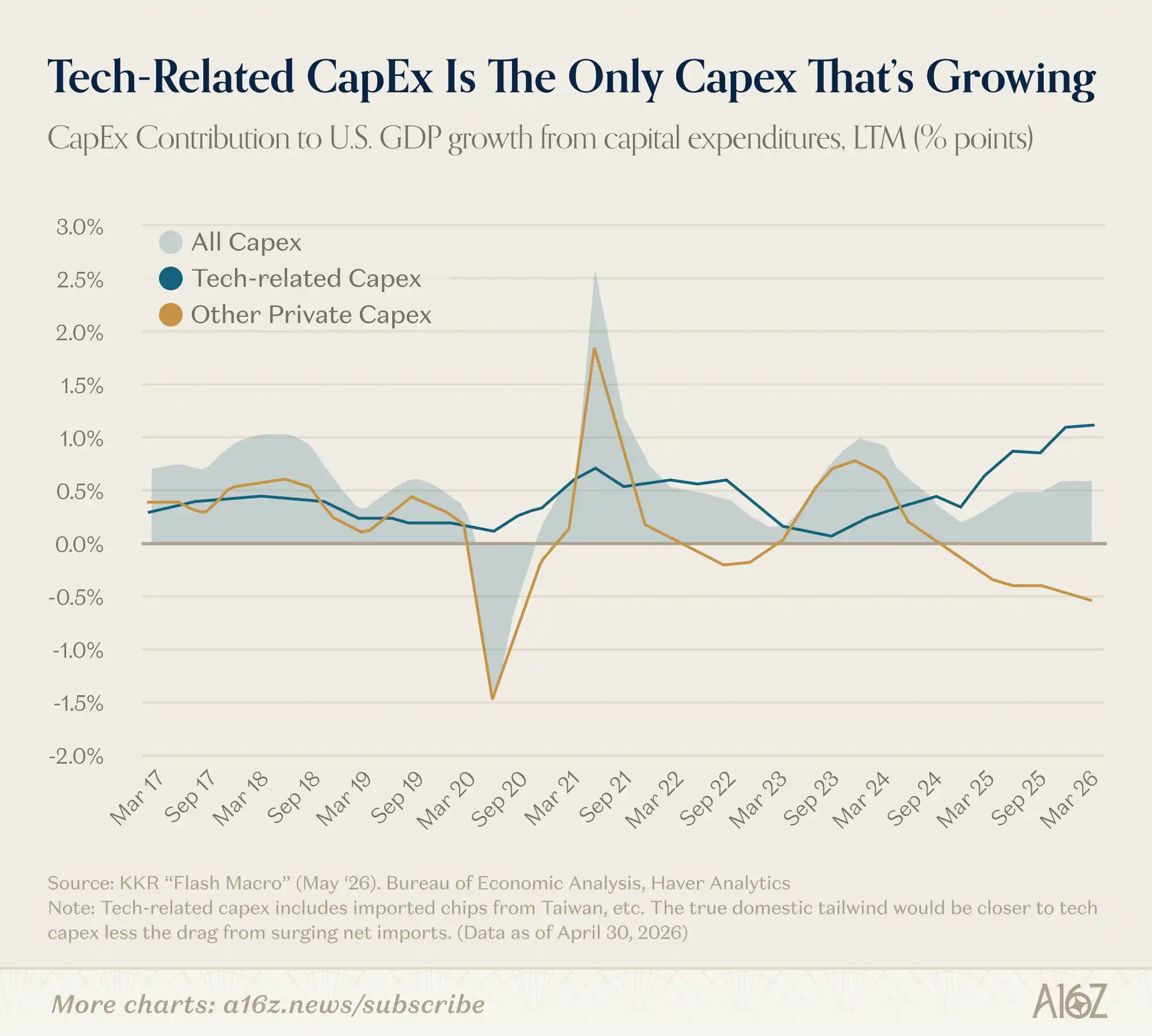
Chart Note: Of the 2% growth in US GDP in Q1, tech capital expenditure contributed 1.9%, accounting for almost all of it.

US GDP grew by 2% in Q1, with tech capital expenditure contributing 1.9%. Meaning, without tech investment, GDP would have basically stagnated.

Taking a broader perspective, according to the Bureau of Economic Analysis (BEA) statistics on total business capital expenditure (including R&D and software), tech now accounts for 55% of all US business investment:
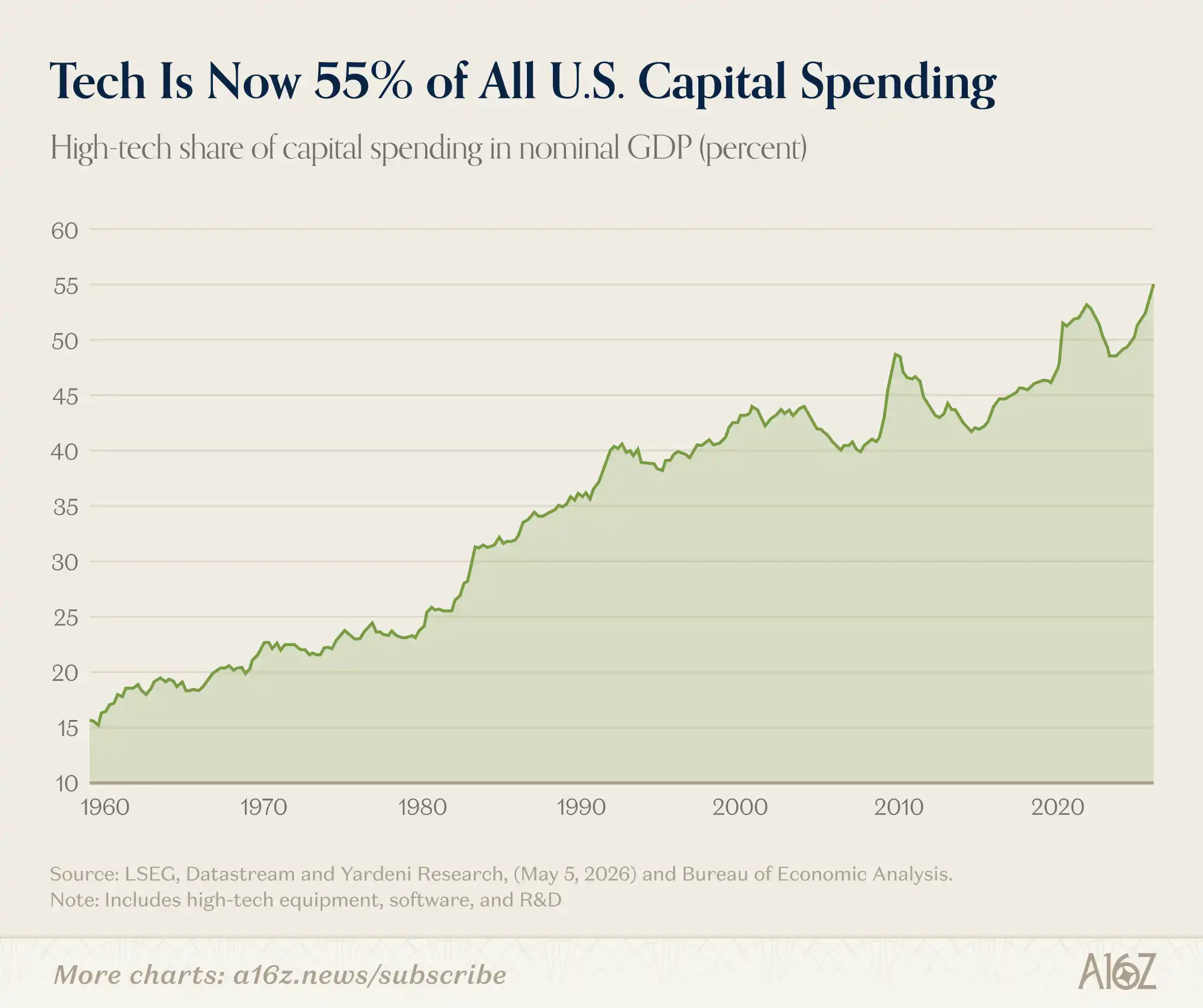
Chart Note: The share of technology in total US business capital expenditure has been climbing steadily and now stands at 55%.

This proportion has been climbing for a long time, and AI might accelerate this trend. Yardeni Research proposes an interesting framework: economics textbooks list three factors of production—land, labor, and capital. Now a fourth should be added: data. AI makes data more useful, and the more useful data becomes, the greater the demand for tools to invest in and process data.

Amazon and Google doing well as VCs is one thing. The bigger reality is: everyone is a tech investor now.

AI Junk Books Are Flooding the Market, But Quality Content Is Also Increasing

Good news: There are far more eBooks on Amazon than before. Bad news: The increase is mostly AI-generated junk.
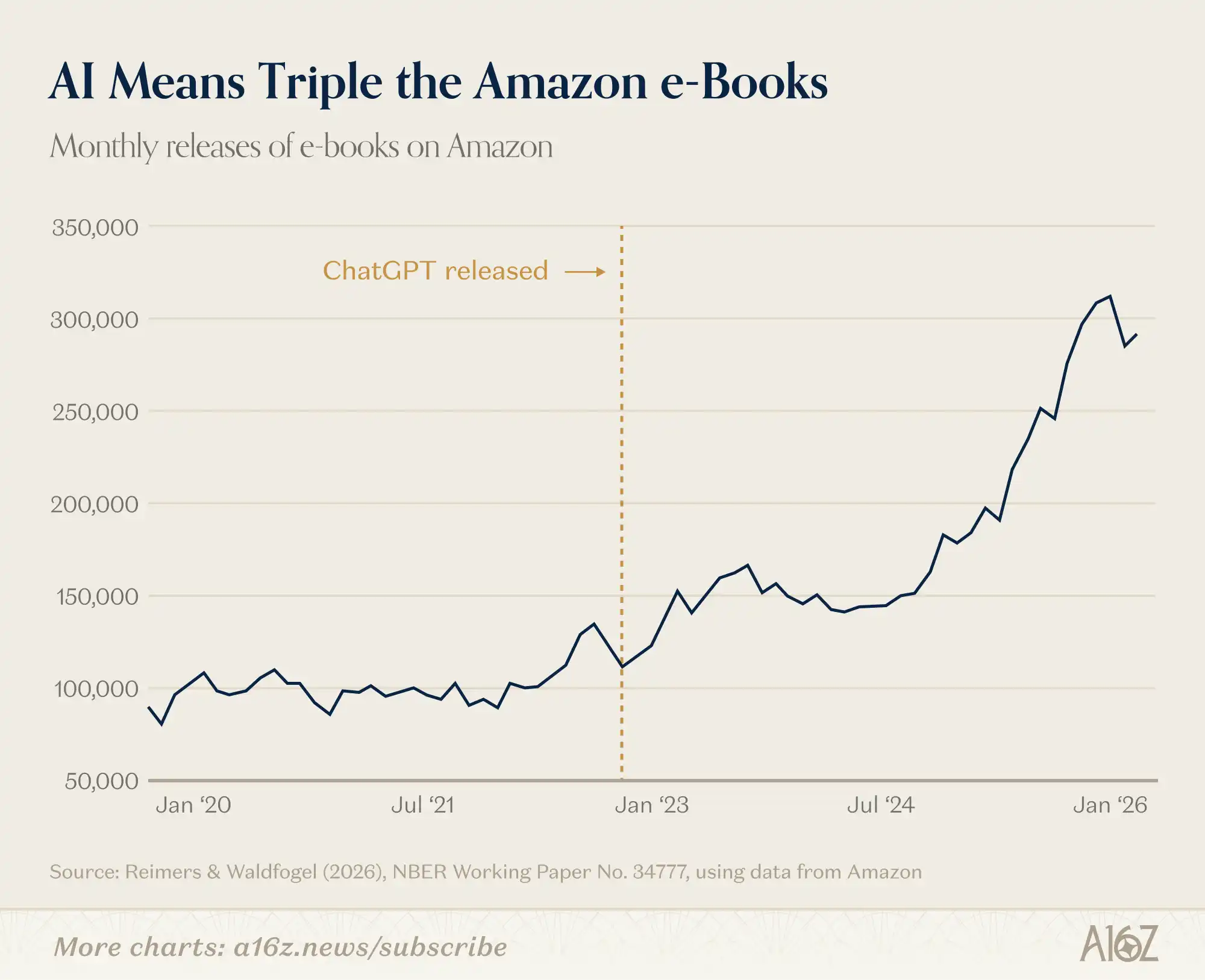
Chart Note: Monthly eBook releases on Amazon have tripled since ChatGPT's launch, exceeding 300,000 per month by late 2025.

Since ChatGPT's launch, monthly eBook releases on Amazon have increased from about 100,000 to over 300,000.

There are two ways to read this chart.

The first is intuitive: AI arrived, a tsunami of junk content followed, and Amazon is flooded with machine-generated low-quality books.

The second is more thought-provoking: Junk has indeed increased, but there are also more 'decent' books than before. A recent NBER paper by professors from Cornell and Minnesota quantified this—using a nested Logit demand model, they estimated the 2025 eBook selection set provided about 7% more consumer surplus compared to a counterfactual baseline of purely human creation. Readers in 2023 gained almost nothing, but by 2025, the gains were perceptible.

Another finding is even more interesting: AI helps 'old authors' (those publishing before LLMs) the most.
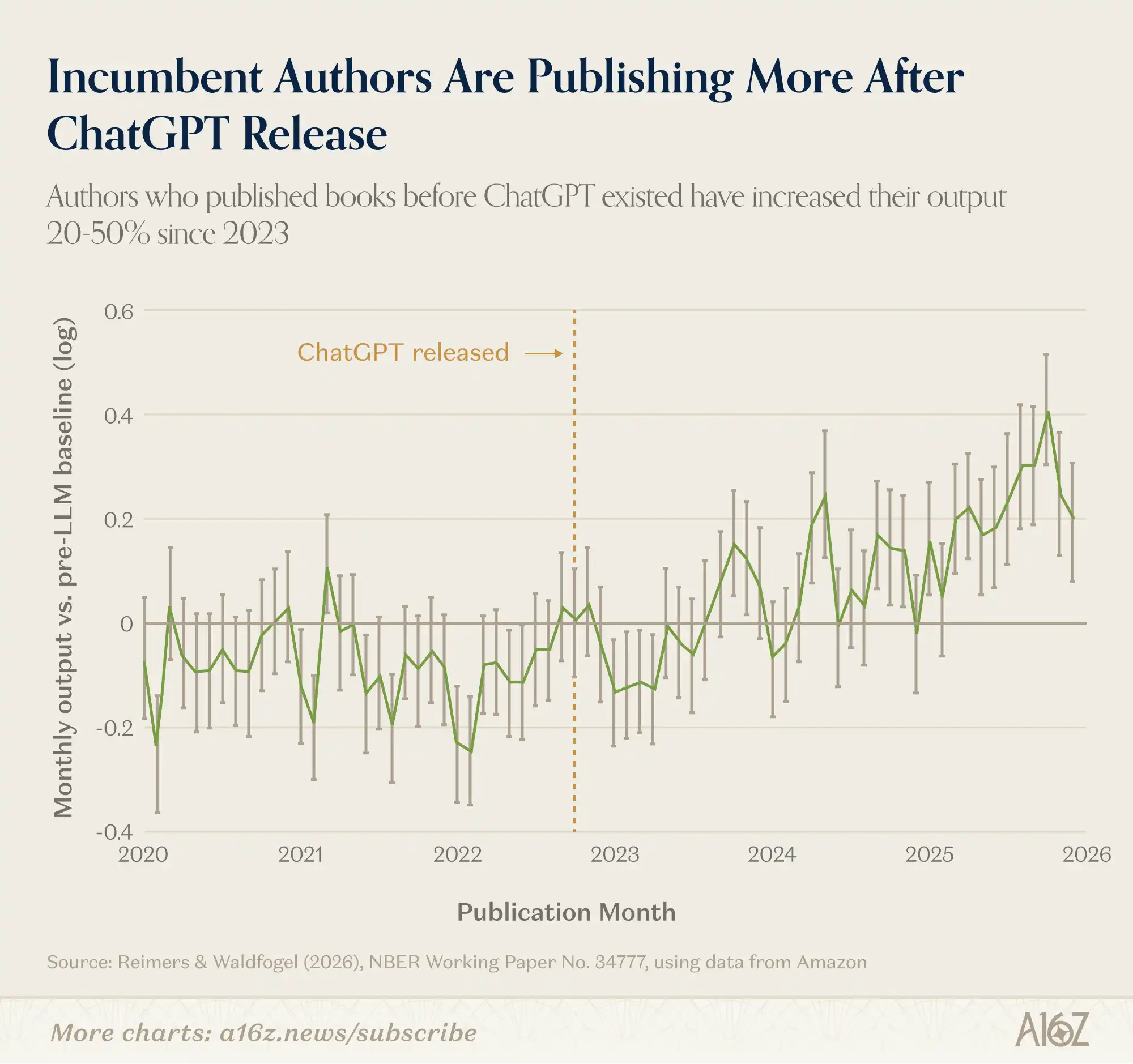
Chart Note: After 2023, output by 'old authors' (those published before LLMs) increased significantly; AI boosted their productivity.

AI didn't just create a bunch of robot authors; it also made human authors more productive.

Marc Andreessen predicted years ago on David Perell's podcast: writing is becoming too easy, so low-quality content will flood the market; but at the same time, with tools this powerful, high-quality content should also experience explosive growth. The junk is real, but the surplus value is also real. Good writers are now writing more.

Call Centers Aren't Dead, Voice AI Is Still Too Expensive

David George just wrote an article arguing that AI replacing jobs is a myth. He distinguishes between 'substitution' and 'augmentation'—customer service is the prime candidate for substitution; AI can answer all questions and has infinite patience.

The logic is sound. But the data doesn't agree.
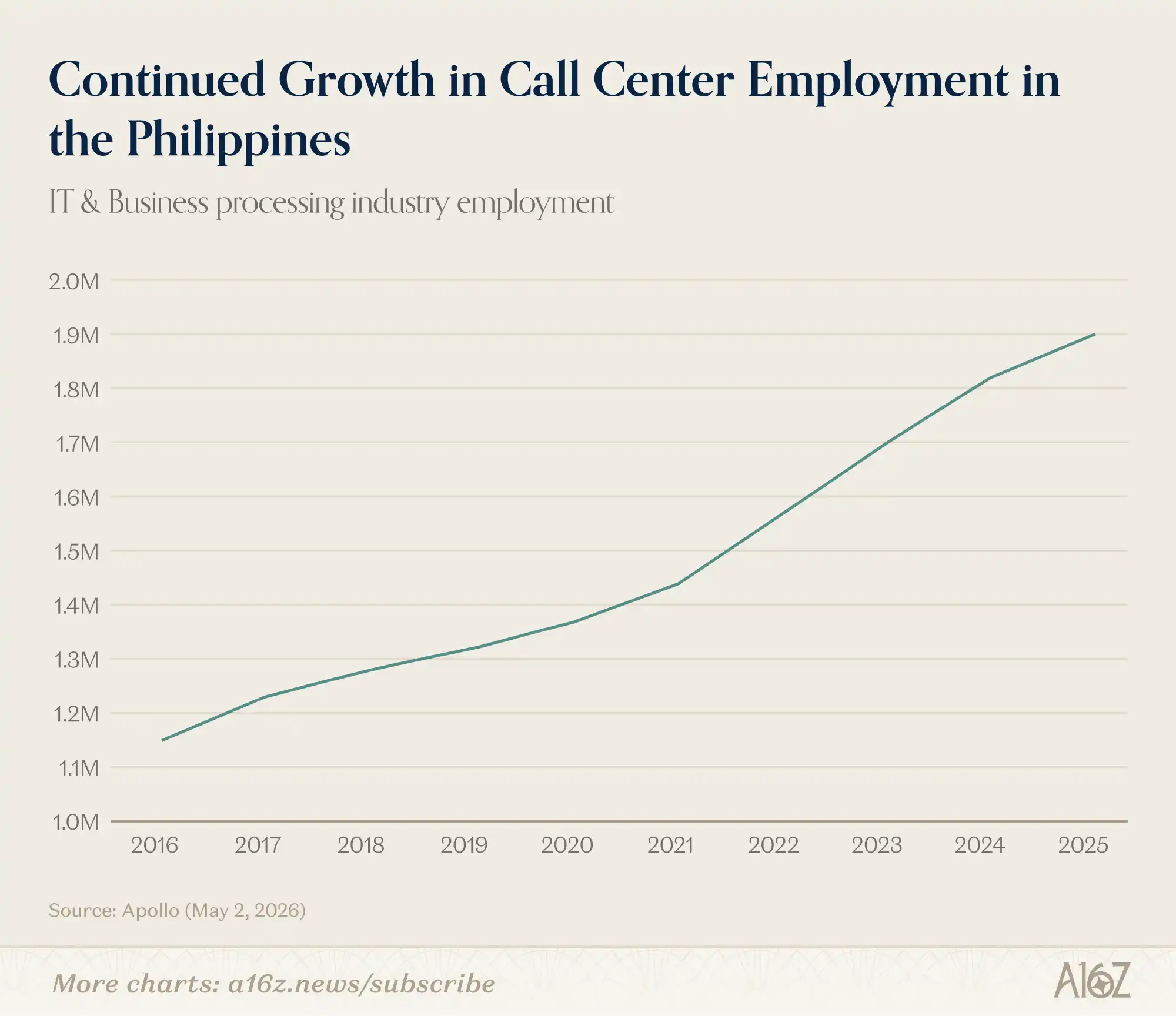
Chart Note: Employment in the Philippines IT and business process outsourcing industry grew from 1.15 million in 2016 to 1.9 million in 2025, spanning every major AI capability leap.

The Philippines is the call center capital of the world. Apollo data shows employment in the IT and business process outsourcing industry grew from 1.15 million in 2016 to 1.9 million in 2025—spanning every major AI upgrade. The industry association projects an additional 70,000 jobs in 2026, a 3.7% year-on-year increase.

The situation in the US is similar. Indeed data shows that customer service job postings haven't decreased; they're actually outperforming the broader market:
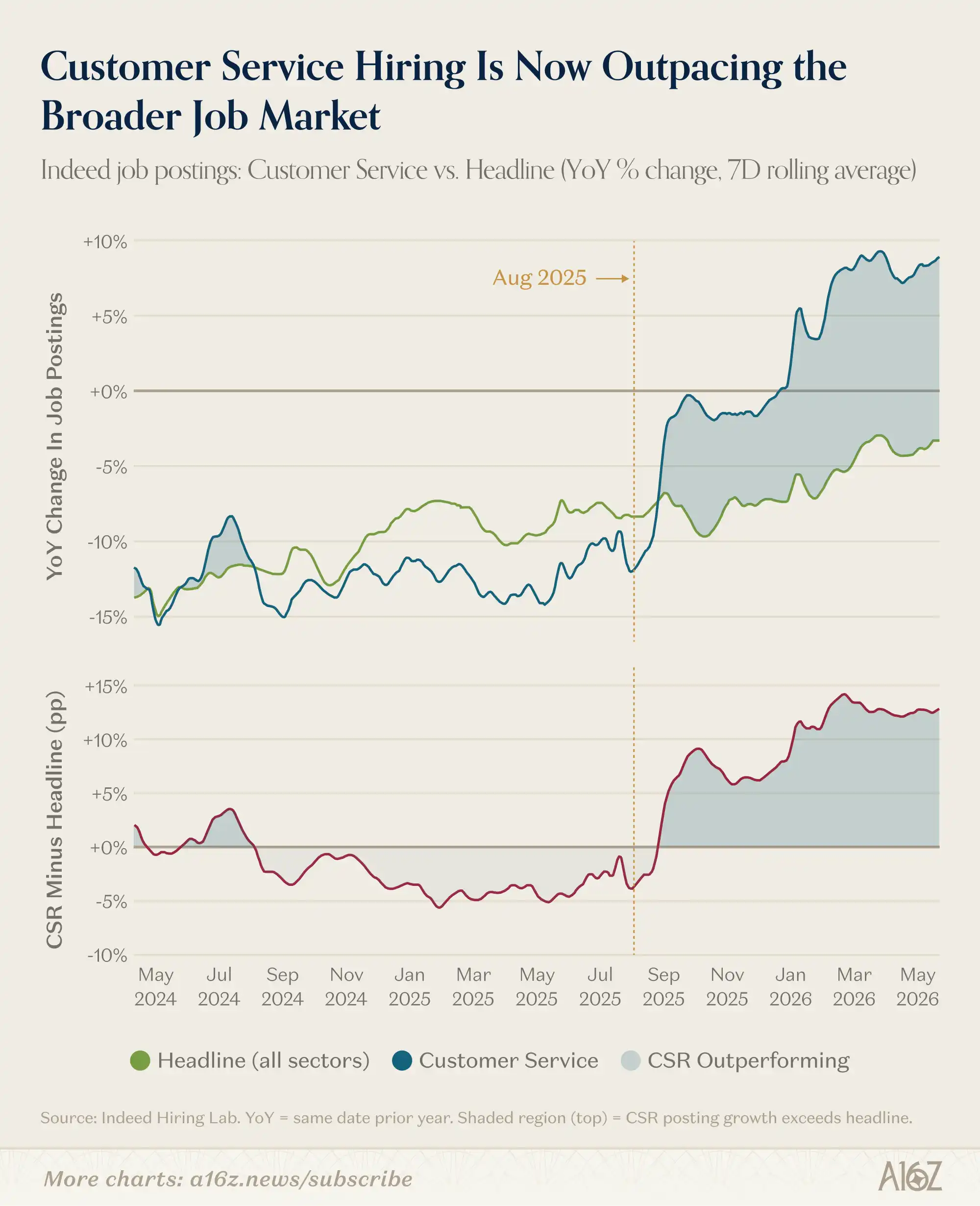
Chart Note: Indeed data shows customer service job postings' year-on-year growth rate is about 10 percentage points higher than overall hiring; the flip happened in August 2025.

The year-on-year growth rate for customer service hiring is about 10 percentage points higher than the overall job market. And this flip only happened recently, in August 2025.

Does this mean AI is actually a boon for the customer service industry? Probably not.

The core reason is cost. Text LLM output is cheap, but voice AI is still expensive. Goldman Sachs conducted an internal test comparing the total cost of AI customer service agents versus human agents:
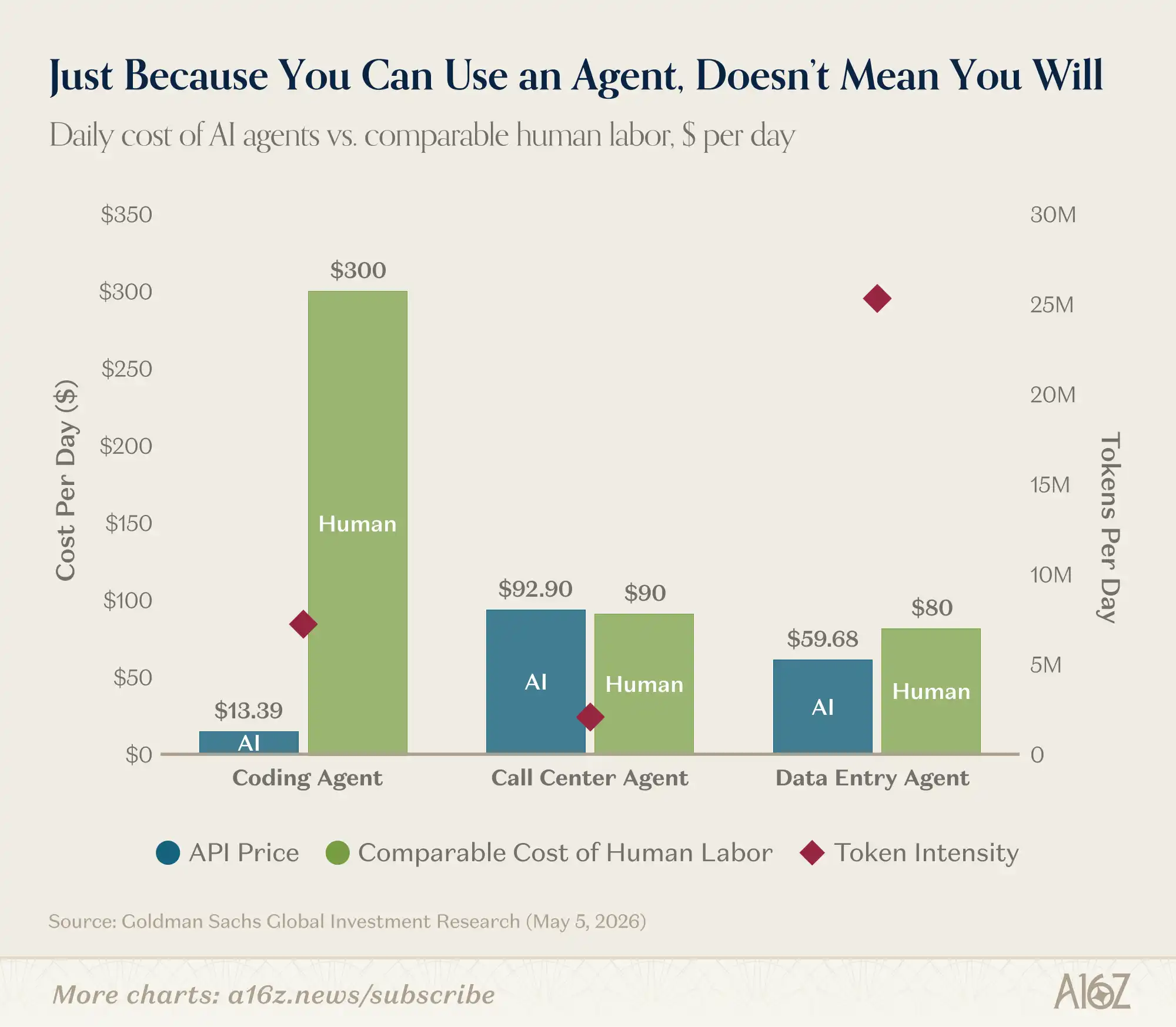
Chart Note: Goldman Sachs estimates the all-in cost of an AI agent is about $92/day, vs. a human agent at about $90/day, roughly equal.

The all-in cost for an AI agent is about $92/day, versus about $90/day for a human agent. Roughly equal. Compare this to coding agents—pure text output, costs are orders of magnitude lower than human labor. The difference between code and customer service is that the potential demand for code far exceeds that for customer service, so the leverage from cost reductions is completely different.

The Klarna story is the best footnote. In early 2024, Klarna announced replacing 700 customer service agents with AI, with the CEO saying AI was doing everyone's job. This became a benchmark case for 'AI replacing humans.' By May 2025, the CEO backtracked, starting to rehire—service quality declined, and users received cookie-cutter responses.

This situation won't last forever. API costs are falling rapidly, companies like Decagon are growing fast, and the cost comparison might look completely different in 18 months.

Great AI Products Explode Rapidly

The penetration speed of AI on mobile is astonishing:
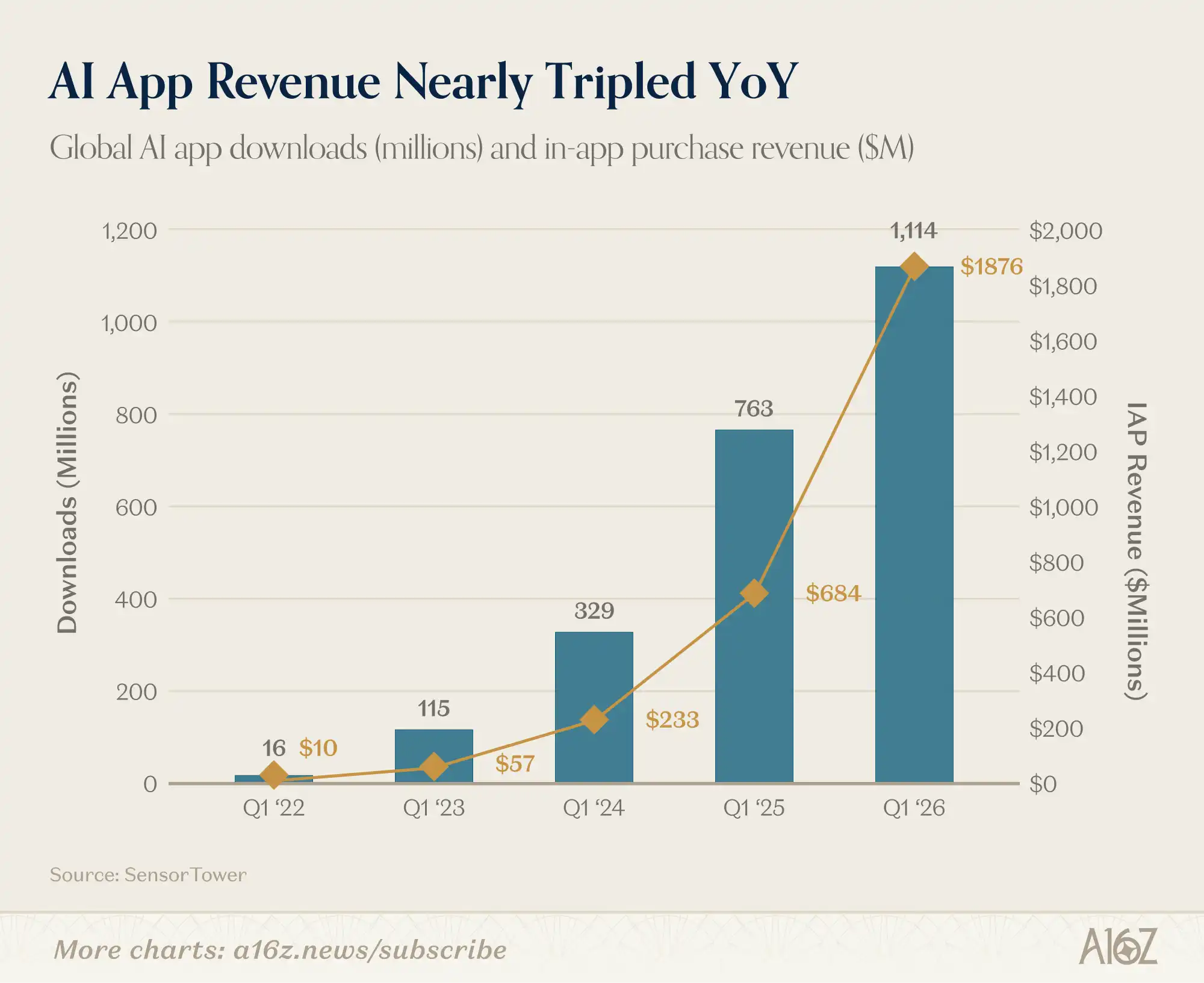
Chart Note: Q1 data for AI app mobile downloads, revenue, and usage time.
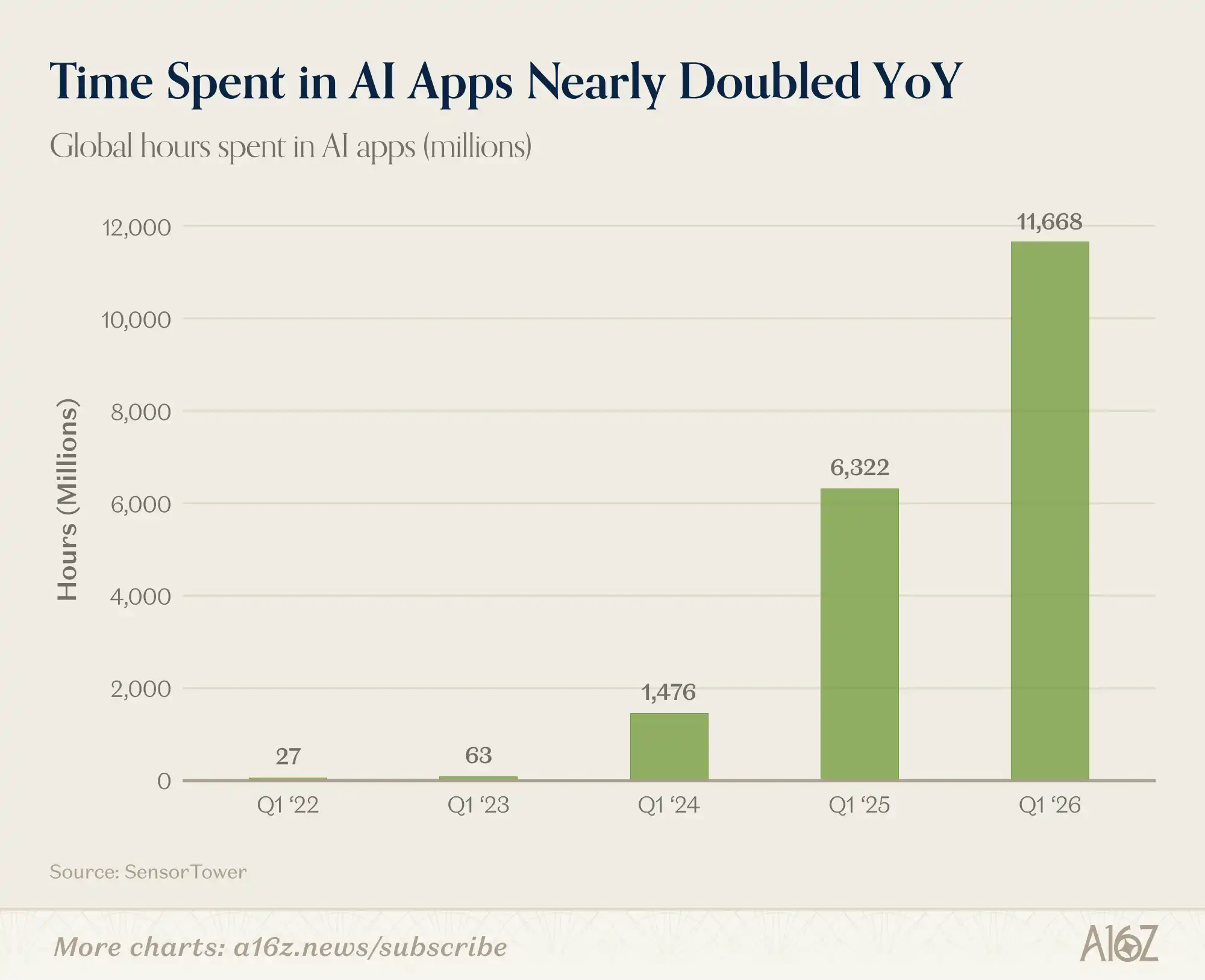
Chart Note: Monetization and usage time for AI apps nearly doubled year-on-year in Q1.

Downloads, monetization, and usage time all turned upward in Q1, with monetization and usage time nearly doubling year-on-year.

Maybe people are spending less time on social media because they're vibe coding with AI on their phones? Not necessarily a bad thing.

Speaking of vibe coding, a new contender has arrived:
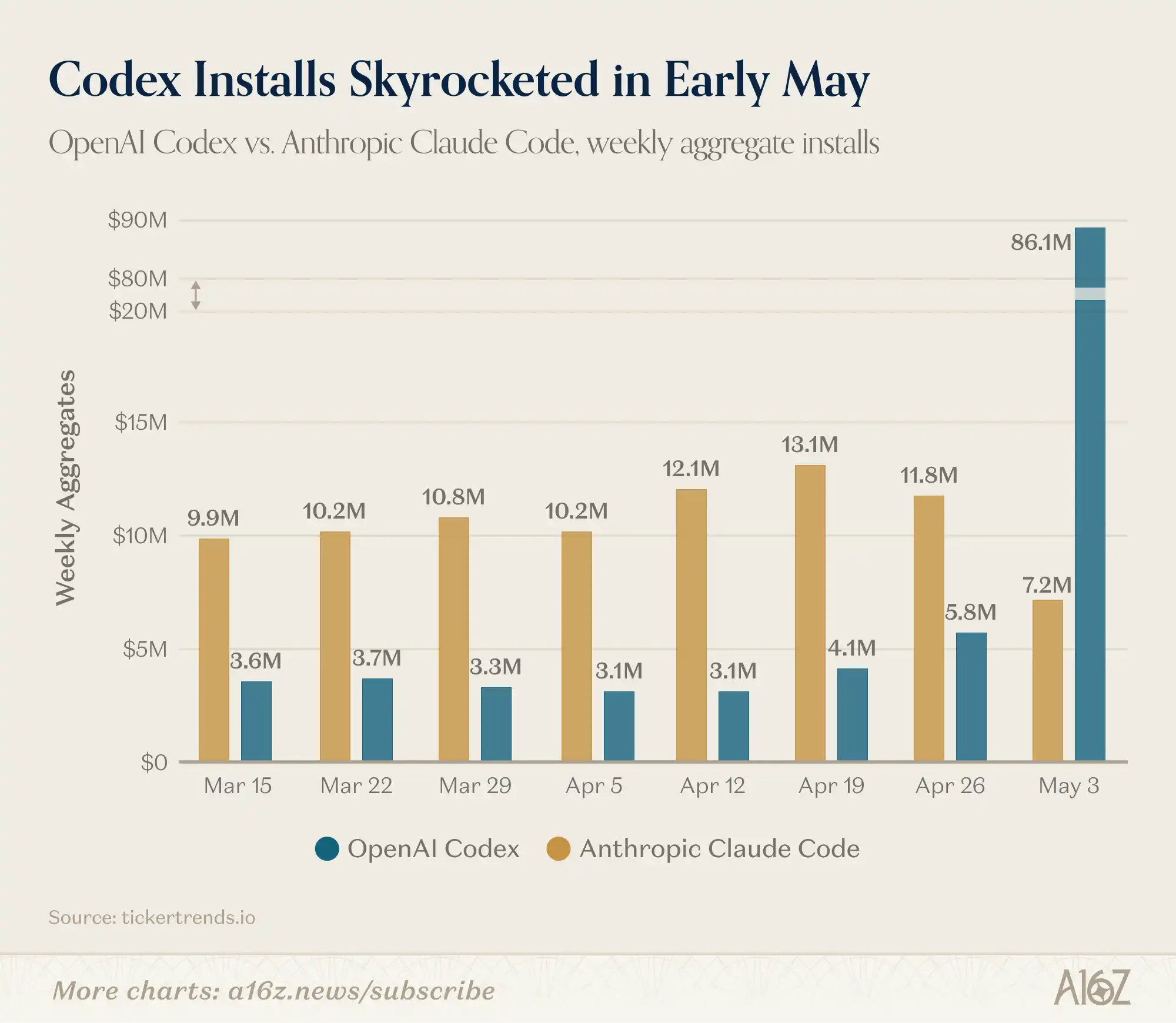
Chart Note: Codex's daily installs surged in May, exceeding Claude Code in a single day—the latter had been the king of code tools for the past year.

Codex's daily installs surged in May, surpassing Claude Code in a single day. Of course, this is just single-day data, and the base is lower, but it illustrates a point: great products spread extremely fast.

Jeff Bezos said something in 2012: You used to be able to sell a mediocre product with marketing, but that's getting harder and harder. A great product will get users to spread the word for you.

In the AI field, this logic is taken to the extreme. Signals propagate quickly, users are highly willing to switch, and no one feels loyalty to a platform or model.

The same holds true in the B2B realm:
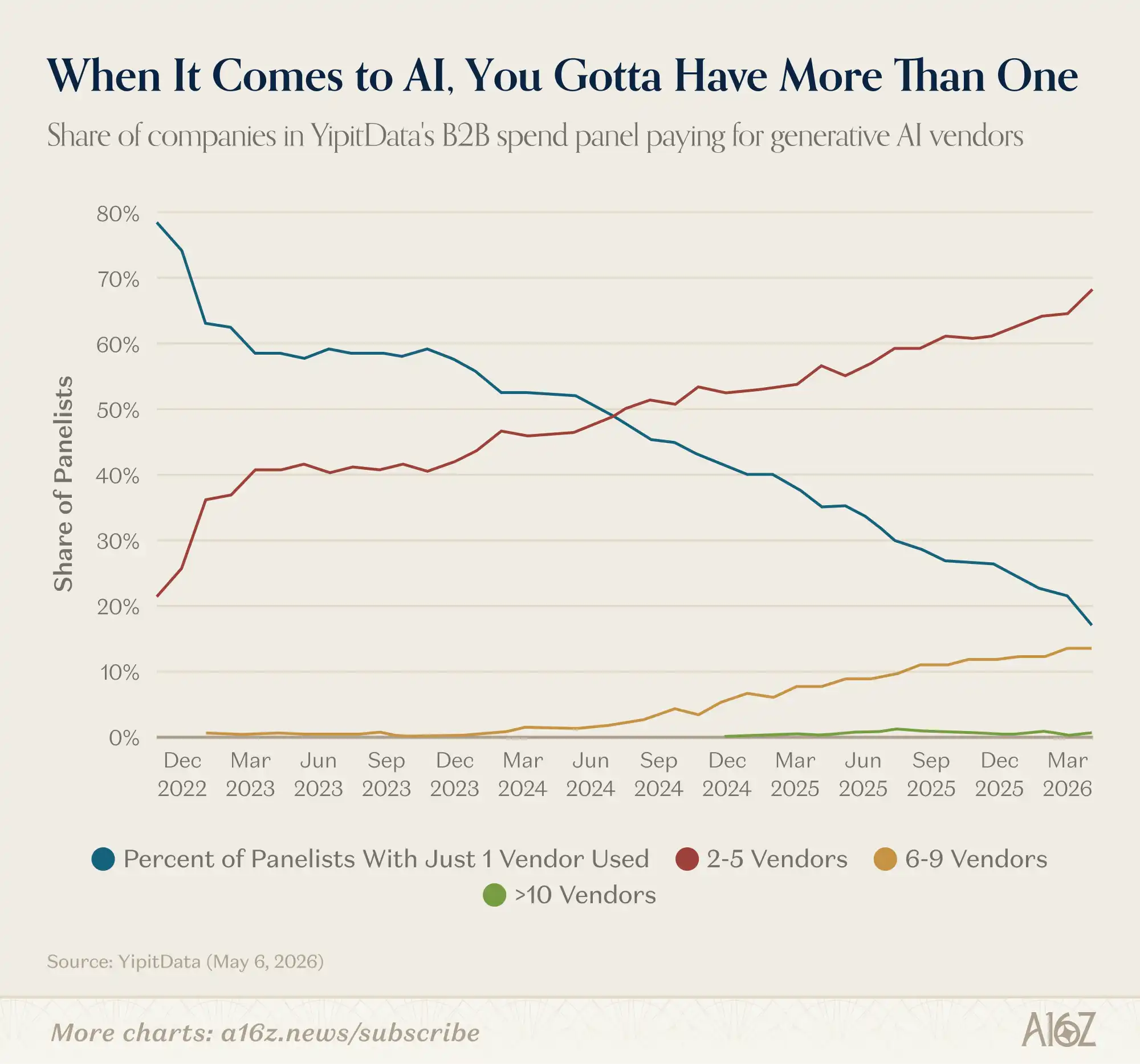
Chart Note: YipitData shows the proportion of enterprises using 2-5 and 6-9 AI vendors is rising steadily, with less than 20% using just one.

The proportion of enterprises using multiple AI vendors continues to rise, with those using just one now below 20%. The B2B AI market has no winner-take-all dynamics, for now.


Related Questions

QAccording to the article, what does the exceptionally high proportion of 'Other Income' in Q1 earnings for super-platforms mainly come from?

AThe exceptionally high proportion of 'Other Income' in Q1 earnings for super-platforms like Amazon and Google mainly comes from their private equity investment returns, specifically from unrealized gains in their non-public equity investment portfolios and investments like Amazon's in Anthropic.

QWhat are the two interpretations the article offers for the surge in e-book titles on Amazon following ChatGPT's release?

AThe two interpretations are: 1) An intuitive view that there has been a 'spam tsunami' of low-quality, AI-generated content flooding Amazon. 2) A more nuanced view that while spam has increased, the number of 'decent' books has also grown, providing measurable consumer surplus gains.

QWhy does the article suggest that voice-based AI hasn't significantly replaced human call center jobs, using the Philippines as a case study?

AThe article suggests voice-based AI hasn't significantly replaced human call center jobs because its cost is still not competitive with human labor. Goldman Sachs estimates show the all-in cost for an AI customer service agent is roughly equal to that of a human agent, making widespread replacement economically unattractive currently.

QWhat trend does the data show about the adoption and usage of AI applications on mobile devices in Q1?

AThe data shows a sharp upward trend for AI applications on mobile devices in Q1, with downloads, revenue, and user engagement (time spent) all increasing significantly. Revenue and time spent nearly doubled year-over-year.

QWhat point does the article make about enterprise adoption of AI, based on the YipitData chart showing vendor usage?

AThe article points out that the enterprise AI market is not currently a winner-takes-all market. The data shows a growing proportion of enterprises using multiple AI vendors (2-5 or 6-9), while the share using only one vendor has fallen below 20%.

Related Reads

Gensyn AI: Don't Let AI Repeat the Mistakes of the Internet

In recent months, the rapid growth of the AI industry has attracted significant talent from the crypto sector. A persistent question among researchers intersecting both fields is whether blockchain can become a foundational part of AI infrastructure. While many previous AI and Crypto projects focused on application layers (like AI Agents, on-chain reasoning, data markets, and compute rentals), few achieved viable commercial models. Gensyn differentiates itself by targeting the most critical and expensive layer of AI: model training. Gensyn aims to organize globally distributed GPU resources into an open AI training network. Developers can submit training tasks, nodes provide computational power, and the network verifies results while distributing incentives. The core issue addressed is not decentralization for its own sake, but the increasing centralization of compute power among tech giants. In the era of large models, access to GPUs (like the H100) has become a decisive bottleneck, dictating the pace of AI development. Major AI companies are heavily dependent on large cloud providers for compute resources. Gensyn's approach is significant for several reasons: 1) It operates at the core infrastructure layer (model training), the most resource-intensive and technically demanding part of the AI value chain. 2) It proposes a more open, collaborative model for compute, potentially increasing resource utilization by dynamically pooling idle GPUs, similar to early cloud computing logic. 3) Its technical moat lies in solving complex challenges like verifying training results, ensuring node honesty, and maintaining reliability in a distributed environment—making it more of a deep-tech infrastructure company. 4) It targets a validated, high-growth market with genuine demand, rather than pursuing blockchain integration without purpose. Ultimately, the boundaries between Crypto and AI are blurring. AI requires global resource coordination, incentive mechanisms, and collaborative systems—areas where crypto-native solutions excel. Gensyn represents a step toward making advanced training capabilities more accessible and collaborative, moving beyond a niche controlled by a few giants. If successful, it could evolve into a fundamental piece of AI infrastructure, where the most enduring value in the AI era is often created.

marsbit5h ago

Gensyn AI: Don't Let AI Repeat the Mistakes of the Internet

marsbit5h ago

Why is China's AI Developing So Fast? The Answer Lies Inside the Labs

A US researcher's visit to China's top AI labs reveals distinct cultural and organizational factors driving China's rapid AI development. While talent, data, and compute are similar to the West, Chinese labs excel through a pragmatic, execution-focused culture: less emphasis on individual stardom and conceptual debate, and more on teamwork, engineering optimization, and mastering the full tech stack. A key advantage is the integration of young students and researchers who approach model-building with fresh perspectives and low ego, prioritizing collective progress over personal credit. This contrasts with the US culture of self-promotion and "star scientist" narratives. Chinese labs also exhibit a strong "build, don't buy" mentality, preferring to develop core capabilities—like data pipelines and environments—in-house rather than relying on external services. The ecosystem feels more collaborative than tribal, with mutual respect among labs. While government support exists, its scale is unclear, and technical decisions appear driven by labs, not state mandates. Chinese companies across sectors, from platforms to consumer tech, are building their own foundational models to control their tech destiny, reflecting a broader cultural drive for technological sovereignty. Demand for AI is emerging, with spending patterns potentially mirroring cloud infrastructure more than traditional SaaS. Despite challenges like a less mature data industry and GPU shortages, Chinese labs are propelled by vast talent, rapid iteration, and deep integration with the open-source community. The competition is evolving beyond a pure model race into a contest of organizational execution, developer ecosystems, and industrial pragmatism.

marsbit6h ago

Why is China's AI Developing So Fast? The Answer Lies Inside the Labs

marsbit6h ago

3 Years, 5 Times: The Rebirth of a Century-Old Glass Factory

Corning, a 175-year-old glass company, is experiencing a dramatic revival as a key player in AI infrastructure, driven by surging demand for high-performance optical fiber in data centers. AI data centers require vastly more fiber than traditional ones—5 to 10 times as much per rack—to handle high-speed data transmission between GPUs. This structural demand shift, coupled with supply constraints from the lengthy expansion cycle for fiber preforms, has created a significant supply-demand gap. Nvidia has invested in Corning, along with Lumentum and Coherent, in a $4.5 billion total commitment to secure the optical supply chain for AI. Corning's competitive edge lies in its expertise in producing ultra-low-loss, high-density, and bend-resistant specialty fiber, which is critical for 800G+ and future 1.6T data rates. Its deep involvement in co-packaged optics (CPO) with partners like Nvidia further solidifies its position. While not the largest fiber manufacturer globally, Corning's revenue from enterprise/data center clients now exceeds 40% of its optical communications sales, and it has secured multi-year supply agreements with major hyperscalers including Meta and Nvidia. Financially, Corning's optical communications revenue has surged, doubling from $1.3 billion in 2023 to over $3 billion in 2025. Its stock price has risen nearly 6-fold since late 2023. Key future catalysts include the rollout of Nvidia's CPO products and the scale of undisclosed customer agreements. However, risks include high current valuations and potential disruption from next-generation technologies like hollow-core fiber. The company's long-term bet on light over electricity, maintained even through the telecom bubble crash, is now being validated by the AI boom.

marsbit7h ago

3 Years, 5 Times: The Rebirth of a Century-Old Glass Factory

marsbit7h ago

Trading

Spot
Futures

Hot Articles

Discussions

Welcome to the HTX Community. Here, you can stay informed about the latest platform developments and gain access to professional market insights. Users' opinions on the price of AI (AI) are presented below.

活动图片














