In the midst of a heated market, Vitalik has finally made his move again after two years.
Last month, Vitalik invested 16 ETH (approximately $28,000) in the first round of the CCA public auction for The Interfold on Uniswap. Prior to this, the last time Vitalik made a substantial public investment in a new project token or related asset was in November 2024, when he invested 32 ETH (approximately $107,000) in the public NFT sale of the prediction market Truemarkets.
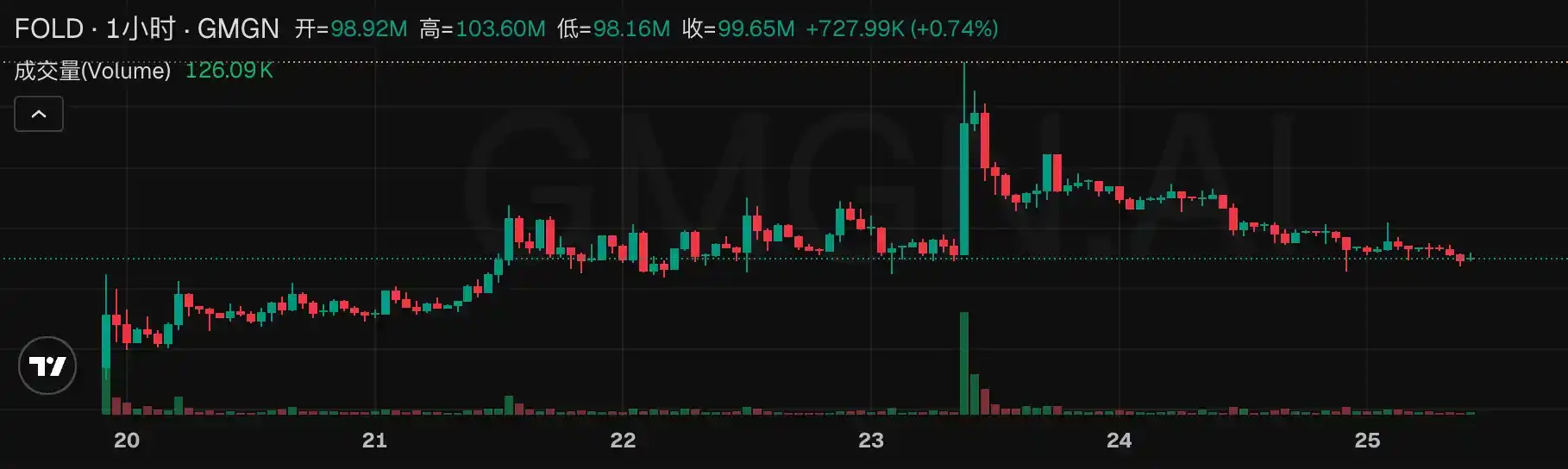
On August 19th, $FOLD underwent its TGE, subsequently skyrocketing more than 7 times at its peak. This price surge can be examined in two phases. On August 23rd, Upbit listed $FOLD, causing its price to double instantly and briefly reach a market cap of around $230 million. Before this, the momentum was almost entirely driven by the narrative 'Vitalik bought it,' with on-chain players organically building consensus around this story, pushing the coin's market cap from approximately $28 million to a high of around $140 million.
After the sudden positive news of the Upbit listing, $FOLD did not ride the market trend higher but instead retraced to levels seen before the news broke. Therefore, we can roughly say that the coin has now returned to the value range dictated by the 'Vitalik bought it' narrative:
In reality, the 'Vitalik bought it' narrative surrounding the $FOLD token is more substantial than it seems. This is a privacy-focused project, an open-source privacy protocol developed by Gnosis Guild. It enables multiple distrusting independent parties to collaboratively perform verifiable computations, yielding a shared result, without exposing their private inputs, relying on a single operator, or using trusted hardware.
For specific use cases, consider a DAO where anyone can vote privately; no one can see any individual voting record, yet everyone can verify the authenticity of the final voting result.
Encrypted data inputs are submitted to the protocol's encrypted execution environment, E3. Each computation involving encrypted data creates an independent E3. After the computation concludes, the E3 is terminated, leaving no data traces behind.
Nodes that perform the ciphertext computations and decryption need to stake $FOLD to qualify.
Compared to ZEC, ZEC itself is an asset primarily focused on privacy, whereas The Interfold is a multi-party private computation protocol that allows various parties collaborating on a task to complete it together without sharing their respective data. When imagining real-world applications, this feels quite hardcore, especially regarding the necessity for privacy protection.
In terms of how easily narratives are accepted, something like ZEC is simple: 'the private version of Bitcoin, nobody sees where my money goes.' However, understanding something like The Interfold presents a higher barrier. Vitalik directly promoted this project on X as early as the end of May this year. Just looking at his reasons for recommending it shows it's not easily grasped...
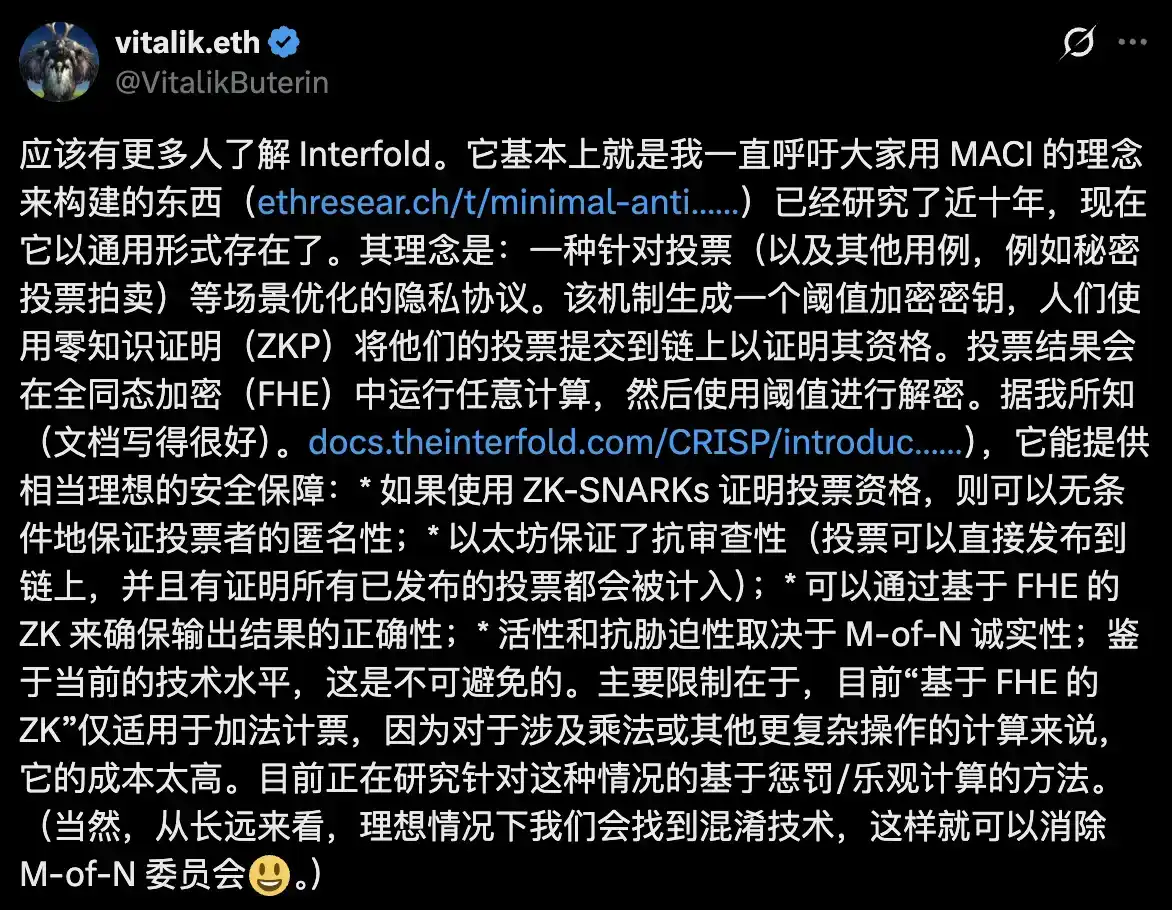
At dappcon in July this year, Vitalik mentioned the project again on stage:

Furthermore, while Vitalik invested 16 ETH in the public auction, he has not yet claimed the tokens from his participation in the sale, let alone sold any. Based on the various behaviors mentioned above, one could say players don't really care about what The Interfold can be used for. It's enough to know it's a project that Vitalik is optimistic about, has repeatedly mentioned, and has personally invested in.
As for where this token might go from here, my personal view is relatively optimistic. Firstly, it's difficult to compare it to Truemarkets, the prediction market Vitalik participated in last time. When $TRUE had its TGE last year, the market environment was incomparable to now, and $TRUE wasn't listed on any exchange, major or minor.
$TRUE's fully diluted market cap didn't break $20 million at its peak. $FOLD currently has about 27% circulating, with a circulating market cap of approximately $27 million and an FDV of around $100 million. For a project that listed on Upbit just days after its TGE, $FOLD seems to have room from this perspective.
For projects Vitalik supports with his own money, for medium-to-short-term trading, one could assume he won't sell—at least with Truemarkets, he hasn't moved his holdings, whether during the current price lows or the peak last October. The 'Vitalik bought it' narrative for $FOLD is likely to persist, especially since he himself keeps mentioning it. The probability of waking up one day to find the narrative changed to 'Vitalik sold' is indeed quite low.
Secondly, although this project is a legitimate privacy protocol, from a speculative standpoint, there's nothing wrong with approaching it with a meme coin mindset. The positive catalysts we can list now—ETH strength, overall good on-chain market conditions, Upbit listing, and Vitalik repeatedly mentioning it—are all essentially attention-driven logic. The bet is that in a generally liquid market, ETH will also have its own hotly chased asset.
The inherent complexity of its technology and use cases means that for most on-chain players, the attention-grabbing factors won't be the tech or use cases themselves, but rather the multiple attention-driven factors mentioned above.
However, with decent profit potential on Robinhood, BSC, Solana, and other chains, speculating on a project with a circulating market cap nearing $30 million, and on the Ethereum mainnet—a chain currently lacking much heat—could be seen as either getting ahead of the curve or being too niche. It's hard to judge at this point. At the current price level, while $FOLD has Vitalik's endorsement, the risk-reward ratio might not be particularly enticing either.