A High-Stakes Gamble in the Regulatory Void: Binance Fully Backs Unlicensed Stablecoin U

比推Published on 2026-01-13Last updated on 2026-01-13

Abstract

On January 13, Binance announced the listing of the stablecoin United Stables (U), launching U/USDT and U/USDC trading pairs with zero trading and leverage fees. Within 30 minutes, trading volume exceeded $4.5 million. U is issued by United Stables Limited, a BVI-registered entity, and is backed 1:1 by reserves held in a trust structure with fiat in regulated banks and digital assets with licensed custodians. It has received a custody attestation from Ceffu and a smart contract audit from PeckShield. Notably, U currently lacks regulatory approval under major frameworks like EU’s MiCA, Hong Kong’s Stablecoin Ordinance, or the U.S. GENIUS Act. Binance, though not the official issuer, is deeply integrated with U across its ecosystem—including BNB Chain, Binance Wallet, and DeFi protocols—providing liquidity and adoption support. The CEO, Athena Y, is a former Binance NFT lead and Ceffu CEO, but the project has not fully disclosed its core team or financial backing. U aims to serve as a “unified liquidity layer” rather than a direct competitor to USDT or USDC, targeting use cases in exchanges, DeFi, payments, and AI agents. As of January 13, U’s supply is around 410 million tokens with nearly 14,000 holders. It has been adopted by HTX, Aster, Lista DAO, and AEON Pay, though on-chain activity remains moderate.

Author: Nicky, Foresight News

Original Title: Is U the Stablecoin Binance Needs?


On January 13, Binance announced the listing of United Stables (U) and opened spot trading pairs for U/USDT and U/USDC, simultaneously launching zero-fee activities for these spot and leverage trading pairs. Within 30 minutes of the listing, the trading volume exceeded $4.5 million.

Against the backdrop of a highly mature stablecoin landscape and a continuously tightening regulatory environment, Binance's decision to list a new dollar-denominated stablecoin at this time carries significant implications. Since the gradual phase-out of BUSD, the compliance costs and regulatory pressures faced by centralized exchanges directly issuing stablecoins have significantly increased, while the demand for stable assets in trading, DeFi, and on-chain settlement scenarios has not diminished. How to introduce a stablecoin that is highly synergistic with its ecosystem without directly assuming issuance responsibilities has become a practical issue that exchanges must address.

The emergence of United Stables (U) may precisely meet this need. U is issued by the independent legal entity United Stables Limited, with Binance not being its legal issuer. However, the stablecoin has been rapidly integrated into BNB Chain, Binance Wallet, Binance Exchange, and multiple ecosystem protocols, making it highly tied to the Binance ecosystem in terms of usage.

Binance not only provides spot and leverage trading pairs for U but also simultaneously launches zero-fee activities to create conditions for its rapid establishment of liquidity and usage depth in the early stages.

On December 18, 2025, Binance founder CZ mentioned the latest progress of U during the "2025 Year-End Q&A AMA" hosted by BNB Chain, stating that it "has certain potential." However, the project has not disclosed any financing progress, and YZi Labs has also not disclosed relevant investment information.

United Stables (U) is issued by United Stables Limited, a company registered in the British Virgin Islands (BVI). According to the project's official website, U is pegged to the US dollar and adopts a 1:1 reserve backing mechanism. Reserve assets are custodied through an independent trust structure to achieve legal isolation from the issuer's assets. Fiat reserves are held in compliant banking institutions, while digital asset reserves are custodied by licensed custodians.
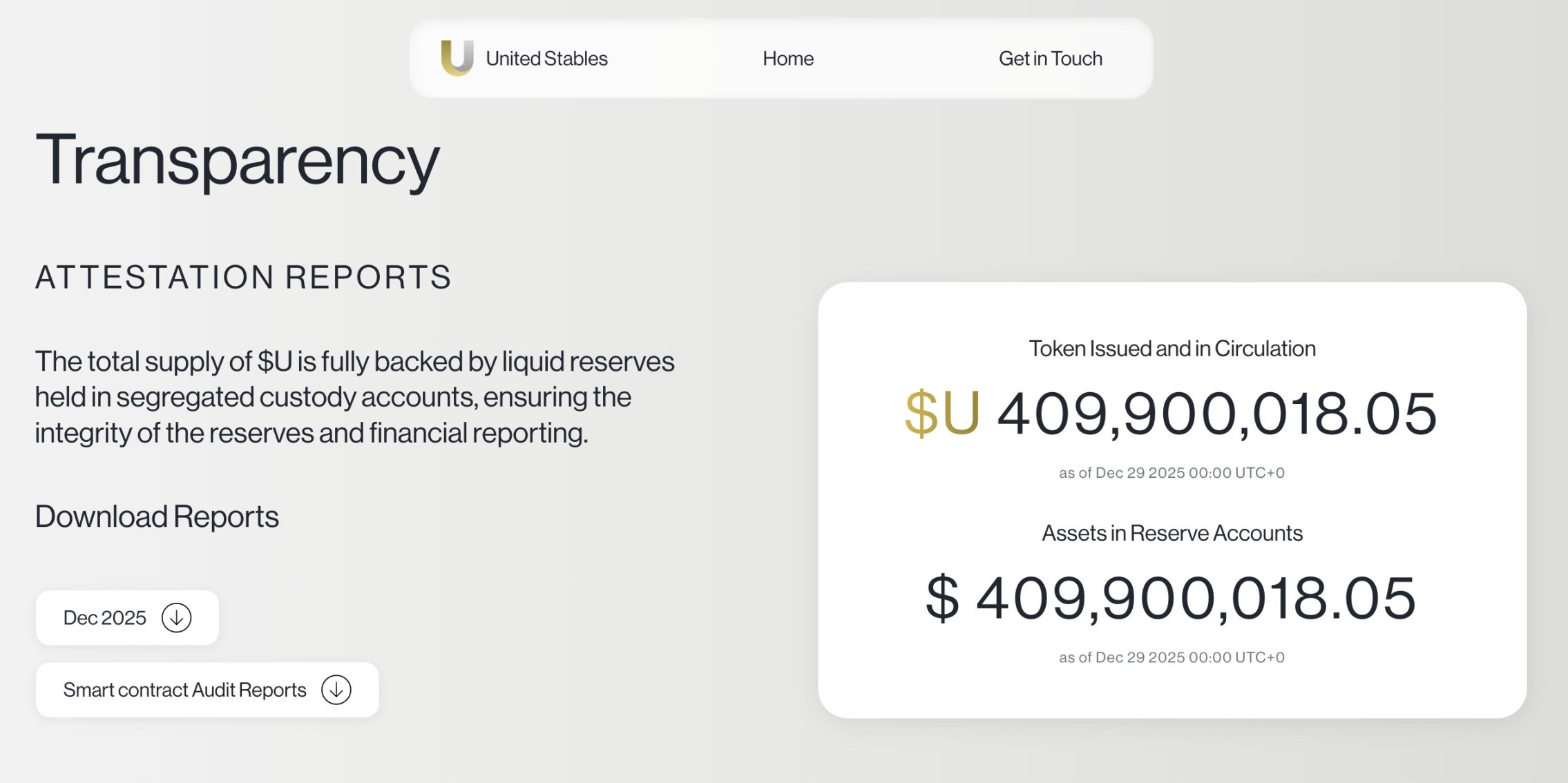
Previously, the digital asset custody platform Ceffu issued the latest custody balance proof for the project on December 29, 2025, while PeckShield has issued a smart contract audit report.

For comparison, the reserve management models of current mainstream stablecoins vary. Tether (USDT) is issued by Tether Limited, with its reserve assets primarily consisting of US Treasury bonds, money market instruments, reverse repurchase agreements, and cash. These assets are held by multiple financial institutions and custodians, and reserve proof reports issued by third-party accounting firms are regularly published. Circle (USDC), on the other hand, manages its reserves through regulated bank accounts and US-registered government money market funds, continuously disclosing reviewed or audited reserve reports.

It is important to note that United Stables Limited explicitly states on its official website that U has not been registered or licensed under the EU's MiCA, Hong Kong's "Stablecoin Ordinance," the US GENIUS Act, or any relevant US or EU securities or stablecoin regulatory frameworks. This means the stablecoin is currently not included in the regulatory systems for stablecoins in major jurisdictions.

Public information shows that its core members include Athena Y and Charles W., among others. Athena Y is currently the CEO of United Stables, previously the co-founder of the payment platform Wello, and has served as the head of Binance's NFT business and as the CEO of the institutional digital asset custody platform Ceffu. Charles W. is currently studying at the London School of Economics (LSE) and participates in the project's community communication and external collaboration as an intern at United Stables. His past experiences include internships at institutions such as Goldman Sachs and Citadel.

Further background checks on the project reveal that, apart from the public information about the CEO, United Stables has not systematically disclosed a complete management team structure, including key positions such as compliance, risk control, finance, or reserve management.

In terms of product positioning, U does not describe itself as a direct replacement for mainstream stablecoins like USDT or USDC but rather attempts to serve as a "unified liquidity layer." Its core idea is to use fiat or mainstream stablecoins for minting, providing a unified settlement and circulation vehicle for different stablecoins when used on-chain, thereby reducing the operational friction costs across protocols and scenarios. The official documentation also mentions that U's target use cases include exchanges, DeFi, payment networks, and AI automation agents, among others.

According to on-chain data, as of the time of writing on January 13, the total supply of U is approximately 410 million tokens, with nearly 14,000 holder addresses and over 1.8 million cumulative transfers.

In terms of ecosystem progress, U has been rapidly integrated into multiple applications and protocols centered around BNB Chain after its launch. On December 18, 2025, HTX listed U and opened deposit and withdrawal services, while Aster simultaneously opened the U/USDT trading pair. Binance Wallet also supported trading on BNB Chain and Ethereum networks on the same day.

On the same day, Four.Meme announced that U would be one of the stablecoins used for fundraising and trading on its platform. However, current on-chain data shows that the overall scale of Meme tokens using U as their liquidity remains limited, with UDOG leading with a market capitalization of approximately $900,000, though it was not launched on the Four.Meme platform.

In DeFi, Lista DAO has launched U vaults and multiple lending markets. As of the time of writing on January 13, the deposit scale of the U Vault is approximately 3.51 million tokens, with an annualized yield of about 3.3%. In the payment sector, AEON announced a collaboration with United Stables. Its AEON Pay already supports offline扫码 payments using U and has adopted U as a settlement asset for x402 AI-native payment and automated trading scenarios on BNB Chain.


Twitter:https://twitter.com/BitpushNewsCN

Bitpush TG Discussion:https://t.me/BitPushCommunity

Bitpush TG Subscription: https://t.me/bitpush

Original link:https://www.bitpush.news/articles/7602245

Related Questions

QWhat is the name of the new stablecoin that Binance has listed, and what trading pairs were launched?

AThe new stablecoin is called United Stables (U). Binance launched the U/USDT and U/USDC spot trading pairs.

QWhich company issues the U stablecoin, and in which jurisdiction is it registered?

AThe U stablecoin is issued by United Stables Limited, which is registered in the British Virgin Islands (BVI).

QAccording to the article, what major regulatory frameworks has U NOT obtained registration or licensing under?

AU has not obtained registration or licensing under the EU's MiCA, Hong Kong's Stablecoin Ordinance, the U.S. GENIUS Act, or any U.S. or EU securities or stablecoin regulatory frameworks.

QWho is the CEO of United Stables, and what is her previous professional background?

AThe CEO of United Stables is Athena Y. She was previously a co-founder of the payment platform Wello, served as the head of Binance's NFT business, and was the CEO of the institutional digital asset custody platform Ceffu.

QWhat is the stated goal or core idea behind the U stablecoin's product positioning?

AThe core idea is to act as a 'unified liquidity layer' by accepting fiat or major stablecoins for minting, providing a unified settlement and circulation载体 for different stablecoins to reduce friction costs in cross-protocol and cross-scenario operations.

Related Reads

Has the 'Digital Gold' Narrative for BTC Failed?

**Title: Has the "Digital Gold" Narrative for Bitcoin Failed?** The article argues that Bitcoin's "digital gold" narrative remains valid despite a recent sharp price decline (from a peak near $126k in Oct 2025 to briefly under $61k in Feb 2026). It presents a long-term investment framework based on three core points: **1. Viewing Bitcoin as an Asset:** Bitcoin is presented as a superior potential store of value compared to gold. Key arguments are its absolute scarcity (21 million cap), superior portability, and transparent auditability via its public ledger. While acknowledging its current use in early, volatile stages (~3-4% global adoption), the author draws parallels to the early, disruptive phases of the internet and e-commerce. **2. Understanding the Recent Downturn:** The current ~50% correction is framed as a predictable, consensus-driven cycle following its post-halving peak (the 2024 halving preceded the Oct 2025 high). A crucial factor is a historic "changing of hands": the influx of new institutional buyers via ETFs allowed early, low-cost holders (miners, OG believers) to take profits. The author notes that while severe, Bitcoin's historical drawdowns (e.g., 93% in 2011, 77% in 2021-22) have been progressively smaller, suggesting maturing holder structure and decreasing volatility over time. **3. The Long-Term Perspective:** The long-term thesis hinges on Bitcoin capturing a portion of gold's market value. With Bitcoin's market cap at ~$1.4 trillion (at $70k) versus gold's ~$20 trillion, significant upside potential exists if the "digital gold" narrative is partially realized. However, the author strongly cautions that short-term risks remain, the bottom is unpredictable, and high volatility is inherent. The real risk is not Bitcoin failing but poor personal position management (over-leverage, wrong capital) and a lack of deep understanding, which can force investors out during severe downturns. The conclusion uses Amazon's 95% crash post-2000 dot-com bubble and subsequent 42x recovery as an analogy. The ultimate question is not if Bitcoin's price will rise, but if an investor's strategy and conviction can withstand the volatility to see the long-term play out. The recent divergence (gold up, Bitcoin down) is posed not as a narrative failure, but as potential evidence of this ongoing, painful transition from a speculative asset to a mainstream allocation.

marsbit1h ago

Has the 'Digital Gold' Narrative for BTC Failed?

marsbit1h ago

Has BTC's 'Digital Gold' Narrative Failed?

The article discusses Bitcoin's "digital gold" narrative, its recent price drop, and long-term outlook through the perspective of "Jason". It argues the narrative is not a failure but that Bitcoin represents a superior, new asset class due to its fixed supply (21 million), portability, and auditability. The piece compares its current ~3-4% global adoption rate to early internet/e-commerce, suggesting significant growth potential. Regarding the 2025-2026 price decline (from ~$126k to briefly under $61k), the author views it as a predictable, consensus-driven sell-off within Bitcoin's ~4-year cycle post-halving, exacerbated by a major "handover" from early, low-cost holders to new institutional buyers via ETFs. A key observation is that historical peak-to-trough drawdowns have lessened over time (e.g., 93% in 2011 to ~50% in 2026), indicating maturing volatility as holder structure changes. For the long term, the author uses a simple framework: Bitcoin's total market cap (~$1.4T at $70k) is only about 7% of gold's (~$20T). Even capturing 30-50% of gold's value would imply substantial upside. However, the article strongly cautions against viewing this as investment advice, emphasizing extreme volatility and the critical importance of risk management, position sizing, and deep fundamental understanding to survive severe drawdowns. It concludes by drawing a parallel to Amazon's 95% crash in 2000 and subsequent 42x recovery, stressing that the key is surviving market cycles to realize long-term potential.

链捕手1h ago

Has BTC's 'Digital Gold' Narrative Failed?

链捕手1h ago

From Code to Cognition: A Ten-Thousand-Word Guide to the Evolution of the Robot Brain

"From Code to Cognition: The Evolution of Robot Brains" The journey of robotic intelligence has shifted dramatically from manually coded systems to AI-driven brains. For decades, robots relied on layered software stacks—perception, state estimation, planning, control—each handcrafted. While predictable, they lacked adaptability. The 2010s saw deep learning revolutionize perception (e.g., object detection) and control (via reinforcement learning), but learned skills remained narrow. The arrival of Large Language Models (LLMs) marked a turning point. LLMs acted as high-level planners, interpreting natural language instructions and generating sequences of actions for traditional robotic systems to execute. However, true integration came with Visual-Language-Action (VLA) models, which fused vision, language, and motion prediction into a single network. Pioneered by models like RT-2 and open-source projects like OpenVLA, VLAs enable robots to reason and act directly from visual input and commands. The most advanced humanoid robots now employ a "dual-brain" architecture: a slow-thinking, large VLA (System 2) for reasoning and planning, and a fast-reacting, small network (System 1) for high-frequency motion control, sometimes with an even lower-level System 0 for balance. This split balances cognition with the physics of real-time movement. Computation is split between onboard hardware (e.g., NVIDIA Jetson) for safety-critical control loops and cloud/edge servers for non-critical tasks like learning and interfaces. A crucial driver is the open-source ecosystem—models like GR00T and OpenVLA allow startups to build upon pre-trained brains and fine-tune them with their own data, accelerating development. Despite progress, current systems struggle with recovery from errors, sample inefficiency, and long-horizon tasks. This has spurred the rise of **World Models**—neural networks that predict the consequences of actions. By simulating possible futures before acting (like NVIDIA Cosmos or Meta V-JEPA), robots can plan, recover, and generalize better. This represents the next frontier: shifting intelligence from learned reactions to an internal model of physics and cause-and-effect. The field is rapidly evolving. While not yet at its "ChatGPT moment," the convergence of cheaper hardware, scalable simulation, and world models points toward robots that are increasingly capable, adaptive, and useful. The question is shifting from "what can robots do?" to "what *should* they do?"

marsbit2h ago

From Code to Cognition: A Ten-Thousand-Word Guide to the Evolution of the Robot Brain

marsbit2h ago

AI Bubble Is Bursting

The AI Bubble is Bursting: A Necessary Purge on the Path to Ubiquitous Intelligence Market volatility has reignited debates about an AI bubble, with figures like Ray Dalio pointing to high valuations. However, this parallels the dot-com bubble, which, despite its crash, laid the physical infrastructure for today's internet era. The current AI investment frenzy, with tech giants planning trillions in infrastructure spending far outstripping current AI application revenues, appears similarly imbalanced. This 'bubble' is seen as an inevitable phase for a disruptive technology, paying the "innovation tax." Critically, AI inference costs have plummeted over 99.7% since 2023, making intelligence nearly free at the margin. This hasn't reduced spending but has instead unlocked massive new demand, as seen in enterprise AI cloud expenditure tripling. This follows the Jevons Paradox: efficiency gains lead to greater total consumption. The market is now entering a cleansing phase, weeding out speculative ventures lacking real moats. The deeper shift is a move from capital expenditure (CapEx) on hardware to value creation in operational expenditure (OpEx) through AI applications that solve real industry problems. While infrastructure valuations are high, rapid earnings growth from widespread AI adoption across sectors—from manufacturing and finance to law and healthcare—may digest these valuations over time. Ultimately, this creative destruction will leave behind robust infrastructure and optimized models, cheaply powering an AI-augmented future for all industries, much as the internet became indispensable after its own bubble burst. The core productive potential remains undiminished.

链捕手2h ago

AI Bubble Is Bursting

链捕手2h ago

Trading

Spot
Futures

Hot Articles

What is BNB WHALES

Understanding BNB Whales: A Deep Dive into the Cryptocurrency Landscape Introduction to BNB Whales In the vibrant world of cryptocurrencies, new projects regularly emerge, often promising innovative solutions and unique experiences. One such project is BNB Whales, launched in 2023 and built on the BNB Smart Chain (BEP20). BNB Whales sets out to establish a distinctive presence within the cryptocurrency ecosystem, focusing on creating an engaging platform that combines the benefits of blockchain technology with social and gaming interactions. This article aims to delve deeper into BNB Whales, exploring its core components, mechanics, and developmental trajectory. What are BNB Whales? BNB Whales is a cryptocurrency initiative that seeks to provide a diverse range of features and opportunities for its users in the burgeoning Web3 environment. Utilizing the BEP20 standard, the project operates with a total token supply of 100 trillion (100,000,000,000,000,000). Despite this significant figure, it is noteworthy that no tokens are currently in circulation, indicating that the project may still be in its early developmental stages. The primary goal of BNB Whales is to create a platform where users can participate in various interactive activities while benefiting from the security and transparency afforded by blockchain technology. By fostering a unique and engaging environment, BNB Whales aims to build a strong community of users who are invested in the project and its development. Who is the Creator of BNB Whales? The identity of the creator of BNB Whales remains undisclosed at this time, presenting a challenge for those looking to understand the project's founding principles and visionary insights. This absence of publicly available information regarding the project's leadership may raise questions among potential investors and users about its governance and accountability structure. Who are the Investors of BNB Whales? As BNB Whales continues to evolve, information concerning specific investors or support from investment foundations is currently unavailable. The project’s official documentation, including its whitepaper, does not disclose either individual or institutional financial backers. The lack of transparency in this regard can sometimes raise questions about the legitimacy and sustainability of new projects within the cryptocurrency ecosystem. How Does BNB Whales Work? BNB Whales operates on the BNB Smart Chain utilizing the BEP20 standard, which is known for its efficiency and low transaction fees, attracting a variety of developers and projects. The unique aspect of BNB Whales lies in its focus on creating a community-driven platform. While precise operational details are scarce, the project emphasizes interaction and engagement, potentially incorporating gamified elements into its offerings. The emphasis on community is pivotal, as it aligns with prevailing trends in the cryptocurrency space, where user input and participation often dictate a project's success. Further innovation may be anticipated, but at present, the specific mechanisms and features that differentiate BNB Whales from other crypto initiatives remain to be fully elucidated. Without detailed information regarding its functionality, it is challenging to evaluate the project's differentiators comprehensively. Timeline of BNB Whales The development of BNB Whales has unfolded across key milestones, marking its journey in the cryptocurrency landscape. Below is a timeline of significant events pertaining to the project: 2023: Launch of BNB Whales, marking the project's entry into the market. 2023: Publication of the project's whitepaper, which lays out the overarching goals and operational framework. Ongoing: BNB Whales continues to develop its features, aiming to build a robust user base and expand its offerings. Key Points About BNB Whales Platform: BNB Smart Chain (BEP20) Total Supply: 100 trillion tokens (100,000,000,000,000,000) Circulating Supply: 0 tokens (indicating a nascent stage) Project Goal: To foster an engaging cryptocurrency platform for interaction and community building. Creator: Unknown Investors: Not disclosed Operational Status: Active with ongoing development and expansion Conclusion As BNB Whales navigates the competitive cryptocurrency landscape, it offers a glimpse into the potential of community-driven projects built on the foundations of blockchain technology. By focusing on engagement and interaction, the initiative stands at the forefront of innovation in the Web3 space. However, the project's success ultimately hinges on the clarity of its operational mechanics, the disclosure of its governance, and the establishment of a solid user community. For potential users and investors alike, BNB Whales represents a case study in the evolving nature of cryptocurrency projects—one that illustrates both the exciting possibilities and the complexities associated with new initiatives. As the landscape continues to evolve, it will be essential to monitor BNB Whales' progress and its impact on the broader cryptocurrency ecosystem.

3.5k Total ViewsPublished 2024.04.01Updated 2024.12.03

What is BNB WHALES

What is PONKE BNB

Ponke BNB: A New Approach in the Cryptocurrency Space Introduction Ponke BNB, a newcomer in the cryptocurrency arena, was launched in 2024 and operates on the BNB Smart Chain (BEP20) platform. This innovative project seeks to build a distinctive and engaged community, focusing on sustainable reward generation. As the cryptocurrency landscape evolves, Ponke BNB aims to address critical issues surrounding reward sustainability, making it a project worth observing for enthusiasts and investors alike. What is Ponke BNB? At its core, Ponke BNB is a cryptocurrency designed specifically for the BNB Smart Chain ecosystem. Boasting an immense total supply of 370,000,000,000,000,000 tokens, it is worth noting that currently, there are no tokens in circulation. The guiding mission of Ponke BNB is to foster a sustainable reward system that mitigates the challenges associated with rewards depletion, a common pitfall in many cryptocurrencies today. The mechanics of Ponke BNB's functionality centre around encouraging user participation, while simultaneously providing rewards that can stand the test of time. The unique structure of its reward system is aimed at ensuring longevity and stability, addressing essential market concerns. Who is the Creator of Ponke BNB? Despite extensive exploration, the identity of Ponke BNB's creator remains unknown. There is a notable absence of publicly available information regarding the project’s founder or its development team. This anonymity, while not uncommon in the cryptocurrency space, raises some questions about transparency and accountability in project management. Who are the Investors of Ponke BNB? Similar to the lack of clarity surrounding its creator, there is no public information available regarding any investment foundations or organizations that support Ponke BNB. This absence of investor data can often breed uncertainty among prospective investors, who typically prefer a clear understanding of the backing behind cryptocurrencies they consider engaging with. How Does Ponke BNB Work? Ponke BNB stands out through its inventive two-layered sustainable reward generating system. This system is built to tackle the issue of rewards depletion effectively. By engaging users and creating a vibrant community, Ponke BNB seeks to provide a stable and enjoyable environment, which emphasizes user interaction and rewards. The operation framework of Ponke BNB encourages participation through various activities and challenges that are designed to incentivise users while ensuring that the reward system remains sustainable. It aims to stimulate the community and promote an engaging atmosphere where members can feel valued and appreciated. Timeline of Ponke BNB The evolution of Ponke BNB can be summarized through a few key milestones: 2024: The inception of Ponke BNB on the BNB Smart Chain (BEP20) platform marked a significant entry into the cryptocurrency market. 2024: The release of the project’s whitepaper and official website provided comprehensive insights into Ponke BNB’s goals and objectives, forming the foundation for its community-driven approach. Key Features of Ponke BNB Ponke BNB is built on several key features that set it apart from other cryptocurrency projects: Sustainable Reward System The two-layered reward system is designed to foster engagement, prevent depletion of rewards, and ensure the longevity of returns for participants in the Ponke BNB ecosystem. Community Engagement The project places a strong emphasis on active community engagement, driving participation through activities designed to create a social and collaborative environment. This community-centric approach empowers users to have a hand in shaping the project's future directions. BNB Smart Chain Integration Operating on the BEP20 platform, Ponke BNB is reinforced by the security and efficiency offered by the BNB Smart Chain. Users benefit from fast and cost-effective transactions, positioning Ponke BNB well within the broader cryptocurrency ecosystem. Conclusion In summary, Ponke BNB is an emergent cryptocurrency project aiming to carve a niche for itself in the growing digital currency landscape. With its focus on a sustainable reward system and community engagement, it presents a fresh outlook in an otherwise volatile sector. While uncertainties linger concerning the project's creators and investors, Ponke BNB continues to strive for transparency and innovation. As the cryptocurrency market continues to develop, Ponke BNB’s principles of sustainability and community-driven dynamics place it in a promising light for future observers and participants alike.

3.4k Total ViewsPublished 2024.04.01Updated 2024.12.03

What is PONKE BNB

What is BNB CARD

Understanding BNB Card: Revolutionizing Digital Identity in Web3 In the rapidly evolving landscape of blockchain technology and cryptocurrency, the BNB Card or $BNBCARD stands out as a noteworthy project. This community-driven utility meme token leverages the BNB Smart Chain (BSC), aiming to integrate meme culture with innovative digital identity solutions. As more users dive into the realms of decentralization, it is crucial to dissect what BNB Card offers, its operational nuances, and its potential market impact. What is BNB Card ($BNBCARD)? At its core, BNB Card represents a meme token with substantial utility. It is designed to empower users by enabling the creation of personalized digital identity cards that are both expressive and functional. The project encapsulates several key features: Customizable ID Cards: Users have the ability to design Binance-themed digital ID cards, providing them with a platform for self-expression and enhanced community interaction. Decentralized Framework: Developed on the BSC, BNB Card emphasizes key attributes such as security, transparency, and user sovereignty. The decentralized nature of the framework allows for transactions that are both efficient and secure. Community-Centric Model: The emphasis on grassroots participation rather than laboratory-driven financial models creates an engaging environment for its users. By leveraging the inherent virality of meme culture, BNB Card fosters a robust community movement. The primary goal of BNB Card is to democratize digital identity tools in Web3, offering accessible solutions that benefit the users without the encumbrances typically associated with traditional identity management systems. Creator and Investors When exploring the identity behind BNB Card, it is important to note that no singular creator is explicitly credited. Instead, the project appears to be community-driven, suggesting a collective effort inspired by the notion of Binance's “Early Builder Card.” This organic development approach is common among projects within the meme token spectrum, where development is often influenced by the community's passion rather than a central authority. In terms of investment, the absence of publicly disclosed institutional backers further highlights the project's grassroots foundation. It thrives on organic community support, reflecting a usual characteristic of meme-driven projects that often engage their audience through social channels rather than formal investment routes. How It Works BNB Card employs several mechanisms that delineate its functioning and innovative spirit: Token Utility: The BNBCARD token allows users access to a suite of ID creation tools while also providing a platform for community governance. The token serves as the linchpin that enables these functionalities. Blockchain Integration: By utilizing the BSC, BNB Card ensures compatibility with Ethereum Virtual Machine (EVM)-based applications. This integration provides users with the benefits of low transaction fees while enhancing accessibility. DIY Ecosystem: Central to BNB Card’s appeal is its do-it-yourself (DIY) approach to digital identity card generation. This participatory element encourages users to engage in creative expression, fostering an inclusive culture that thrives on contribution and collaboration. Timeline Chronology is vital to understanding BNB Card's trajectory. Important milestones in the project’s history include: March 18, 2025: BNB Card was listed on LBank, marking a significant step in its exchange journey and opening doors for liquidity and user accessibility. March 19, 2025: A pivotal moment occurred as the token experienced an astronomical surge of 26,000% within 24 hours, garnering attention for its potential and the community’s enthusiasm. Ongoing Developments: The project is continuously expanding its partnerships with decentralized exchanges (DEXs) like PancakeSwap, further enhancing liquidity and user engagement. Innovation and Differentiation Understanding what sets BNB Card apart involves deeper exploration into its innovative framework: Meme-Utility Hybrid: BNB Card successfully merges the playful allure of meme culture with practical applications in digital identity management. This niche approach effectively caters to a broad demographic, appealing to both tech-savvy users and those new to crypto. Decentralized Governance: Operating devoid of centralized control allows the project to harness community input directly. The collective decision-making process buoyed by community involvement empowers users, ensuring their voices contribute to the development and direction of the project. Scalability: BNB Card stands to benefit immensely from the 2025 roadmap upgrades to the BNB Chain, which include enhancements such as increased transaction speeds and the integration of artificial intelligence tools. These improvements position the project advantageously within a highly competitive environment. Conclusion BNB Card is emblematic of a new wave of digital identity solutions within the Web3 ecosystem. By blending fun, community engagement, and practical utility, it invites users to participate actively in shaping their digital personas. As the project navigates the dynamic cryptocurrency landscape, its success will likely hinge on maintaining strong community support while adapting to technological advancements and user needs. The integration of decentralization with meme culture serves not only as a means for user-driven engagement but also as a foundation for the evolving narrative surrounding digital identity in the age of blockchain. In summation, BNB Card not only exemplifies the convergence of creativity and utility within the crypto space but also underscores the importance of community in steering the future of decentralized technologies.

3.8k Total ViewsPublished 2025.03.26Updated 2025.03.26

What is BNB CARD

Discussions

Welcome to the HTX Community. Here, you can stay informed about the latest platform developments and gain access to professional market insights. Users' opinions on the price of BNB (BNB) are presented below.

活动图片