A Critical Review of Base Co-founder's "Letter of Self-Criticism"

marsbitPublished on 2026-07-17Last updated on 2026-07-17

Abstract

Yesterday, Base co-founder Jesse Pollak published a self-critical post on X, reflecting on Base's successes and failures over the past two years. While his candor is commendable, the author argues his analysis still misses key points. Jesse admitted his primary mistake was heavily betting that onchain social platforms (like Farcaster) and creator tokens would drive mainstream crypto adoption. The author harshly criticizes this strategy, giving it a "0/100" score. They argue onchain social offers no superior user experience, and creator tokens, like Jesse's own $JESSE, fail to solve fundamental issues about value and creator adoption, unlike successful memecoins on other chains. The author is more forgiving regarding Base lagging in areas like perpetual DEXs and prediction markets, giving this an "80/100". They note strong competitors like Hyperliquid had unique advantages, and Base has found significant success in other narratives like AI and RWA. The author gives Jesse's overall reflection a "60/100" or passing grade. While Jesse now correctly sees multiple paths to adoption (stablecoins, payments, AI Agents) beyond just social, he, along with other industry leaders like Toly and Vitalik, still underestimates the powerful role of memecoins in driving mainstream awareness and adoption. The critique concludes that leaders often leverage memes for user acquisition but fail to genuinely embrace or thoughtfully develop the space, revealing a retreat from idealism and a disconn...

Early yesterday morning, Base co-founder Jesse Pollak posted a long thread on X, reviewing what Base's development strategy had done well and poorly over the past two years.

It was a rather candid post, both to himself and the public. It's not easy for anyone to admit they've made mistakes. Jesse believes it was a mistake for him and the Base team to place their bet on the social field, expecting on-chain native social experiences to drive mass adoption of Base and even cryptocurrency as a whole. However, the other bet—that application developers on Base would also drive mass adoption by producing great applications—was correct.

Now, he has handed over Base App (Base's super app, not the Base chain) to Cobie and has returned to focus on developing the Base chain. From the perspective of an on-chain player, looking back at some of Jesse's actions over the past two years, while I highly commend the candor of this "letter of self-criticism," I also feel there are debatable points in his reflections.

Betting on Social: 0 points

Native on-chain social does not enhance the social experience for the masses at all; it even makes social interactions more complicated. In fact, I wish Jesse had thoroughly analyzed in his "letter of self-criticism" what exactly users could gain from building a brand-new social app like Farcaster—what new social enjoyment they could experience, what new forms of social content they could access, or what novel paths for social network formation the app itself provides—that led him and the entire Base team to think this thing could drive Base's mass adoption by challenging the traditional social media market...

If it were for the ideal of decentralized social, this move might score some points. But thinking this could drive mass adoption? That's a pure 0.

Let's continue. On the social front, Jesse also mentioned creator tokens, referencing the recently popular $ANSEM on Solana. He indicated he wasn't entirely sure whether he promoted Zora at the wrong time or whether the idea of creator tokens was wrong from the start.

This understanding also gets 0 points. First, pushing the concept of "creator tokens" is itself strange. From the debate between Jesse and Toly back then, it was clear: Jesse believes "content" has value, and creators as personal brands have value. Therefore, unlike meme coins, this has fundamentals, so he wanted to promote something with fundamentals.

But who could this logic convince? In any case, Jesse himself led by example and issued $JESSE. Nearly 240 days later, the situation is as follows:
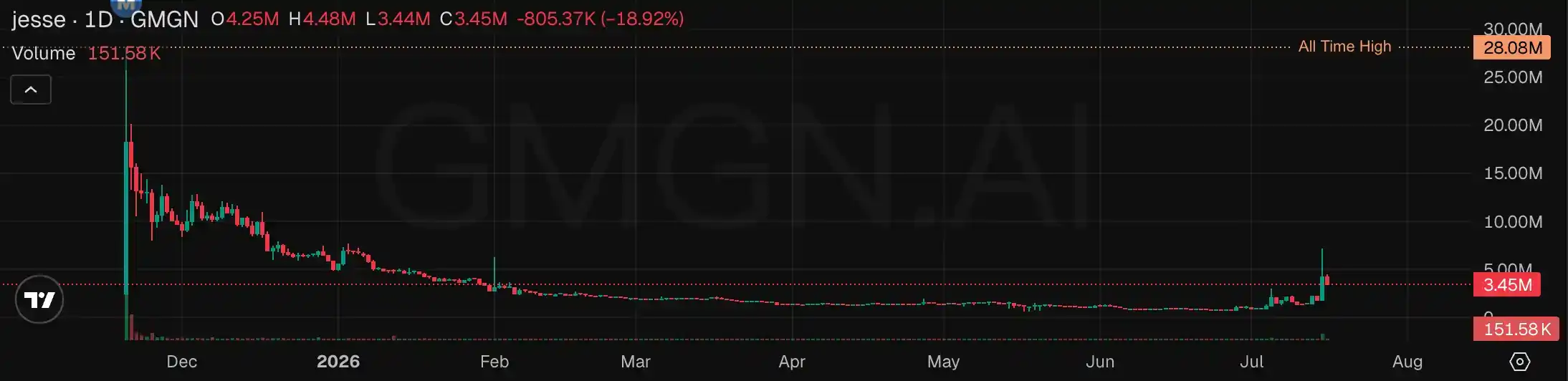
Content and personal IP do have value, but is issuing a token some uniquely effective monetization channel? What caliber of creators can you attract? How do you ensure the value you emphasize has a logical chain of reasoning? There are too many problems to solve in between. But Base gave people the feeling of, "The stage is set, and people will naturally perform."

In this regard, Jesse's understanding is completely defeated by Toly's. At least Toly could say something like, "Meme coins have no value, but mobile game items and skins also have no value, yet people worldwide are still willing to spend hundreds of billions of dollars a year on worthless things."

$ANSEM isn't the kind of "creator token" Jesse was pushing at all. First, it wasn't issued by Ansem himself, nor was it created to monetize his personal IP. It's a mismatch in every way.

In short, Jesse, regarding the social bet, you were really wrong, but you haven't fully figured it out yet. In fact, the best reference case in Crypto + social so far should be the social trading app FOMO.

Lagging Behind in Perp DEX and Other Areas: 80 points

The score could actually be even higher. Looking horizontally, Solana hasn't shown much stronger competitiveness in the Perp DEX and prediction market fields compared to Hyperliquid and Polymarket either, not significantly better than Base.

The reason Jesse feels quite regretful is, "Because we over-invested in social, we didn't keep up in these two areas." This is setting the bar a bit too high for oneself. After all, this is hindsight from a god's perspective. Hyperliquid is a competitor that completely figured out this sector. Without its emergence, Perp DEX would likely have remained at the level of GMX, dYdX. As for prediction markets, Polymarket has first-mover advantage; it's not a major competitive failure.

Moreover, Base has been quite successful in AI. It not only has a presentable but also a leading on-chain narrative sector in the entire market. In terms of specific tokens, there are major ones like $vvv that attracted market-wide attention, and launchpads like Virtuals. The x402 protocol is leading in Agent payments and has also made USDC the dominant stablecoin for inter-agent payments.

Base's success in the AI narrative has also spilled over into some tech narratives related to AI. For example, among the tokens performing well in the robotics sector, quite a few have appeared on Base. In RWA, before Solana dominated on-chain U.S. stock token spot trading with $SPCX, on-chain players would also think of Base more often, such as $LFI, which previously worked on on-chain real estate tax lien trading.

If Jesse did anything less than ideal in this regard, I think it goes back to the beginning of the article, where he mentioned "betting that Base's application developers would also drive mass adoption by producing great applications." In fact, Base's support for its on-chain developers isn't as good as he suggests. From the perspective of an on-chain player, when selecting tokens on Base, checking whether project founders have some connection with the Base team is crucial—you have to play within the "circle." The scenario where a developer has a flash of inspiration, creates a hot project outside Base's prioritized sectors, and quickly receives Base's support is really rare.

Developers complained about this earlier this year, "the three years a developer wasted on Base." I believe that not being sufficiently engaged with the developer community and the market, perhaps as much as overemphasizing the social sector, is a reason for the relative weakness in innovation competition within new narrative sectors.

Jesse's Reflection: 60 points

Does cryptocurrency need social to drive mass adoption on the scale of a billion people? Jesse previously thought it definitely did and was the only path. Now he believes stablecoins, prediction markets, Perp DEX, and RWA can all drive adoption; social isn't the only path to mass adoption.

Therefore, he stated that Base will now focus on winning the competition in three areas: trading, payments, and AI Agents. Base aims to become an indispensable part of the global on-chain financial system.

Jesse has realized one thing—exhausting oneself to pull in users directly and spending heavily to be the vanguard of cryptocurrency evangelism is less effective than overnight policy friendliness or even support for sectors like stablecoins, RWA, and prediction markets. No matter how much you promote Bitcoin/stablecoins for real-world payments, perhaps only users with real inflation-hedging needs, like those in Venezuela or Africa, are easily won over. This is a matter of national-level direction, not something easily done by companies.

But I only give a passing grade because, whether it's Jesse, Solana's Toly, Ethereum's Vitalik, or others, none have realized that for many years, meme coins have been an important path to driving mass adoption.

They have regressed from "I have a mission to actively promote cryptocurrency's conquest of the world" to "National-level forces have already become friendly, we just need to go with the flow." Jesse says he now thinks social is no longer the only path to mass adoption. He still doesn't understand—of course, cryptocurrency still needs word-of-mouth and active discussion among billions of people worldwide. But this isn't something you can achieve by providing an on-chain social platform.

People using Polymarket to bet on World Cup match outcomes won't discuss what stablecoins are. Similarly, people using Agent payments or trading U.S. stocks on-chain also won't care about stablecoins or blockchain. After all these years, the extent to which concepts like NFTs and the metaverse became mainstream topics is now only matched by the most disliked pump.fun, which persists in promoting lottery-like meme coin get-rich-quick stories to once again capture the public's mind.

Whether it's Jesse, Toly, or Robinhood's Vlad recently, everyone knows meme coins are a great user acquisition tool, but they are basically used and discarded. Everyone says nice things about liking memes, but no one steps up to guide the meme coin industry toward becoming more standardized.

Very smart and rational business cognition and choices, but the retreat in idealism and the insufficiently down-to-earth thinking about mass adoption lead me, from the perspective of a small on-chain shrimp, to ultimately give Jesse's reflection on the past two years only a passing grade.

Trending Cryptos

Related Questions

QWhat was Jesse Pollak's main admission regarding Base's past strategy, and which specific bet did he acknowledge as a mistake?

AJesse Pollak's main admission was that Base's past strategic focus was flawed. He specifically acknowledged that betting on on-chain native social experiences (like Farcaster) to drive mainstream adoption of Base and crypto was a mistake. He gave this bet a score of 0.

QAccording to the article, why did the author give Jesse's reflection on 'creator tokens' a score of 0?

AThe author gave a score of 0 because they found the logic behind promoting 'creator tokens' flawed. The idea that a creator's personal brand or content inherently provides fundamental value to a token was unconvincing. The poor performance of Jesse's own $JESSE token was cited as evidence. Furthermore, the author argued that successful examples like $ANSEM on Solana were not true 'creator tokens' in the sense Jesse promoted, making his understanding incorrect.

QIn which areas did the article state that Base has been successful, partially offsetting its failures in social and perp DEXes?

AThe article stated that Base has been particularly successful in the AI narrative. It has leading projects like $vvv and launchpads like Virtuals. The x402 protocol is leading in Agent payments and helped make USDC the dominant stablecoin for such transactions. Success in AI also spilled over into related tech narratives like robotics. Base was also previously strong in RWA (Real World Assets) narratives before Solana gained dominance in that area.

QWhat criticism did the article level against Base's support for its on-chain developers?

AThe article criticized that Base's support for its on-chain developers was not as good as Jesse claimed. From a user's perspective, it was crucial for a project to have some connection to the 'inner circle' of the Base team to receive support. The ecosystem lacked the agility to quickly support promising projects from developers outside its predefined focus areas, as evidenced by a developer's complaint about 'wasting three years on Base.' This lack of grassroots developer engagement was seen as a weakness.

QWhy did the author only give Jesse's overall reflection a passing score of 60, despite praising its honesty?

AThe author gave a score of 60 because while Jesse correctly realized that crypto adoption doesn't rely solely on social apps and can be driven by stablecoins, DeFi, and RWA, he missed a key point. The author argues that Jesse, along with other leaders like Toly and Vitalik, fails to recognize meme coins as a crucial, grassroots-driven path to mainstream adoption. They have retreated from idealistic, proactive mission-driven promotion to a more passive, policy-following stance. The author believes true mass adoption requires organic, word-of-mouth discussion, which an on-chain social platform cannot engineer, but meme culture potentially can.

Related Reads

1inch Co-founder Anton Bukov Leaves, Launches New Project Second Tier

Anton Bukov, co-founder of the decentralized exchange aggregator protocol 1inch, has announced his departure from the company's daily operations. Bukov, who was instrumental in designing core 1inch architectures like the Router, Fusion, and cross-chain Swap, ceased involvement in November 2025 due to strategic and leadership disagreements, though he retains his co-founder title and 50% equity stake. Concurrently, Bukov unveiled his new venture, Second Tier (tier.xyz), describing it as infrastructure to "shorten the distance between economic intent and on-chain execution." He explicitly stated it is not a DEX or aggregator. The project's public-facing material is currently a manifesto criticizing systemic financial friction and advocating for building new architectural categories rather than competing within existing ones. No product details, team, or funding have been disclosed. The split highlights a strategic divergence within 1inch. While CEO Sergej Kunz has steered the company toward traditional finance integration—evidenced by a 2025 brand refresh and a major Coinbase partnership—Bukov emphasized a commitment to decentralized, permissionless DeFi principles. Bukov's exit coincides with a challenging period for 1inch. Q1 2026 data shows a 60.3% quarterly drop in its daily average trading volume to $97.1 million, underperforming the broader DEX aggregator market decline. Its market share fell from 25.2% to 17.0%, dropping it to fourth place among competitors. Key questions remain regarding Bukov's future role as a major 1inch shareholder, the timeline for Second Tier's product development, and whether 1inch's institutional-focused strategy can reverse its declining trading metrics.

Foresight News6m ago

1inch Co-founder Anton Bukov Leaves, Launches New Project Second Tier

Foresight News6m ago

Meituan Leads Investment, New Unicorn in Dexterous Hands Born

Xynova, a full-stack provider of dexterous hand solutions for embodied intelligence, has officially become a unicorn after securing a 500 million yuan Series A+ round led by Meituan. This marks the company's third major funding in 2024, bringing the total raised in four months to approximately 1.5 billion yuan. The investment lineup features a prominent group of industrial and internet giants, including repeat investors like Xiaomi and new backers such as NIO Capital and China Merchants Capital. With total market capitalization of its industrial shareholders exceeding 5 trillion yuan, the backing represents a strategic positioning across the new energy manufacturing, smart logistics, and last-mile delivery sectors. Founded in 2024 by CEO Xia Yuxuan, Xynova focuses on the critical "last centimeter" of robot interaction—the dexterous hand. Moving beyond traditional technical debates, the company adopts a full-stack, self-developed approach, integrating hardware and algorithms. Its flagship product, the Flex 2, is a hybrid tendon-and-direct-drive hand with 23 degrees of freedom, weighing under 400 grams and boasting a key component lifespan of over 1.5 million cycles. The industry narrative is shifting from robot mobility to practical utility, making reliable, mass-producible components crucial. Xynova has established a 5,400-square-meter factory in Hangzhou, with annual capacity expected to reach 10,000 units by year-end. The company believes embodied robots will see large-scale real-world adoption within three years, potentially as soon as 18 months.

marsbit15m ago

Meituan Leads Investment, New Unicorn in Dexterous Hands Born

marsbit15m ago

Understanding the Stablecoin Industry Chain in One Article: The Real Profits Are Not in the Issuance

Understanding the Stablecoin Industry Value Chain: The Real Profits Are Not in Issuance The article argues that while industry discussion focuses on stablecoin issuers like Tether and Circle, the real profit opportunities lie further down the value chain. It breaks the stablecoin ecosystem into five key segments: issuance, on/off-ramps, on-chain transfers, payments, and yield generation/asset growth. Issuance is dominated by a few giants with massive scale and trust advantages, making direct competition difficult. New entrants are advised to focus on specialized infrastructure roles within this segment instead. The on/off-ramp sector faces intense competition and margin pressure on basic transaction fees, pushing service providers to expand into adjacent services for recurring revenue. The on-chain transfer segment, particularly for cross-border payments and payroll, offers significant cost advantages over traditional systems. Profits are not in the transfer itself but in the surrounding compliance, FX services, and leveraging idle funds. In payments, the core profitability lies not in consumer-facing card brands but in the backend infrastructure for issuing, clearing, and settlement. This allows players to capture reserve interest and improve capital efficiency through real-time, on-chain clearing. Finally, the asset growth/yield segment has evolved into a full-fledged on-chain asset management industry. It features layered models with specialized risk managers and offers products ranging from tokenized treasuries (RWA) to yield-bearing synthetic dollars. The future direction points towards integrating stablecoin advantages (24/7 clearing, low-cost transfers, programmable yield) into existing traditional financial infrastructure, as seen in recent acquisitions. Value is shifting downstream to the clearing/payments layer and towards compliant integration with traditional finance, including the rise of regional non-USD stablecoins.

Foresight News29m ago

Understanding the Stablecoin Industry Chain in One Article: The Real Profits Are Not in the Issuance

Foresight News29m ago

Stock Price Falls Below IPO Price, First Launch After IPO Hits a Snag, Where Will SpaceX Go From Here?

SpaceX Faces Post-IPO Pressure as Starship Launch Aborted, Stock Slumps SpaceX's highly anticipated 13th test flight of its Starship rocket was aborted during the final ignition sequence on July 17th due to issues with some Raptor engines failing to start as expected. CEO Elon Musk stated the company will replace two engines and aims for another launch attempt early next week. This setback comes at a critical time for SpaceX. Following its historic IPO last month, the company's stock (SPCX) has recently fallen below its offering price, down nearly 40% from its peak. The market had hoped a successful test would bolster the declining share price, but the abort triggered further after-hours selling. The article highlights a shift in investor perspective post-IPO. While previous Starship test failures were often viewed within SpaceX's "fail fast, iterate" Silicon Valley engineering culture as valuable data points, public market investors are now more focused on timelines, commercialization prospects, and their impact on valuation and future cash flows. Each delay or issue is now quickly factored into the stock price. While public listing provides crucial capital for ambitious projects like Starlink and Starship, it also brings increased scrutiny and pressure for predictable progress. The upcoming launch attempt is now seen as more than a technical milestone; its success or failure is likely to significantly influence market sentiment and the stock's near-term trajectory as SpaceX navigates the new realities of being a publicly traded company.

Odaily星球日报1h ago

Stock Price Falls Below IPO Price, First Launch After IPO Hits a Snag, Where Will SpaceX Go From Here?

Odaily星球日报1h ago

Trading

Spot

Hot Articles

What is SONIC

Sonic: Pioneering the Future of Gaming in Web3 Introduction to Sonic In the ever-evolving landscape of Web3, the gaming industry stands out as one of the most dynamic and promising sectors. At the forefront of this revolution is Sonic, a project designed to amplify the gaming ecosystem on the Solana blockchain. Leveraging cutting-edge technology, Sonic aims to deliver an unparalleled gaming experience by efficiently processing millions of requests per second, ensuring that players enjoy seamless gameplay while maintaining low transaction costs. This article delves into the intricate details of Sonic, exploring its creators, funding sources, operational mechanics, and the timeline of significant events that have shaped its journey. What is Sonic? Sonic is an innovative layer-2 network that operates atop the Solana blockchain, specifically tailored to enhance the existing Solana gaming ecosystem. It accomplishes this through a customised, VM-agnostic game engine paired with a HyperGrid interpreter, facilitating sovereign game economies that roll up back to the Solana platform. The primary goals of Sonic include: Enhanced Gaming Experiences: Sonic is committed to offering lightning-fast on-chain gameplay, allowing players and developers to engage with games at previously unattainable speeds. Atomic Interoperability: This feature enables transactions to be executed within Sonic without the need to redeploy Solana programmes and accounts. This makes the process more efficient and directly benefits from Solana Layer1 services and liquidity. Seamless Deployment: Sonic allows developers to write for Ethereum Virtual Machine (EVM) based systems and execute them on Solana’s SVM infrastructure. This interoperability is crucial for attracting a broader range of dApps and decentralised applications to the platform. Support for Developers: By offering native composable gaming primitives and extensible data types - dining within the Entity-Component-System (ECS) framework - game creators can craft intricate business logic with ease. Overall, Sonic's unique approach not only caters to players but also provides an accessible and low-cost environment for developers to innovate and thrive. Creator of Sonic The information regarding the creator of Sonic is somewhat ambiguous. However, it is known that Sonic's SVM is owned by the company Mirror World. The absence of detailed information about the individuals behind Sonic reflects a common trend in several Web3 projects, where collective efforts and partnerships often overshadow individual contributions. Investors of Sonic Sonic has garnered considerable attention and support from various investors within the crypto and gaming sectors. Notably, the project raised an impressive $12 million during its Series A funding round. The round was led by BITKRAFT Ventures, with other notable investors including Galaxy, Okx Ventures, Interactive, Big Brain Holdings, and Mirana. This financial backing signifies the confidence that investment foundations have in Sonic’s potential to revolutionise the Web3 gaming landscape, further validating its innovative approaches and technologies. How Does Sonic Work? Sonic utilises the HyperGrid framework, a sophisticated parallel processing mechanism that enhances its scalability and customisability. Here are the core features that set Sonic apart: Lightning Speed at Low Costs: Sonic offers one of the fastest on-chain gaming experiences compared to other Layer-1 solutions, powered by the scalability of Solana’s virtual machine (SVM). Atomic Interoperability: Sonic enables transaction execution without redeployment of Solana programmes and accounts, effectively streamlining the interaction between users and the blockchain. EVM Compatibility: Developers can effortlessly migrate decentralised applications from EVM chains to the Solana environment using Sonic’s HyperGrid interpreter, increasing the accessibility and integration of various dApps. Ecosystem Support for Developers: By exposing native composable gaming primitives, Sonic facilitates a sandbox-like environment where developers can experiment and implement business logic, greatly enhancing the overall development experience. Monetisation Infrastructure: Sonic natively supports growth and monetisation efforts, providing frameworks for traffic generation, payments, and settlements, thereby ensuring that gaming projects are not only viable but also sustainable financially. Timeline of Sonic The evolution of Sonic has been marked by several key milestones. Below is a brief timeline highlighting critical events in the project's history: 2022: The Sonic cryptocurrency was officially launched, marking the beginning of its journey in the Web3 gaming arena. 2024: June: Sonic SVM successfully raised $12 million in a Series A funding round. This investment allowed Sonic to further develop its platform and expand its offerings. August: The launch of the Sonic Odyssey testnet provided users with the first opportunity to engage with the platform, offering interactive activities such as collecting rings—a nod to gaming nostalgia. October: SonicX, an innovative crypto game integrated with Solana, made its debut on TikTok, capturing the attention of over 120,000 users within a short span. This integration illustrated Sonic’s commitment to reaching a broader, global audience and showcased the potential of blockchain gaming. Key Points Sonic SVM is a revolutionary layer-2 network on Solana explicitly designed to enhance the GameFi landscape, demonstrating great potential for future development. HyperGrid Framework empowers Sonic by introducing horizontal scaling capabilities, ensuring that the network can handle the demands of Web3 gaming. Integration with Social Platforms: The successful launch of SonicX on TikTok displays Sonic’s strategy to leverage social media platforms to engage users, exponentially increasing the exposure and reach of its projects. Investment Confidence: The substantial funding from BITKRAFT Ventures, among others, emphasizes the robust backing Sonic has, paving the way for its ambitious future. In conclusion, Sonic encapsulates the essence of Web3 gaming innovation, striking a balance between cutting-edge technology, developer-centric tools, and community engagement. As the project continues to evolve, it is poised to redefine the gaming landscape, making it a notable entity for gamers and developers alike. As Sonic moves forward, it will undoubtedly attract greater interest and participation, solidifying its place within the broader narrative of blockchain gaming.

1.8k Total ViewsPublished 2024.04.04Updated 2024.12.03

What is SONIC

What is $S$

Understanding SPERO: A Comprehensive Overview Introduction to SPERO As the landscape of innovation continues to evolve, the emergence of web3 technologies and cryptocurrency projects plays a pivotal role in shaping the digital future. One project that has garnered attention in this dynamic field is SPERO, denoted as SPERO,$$s$. This article aims to gather and present detailed information about SPERO, to help enthusiasts and investors understand its foundations, objectives, and innovations within the web3 and crypto domains. What is SPERO,$$s$? SPERO,$$s$ is a unique project within the crypto space that seeks to leverage the principles of decentralisation and blockchain technology to create an ecosystem that promotes engagement, utility, and financial inclusion. The project is tailored to facilitate peer-to-peer interactions in new ways, providing users with innovative financial solutions and services. At its core, SPERO,$$s$ aims to empower individuals by providing tools and platforms that enhance user experience in the cryptocurrency space. This includes enabling more flexible transaction methods, fostering community-driven initiatives, and creating pathways for financial opportunities through decentralised applications (dApps). The underlying vision of SPERO,$$s$ revolves around inclusiveness, aiming to bridge gaps within traditional finance while harnessing the benefits of blockchain technology. Who is the Creator of SPERO,$$s$? The identity of the creator of SPERO,$$s$ remains somewhat obscure, as there are limited publicly available resources providing detailed background information on its founder(s). This lack of transparency can stem from the project's commitment to decentralisation—an ethos that many web3 projects share, prioritising collective contributions over individual recognition. By centring discussions around the community and its collective goals, SPERO,$$s$ embodies the essence of empowerment without singling out specific individuals. As such, understanding the ethos and mission of SPERO remains more important than identifying a singular creator. Who are the Investors of SPERO,$$s$? SPERO,$$s$ is supported by a diverse array of investors ranging from venture capitalists to angel investors dedicated to fostering innovation in the crypto sector. The focus of these investors generally aligns with SPERO's mission—prioritising projects that promise societal technological advancement, financial inclusivity, and decentralised governance. These investor foundations are typically interested in projects that not only offer innovative products but also contribute positively to the blockchain community and its ecosystems. The backing from these investors reinforces SPERO,$$s$ as a noteworthy contender in the rapidly evolving domain of crypto projects. How Does SPERO,$$s$ Work? SPERO,$$s$ employs a multi-faceted framework that distinguishes it from conventional cryptocurrency projects. Here are some of the key features that underline its uniqueness and innovation: Decentralised Governance: SPERO,$$s$ integrates decentralised governance models, empowering users to participate actively in decision-making processes regarding the project’s future. This approach fosters a sense of ownership and accountability among community members. Token Utility: SPERO,$$s$ utilises its own cryptocurrency token, designed to serve various functions within the ecosystem. These tokens enable transactions, rewards, and the facilitation of services offered on the platform, enhancing overall engagement and utility. Layered Architecture: The technical architecture of SPERO,$$s$ supports modularity and scalability, allowing for seamless integration of additional features and applications as the project evolves. This adaptability is paramount for sustaining relevance in the ever-changing crypto landscape. Community Engagement: The project emphasises community-driven initiatives, employing mechanisms that incentivise collaboration and feedback. By nurturing a strong community, SPERO,$$s$ can better address user needs and adapt to market trends. Focus on Inclusion: By offering low transaction fees and user-friendly interfaces, SPERO,$$s$ aims to attract a diverse user base, including individuals who may not previously have engaged in the crypto space. This commitment to inclusion aligns with its overarching mission of empowerment through accessibility. Timeline of SPERO,$$s$ Understanding a project's history provides crucial insights into its development trajectory and milestones. Below is a suggested timeline mapping significant events in the evolution of SPERO,$$s$: Conceptualisation and Ideation Phase: The initial ideas forming the basis of SPERO,$$s$ were conceived, aligning closely with the principles of decentralisation and community focus within the blockchain industry. Launch of Project Whitepaper: Following the conceptual phase, a comprehensive whitepaper detailing the vision, goals, and technological infrastructure of SPERO,$$s$ was released to garner community interest and feedback. Community Building and Early Engagements: Active outreach efforts were made to build a community of early adopters and potential investors, facilitating discussions around the project’s goals and garnering support. Token Generation Event: SPERO,$$s$ conducted a token generation event (TGE) to distribute its native tokens to early supporters and establish initial liquidity within the ecosystem. Launch of Initial dApp: The first decentralised application (dApp) associated with SPERO,$$s$ went live, allowing users to engage with the platform's core functionalities. Ongoing Development and Partnerships: Continuous updates and enhancements to the project's offerings, including strategic partnerships with other players in the blockchain space, have shaped SPERO,$$s$ into a competitive and evolving player in the crypto market. Conclusion SPERO,$$s$ stands as a testament to the potential of web3 and cryptocurrency to revolutionise financial systems and empower individuals. With a commitment to decentralised governance, community engagement, and innovatively designed functionalities, it paves the way toward a more inclusive financial landscape. As with any investment in the rapidly evolving crypto space, potential investors and users are encouraged to research thoroughly and engage thoughtfully with the ongoing developments within SPERO,$$s$. The project showcases the innovative spirit of the crypto industry, inviting further exploration into its myriad possibilities. While the journey of SPERO,$$s$ is still unfolding, its foundational principles may indeed influence the future of how we interact with technology, finance, and each other in interconnected digital ecosystems.

121 Total ViewsPublished 2024.12.17Updated 2024.12.17

What is $S$

What is AGENT S

Agent S: The Future of Autonomous Interaction in Web3 Introduction In the ever-evolving landscape of Web3 and cryptocurrency, innovations are constantly redefining how individuals interact with digital platforms. One such pioneering project, Agent S, promises to revolutionise human-computer interaction through its open agentic framework. By paving the way for autonomous interactions, Agent S aims to simplify complex tasks, offering transformative applications in artificial intelligence (AI). This detailed exploration will delve into the project's intricacies, its unique features, and the implications for the cryptocurrency domain. What is Agent S? Agent S stands as a groundbreaking open agentic framework, specifically designed to tackle three fundamental challenges in the automation of computer tasks: Acquiring Domain-Specific Knowledge: The framework intelligently learns from various external knowledge sources and internal experiences. This dual approach empowers it to build a rich repository of domain-specific knowledge, enhancing its performance in task execution. Planning Over Long Task Horizons: Agent S employs experience-augmented hierarchical planning, a strategic approach that facilitates efficient breakdown and execution of intricate tasks. This feature significantly enhances its ability to manage multiple subtasks efficiently and effectively. Handling Dynamic, Non-Uniform Interfaces: The project introduces the Agent-Computer Interface (ACI), an innovative solution that enhances the interaction between agents and users. Utilizing Multimodal Large Language Models (MLLMs), Agent S can navigate and manipulate diverse graphical user interfaces seamlessly. Through these pioneering features, Agent S provides a robust framework that addresses the complexities involved in automating human interaction with machines, setting the stage for myriad applications in AI and beyond. Who is the Creator of Agent S? While the concept of Agent S is fundamentally innovative, specific information about its creator remains elusive. The creator is currently unknown, which highlights either the nascent stage of the project or the strategic choice to keep founding members under wraps. Regardless of anonymity, the focus remains on the framework's capabilities and potential. Who are the Investors of Agent S? As Agent S is relatively new in the cryptographic ecosystem, detailed information regarding its investors and financial backers is not explicitly documented. The lack of publicly available insights into the investment foundations or organisations supporting the project raises questions about its funding structure and development roadmap. Understanding the backing is crucial for gauging the project's sustainability and potential market impact. How Does Agent S Work? At the core of Agent S lies cutting-edge technology that enables it to function effectively in diverse settings. Its operational model is built around several key features: Human-like Computer Interaction: The framework offers advanced AI planning, striving to make interactions with computers more intuitive. By mimicking human behaviour in tasks execution, it promises to elevate user experiences. Narrative Memory: Employed to leverage high-level experiences, Agent S utilises narrative memory to keep track of task histories, thereby enhancing its decision-making processes. Episodic Memory: This feature provides users with step-by-step guidance, allowing the framework to offer contextual support as tasks unfold. Support for OpenACI: With the ability to run locally, Agent S allows users to maintain control over their interactions and workflows, aligning with the decentralised ethos of Web3. Easy Integration with External APIs: Its versatility and compatibility with various AI platforms ensure that Agent S can fit seamlessly into existing technological ecosystems, making it an appealing choice for developers and organisations. These functionalities collectively contribute to Agent S's unique position within the crypto space, as it automates complex, multi-step tasks with minimal human intervention. As the project evolves, its potential applications in Web3 could redefine how digital interactions unfold. Timeline of Agent S The development and milestones of Agent S can be encapsulated in a timeline that highlights its significant events: September 27, 2024: The concept of Agent S was launched in a comprehensive research paper titled “An Open Agentic Framework that Uses Computers Like a Human,” showcasing the groundwork for the project. October 10, 2024: The research paper was made publicly available on arXiv, offering an in-depth exploration of the framework and its performance evaluation based on the OSWorld benchmark. October 12, 2024: A video presentation was released, providing a visual insight into the capabilities and features of Agent S, further engaging potential users and investors. These markers in the timeline not only illustrate the progress of Agent S but also indicate its commitment to transparency and community engagement. Key Points About Agent S As the Agent S framework continues to evolve, several key attributes stand out, underscoring its innovative nature and potential: Innovative Framework: Designed to provide an intuitive use of computers akin to human interaction, Agent S brings a novel approach to task automation. Autonomous Interaction: The ability to interact autonomously with computers through GUI signifies a leap towards more intelligent and efficient computing solutions. Complex Task Automation: With its robust methodology, it can automate complex, multi-step tasks, making processes faster and less error-prone. Continuous Improvement: The learning mechanisms enable Agent S to improve from past experiences, continually enhancing its performance and efficacy. Versatility: Its adaptability across different operating environments like OSWorld and WindowsAgentArena ensures that it can serve a broad range of applications. As Agent S positions itself in the Web3 and crypto landscape, its potential to enhance interaction capabilities and automate processes signifies a significant advancement in AI technologies. Through its innovative framework, Agent S exemplifies the future of digital interactions, promising a more seamless and efficient experience for users across various industries. Conclusion Agent S represents a bold leap forward in the marriage of AI and Web3, with the capacity to redefine how we interact with technology. While still in its early stages, the possibilities for its application are vast and compelling. Through its comprehensive framework addressing critical challenges, Agent S aims to bring autonomous interactions to the forefront of the digital experience. As we move deeper into the realms of cryptocurrency and decentralisation, projects like Agent S will undoubtedly play a crucial role in shaping the future of technology and human-computer collaboration.

787 Total ViewsPublished 2025.01.14Updated 2025.01.14

What is AGENT S

Discussions

Welcome to the HTX Community. Here, you can stay informed about the latest platform developments and gain access to professional market insights. Users' opinions on the price of S (S) are presented below.

活动图片