A Company Once on the Verge of Collapse Now Has a Market Cap Surpassing Bitcoin

marsbitPublished on 2026-06-22Last updated on 2026-06-22

Abstract

"Once nearly bankrupt, SK Hynix now surpasses Bitcoin in market cap." On June 22, SK Hynix's market value reached $1.35 trillion, exceeding Bitcoin's $1.29 trillion, driven by soaring demand for its High-Bandwidth Memory (HBM), a critical component for AI training. As NVIDIA's primary HBM supplier with over 60% market share, the company reported a 72% operating profit margin in Q1. Its remarkable turnaround stems from a 13-year bet on HBM technology, initiated in 2009 and rescued by SK Group's acquisition in 2012. The company plans a Nasdaq listing, potentially attracting more institutional capital. This milestone highlights a market preference for tangible AI infrastructure assets—like HBM with its physical scarcity and verifiable revenue—over narrative-driven crypto-AI projects, which remain in early developmental stages and lack comparable proof of scalable demand or economic models. The capital shift underscores the premium placed on real-world supply constraints and profitability in the current AI boom.

Author:Zhou,ChainCatcher

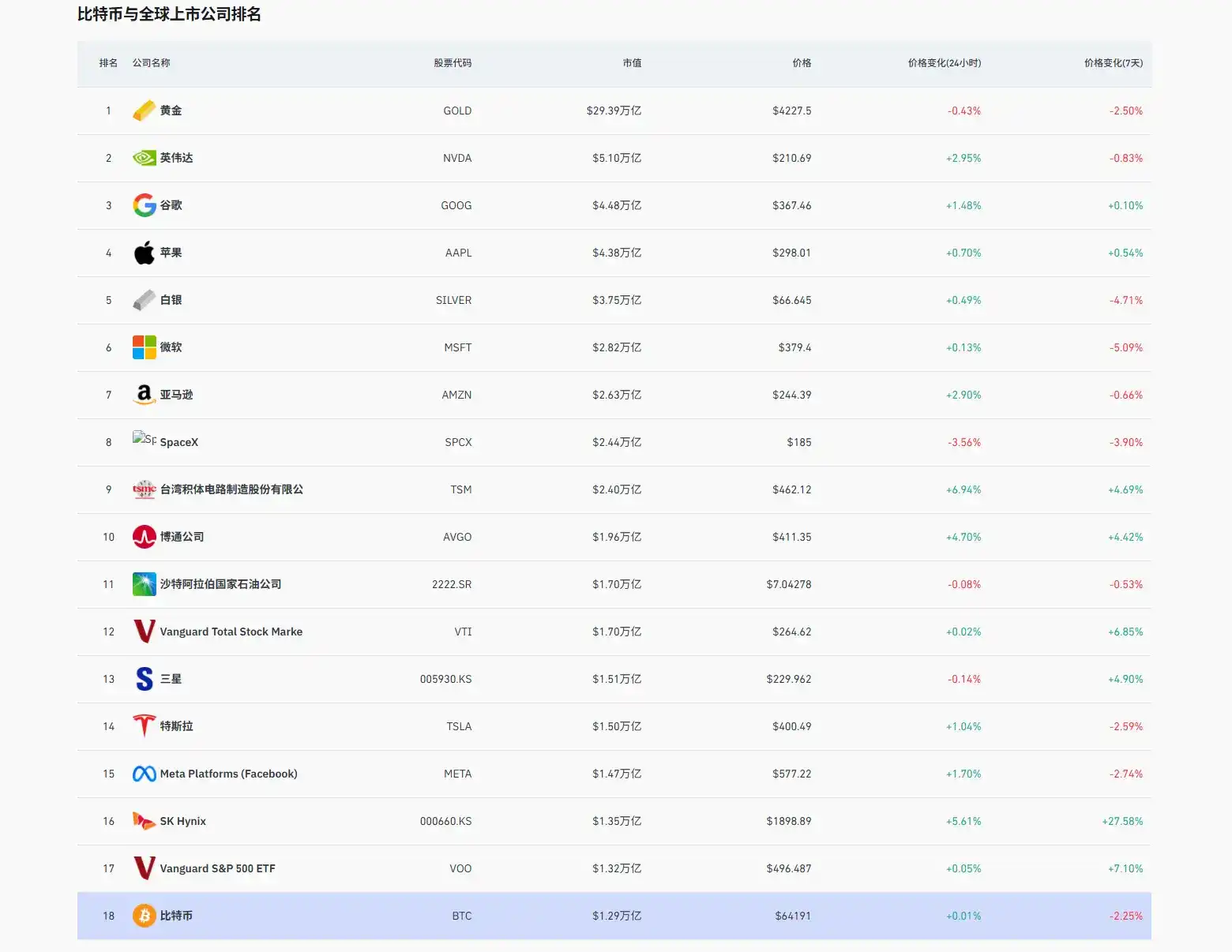
On June 22, a surge in SK Hynix's stock price propelled its market capitalization to $1.35 trillion, surpassing Bitcoin's total market cap of approximately $1.29 trillion. At one point during the trading session, it even overtook Samsung Electronics to become South Korea's highest-valued company.

According to Coinglass data, in the global asset rankings, SK Hynix rose to 16th place, while Bitcoin slid to 18th.
HBM, and a 13-Year Gamble

The core driver of SK Hynix's recent rally is HBM (High Bandwidth Memory). AI training and inference place extremely high demands on memory bandwidth, and SK Hynix is NVIDIA's primary HBM supplier, holding a market share exceeding 60%.

Financial reports show SK Hynix's Q1 revenue was 52.58 trillion won, with operating profit at 37.61 trillion won, achieving a profit margin of 72%. Analysts' current consensus for SK Hynix's Q2 operating profit is around 62~65 trillion won, with some brokerage houses' optimistic forecasts already revised upwards to over 68 trillion won.

In early April this year, most market expectations for Q2 were still in the 50 trillion won range. Since then, with persistently strong memory prices, brokerages have generally made significant upward revisions. Management stated during the earnings call that the structural memory shortage driven by artificial intelligence would last for at least several years and plans to significantly increase capital expenditure to expand advanced capacity.

Reportedly, SK Hynix began betting on HBM technology as early as 2009, a time when almost no one paid attention to this complex technology with limited initial demand. From the first generation of HBM to HBM3E, this all-or-nothing gamble lasted nearly 13 years, only reaching its coronation moment with the advent of ChatGPT.
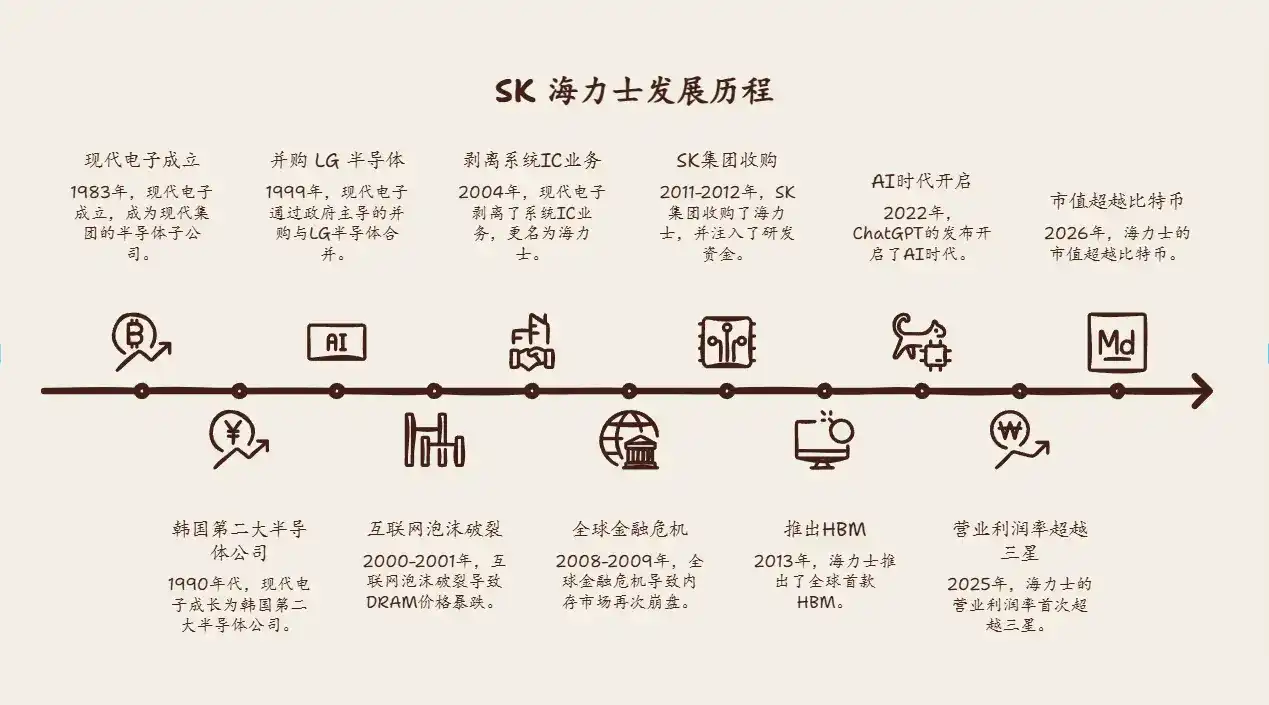
Image Source: AI Generated

SK Hynix's journey to this point cannot be separated from a critical external rescue. After the dot-com bubble burst in 2001, Hynix was deeply mired in a debt crisis, its stock price once falling to junk levels. It even negotiated a sale to Micron Technology, which ultimately failed. For the following decade, the company remained under creditor control.

In 2012, SK Group Chairman Chey Tae-won overrode board opposition and acquired the company for approximately $3 billion through its investment holding subsidiary SK Square, renaming it SK Hynix and injecting substantial R&D funding. This investment enabled the company to continue advancing the then-niche HBM technology. Currently, SK Square holds about 20% of SK Hynix shares, making it the largest single shareholder.

It is worth noting that SK Square itself once attempted to enter the crypto market. In 2021, it acquired a 35% stake in the Korean crypto exchange Korbit for about 90 billion won and planned to issue its own token, SK Coin. According to public reports, after the Terra/LUNA crash in 2022, the market cooled sharply, and the SK Coin issuance plan was subsequently shelved, with no substantial progress since.

According to a Reuters report citing informed sources, SK Hynix plans to list on NASDAQ as early as August this year, which would lower the trading threshold for U.S. institutional and passive funds and potentially attract further capital inflows. NVIDIA CEO Jensen Huang recently stated that NVIDIA's collaboration with SK Hynix is expected to bring South Korea business opportunities worth hundreds of billions of dollars in the future.

Why is Capital Buying In? Crypto AI in the Mirror

In this wave of AI, the market is more willing to pay a premium for segments that already have real orders and visible supply bottlenecks. Assets directly involved in the AI supply side—computing power, memory, and electricity—have received priority allocation due to their quantifiable revenue and verifiable barriers.

HBM production capacity is highly concentrated in the hands of SK Hynix, Samsung, and Micron, with expansion cycles taking 2 to 3 years. This physical scarcity is not built on narratives; it is locked in by production cycles and technological barriers. The valuation logic of the memory industry is also shifting from "cyclical stock" to "growth stock."

SK Hynix's market cap surpassing Bitcoin is the capital market's public statement on two types of scarcity. With such high barriers already formed at the physical layer, the situation of Crypto AI is worth re-examining.

The Crypto AI sector has been telling a story for the past two years: decentralized computing power will reshape AI infrastructure, and open networks will surpass closed enterprise data centers. The potential of this direction is real, but standing before the market cap figure of SK Hynix today, several realities are worth confronting directly.

The IC3 report jointly released by Cornell University and 12 other universities points out that the convergence of Crypto and AI is still in its early stages, and the noise surrounding this intersection has overshadowed practical progress. Decentralized computing power, data markets, and governance mostly remain at the conceptual stage.

At the project level, taking Bittensor, one of the most representative projects in the Crypto AI sector, as an example, its token TAO has fallen 20% over the past 3 months. Bittensor co-founder const posted on platform X, stating that the project's economic incentive layer is still dominated by the core team, who chose to prioritize rapid iteration at the cost of maintaining centralization, and it is estimated to take another year and a half to complete the core mechanism construction. In other words, their underlying mechanisms are still being patched.

Crypto mining companies, which are closer to the hardware layer, are also facing challenges. According to Galaxy Research data, Bitcoin miners are entering a "capitulation period." The current network mining difficulty has dropped more than 20% from its historical high, marking the largest decline since China's crackdown on Bitcoin mining in 2021, with some miners continuing to exit the network or shut down equipment.
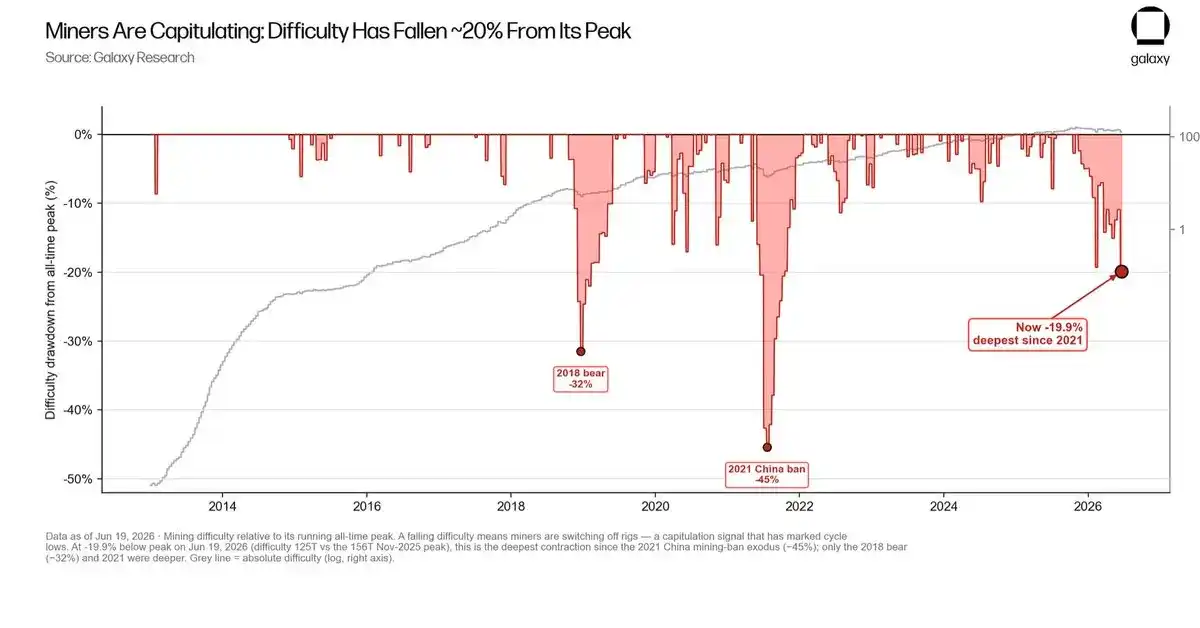
Seeking transformation, mining companies like Core Scientific, TeraWulf, and Hut 8 have announced moves into AI and high-performance computing. However, according to a VanEck report, this transformation faces a short-term funding gap of about $50 billion, with long-term capital needs around $221 billion. Furthermore, the industry has only delivered about 25% of the leased AI capacity—companies missing construction milestones already face investor downgrades.

The IC3 report jointly released by Cornell University and 12 other universities mentions that the convergence of Crypto and AI is still in its early stages, and the noise surrounding this intersection has overshadowed practical progress. Decentralized computing power, data markets, and governance mostly remain at the conceptual stage.

In terms of funding, Arthur Hayes pointed out in his recent article "Reality Test" that since the release of ChatGPT in 2022, the AI industry has cumulatively issued about $1.5 trillion in debt, roughly equivalent to the increase in U.S. M2 money supply during the same period—AI has absorbed almost all new liquidity; Bitcoin never had a chance. Hayes believes this is not a logic of "if AI falls, funds will flow back to crypto." The upcoming large-scale IPOs of Anthropic and OpenAI will further siphon market funds. Once the AI bubble bursts, bank credit contraction will simultaneously tighten liquidity, and Bitcoin will be sold off alongside AI.

Since the second half of last year, many traders previously active in the crypto market have shifted their attention to U.S. and South Korean stocks, chasing the AI hardware trend. The logic of capital flowing into AI infrastructure is also straightforward: real orders, physical barriers, quantifiable profit margins.

This certainty is the fundamental reason capital is willing to pay a high premium today, whereas the AI narrative in the crypto market lacks precisely this kind of certainty.

In other words, the dividends of AI infrastructure are currently more inclined to be captured by entities with technological barriers and real supply capabilities. In this process, crypto networks need to more clearly define their position in the value chain.

Trending Cryptos

Related Questions

QWhat is the primary driver behind SK Hynix's recent stock surge and its market capitalization surpassing that of Bitcoin?

AThe primary driver is the high demand for HBM (High Bandwidth Memory), a critical component for AI training and inference. SK Hynix is the dominant supplier (over 60% market share) of HBM to Nvidia, with strong financial results and optimistic analyst forecasts fueling the stock rise.

QHow did SK Hynix survive its financial crisis in the early 2000s and eventually thrive in the AI era?

AAfter a near-bankruptcy in the 2001 dot-com bust, SK Hynix was acquired in 2012 by SK Square, a subsidiary of SK Group, for about $3 billion. This investment provided crucial R&D funding, allowing the company to persist in developing HBM technology, which was a niche and unproven field at the time. This 13-year bet ultimately paid off with the AI boom.

QWhat are the key challenges faced by the Crypto AI sector according to the article?

AThe Crypto AI sector faces challenges including a lack of tangible progress beyond conceptual stages (e.g., decentralized compute and data markets), immature project infrastructure (e.g., Bittensor's core mechanisms still under development), significant capital shortfalls for miners trying to pivot to AI, and competition for liquidity that is being absorbed by traditional AI infrastructure with more proven, revenue-generating models.

QWhat does the article suggest is a major reason capital is favoring companies like SK Hynix over Crypto AI projects?

ACapital favors companies like SK Hynix due to their 'deterministic' value proposition: real, quantifiable orders, physical supply bottlenecks with high barriers to entry (2-3 year expansion cycles), and verifiable profit margins. This contrasts with the more speculative and narrative-driven nature of many Crypto AI projects, which lack similar immediate, proven fundamentals.

QWhat perspective does Arthur Hayes offer on the relationship between the AI funding boom and Bitcoin's market performance?

AArthur Hayes argues that the AI industry has absorbed virtually all new liquidity (issuing ~$1.5 trillion in debt since ChatGPT's launch), leaving little for Bitcoin. He contends that Bitcoin's fate is currently tied to AI's; if the AI bubble bursts, a subsequent credit contraction would likely lead to Bitcoin being sold off alongside AI assets, rather than benefiting from a capital rotation.

Related Reads

Conversation with Co-founder of Hyperdash: Why is Hyperliquid Still Severely Undervalued?

Interview Summary with Hanson Birringer, Co-founder of Hyperdash: Why Hyperliquid Remains Undervalued In an interview on *The Rollup*, Hanson Birringer, Co-founder and Chief Revenue Officer of Hyperdash—a trading data analytics platform for Hyperliquid—shared his investment thesis on the Hyperliquid ecosystem. He described Hyperliquid as a pure play on three key crypto super-trends: perpetual contracts, real-world assets (RWAs), and stablecoins. The platform is an open-source, decentralized, and high-performance financial system uniquely positioned to bridge traditional institutional capital with decentralized finance. Birringer highlighted Hyperliquid's leadership in perpetual DEX trading and its recent innovation of RWA perpetual contracts. He emphasized the significance of USDC becoming a core quoting asset, which, by allocating 90% of its backend yield from assets like US treasuries to a protocol buyback fund, creates substantial, programmatic buy pressure for the Hype token. He addressed regulatory challenges, noting that Hyperliquid's policy team is actively engaging with US regulators like the CFTC to establish clear rules for decentralized venues. Once achieved, regulated brokers could route orders directly to Hyperliquid's backend, tapping into its low-cost liquidity layer. Regarding revenue, Birringer was optimistic, citing the immense size of traditional financial markets. Even capturing a small fraction of global trading volume in products like RWA perpetuals could lead to exponential growth for the protocol. The recently launched Grayscale Hyperliquid ETF, seeded by their SPV (Hyper Holdings Global), provides a compliant on-ramp for institutional investors drawn to the clear "cash flow + token buyback" model. Finally, he discussed Hyperdash's acquisition of Imperator, enhancing its data and node infrastructure to serve both retail traders and traditional asset managers. His bullish case rests on Hyperliquid's potential to provide unprecedented global access to dollar-based capital markets. He struggled to articulate a bear case, seeing the long-term trends of internet adoption and financial inclusion as powerful tailwinds.

marsbit50m ago

Conversation with Co-founder of Hyperdash: Why is Hyperliquid Still Severely Undervalued?

marsbit50m ago

DeepSeek V4 'Full-Blooded Edition' Leaked, Could Be Released As Early As Tomorrow

The highly anticipated full release of DeepSeek V4 is imminent, expected to launch as early as tomorrow after nearly three months of waiting. A select group has already received access to the GA (General Availability) beta, which includes two versions: DeepSeek V4 Flash and DeepSeek V4 Pro. Early testers report that V4's overall performance is close to the level of Opus 4.8, with coding capabilities rivaling GPT-5.6 Sol. Its agent abilities are significantly enhanced, and 3D/SVG generation has improved notably. While it may not surpass the recently released Kimi K3 in performance, its expected price point is significantly lower. The official release will introduce a new "peak/off-peak" pricing model for its API. For example, deepseek-v4-pro will cost $0.87 per million output tokens during standard times and $1.74 during peak hours. The flash version is even more aggressive at $0.28/$0.56 per million tokens, with cached input tokens priced extremely low at $0.0028. This makes V4 a strong contender in terms of cost-effectiveness, potentially offering Opus-level capabilities at a fraction of the cost, continuing DeepSeek's reputation as a "price disruptor" in the AI market. Initial demos showcasing V4's capabilities have begun circulating, including generated 3D simulation games, HTML games blending elements of Minecraft and No Man's Sky, and classic games like a "Cut the Rope" clone. The final GA version is set to replace the older deepseek-chat and deepseek-reasoner models, which will be retired on July 24th.

marsbit59m ago

DeepSeek V4 'Full-Blooded Edition' Leaked, Could Be Released As Early As Tomorrow

marsbit59m ago

WEEX Labs Weekly Observation: The 'Power Restructuring' of AI Infrastructure and the 'Deep Dive Movement' into the Real Economy

WEEX Labs Weekly Review: AI Infrastructure's "Power Restructuring" and the "Deep Dive" into the Real Economy Mid-July 2026 marks a pivotal shift in the global AI industry. The allocation of computing power is transferring from cloud giants to compute resource owners, while the core value of AI is solidifying around its penetration into physical industry, moving beyond the race for model parameters. The era of fragmented model development is over, replaced by a capital-intensive, integrated chain driven by hard tech. Key developments this week include Meta's planned entry into the cloud computing market with "MetaCompute." This move by social media giants with massive GPU clusters challenges traditional cloud providers like AWS, integrating compute, models, and data into one-stop services, which will squeeze smaller rental providers and shift enterprise focus towards underlying model ecosystems. Chinese foundational models like DeepSeek-V4 and Tencent's Hy-3 are pushing towards "utility" status through open-source releases and extreme cost reductions via MoE architectures. This lowers entry barriers for enterprises, allowing them to focus resources on private deployment and deep business integration. Embodied intelligence, particularly humanoid robots, is transitioning from lab demos to real-world factory applications, driven by policies promoting large-scale, practical deployment in logistics and manufacturing. The value focus is shifting from spectacle to stable industrial data and real operational efficiency. Global governance, through forums like WAIC, is evolving from theoretical ethics to practical operational frameworks for "Sovereign AI," raising geopolitical compliance barriers and making auditability and data sovereignty core design requirements from the outset. WEEX Labs Insights: The current transformation shows AI's prosperity is deeply embedding into the fabric of global manufacturing. Strategic recommendations include: 1) leveraging open-source models for private, proprietary knowledge bases; 2) maintaining cloud provider diversity to avoid vendor lock-in from integrated model ecosystems; and 3) seeking opportunities in the "embodied infrastructure" supporting robots, such as data collection, industrial simulation, and factory AI adaptation services.

marsbit1h ago

WEEX Labs Weekly Observation: The 'Power Restructuring' of AI Infrastructure and the 'Deep Dive Movement' into the Real Economy

marsbit1h ago

Is WEEX TradFi Reliable? What You Should Know Before Your First Trade of U.S. Stock Tokens

In recent years, cryptocurrency users have expanded their focus beyond Bitcoin and Ethereum to include popular traditional financial (TradFi) assets like Nvidia, Apple, and Tesla stocks. This shift raises key questions: What do these TradFi assets represent on crypto trading platforms? How do they differ from traditional stock ownership? And how can users assess the reliability of platforms offering such products? TradFi products, such as those offered by WEEX TradFi (including NVDA, MSFT, AAPL, TSLA, and QQQ tokens), are blurring the lines between crypto and traditional markets. They allow users to trade based on the price movements of traditional assets within a familiar digital asset trading environment. However, it's crucial to understand that trading a "stock token" is not equivalent to owning the actual stock. Users are participating in price speculation, not gaining shareholder rights like dividends or voting. A key feature of these products is 7x24 trading, offering flexibility beyond traditional market hours. While convenient, this also introduces unique risks, such as potential liquidity gaps and volatility when underlying markets are closed. For users evaluating TradFi products, reliability hinges on transparency and risk management. Critical factors include understanding the product mechanism, how prices track the underlying assets, and the associated risks—especially when using leverage. Popular stocks and indices are still subject to company performance, macroeconomic shifts, and sector trends. Ultimately, TradFi represents a new gateway connecting crypto users to global markets. The future points toward integrated trading environments where the distinction between "crypto investor" and "traditional investor" fades. For newcomers, a platform's reliability stems not from promises, but from a clear understanding of the product, a comprehensive view of risks, and informed judgment of the platform's capabilities.

marsbit1h ago

Is WEEX TradFi Reliable? What You Should Know Before Your First Trade of U.S. Stock Tokens

marsbit1h ago

Trading

Spot

Hot Articles

What is $BITCOIN

DIGITAL GOLD ($BITCOIN): A Comprehensive Analysis Introduction to DIGITAL GOLD ($BITCOIN) DIGITAL GOLD ($BITCOIN) is a blockchain-based project operating on the Solana network, which aims to combine the characteristics of traditional precious metals with the innovation of decentralized technologies. While it shares a name with Bitcoin, often referred to as “digital gold” due to its perception as a store of value, DIGITAL GOLD is a separate token designed to create a unique ecosystem within the Web3 landscape. Its goal is to position itself as a viable alternative digital asset, although specifics regarding its applications and functionalities are still developing. What is DIGITAL GOLD ($BITCOIN)? DIGITAL GOLD ($BITCOIN) is a cryptocurrency token explicitly designed for use on the Solana blockchain. In contrast to Bitcoin, which provides a widely recognized value storage role, this token appears to focus on broader applications and characteristics. Notable aspects include: Blockchain Infrastructure: The token is built on the Solana blockchain, known for its capacity to handle high-speed and low-cost transactions. Supply Dynamics: DIGITAL GOLD has a maximum supply capped at 100 quadrillion tokens (100P $BITCOIN), although details regarding its circulating supply are currently undisclosed. Utility: While precise functionalities are not explicitly outlined, there are indications that the token could be utilized for various applications, potentially involving decentralized applications (dApps) or asset tokenization strategies. Who is the Creator of DIGITAL GOLD ($BITCOIN)? At present, the identity of the creators and development team behind DIGITAL GOLD ($BITCOIN) remains unknown. This situation is typical among many innovative projects within the blockchain space, particularly those aligning with decentralized finance and meme coin phenomena. While such anonymity may foster a community-driven culture, it intensifies concerns about governance and accountability. Who are the Investors of DIGITAL GOLD ($BITCOIN)? The available information indicates that DIGITAL GOLD ($BITCOIN) does not have any known institutional backers or prominent venture capital investments. The project seems to operate on a peer-to-peer model focused on community support and adoption rather than traditional funding routes. Its activity and liquidity are primarily situated on decentralized exchanges (DEXs), such as PumpSwap, rather than established centralized trading platforms, further highlighting its grassroots approach. How DIGITAL GOLD ($BITCOIN) Works The operational mechanics of DIGITAL GOLD ($BITCOIN) can be elaborated on based on its blockchain design and network attributes: Consensus Mechanism: By leveraging Solana’s unique proof-of-history (PoH) combined with a proof-of-stake (PoS) model, the project ensures efficient transaction validation contributing to the network's high performance. Tokenomics: While specific deflationary mechanisms have not been extensively detailed, the vast maximum token supply implies that it may cater to microtransactions or niche use cases that are still to be defined. Interoperability: There exists the potential for integration with Solana’s broader ecosystem, including various decentralized finance (DeFi) platforms. However, the details regarding specific integrations remain unspecified. Timeline of Key Events Here is a timeline that highlights significant milestones concerning DIGITAL GOLD ($BITCOIN): 2023: The initial deployment of the token occurs on the Solana blockchain, marked by its contract address. 2024: DIGITAL GOLD gains visibility as it becomes available for trading on decentralized exchanges like PumpSwap, allowing users to trade it against SOL. 2025: The project witnesses sporadic trading activity and potential interest in community-led engagements, although no noteworthy partnerships or technical advancements have been documented as of yet. Critical Analysis Strengths Scalability: The underlying Solana infrastructure supports high transaction volumes, which could enhance the utility of $BITCOIN in various transaction scenarios. Accessibility: The potential low trading price per token could attract retail investors, facilitating wider participation due to fractional ownership opportunities. Risks Lack of Transparency: The absence of publicly known backers, developers, or an audit process may yield skepticism regarding the project's sustainability and trustworthiness. Market Volatility: The trading activity is heavily reliant on speculative behavior, which can result in significant price volatility and uncertainty for investors. Conclusion DIGITAL GOLD ($BITCOIN) emerges as an intriguing yet ambiguous project within the rapidly evolving Solana ecosystem. While it attempts to leverage the “digital gold” narrative, its departure from Bitcoin's established role as a store of value underscores the need for a clearer differentiation of its intended utility and governance structure. Future acceptance and adoption will likely depend on addressing the current opacity and defining its operational and economic strategies more explicitly. Note: This report encompasses synthesised information available as of October 2023, and developments may have transpired beyond the research period.

906 Total ViewsPublished 2025.05.13Updated 2025.05.13

What is $BITCOIN

Discussions

Welcome to the HTX Community. Here, you can stay informed about the latest platform developments and gain access to professional market insights. Users' opinions on the price of BTC (BTC) are presented below.

活动图片