Source: "The Rollup"
Compiled by: Felix, PANews
Hanson Birringer, Co-founder and Chief Revenue Officer of Hyperdash, a trading data analysis platform based on Hyperliquid, recently appeared on "The Rollup" podcast. He elaborated on how Hyperliquid is building an efficient and decentralized liquidity layer by combining the three major trends of perpetual contracts, RWA, and stablecoins. The interview also mentioned the relevant ETF products launched by Grayscale, believing they provide institutional investors with a compliant channel to enter this ecosystem. It expressed high optimism for the protocol's value capture mechanism achieved through token buybacks.
PANews has compiled the highlights of the interview.
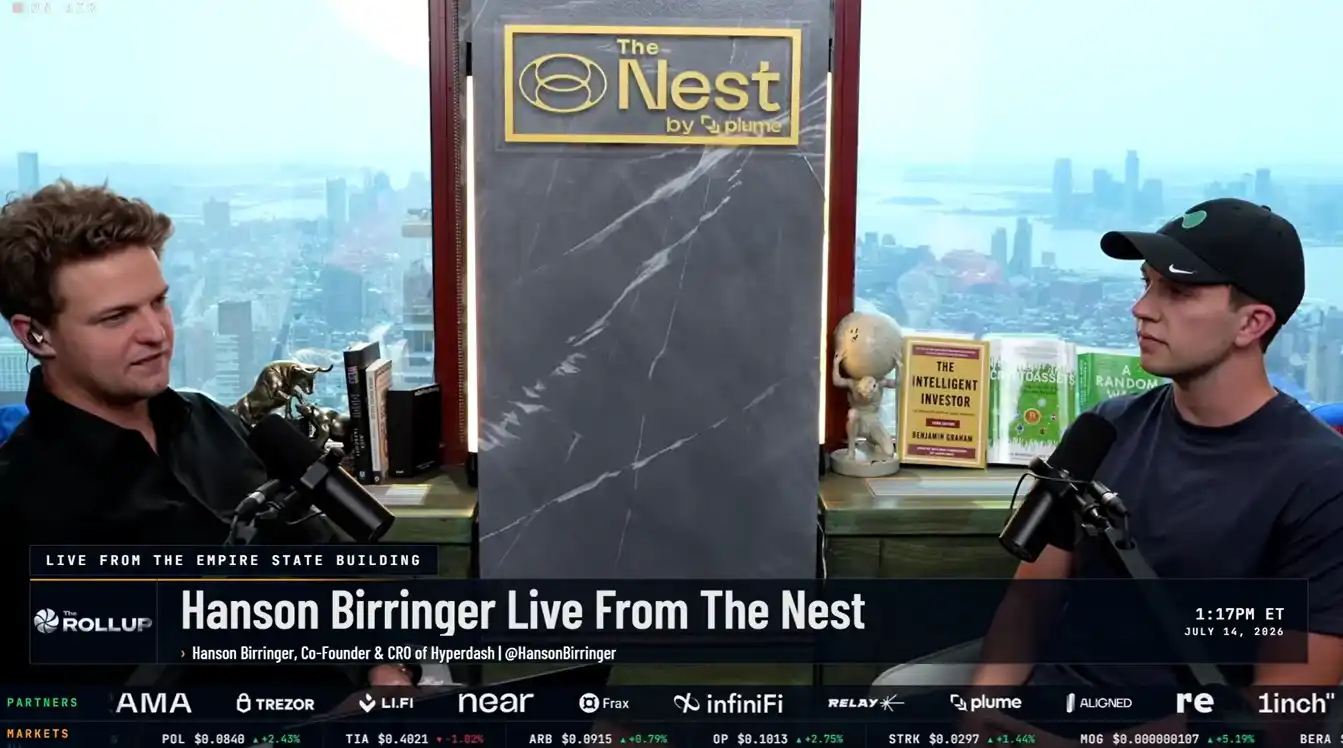
Host: How has the month been?
Hanson: An amazing month. We've released a lot of announcements. For example, I officially joined HyperDEX full-time, announced the acquisition of Imperator, so we are now launching a full-fledged data and node infrastructure validator business. Really looking forward to the Hyperliquid summit later this week. In short, it's an exciting time to be building in the Hyperliquid ecosystem right now.
Host: I think over the past few years, the investment thesis around Hyperliquid has evolved significantly as the products and the development of tokenization and trading have changed. Could you perhaps share what your current investment thesis for Hyperliquid is? When you're raising funds for the Grayscale ETF's SPV and speaking with high-net-worth individuals and institutional allocators, what logic really resonates with them?
Hanson: This is one of my favorite topics. We can talk about why Hyperliquid is not just important for crypto capital markets, but also for the broader traditional financial markets that are co-evolving. I think, at its core, the reasons investors, researchers, traders, and market participants are so excited about and want to participate in what Hyperliquid is building are multifaceted. Firstly, it is open-source, permissionless, and decentralized. It has the same rules for every participant on the platform. Furthermore, it not only embodies the spirit of cryptocurrency but also combines it with a high-performance financial system and applications that can genuinely allow institutional capital to participate in this decentralized world, something we haven't seen before. In my decade-long crypto career, it's truly the only project that has allowed these two worlds to truly co-evolve rather than exist separately.
Host: How do you view Hyperliquid as a way to express a bullish view on the trends of perpetual contracts, tokenization, and stablecoins? How do you see the combination of these three super-trends, destined for exponential, decade-long growth? Is Hyperliquid a good vehicle for expressing all three?
Hanson: Absolutely, it's the purest expression of these trends. Regarding perpetual contracts, the answer is obvious. Hypercore is the leading perpetual DEX, competing with centralized exchanges. Looking at market share by open interest (OI) and trading volume, or from a liquidity perspective, it's already a top-tier, even number one or two market for certain trading pairs. It's also a category leader in launching new asset types. We saw the launch of HIP-3 introducing RWA perpetuals. So you're actually combining these larger trends into a single, fantastic product. Regarding trading commodity and stock perpetuals, Hyperliquid today is already the de facto category leader among crypto exchanges. What they've done is truly open-sourcing the builder layer instead of outsourcing it. This is at the core of the Hyperliquid ethos: enabling other high-quality, capable builders to come in and start adding value to the ecosystem.
As for stablecoins, USDC becoming the core quote asset, I don't think the market has truly grasped how significant this move is. Because since these stablecoins were born, they've never done a deal like this. They voluntarily gave up 90% of the revenue just to be part of the Hyperliquid narrative, which I think is something important for people to really digest and understand, not just from a narrative angle, but also from a revenue perspective. Considering the trading volume and activity on the exchange, there's roughly about $10 billion in stablecoin supply on Hyperliquid, HyperEVM, and Hypercore combined currently. Of this $10 billion, assuming a 4% net spread earned on the back-end US Treasuries, 90% of that yield goes into the aid fund and is used to programmatically buy back Hype tokens on-chain. That adds hundreds of millions of dollars in buy pressure for the protocol, on top of the trading fees.
So, to summarize your question, Hype, as a token and an ecosystem, really is the purest expression of the three crypto super-trends of perpetuals, RWA, and stablecoins, and they compound on each other over time.
Host: Jeff once mentioned that Hyperliquid is like AWS for liquidity; liquidity begets more liquidity. But there's a headwind: strictly regulated consumer-facing frontends like Robinhood, Kalshi, find it difficult to directly plug into this system. How do you view this regulatory headwind?
Hanson: This is a global challenge, but Hyperliquid is proactively addressing it. The Hyperliquid Policy Center and wallet provider Phantom are actively lobbying US regulators (like the CFTC) to seek clear regulatory positioning for decentralized trading venues. Once achieved, traditionally regulated broker frontends could directly route orders to Hyperliquid's backend for execution. Furthermore, traditional brokers disrupted the industry with "zero commissions" back in the day, and now Hyperliquid offers highly competitive, low-cost underlying liquidity, which is a massive market.
Host: Recently, HLP 3 (RWA markets) open interest (OI) hit an all-time high. Considering stablecoin yield and priority fees, how do you anticipate Hyperliquid's revenue growth story over the next year or two?
Hanson: Traditional financial markets are incredibly vast. Nominal trading volumes for some options and ETFs are in the trillions or even quadrillions. If RWA perpetuals can capture even a small fraction of the global trading volume, Hyperliquid's revenue has the potential to grow 100x over the next decade. As trading volume grows, the margin on the protocol will also surge, further amplifying the scale of stablecoin yield and token buybacks.
Host: You established Hyper Holdings and helped facilitate the launch of the Grayscale Hyperliquid ETF. What was the thinking behind this?
Hanson: Hyper Holdings Global is a special purpose vehicle (SPV). We set up the SPV and provided seed capital in-kind to the Grayscale ETF. Traditional institutional investors often don't have Coinbase accounts and face stringent risk and compliance friction. ETFs provide them with a one-click investment path, and our capital backing ensured the product's initial assets under management (AUM) and liquidity, allowing large funds to enter and exit comfortably. Institutional investors place great value on Hyperliquid's clear "cash flow + token buyback" business model, which is much easier to value than other blockchain networks.
Host: HyperDash has processed over $35 billion in trading volume. You recently acquired Imperator, an institutional-grade data company. What value does this bring to the platform?
Hanson: HyperDash is essentially a global brokerage and trading data terminal, offering more advanced tools than the official frontend. After acquiring Imperator, we became an active validating node on Hyperliquid, able to process on-chain data at the fastest speed. This not only enhances the trading experience for retail users but also allows us to offer enterprise-grade data packages to traditional asset management companies, aiding their investment underwriting and decision-making assessments.
Host: Regarding Hyperliquid, what are your bullish and bearish predictions? Not necessarily price-wise, but from your perspective, for HyperDash, Hyper Holdings, and the entire Hyperliquid ecosystem to achieve the most optimistic outcome over the next 18 months, what needs to go smoothly? And in your view, what would a moderate or bearish scenario look like?
Hanson: The bullish thesis is very clear. The integration of stablecoins and local fiat on-ramps allows people globally, who were previously excluded from dollar capital markets, to access global liquidity with just a few taps on their phones. This is something unprecedented in human history. As for the bearish thesis, I struggle to find one. Unless the long-term trends of global internet penetration and financial inclusion reverse, we have every reason to remain extremely optimistic.
Related reading: After Supporting Half of Hyperliquid, Trade.XYZ's Token Speculation Worries the Community...