‘40% of long-term supply under loss’ – Why Fidelity foresees Bitcoin cycle bottom

ambcryptoPublished on 2026-07-17Last updated on 2026-07-17

Abstract

Bitcoin is showing signs of potentially forming a market cycle bottom, according to Fidelity. Analyst Zack Wainwright notes that long-term holders now possess a near-record 15 million BTC, with over 40% of this supply held at a loss—a level historically associated with bottoming phases. Data shows the supply in loss recently climbed to 50% as Bitcoin fell below $63,000, mirroring patterns seen at past cycle lows like the 2022 bottom near $16,000. However, recovery may face headwinds. U.S. spot Bitcoin ETF demand remains muted, with significant institutional outflows persisting, particularly from giants like BlackRock and Fidelity. Analysts suggest any sustained price recovery requires a reversal in this institutional selling pressure. Options market activity reflects caution, with high trading volumes for put options (bearish bets) targeting $62.5K and $56K, indicating hedging against further downside. While there is also call option interest at higher prices, signaling potential for a sideways range between $55K and $70K, the overall sentiment suggests $60K is a critical support level. Analysts warn that despite bottoming signals, sharp moves below $60K are possible amid ongoing macroeconomic and geopolitical pressures.

After a persistent downturn since last October, Bitcoin is showing signs of forming a market cycle bottom.

According to Fidelity Research Analyst Zack Wainwright, long-term holders (those who’ve held for over six months) are nearing a record 15 million BTC.

At the same time, over 40% of this supply is underwater, mirroring past historical patterns.

Nearly 40% of that supply is now at a loss—a level that has previously aligned with bitcoin’s bottoming process. The key question: Is history starting to rhyme?

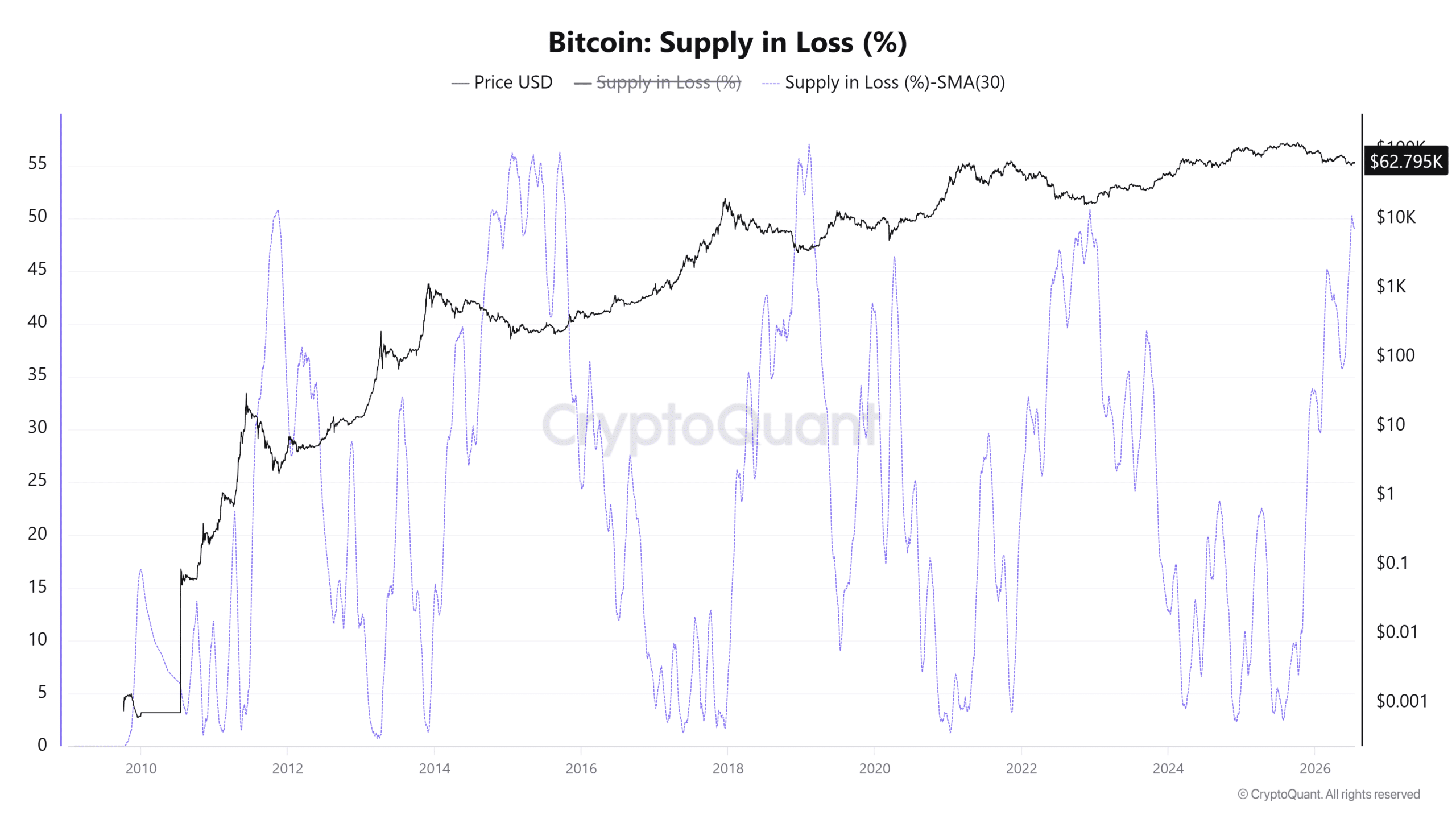
On a 30-day average, the BTC supply in loss had climbed to 50% as the asset slipped below $63K on Friday, 17th of July.
Source: CryptoQuant

In the past, BTC bottomed out when supply in loss hit around 46%-56%. In 2022, BTC marked a bottom near $16K, and the supply in loss peaked at 50%.

Although history rhymes, past patterns don’t always predict future outcomes. In fact, ongoing macro and geopolitical pressures could limit risk appetite for crypto and the U.S equity market in Q3, according to other analysts. And institutional demand is already reinforcing this.

U.S. Spot Bitcoin ETF demand remains muted

Despite recording three consecutive days of inflows since Tuesday, U.S. Spot BTC ETFs have been muted on a month-over-month average.

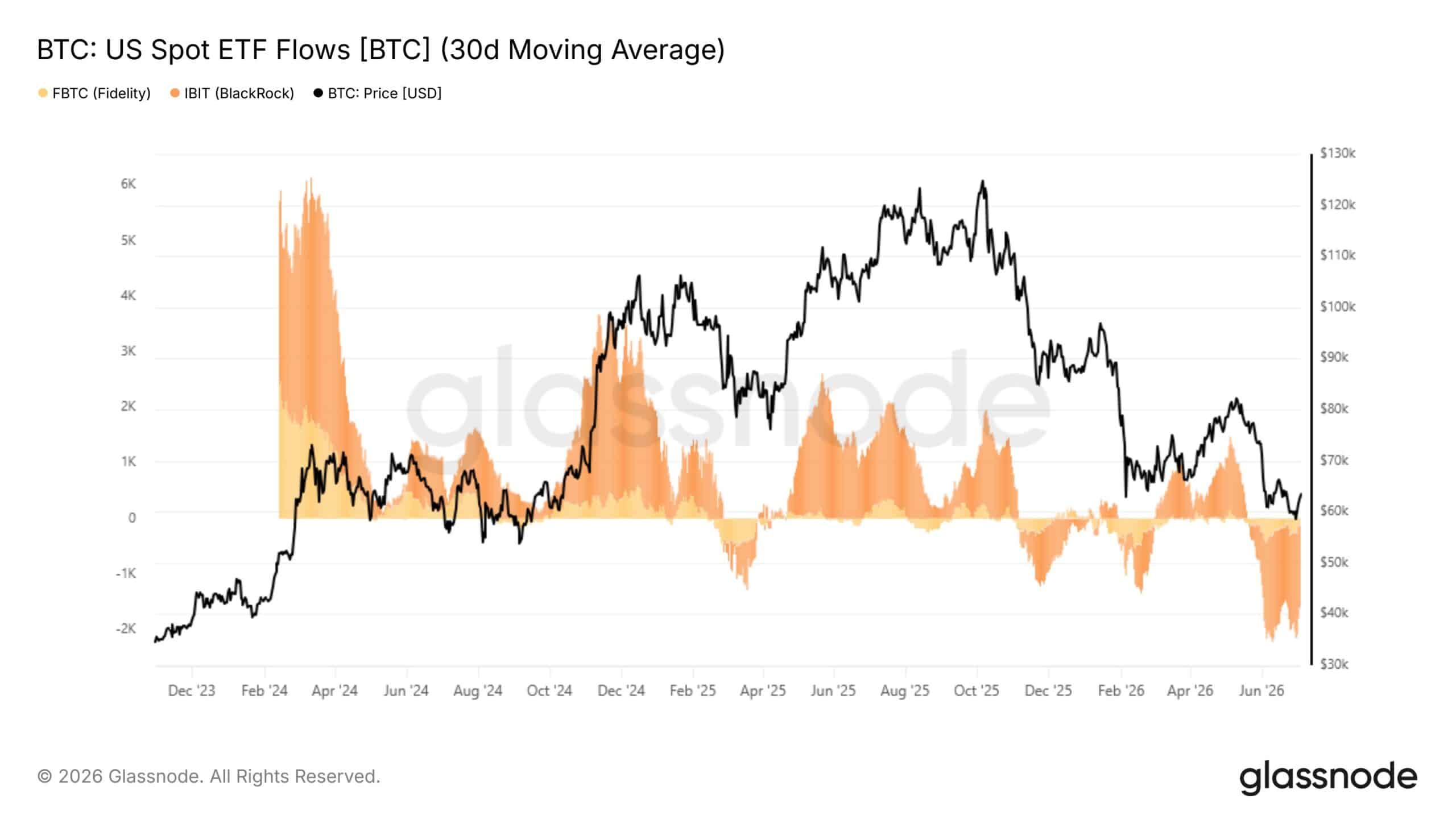
According to Glassnode, the two largest entities, BlackRock and Fidelity, have seen a sustained institutional sell-off that rivals 2025.
Source: Glassnode

The 30-day average ETF outflows hit over 2K BTC per day in June and early July. This has eased slightly to about 1,250 BTC per day this week, but the speculative interest has also dropped, as indicated by ETF trade volumes.

For Glassnode, this meant any potential BTC price recovery could be delayed unless institutional demand improves.

Both directional conviction and activity levels among the top two ETF vehicles remain deeply muted. Any durable recovery will need this dynamic to reverse meaningfully.

As of writing, Bitcoin [BTC] traded at $62.8K, down 4% and close to erasing all the gains made after the relief rally triggered by a softer CPI print.

And institutions and professional traders were not ruling out further pullback, as shown by Options positioning.

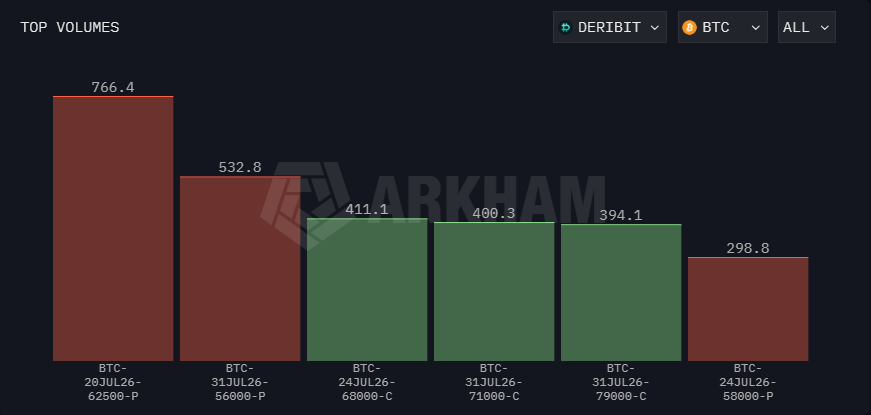
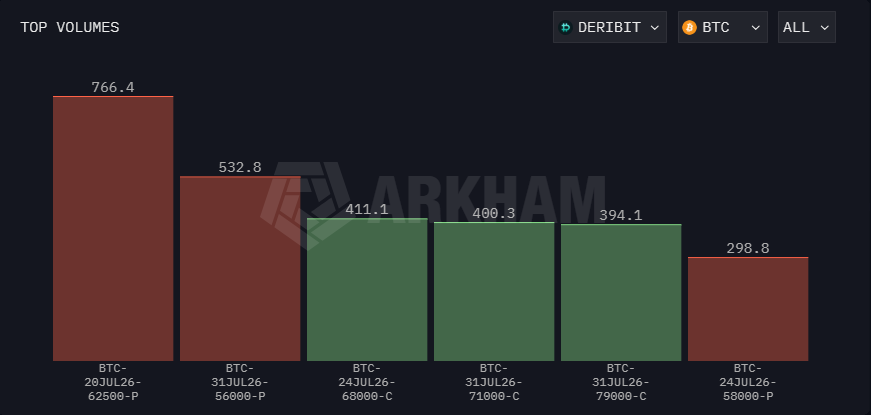
In the past 24 hours, the top Options volumes were concentrated at $62.5K and $56K price targets for puts (bearish bets), underscoring massive hedging for further downside protection.
Source: Arkham

Still, there was significant volume for calls (bullish bets, green bars) eyeing $68K and $79K. This underscored a potential sideways structure expectation in July between $55K-$70K.

Overall, $60K has been a key support, and metrics signal that it could become a potential market cycle bottom. However, sharp moves below $60K can’t be overruled in the short term amid macro headwinds.


Final Summary

  • Fidelity projected that Bitcoin was likely in the cycle bottoming phase as supply in loss hit +40%
  • In the meantime, traders were betting BTC price could slide to $62.5K or $56K this month

Trending Cryptos

Related Questions

QAccording to Fidelity, what historical pattern suggests Bitcoin may be forming a market cycle bottom?

AFidelity notes that over 40% of the long-term holder supply (held for over six months) is currently at a loss, a level that has historically aligned with Bitcoin's bottoming process.

QWhat level did the 30-day average of BTC supply in loss reach as the price fell below $63K in mid-July?

AOn a 30-day average, the BTC supply in loss had climbed to 50% as the asset's price slipped below $63K on Friday, July 17th.

QWhat is the current trend regarding institutional demand for U.S. Spot Bitcoin ETFs according to Glassnode?

AInstitutional demand for U.S. Spot Bitcoin ETFs remains muted. The two largest entities, BlackRock and Fidelity, have seen a sustained institutional sell-off, and the 30-day average ETF outflows have been significant, though they eased slightly in the reporting week.

QBased on recent options trading activity, what are the two key downside price targets (puts) that traders are hedging for?

AIn the past 24 hours, the top Options volumes for puts (bearish bets) were concentrated at the $62.5K and $56K price targets, indicating massive hedging for further downside protection.

QWhat is the overall key support level for Bitcoin mentioned in the article, and what is the potential short-term risk?

AThe overall key support level for Bitcoin is $60K, and metrics signal it could become a potential market cycle bottom. However, sharp moves below $60K can't be overruled in the short term amid macro headwinds.

Related Reads

With Less Than 1% Support, Will BIP-110 Still Force a Bitcoin Soft Fork?

**English Summary:** Despite garnering minimal support (less than 1% from miners and around 14.6% of nodes), the controversial BIP-110 proposal is poised to enter its "forced activation" window in early August. Proposed in December 2025 by Dathon Ohm and backed by Bitcoin Core developer Luke Dashjr, BIP-110 aims to temporarily restrict non-monetary data (like Ordinals and Bitcoin NFTs) in transactions for one year to reduce network "spam" and refocus Bitcoin on its monetary function. The proposal's contentious mechanism means that supporting nodes will enforce the new rules starting at block height 965,664 (late August/early September), even without reaching the 55% activation threshold. This will likely cause a chain split between nodes enforcing BIP-110 and the main chain. **Supporters**, led by Luke Dashjr and his Ocean mining pool, view BIP-110 as a necessary correction to stop what they consider an "attack" on Bitcoin—the use of block space for data storage, which they argue drives up transaction fees and burdens nodes. They believe the stricter BIP-110 chain could eventually become the longest chain. **Opponents**, including figures like Adam Back, Jameson Lopp, and Michael Saylor, argue that BIP-110 fails to solve core issues while creating new risks. Their concerns include stifling future innovation (e.g., hindering BitVM), compromising Bitcoin's censorship-resistant and decentralized ethos, introducing potential chain-split uncertainties like double-spend risks, and fracturing the ecosystem's resources and consensus. They maintain the proposal addresses a cultural problem with a flawed technical solution and are confident it will fail economically. Potential outcomes post-activation range from the BIP-110 chain stalling due to insufficient miner support, to a sustained minority chain that struggles to attract economic activity, potentially leading to a permanent hard fork—an outcome Luke Dashjr currently opposes. Most analysts and prediction markets assign a low probability (around 10%) to BIP-110 successfully becoming the dominant Bitcoin chain.

Odaily星球日报12m ago

With Less Than 1% Support, Will BIP-110 Still Force a Bitcoin Soft Fork?

Odaily星球日报12m ago

CLARITY Act Delays Have Become a Compliance Crisis, Not Just a Political Impasse

A year after the passage of three landmark digital asset bills in the U.S. House of Representatives, two have become law, while the critical CLARITY Act remains stalled in the Senate. This bill, which would definitively classify digital assets as either securities (SEC-regulated) or commodities (CFTC-regulated), has evolved from a political issue into a pressing compliance deadline for businesses. The ongoing delay perpetuates significant regulatory uncertainty, forcing companies to navigate a "regulation by enforcement" landscape that complicates governance, risk management, and strategic planning. With the Senate's legislative window rapidly closing before the August recess, the failure to pass the CLARITY Act could postpone comprehensive market structure legislation for years. Major sticking points in the Senate include ethical concerns over officials' crypto holdings, law enforcement opposition to certain liability shields, potential loopholes in stablecoin regulations, and vacancies at the key regulatory agencies (SEC and CFTC). This impasse stands in contrast to other jurisdictions, like South Africa, which are advancing with clear regulatory frameworks. Regardless of the legislative outcome, compliance leaders are urged to proactively audit their digital asset exposures, document their compliance rationale, and prepare contingency plans for both regulatory scenarios. The clarity promised by Congress remains incomplete, and businesses must prepare for either outcome.

marsbit12m ago

CLARITY Act Delays Have Become a Compliance Crisis, Not Just a Political Impasse

marsbit12m ago

Trump’s Teleprompter Operator Investigated for Insider Trading, "Whistleblower" Turns Out to Be Prediction Platform Kalshi

According to reports from CNBC and ABC, a longtime teleprompter operator for President Trump, Gabriel Perez, is under federal investigation for allegedly using insider information to place bets on the prediction market platform Kalshi. Perez, who had handled Trump's speeches since 2016, is suspected of trading on over a dozen upcoming presidential addresses, including the State of the Union, based on his advance knowledge of speech content. Kalshi's monitoring systems flagged the atypical trading patterns in March, leading to his account being frozen and the case being referred to the Commodity Futures Trading Commission (CFTC). Perez reportedly profited over $90,000, though most funds are held by the platform. He is now in settlement talks with the CFTC and has been placed on unpaid leave by the White House. This incident is part of a broader pattern of insider trading on prediction markets. Similar cases involve a congressional candidate betting against his own attendance, military personnel using classified information, and a Google engineer trading on internal data. The growing liquidity of these markets, with some contracts seeing over $150,000 in volume, creates incentives for abuse. In response, platforms like Kalshi are enhancing monitoring, requiring occupational disclosures, and cooperating with regulators. The CFTC and the Justice Department are pursuing civil and criminal actions, while the White House has issued memos explicitly barring staff from such trading.

Foresight News21m ago

Trump’s Teleprompter Operator Investigated for Insider Trading, "Whistleblower" Turns Out to Be Prediction Platform Kalshi

Foresight News21m ago

CLARITY Act Delays Have Become a Compliance Crisis, Not Just a Political Stalemate

The article discusses the ongoing delay in the US Senate regarding the CLARITY Act, a bill intended to clarify the regulatory status of digital assets as either securities under the SEC or commodities under the CFTC. A year after the House passed it, this inaction is creating a concrete governance, risk, and compliance crisis for businesses, moving beyond mere political gridlock. While related bills for stablecoins and CBDC prohibitions have become law, the comprehensive CLARITY Act remains stalled. The delay creates profound uncertainty for companies on fundamental rules for exchanges, custodians, and all market participants. Without clear congressional action, regulatory classification depends on shifting enforcement actions and presidential administrations, making stable compliance impossible. The Senate's window for action is narrowing, with key votes needed before the August recess. Several major issues are blocking passage, including ethical concerns over crypto holdings by officials, law enforcement opposition to certain provisions, perceived loopholes for stablecoin rewards, and regulatory agency vacancies at the SEC and CFTC. Bipartisan support is fragile. Further delay risks postponing the legislation until 2030, perpetuating a costly "regulation by enforcement" environment. In contrast, passage would provide a durable regulatory framework. Regardless of the outcome, compliance leaders are urged to immediately map their digital asset exposures, prepare governance materials for both scenarios, and stress-test their arrangements. The article concludes that while the Senate's action is uncertain, corporate preparedness is not.

Foresight News51m ago

CLARITY Act Delays Have Become a Compliance Crisis, Not Just a Political Stalemate

Foresight News51m ago

Trading

Spot

Hot Articles

What is $BITCOIN

DIGITAL GOLD ($BITCOIN): A Comprehensive Analysis Introduction to DIGITAL GOLD ($BITCOIN) DIGITAL GOLD ($BITCOIN) is a blockchain-based project operating on the Solana network, which aims to combine the characteristics of traditional precious metals with the innovation of decentralized technologies. While it shares a name with Bitcoin, often referred to as “digital gold” due to its perception as a store of value, DIGITAL GOLD is a separate token designed to create a unique ecosystem within the Web3 landscape. Its goal is to position itself as a viable alternative digital asset, although specifics regarding its applications and functionalities are still developing. What is DIGITAL GOLD ($BITCOIN)? DIGITAL GOLD ($BITCOIN) is a cryptocurrency token explicitly designed for use on the Solana blockchain. In contrast to Bitcoin, which provides a widely recognized value storage role, this token appears to focus on broader applications and characteristics. Notable aspects include: Blockchain Infrastructure: The token is built on the Solana blockchain, known for its capacity to handle high-speed and low-cost transactions. Supply Dynamics: DIGITAL GOLD has a maximum supply capped at 100 quadrillion tokens (100P $BITCOIN), although details regarding its circulating supply are currently undisclosed. Utility: While precise functionalities are not explicitly outlined, there are indications that the token could be utilized for various applications, potentially involving decentralized applications (dApps) or asset tokenization strategies. Who is the Creator of DIGITAL GOLD ($BITCOIN)? At present, the identity of the creators and development team behind DIGITAL GOLD ($BITCOIN) remains unknown. This situation is typical among many innovative projects within the blockchain space, particularly those aligning with decentralized finance and meme coin phenomena. While such anonymity may foster a community-driven culture, it intensifies concerns about governance and accountability. Who are the Investors of DIGITAL GOLD ($BITCOIN)? The available information indicates that DIGITAL GOLD ($BITCOIN) does not have any known institutional backers or prominent venture capital investments. The project seems to operate on a peer-to-peer model focused on community support and adoption rather than traditional funding routes. Its activity and liquidity are primarily situated on decentralized exchanges (DEXs), such as PumpSwap, rather than established centralized trading platforms, further highlighting its grassroots approach. How DIGITAL GOLD ($BITCOIN) Works The operational mechanics of DIGITAL GOLD ($BITCOIN) can be elaborated on based on its blockchain design and network attributes: Consensus Mechanism: By leveraging Solana’s unique proof-of-history (PoH) combined with a proof-of-stake (PoS) model, the project ensures efficient transaction validation contributing to the network's high performance. Tokenomics: While specific deflationary mechanisms have not been extensively detailed, the vast maximum token supply implies that it may cater to microtransactions or niche use cases that are still to be defined. Interoperability: There exists the potential for integration with Solana’s broader ecosystem, including various decentralized finance (DeFi) platforms. However, the details regarding specific integrations remain unspecified. Timeline of Key Events Here is a timeline that highlights significant milestones concerning DIGITAL GOLD ($BITCOIN): 2023: The initial deployment of the token occurs on the Solana blockchain, marked by its contract address. 2024: DIGITAL GOLD gains visibility as it becomes available for trading on decentralized exchanges like PumpSwap, allowing users to trade it against SOL. 2025: The project witnesses sporadic trading activity and potential interest in community-led engagements, although no noteworthy partnerships or technical advancements have been documented as of yet. Critical Analysis Strengths Scalability: The underlying Solana infrastructure supports high transaction volumes, which could enhance the utility of $BITCOIN in various transaction scenarios. Accessibility: The potential low trading price per token could attract retail investors, facilitating wider participation due to fractional ownership opportunities. Risks Lack of Transparency: The absence of publicly known backers, developers, or an audit process may yield skepticism regarding the project's sustainability and trustworthiness. Market Volatility: The trading activity is heavily reliant on speculative behavior, which can result in significant price volatility and uncertainty for investors. Conclusion DIGITAL GOLD ($BITCOIN) emerges as an intriguing yet ambiguous project within the rapidly evolving Solana ecosystem. While it attempts to leverage the “digital gold” narrative, its departure from Bitcoin's established role as a store of value underscores the need for a clearer differentiation of its intended utility and governance structure. Future acceptance and adoption will likely depend on addressing the current opacity and defining its operational and economic strategies more explicitly. Note: This report encompasses synthesised information available as of October 2023, and developments may have transpired beyond the research period.

849 Total ViewsPublished 2025.05.13Updated 2025.05.13

What is $BITCOIN

Discussions

Welcome to the HTX Community. Here, you can stay informed about the latest platform developments and gain access to professional market insights. Users' opinions on the price of BTC (BTC) are presented below.

活动图片