CryptoQuant Founder: The Cost to Double BTC Has Increased by 20,000 Times, Where Will the $100 Billion Buying Power Come From?

marsbitPublished on 2026-07-07Last updated on 2026-07-07

Abstract

CryptoQuant founder Ki Young Ju analyzes Bitcoin's current capital challenge. He notes that the cryptocurrency market has grown too large for retail-driven momentum alone to generate massive price increases as in past cycles. His calculations show that in 2011, approximately $2.7 million in capital inflow could push BTC's price up by 550x, whereas the current cycle requires an estimated $101 billion in new capital just for a 100% price increase. This shift underscores that sustaining a bull run now depends on attracting large-scale, long-term institutional capital rather than short-term speculative trading. Recent outflows from US spot Bitcoin ETFs, totaling nearly $10 billion since May, highlight the fragility of current demand and challenge the narrative of deep institutional support. While surveys indicate continued institutional interest, these entities prioritize regulated products, risk management, and portfolio integration over speculative gains. For the next significant bull market, Bitcoin must transition to being a core macro asset. The key drivers are no longer just more buyers, but capital allocation from larger, slower-moving entities like wealth advisors, corporate treasuries, banks, and sovereign wealth funds. This new phase pits Bitcoin against other major asset classes like AI for a share of institutional capital, making its growth trajectory dependent on sustained, high-quality inflows from diversified financial balance sheets.

Author: CryptoSlate

Compiled by: Deep Tide TechFlow

Deep Tide Introduction: ETF outflows, institutional wait-and-see, AI capturing investor attention... Bitcoin has grown too large to be moved by retail investors alone. CryptoQuant founder Ki Young Ju did the math: In 2011, $2.7 million could push BTC up 550 times; now, it takes $101 billion to double it. Whether the next bull market arrives depends on whether wealth advisors, corporate treasuries, banks, and sovereign funds are willing to treat BTC as a long-term allocation rather than a short-term trade.

Bitcoin's next major rally may no longer depend on whether investors believe in the asset, but on how much major capital is willing to participate with real money.

The latest analysis from CryptoQuant CEO Ki Young Ju shows that the world's largest cryptocurrency has matured into a market too large to be easily propelled as it was in early cycles. According to him, each bull cycle requires more capital to produce smaller percentage gains, a shift that raises the threshold for another parabolic rally.

This is particularly relevant now as BTC is in a prolonged bear market, having fallen to around $63,000, down 50% from the peak above $126,000 recorded last October.

This pullback tests the institutional adoption that helped push the asset into mainstream portfolios. The core question now is whether Bitcoin can attract enough persistent capital to offset its declining price sensitivity.

A Larger Market Changes the Cycle Math

Bitcoin's early rallies were built on a much smaller base, allowing small amounts of new money to produce massive price changes. This relationship has diminished as the asset has matured.

Ju's analysis compares the growth in Bitcoin's realized capitalization across several bull cycles with the subsequent price gains. Realized capitalization calculates coins at their last on-chain move price, making it a common proxy for the amount of capital absorbed by the network.

Ju said that in the 2011 cycle, roughly $27 million in net capital inflow was associated with a roughly 55,000% price gain.

The current cycle has absorbed about $697 billion, producing about a 689% gain, highlighting how much more capital is needed to generate smaller gains as the asset scales.
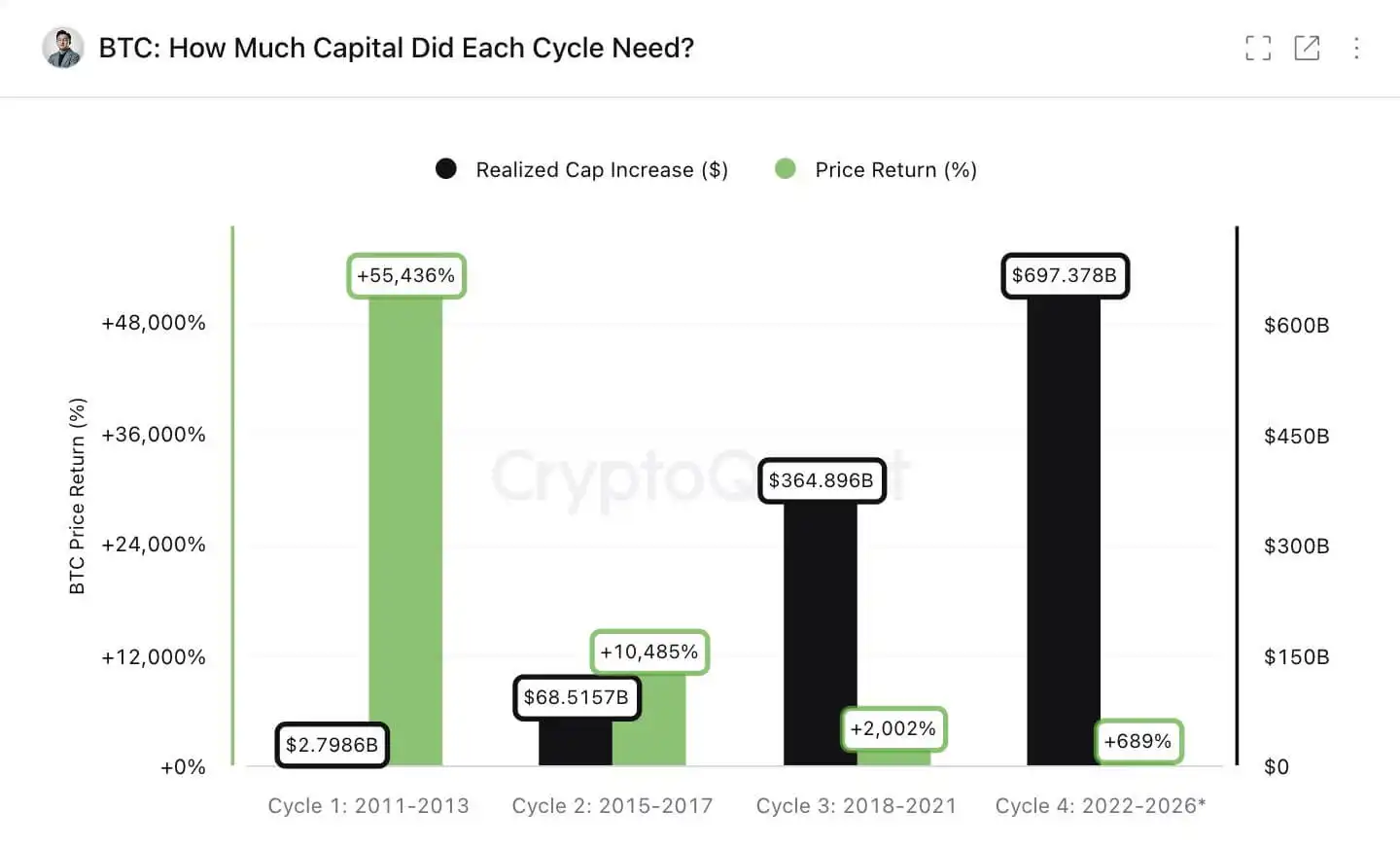
Figure: Bitcoin Price Returns vs Realized Cap Gains

Source: CryptoQuant

The same pattern appears in smaller increments. Ju said that around $5 million in new money was enough to double the Bitcoin price in 2011. In the current cycle, that figure is around $101 billion.

While this doesn't end the bullish thesis around BTC, it changes the type of demand needed to sustain it.

Ju argues another major rally is still possible if Bitcoin becomes a deeper macro allocation. "Bitcoin needs to become a core macro asset," he wrote, adding that the market can no longer rely solely on retail-dominated ETF trading.

This perspective frames Bitcoin's next cycle as a test of financial market integration. Supply shocks from halvings still reduce new issuance, but the growth trajectory increasingly depends on whether capital allocators treat Bitcoin as a recurring portfolio position rather than a tactical trade.

ETF Outflows Weaken the Near-Term Setup

This test arrives as the market's most visible institutional vehicle hits a rough patch.

U.S. spot Bitcoin ETFs helped broaden access following their 2024 launch, offering advisors, hedge funds, and traditional investors a regulated path to the asset. But recent flows have turned negative, undercutting the argument that institutional demand is already deep enough to support another major rally.

Data from Santiment shows nearly $10 billion in outflows from Bitcoin ETFs since early May, with the 12 products currently on an eight-week streak of outflows.

Addressing these numbers, the BTC-focused analytics platform Ecoinometrics said:

"The pattern since May has been very one-sided. Every attempt to rebuild buying momentum almost immediately stalls. Bitcoin ETFs have failed to achieve more than a single day of inflows, while outflow streaks repeatedly last for days, culminating in the longest outflow streak since the ETFs launched."
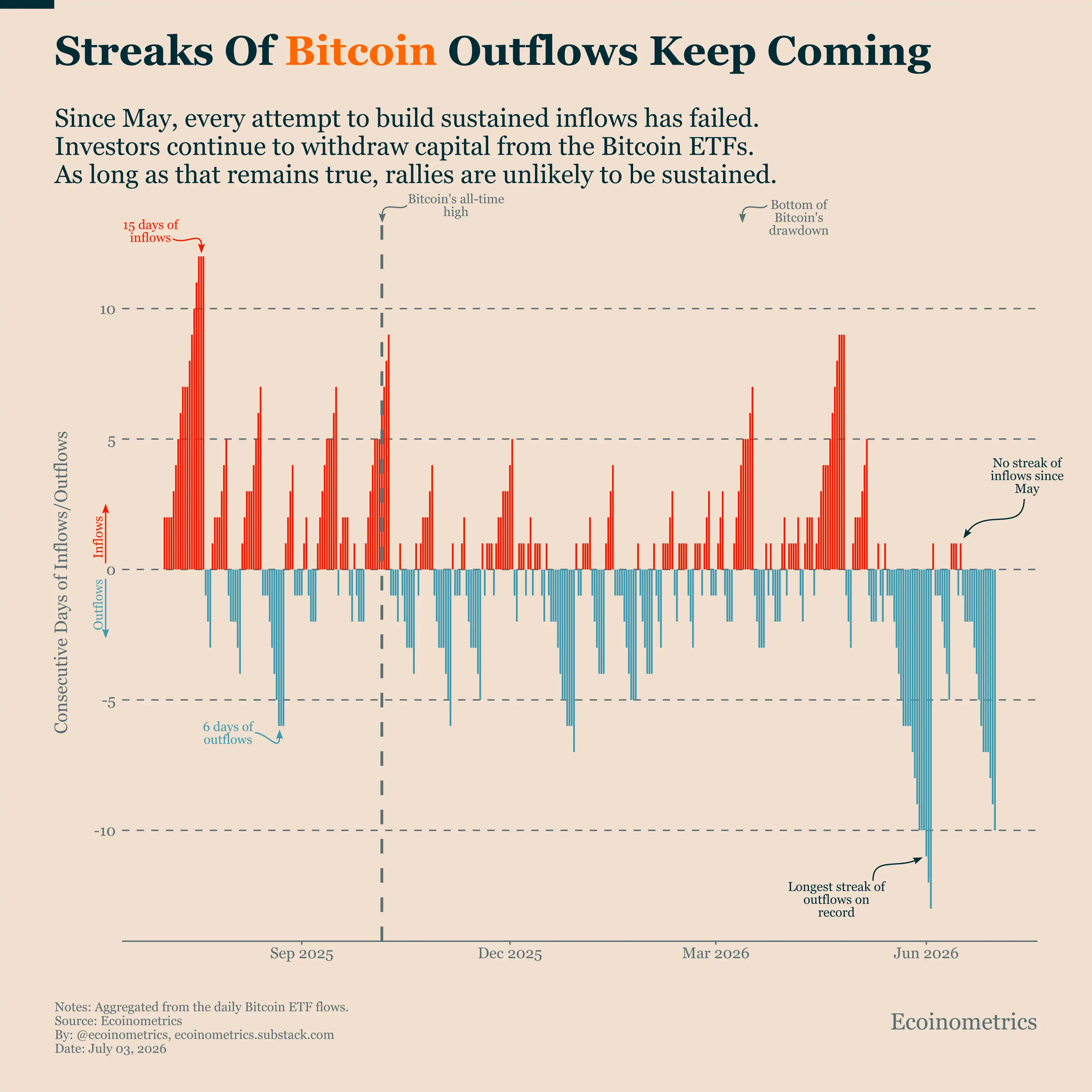
Figure: Bitcoin ETF Outflows

Source: Ecoinometrics

These outflows complicate a rapid return to highs. Bitcoin's October record came during a period when investors were still rewarding ETF access and treating the asset as a beneficiary of friendlier policies, institutional participation, and broader links to global markets.

Now, the ETF weakness suggests access alone is insufficient. The next phase of adoption requires steadier allocations across wealth platforms, model portfolios, corporate balance sheets, and other capital pools that move more slowly than retail traders but can deploy at larger scale.

For Bitcoin, this creates a demand landscape that is higher quality but harder to win. Institutions may bring bigger checks, but they also require liquidity, risk controls, custody standards, portfolio mandates, and compliance approval before allocations become durable.

Institutions Are Still Engaging, But With Stricter Standards

Despite these substantial outflows, survey data from Coinbase suggests institutional interest hasn't vanished.

A January 2026 survey of 351 institutional decision-makers by Coinbase and EY-Parthenon found nearly three-quarters plan to increase crypto allocations, while 74% expect crypto prices to rise in the next 12 months.

The same survey found 49% are placing more emphasis on risk management, liquidity, and position sizing.

This combination matters for Bitcoin's capital problem. Institutions don't approach crypto with the same behaviors that defined early retail-led cycles.

They are more likely to demand regulated products, clear governance, operational resilience, and defined exposure limits.

The survey found 66% of respondents already have exposure through spot crypto ETFs or exchange-traded products, while 81% prefer spot exposure through registered vehicles.

These findings support the view that regulated wrapper products remain central to the next adoption phase.

However, they also show why the recent ETF outflows are a pressure point. If ETFs are the primary institutional on-ramp, sustained weakness in these products could slow the broader allocation process.

Thus, Bitcoin's capital-efficiency problem cuts both ways. Its larger scale may make the asset more acceptable to traditional finance.

But that scale also means marginal buyers must be larger, more consistent, and less speculative than those driving early cycles.

Bitcoin's Next Buyers Must Compete With the Rest of Wall Street

This makes Bitcoin's next cycle dependent on a broader set of investors than the retail traders and crypto-native funds that powered early rallies.

Michael Saylor, executive chairman of MicroStrategy, argues Bitcoin's next decade will be less driven by miner issuance and more by capital flows across financial markets. MicroStrategy is the largest corporate holder of Bitcoin, making Saylor one of the most visible advocates for treating the asset as a balance-sheet tool rather than a speculative trade.

According to him:

"Over the next decade, Bitcoin's trajectory will be less driven by miner issuance and more by capital flows. ETF flows. Corporate treasury flows. Sovereign reserve flows. Banking credit flows. Derivative flows. Insurance flows. Collateral flows. Structured credit flows. Global savings flows. Halvings tighten supply. Capital flows set the growth trajectory. This is the next phase of Bitcoin adoption: not just more buyers, but more balance sheets."

The emphasis is that Bitcoin's supply story is no longer novel. Its issuance schedule is known, halving cycles are understood, and the asset already trades at a scale that requires larger pools of capital to move it meaningfully.

Therefore, any new repricing must come from demand channels capable of absorbing a market valued over $1 trillion.

This means ETF demand is only part of the shift. A stronger cycle may require advisors adding Bitcoin to model portfolios, companies using it more aggressively on balance sheets, banks building credit products around it, insurers and asset managers viewing it as a macro allocation, and sovereign entities considering exposure over time.

This shift may be slower than retail momentum cycles. It will also expose Bitcoin more to rate expectations, regulatory delays, liquidity shocks, and competition with other markets chasing the same institutional capital.

Notably, artificial intelligence has emerged as one of those competitors. AI-related assets and infrastructure have absorbed a significant portion of investor attention this year, with spending and investment forecasts reaching trillions.

In earlier crypto cycles, looser speculative capital might have flowed more easily into Bitcoin. In today's market, Bitcoin must compete for the same pool of institutional capital against AI stocks, private infrastructure deals, credit products, commodities, and other macro trades.

That competition is now at the center of the Bitcoin cycle debate. The asset is large enough to enter mainstream allocation conversations, but that also means it gets compared against every other major capital use.

The views expressed in this article are those of the author alone and do not represent the views of CryptoSlate. Nothing you read on CryptoSlate should be taken as investment advice, nor does CryptoSlate endorse any projects mentioned or linked in this article. Buying and trading cryptocurrencies should be considered a high-risk activity. Please conduct your own due diligence before taking any action related to the content of this article. Finally, CryptoSlate assumes no liability for any losses incurred while trading cryptocurrencies. Please refer to our company disclaimer for more information.


Trending Cryptos

Related Questions

QAccording to the CryptoQuant founder, how has the capital required to double Bitcoin's price changed from 2011 to the current cycle?

AIn 2011, approximately $5 million in new capital was enough to double Bitcoin's price. In the current cycle, that number has risen to about $101 billion, representing a roughly 20,000-fold increase in the capital efficiency cost for generating the same percentage gain.

QWhat does the article suggest is the new key factor for Bitcoin's next major bull run, as opposed to earlier cycles?

AThe article suggests that Bitcoin's next major bull run depends less on investor belief and more on whether large, institutional capital (like wealth advisors, corporate treasuries, banks, and sovereign funds) is willing to make Bitcoin a long-term portfolio allocation, rather than engaging in short-term trading.

QWhat recent trend in U.S. Bitcoin ETFs complicates the argument for immediate institutional-driven price appreciation?

ASince early May, U.S. spot Bitcoin ETFs have experienced nearly $10 billion in net outflows, marking their longest streak of consecutive weekly outflows since launch. This sustained weakness suggests that mere access to regulated products is insufficient and that deeper, more stable institutional allocations are needed.

QAccording to Michael Saylor, what will drive Bitcoin's trajectory in the next decade, replacing the previous dominant factor?

AMichael Saylor states that Bitcoin's trajectory in the next decade will be less driven by miner issuance and more driven by capital flows from various sources, including ETF flows, corporate treasury flows, sovereign reserve flows, bank credit flows, and global savings flows.

QWhat new competitive challenge does Bitcoin face in attracting institutional capital, as mentioned in the article?

ABitcoin now faces significant competition for institutional capital from other major sectors, particularly Artificial Intelligence (AI). AI-related assets and infrastructure are absorbing a large portion of investor attention and capital, forcing Bitcoin to compete for the same pool of institutional funds.

Related Reads

Why 2026 could redefine Ethereum, Solana, Base and Avalanche

Blockchain infrastructure is undergoing a major coordinated transformation, driven by institutional demand for reliability, compliance, and predictable settlement. Over $30 billion in Real-World Assets (RWA) on-chain has exposed network weaknesses. Major blockchains are responding with foundational upgrades, moving beyond incremental speed improvements. Ethereum's "Glamsterdam" upgrade, planned for H1 2026, will significantly increase gas limits and introduce features like PBS (pre-blocked state) for enhanced settlement and parallel execution. Solana's "Alpenglow," targeting a mainnet launch in H2 2026, focuses on reducing finality time dramatically and freeing network resources to improve reliability. Beyond speed, compliance is critical. Base's "Beryl" upgrade in Q3 2026 will introduce a standardized, regulatory-compliant token framework (B20). Avalanche's "Octane" upgrade aims to boost transaction processing and reduce costs for enterprise applications. Even Bitcoin is evolving with the potential activation of OP_CAT by late 2026/early 2027. The competition is shifting. While technical upgrades are widespread, institutions will ultimately allocate capital based on proven execution, operational resilience, and regulatory compatibility during market stress. Ethereum currently leads in tokenized assets, while networks like Base and Solana are strengthening their institutional offerings. The blockchain that best delivers reliable, compliant, and uninterrupted service is poised to attract the greatest share of future institutional capital.

ambcrypto14m ago

Why 2026 could redefine Ethereum, Solana, Base and Avalanche

ambcrypto14m ago

Tiger Research: Take RWA Tokenization Overseas First

This article discusses the strategic choices facing financial institutions in jurisdictions lacking mature regulatory frameworks for Real-World Asset (RWA) tokenization. With the market growing rapidly, institutions must choose between waiting for local legislation, using regulatory sandboxes, or—the recommended priority—expanding into overseas markets to gain early experience. Successfully launching cross-border RWA tokenization requires meticulous preparation across six key areas: establishing an overseas base (e.g., Hong Kong, Singapore, the U.S.), securing necessary licenses, defining the tokenized asset (with bonds being simpler than non-standard assets), defining the target investor scope, deciding on settlement currencies/payment flows, and designing operational requirements like custody and on-chain governance. The article outlines two primary strategic paths: a direct "onshore" path and a "native on-chain" path. The direct path involves setting up a legal entity and obtaining licenses in a mature jurisdiction like Hong Kong, Singapore, or the U.S., leveraging existing platforms (e.g., DigiFT, Securitize) for efficiency. The alternative native on-chain path involves partnering with compliant, decentralized platforms (e.g., Ondo, Plume Nest) that use structures like offshore SPVs to facilitate tokenization and access DeFi liquidity, offering speed and broader reach but with greater structural complexity. The core argument is that institutions should not wait for perfect domestic regulation. A detailed hypothetical case study illustrates the multi-step, 6-12 month process of launching an overseas tokenized bond. The key takeaway is that the essence of a tokenization business lies not in the technology but in successfully executing the entire sales and operational process. The market is moving forward, and the time to act is now.

marsbit25m ago

Tiger Research: Take RWA Tokenization Overseas First

marsbit25m ago

Trading

Spot

Hot Articles

What is $BITCOIN

DIGITAL GOLD ($BITCOIN): A Comprehensive Analysis Introduction to DIGITAL GOLD ($BITCOIN) DIGITAL GOLD ($BITCOIN) is a blockchain-based project operating on the Solana network, which aims to combine the characteristics of traditional precious metals with the innovation of decentralized technologies. While it shares a name with Bitcoin, often referred to as “digital gold” due to its perception as a store of value, DIGITAL GOLD is a separate token designed to create a unique ecosystem within the Web3 landscape. Its goal is to position itself as a viable alternative digital asset, although specifics regarding its applications and functionalities are still developing. What is DIGITAL GOLD ($BITCOIN)? DIGITAL GOLD ($BITCOIN) is a cryptocurrency token explicitly designed for use on the Solana blockchain. In contrast to Bitcoin, which provides a widely recognized value storage role, this token appears to focus on broader applications and characteristics. Notable aspects include: Blockchain Infrastructure: The token is built on the Solana blockchain, known for its capacity to handle high-speed and low-cost transactions. Supply Dynamics: DIGITAL GOLD has a maximum supply capped at 100 quadrillion tokens (100P $BITCOIN), although details regarding its circulating supply are currently undisclosed. Utility: While precise functionalities are not explicitly outlined, there are indications that the token could be utilized for various applications, potentially involving decentralized applications (dApps) or asset tokenization strategies. Who is the Creator of DIGITAL GOLD ($BITCOIN)? At present, the identity of the creators and development team behind DIGITAL GOLD ($BITCOIN) remains unknown. This situation is typical among many innovative projects within the blockchain space, particularly those aligning with decentralized finance and meme coin phenomena. While such anonymity may foster a community-driven culture, it intensifies concerns about governance and accountability. Who are the Investors of DIGITAL GOLD ($BITCOIN)? The available information indicates that DIGITAL GOLD ($BITCOIN) does not have any known institutional backers or prominent venture capital investments. The project seems to operate on a peer-to-peer model focused on community support and adoption rather than traditional funding routes. Its activity and liquidity are primarily situated on decentralized exchanges (DEXs), such as PumpSwap, rather than established centralized trading platforms, further highlighting its grassroots approach. How DIGITAL GOLD ($BITCOIN) Works The operational mechanics of DIGITAL GOLD ($BITCOIN) can be elaborated on based on its blockchain design and network attributes: Consensus Mechanism: By leveraging Solana’s unique proof-of-history (PoH) combined with a proof-of-stake (PoS) model, the project ensures efficient transaction validation contributing to the network's high performance. Tokenomics: While specific deflationary mechanisms have not been extensively detailed, the vast maximum token supply implies that it may cater to microtransactions or niche use cases that are still to be defined. Interoperability: There exists the potential for integration with Solana’s broader ecosystem, including various decentralized finance (DeFi) platforms. However, the details regarding specific integrations remain unspecified. Timeline of Key Events Here is a timeline that highlights significant milestones concerning DIGITAL GOLD ($BITCOIN): 2023: The initial deployment of the token occurs on the Solana blockchain, marked by its contract address. 2024: DIGITAL GOLD gains visibility as it becomes available for trading on decentralized exchanges like PumpSwap, allowing users to trade it against SOL. 2025: The project witnesses sporadic trading activity and potential interest in community-led engagements, although no noteworthy partnerships or technical advancements have been documented as of yet. Critical Analysis Strengths Scalability: The underlying Solana infrastructure supports high transaction volumes, which could enhance the utility of $BITCOIN in various transaction scenarios. Accessibility: The potential low trading price per token could attract retail investors, facilitating wider participation due to fractional ownership opportunities. Risks Lack of Transparency: The absence of publicly known backers, developers, or an audit process may yield skepticism regarding the project's sustainability and trustworthiness. Market Volatility: The trading activity is heavily reliant on speculative behavior, which can result in significant price volatility and uncertainty for investors. Conclusion DIGITAL GOLD ($BITCOIN) emerges as an intriguing yet ambiguous project within the rapidly evolving Solana ecosystem. While it attempts to leverage the “digital gold” narrative, its departure from Bitcoin's established role as a store of value underscores the need for a clearer differentiation of its intended utility and governance structure. Future acceptance and adoption will likely depend on addressing the current opacity and defining its operational and economic strategies more explicitly. Note: This report encompasses synthesised information available as of October 2023, and developments may have transpired beyond the research period.

655 Total ViewsPublished 2025.05.13Updated 2025.05.13

What is $BITCOIN

Discussions

Welcome to the HTX Community. Here, you can stay informed about the latest platform developments and gain access to professional market insights. Users' opinions on the price of BTC (BTC) are presented below.

活动图片