In 2026, AI hardware, at a critical juncture of industrial leap, has moved beyond the stage of fragmented concept stacking.
The series of national standards titled "Classification of Intelligence Levels for Artificial Intelligence Terminals," jointly released by the Ministry of Industry and Information Technology, the Ministry of Commerce, and the State Administration for Market Regulation, establishes a clear scale for this dynamic track, dividing terminal intelligence into four levels from L1 to L4, progressing stepwise from reactive to collaborative.
This standard system clarifies five core competency elements: perception, cognition, execution, memory, and learning. It covers seven product categories including mobile phones, computers, TVs, glasses, vehicle cockpits, smart speakers, and headphones, essentially outlining the first wave of AI hardware forms poised for mass adoption and providing specific testing methodologies.
For consumers, determining how "smart" a device truly is no longer requires deciphering complex technical logic or relying solely on manufacturers' claims.
Nearly concurrent with the standards release, Alibaba Cloud showcased multiple AI hardware landing achievements at its Cloud Summit held on May 20th. Simultaneously, it announced the "Qianwen Smart Hardware X Tmall Collaboration Plan" in partnership with Tmall. This plan includes exclusive benefits for the Qianwen model, Tmall's billion-level traffic support, and cross-channel brand exposure resources. Both parties will jointly invest over 100 million yuan in resources to help hardware manufacturers achieve a value leap from three dimensions—technology, brand, and sales channels—accelerating the explosion of new AI hardware species.
As the Tmall 618 promotional campaign is about to launch, multiple AI hardware products equipped with Qianwen capabilities will debut on Tmall. Both platforms will provide combined traffic and brand exposure resources to accelerate the commercial landing of AI hardware. While the state has delineated the pyramid for AI hardware, cloud vendors provide the foundational capabilities needed to ascend it.
These rapidly occurring changes point to the same trend:
AI hardware is transitioning from on-device proof-of-concept to the mass adoption of device-cloud collaboration, precisely at the inflection point where AI cloud service capabilities are being unleashed.
01. Who Stays at L1, Who Charges Towards L4?
From L1 to L4, each level's ascent corresponds to a higher threshold of capability.
L1 devices can only execute preset commands, essentially representing a smartified version of traditional appliances. L2 devices begin to possess tool-like attributes, allowing users to actively invoke certain functions.
Yu Xiuming, Vice President of the China Electronics Standardization Institute, noted during the standard interpretation that research and testing analysis indicate widely held user products are generally at L1 and L2 levels, with some new products reaching L3.
Overall, AI terminals are evolving along three parallel paths: upgrading traditional terminals, expanding the volume of emerging terminals, and exploring future terminals.
The real watershed is at the L3 "Assistive" level. The core of L3 is the terminal's ability to comprehensively understand user commands and intentions, and possess proactive recognition and service capabilities.
Taking a smart air conditioner as an example, an L3-level device can automatically detect sweat on a user's forehead and proactively lower the temperature. When the user activates "Away Mode," the camera first checks if anyone is still home and turns off the lights only after the person has put on shoes and left. These actions require synthesizing multiple inputs like audio, video, and sensors to perform complex intent recognition and judgment. The standard requires devices to have complex intent understanding, chain-of-thought reasoning, and long-term memory capabilities, meaning devices must not only answer "what" but also understand "why" and even anticipate "what to do next."
Some hardware manufacturers have been stagnating at the L1 level in recent years, exhibiting several typical characteristics.
One is overly closed product definitions, solving only a single function without reserving sensors or computing redundancy for future upgrades. Another is excessive reliance on lightweight models on the device side, leading to capability breakdowns in complex scenarios.
There's a more subtle type: packaging L1 functionalities as L2 or L3 gimmicks. Such products would quickly be exposed under standard testing, and consumers would vote with their feet.
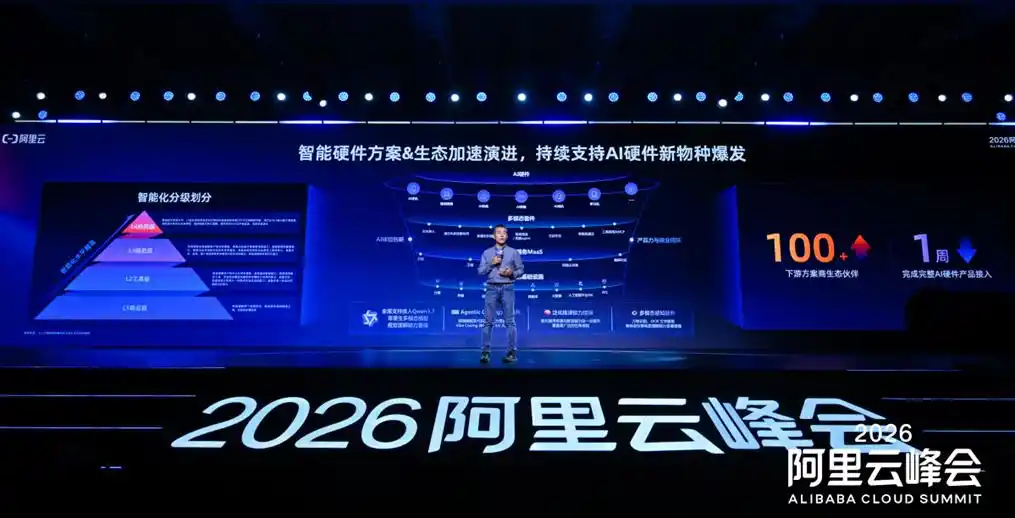
Regarding this, Chen Liwei, Deputy General Manager of the Solutions Architecture Department, Public Cloud Business Group, Alibaba Cloud Intelligence, believes the entire hardware industry is currently transitioning from L2 to L3. Whoever can first build the foundational architecture for L3 and achieve L3-level product experiences will capture a larger market share.
Staying at L1, or even L2, is no longer a safe zone. To smoothly enter the L3 stage, the combination of multimodal perception and generalized reasoning is required.
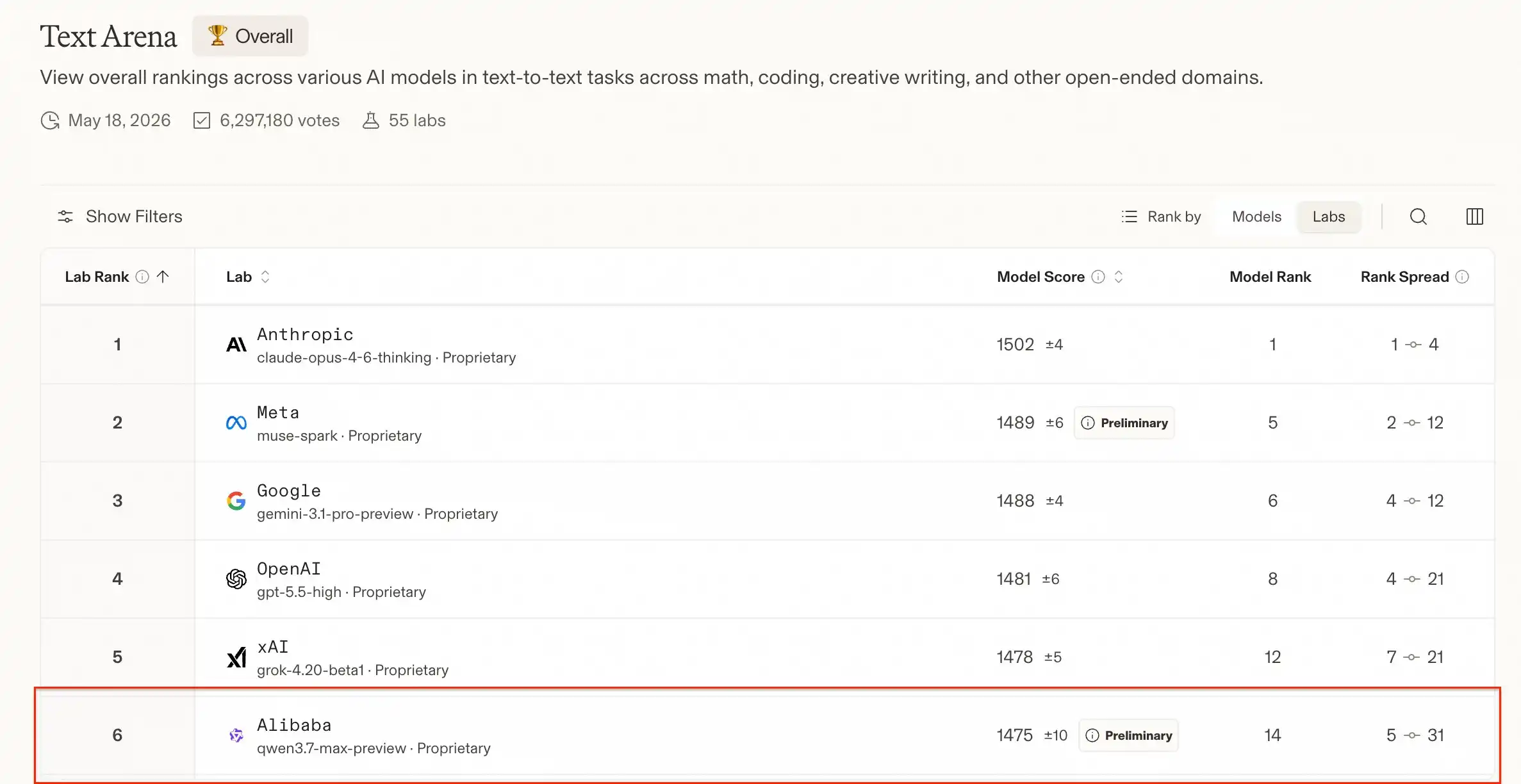
The Alibaba Cloud Summit also重磅 released the flagship model Qwen3.7-Max. In the global large model blind evaluation总榜 by the third-party organization Arena, Qwen3.7-Max ranks first among domestic models, benchmarking against the world's strongest models.
The design初衷 of Qwen3.7-Max is precisely to make the model the core of an Agent,具备 autonomous planning, continuous iteration, and cross-device collaboration capabilities. Its technical upgrades恰好 correspond to the requirements for perception and cognition elements at the L3 level. Currently, the multimodal interaction development kit面向智能硬件行业 provided by Alibaba Cloud fully supports接入 Qwen3.7-Max.
The stronger the cloud-side generalization capabilities, the lower the adaptation cost for hardware to reach L3. Chen Liwei also pointed out: "Today, no single hardware product can achieve an end-to-end closed-loop user experience through a single model. The solution must be a combination of multiple models."
02. Device-Cloud Collaboration Becomes a Necessity
Following the L3 Assistive level, L4 Collaborative represents an even greater leap.
Based on current definitions, the core characteristic of L4 is not whether a single device is smarter, but whether multiple devices form an intelligent system. When a user enters their home, glasses, speakers, robots, and the cockpit automatically share memory and serve the user in the physical world.
Therefore, the biggest challenge hardware manufacturers face in未来 smoothly landing technology and products at L4 is system integration and device collaboration.
In the standard classification table, most products from mobile terminals to glasses and headphones are annotated as "device-cloud collaborative." The underlying logic is straightforward: real-time response relies on the device side, while complex reasoning depends on the cloud—currently the optimal solution for intelligence.
Ecovacs'管家 robot "Bajie" is a prime example. Considering open-source and model iteration capabilities, Ecovacs chose early on to integrate the Qianwen large model.
The core challenge for a管家 robot stems from the non-standard nature of home environments—high safety requirements, dense information, and very long-tail needs. One of the solutions for Ecovacs' "Bajie" is to encapsulate the robot's atomic capabilities (grasping, fetching/placing, perception, planning) into API interfaces easily understood by the model. The cloud side, based on Qwen3.6-Plus, handles complex tasks like environmental perception and action decomposition.
When a user gives a vague command like "tidy up the living room," it can first结合云端理解 what objects the living room contains and what the standard for tidiness is, then拆解 it into a series of action commands sent to the robotic arm. This series of understandings can occur without预编程; the agent on "Bajie" proactively串联 the tasks.
Currently, Ecovacs has also opened up the "Bajie" system, atomic capabilities, and simulation platform, allowing更多生态伙伴 to conveniently participate in algorithm development and application落地 for home robots through "Bajie."
The products from Yanjiwei's Shenmou series similarly confirm the necessity of device-cloud collaboration. As a company focused on low-power intelligent imaging, Yanjiwei's core is optimizing camera power supply and network communication challenges, achieving operation without power or network connections. The challenge posed by low power consumption is the limited算力 of edge chips, unable to handle the inference load of large-scale models.
Their solution is: edge-side real-time tagging and preliminary processing, using edge AI chips to identify people, cars, non-motorized vehicles in the画面, then uploading text/image information via low-power 4G beacons to the cloud. The cloud then performs deep understanding and structured memory based on the Qianwen large model, allowing users to query the camera like searching a photo album, e.g., "What color cat appeared at the door yesterday afternoon?" This体验 is nearly impossible with a纯端侧方案.
Based on this architecture, the company's付费转化率 increased by 25%, average order value increased by 30%, and付费用户持续留存率 reached over 75%. AI capabilities directly translated into commercial competitiveness.
The division-of-labor model of device-cloud collaboration is becoming industry consensus, and the role of cloud vendors has随之 undergone significant changes.
In the past, cloud vendors only provided云 resources like computing and storage. Now, they are transforming into providers of device-cloud collaborative, Agent-centric infrastructure foundations, packaging capabilities like visual understanding, task planning, and even frontend code generation into callable services. They are lowering the门槛 for hardware manufacturers to embed AI capabilities into existing systems through development layers—from providing platforms and models to providing Agentic Coding.
Chen Liwei also summarized Alibaba Cloud's current four core challenges: model组合,工程 complexity, continuous operational capability, and data闭环.
Regarding model组合 and engineering, it's worth mentioning the previously released new-generation全模态大模型 Qwen3.5-Omni.
Qwen3.5-Omni achieved SOTA in 215 tasks including audio-visual understanding, recognition, and interaction, significantly enhancing real-time interaction体验 and possessing "high emotional intelligence." More令人惊喜 is Qwen3.5-Omni's demonstrated ability in音视频 Vibe Coding—users阐述需求 to the camera, and the model can autonomously generate complex product code for apps, web pages, games, etc. Real-time全模态能力 provides the crucial technological foundation for AI hardware progressing from L1/L2 to L3/L4.
While全模态 models不断成熟, hardware manufacturers are also exploring differentiated落地路径.
For example, Robosen, a company focused on toC humanoid robots, is布局 an interesting device-cloud collaboration尝试. Users can completely take over the robot's AI system via home局域网 using their own computer or local agent, enabling the robot to have customized capabilities like smart home control, dialect conversation, and personalized topics.
Guangfan Technology, which just发售 the world's first AI headphone with visual perception capabilities, observed that the biggest change in the AI hardware industry over the past year is "speed"—the惊人迭代速度 of software and hardware. AI has evolved from单纯聊天 to having智能体和自学习能力, and what it can do increases substantially daily. Guangfan's实践路径 is to build一套比 OpenClaw范围更广的 AI-native operating system, covering multimodal interaction, hardware scheduling, software scheduling, and算力调度.
The explorations by these "frontline players" prove that device-cloud collaboration is a "difficult yet correct" long-term theme. Cloud-side intelligence is rapidly evolving, while the execution capabilities and hardware scheduling abilities on the device side remain the key variables determining the intelligence stage of AI hardware.
03. Where the Boundaries of Collaboration Lie, So Lies the Market
Beyond technical guidance, the significance of the分级标准 also includes signaling at the commercialization level.
Consumers can judge products based on L1 to L4, which in turn provides hardware manufacturers with a clear upgrade roadmap.
Especially for startups, self-developing multimodal models and inference frameworks is unrealistic. What更多厂商 need is a standardized AI foundation and a clear path to商业回报.
The commercial imagination for AI hardware services is traceable in the high user stickiness of the Looka Doctor AI Study Camera.公开数据显示 from Looka Doctor shows早期用户日均使用时长 was only over 30 minutes; after integrating Qwen3.6-Plus,日均时长 increased by 50%, with approximately 50 million user-taken photos interacting with AI monthly. More accurate万物识别 and OCR capabilities led to higher-frequency image recognition, and enhanced泛化推理 increased问答轮次. Quantifiable progress in the AI foundation directly fed back as a qualitative change in user stickiness.
After users generate hundreds of daily interactions on a hardware device, accumulating大量个人兴趣数据, a natural需求浮现出来: How can these memories and preferences be联动到其他设备上? For example, continuing to制定学习任务 based on the data on a school device.
Once the intelligence level of a single device reaches a certain高度, the market's true imagination shifts to system intelligence under全场景共生.
The L4 Collaborative level mentioned in the standard focuses on跨设备协同与用户偏好记忆. A phone, a pair of glasses, a cockpit, a speaker—forming an intelligent network围绕用户.
You wear glasses into the car, and the cockpit automatically switches to your driving preferences; you speak to a speaker, and the robot starts tidying the living room. Consistent体验 requires all devices to share the same cloud-side intelligent foundation, and cloud vendors to provide a unified identity, memory, and execution调度体系.
全场景共生 will directly change the商业化逻辑 of AI hardware.
In the past, hardware mostly relied on supply chain profits—each unit sold completed a transaction. Now, AI叠加 opens up entirely new imagination. In the future,溢价服务 can also be generated continuously through subscription models.
In协同场景, users are more willing to pay for跨设备的连续体验, such as subscribing to personal assistant services or purchasing scenario-specific skill packages. Consequently, value distribution across the entire track will be reshuffled.
An existing example: After Rokid glasses integrated Alibaba's version of OpenClaw, JVS Claw,端侧,职场人士 can efficiently perform operations like creating calendars, replying to WeChat, and making payments. If these high-frequency behaviors can be further integrated and沉淀 as scenarios that enhance work efficiency, they could extend into subscription services for life assistants.
During the 618 promotional period, Tmall also上线了数十个主机品牌 equipped with JVS Claw, fully integrated with智能助手, ushering in the Agent PC era.
Hardware becomes the入口 for services, not the终点.
The wave of市场重构 will surge towards products capable of融入这张智能网络, gradually abandoning island-like L1-level devices.
The分级标准 provides guidance for the industry's终局,端云协同 offers a确定性路径, and the云厂商's standardized capabilities are making that path wider and smoother.