Research: Bitcoin Miner Capitulation Has Dragged On for 287 Days

cryptonews.ruPublished on 2026-08-01Last updated on 2026-08-01

Abstract

Research indicates that the capitulation phase for Bitcoin miners has extended for 287 consecutive days, marking one of the longest periods of declining network hash rate. This has led to a 19.9% drop in mining difficulty from its peak. Typically, miner stocks are highly correlated with Bitcoin's price, but recently they have diverged. While Bitcoin lost about 46% of its value over the past year, stocks of major public mining companies like Hut 8, Riot Platforms, and HIVE Digital saw significant gains. Analysts attribute this to the industry's pivot towards providing computing infrastructure for artificial intelligence, shifting investor focus away from pure Bitcoin exposure. Miners' revenue is under pressure. The daily block reward revenue has hit a historic low, partly due to the hash rate decline delaying block times. The Puell Multiple indicator shows daily revenues around $30 million, below the yearly average of ~$40 million. Transaction fees remain minimal, contributing only about $200,000 daily. Currently, fees collected over 28 days do not cover the reward for a single block, meaning fees fund only about ten minutes of the network's daily operation. This is a stark contrast to past cycles where fee revenue occasionally spiked to significant levels. The report concludes that the current mining downturn lacks a clear, singular cause like past events, such as China's mining ban.

Bitcoin's hash rate has been declining for 287 consecutive days – one of the longest periods of falling computational power in the network's history. This is stated in a report by the analytical platform Bitcoin Magazine Pro.

Following the hashrate, the mining difficulty has also dropped – it is currently 19.9% below its peak. Since the advent of specialized equipment for mining the first cryptocurrency, the indicator has fallen harder only twice, and both declines lasted about the same time. The sharpest of them coincided with the mining ban in China. Experts called that episode "extremely clear": the authorities turned off the equipment, so the hash rate collapsed. The current downturn does not offer such clarity, they noted.
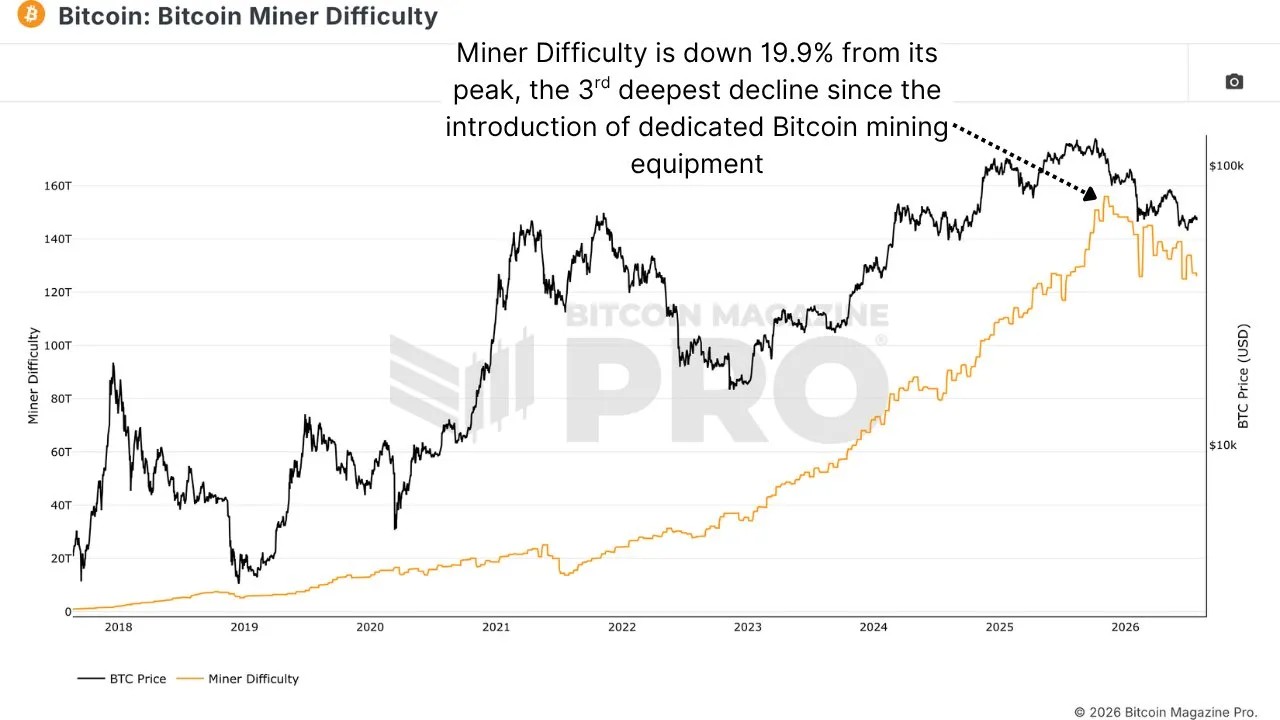
Bitcoin mining difficulty dynamics. Source: X/Bitcoin Magazine Pro.

Miner Stocks Rose Despite Price Decline

Over the past 12 months, bitcoin has lost about 46% of its value. Meanwhile, shares of public mining companies have mostly risen:

  • Hut 8 — by 431%;
  • Riot Platforms — by 62%;
  • HIVE Digital — by 37%.

An exception was MARA Holdings, whose shares fell by 29%.

Specialists emphasized that such dynamics are uncharacteristic for this pair of assets. Historically, miner stocks traded with leverage relative to digital gold – they fell harder during corrections and rose at a faster pace during upward trends.
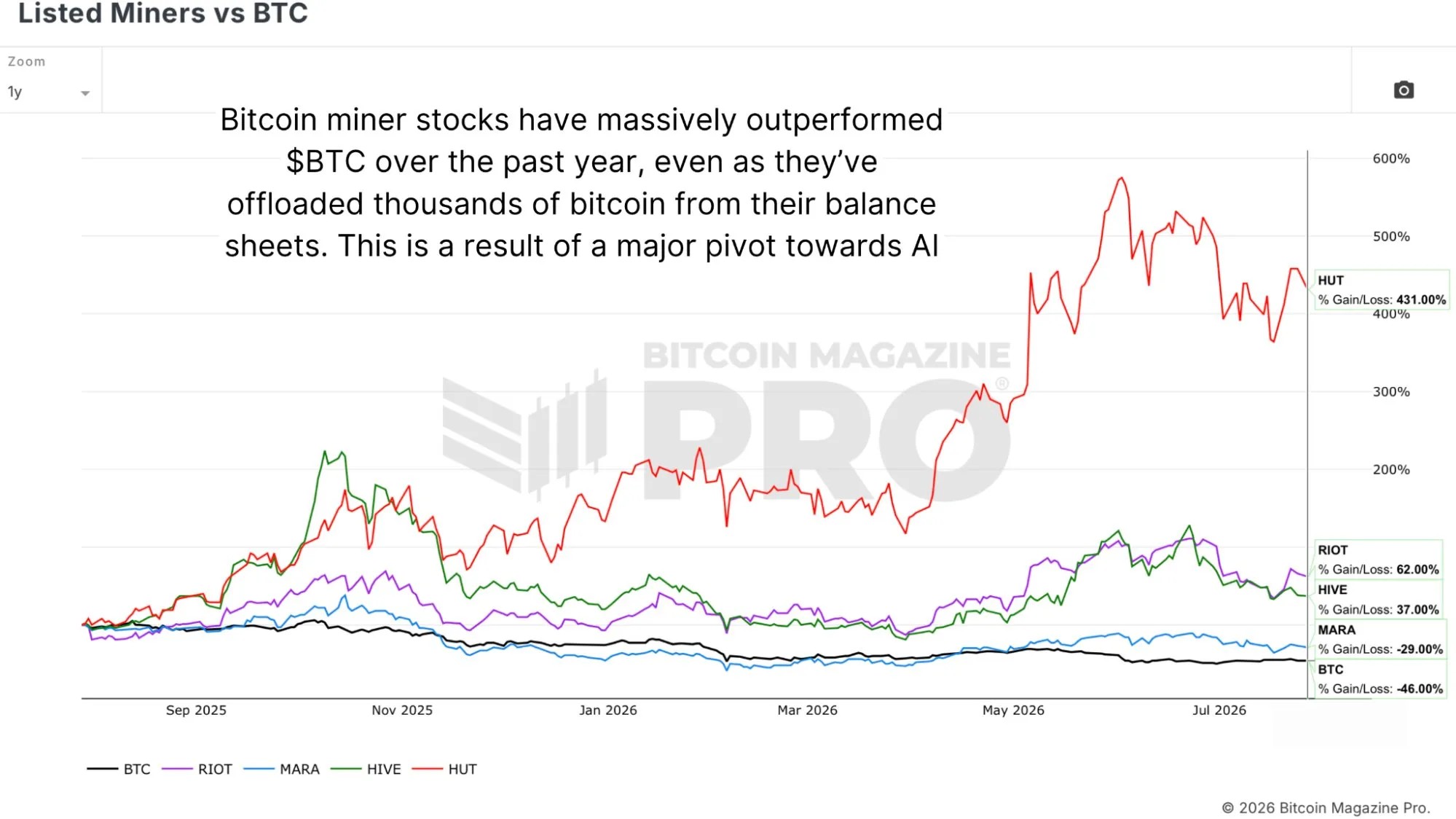
Dynamics of public miner stocks and the bitcoin price over the year. Source: X/Bitcoin Magazine Pro.

Bitcoin Magazine Pro explained the divergence by the industry's pivot to artificial intelligence. Investors are valuing miners not as a bet on bitcoin, but as providers of computational infrastructure. For many years, the first cryptocurrency moved together with AI-sector stocks, with correlation sometimes reaching 0.8-0.9. However, the trend then changed: technology company shares strengthened, while digital gold entered a sell-off phase.

Stocks are appreciating even though bitcoin miners sold thousands of bitcoins during this period. In the first quarter alone, they sold over 32,000 BTC to cover operating expenses – more than in all of 2025.

Transaction Fees Pay for Ten Minutes of Network Operation

Miner revenue comes from two sources – block rewards and transaction fees. Emission halves every four years and will eventually reach zero. After that, only fees will ensure the network's operation. If they are insufficient, the total revenue of miners will decrease, and with it – the cost required to attack the blockchain, noted Bitcoin Magazine Pro.

Daily revenue from block rewards has already hit a historical low. This is partly a consequence of the outflow of computing power: before the difficulty recalculation, the interval between blockchain units exceeds ten minutes. However, the main factor is the standard operation of the protocol, experts believe.

Since the first halving, the industry has used the same argument: the number of coins per block decreases, but their value increases, so dollar revenue remains stable. Until now, this mechanism has worked, analysts acknowledged.

However, now the bitcoin price is falling along with the emission volume. This is visible in the Puell Multiple indicator, which compares current miner revenue with the average over the previous year. The indicator has dropped to about 0.75, which in monetary terms is approximately $30 million per day against an average closer to $40 million.

The second revenue source remains insignificant. Of the same $30 million in daily revenue, only about $200,000 comes from fees. The reward for one block exceeds the entire daily fee collection: over the last 28 days, their average daily volume did not even cover one such payout. With 144 blocks per day, fees fund the network's operation for about ten minutes out of 24 hours.
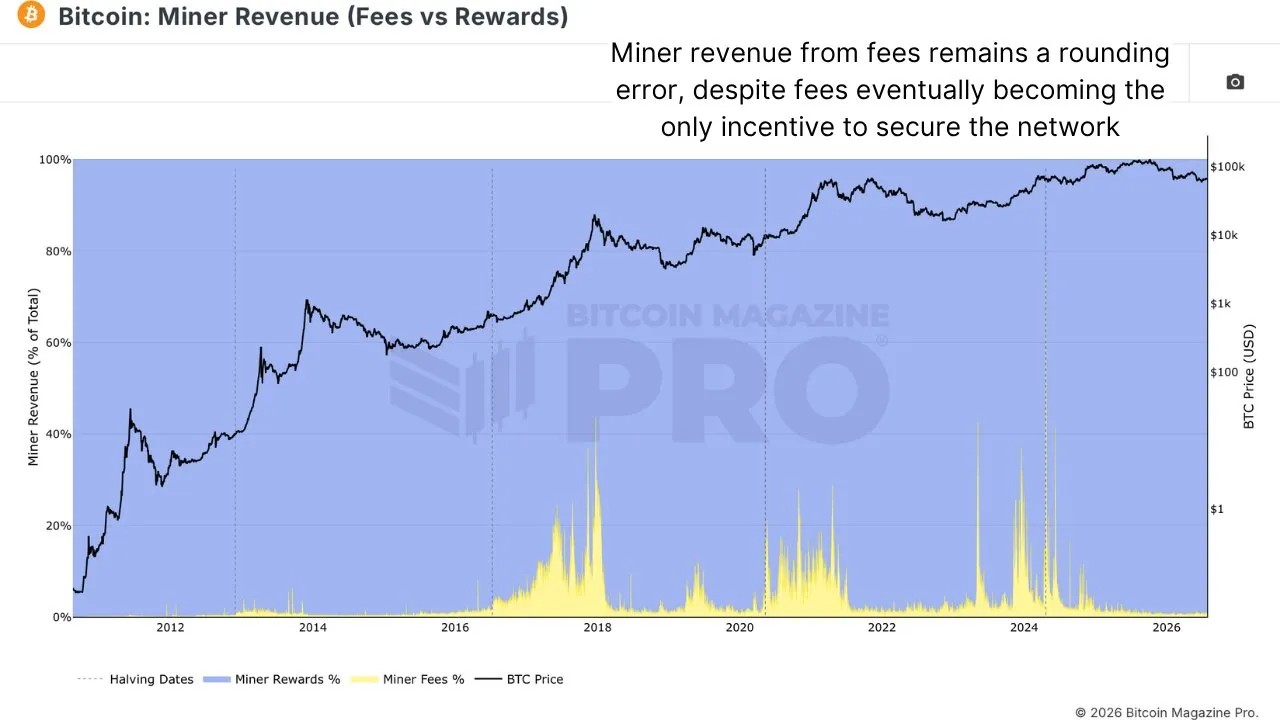
Share of fees and block rewards in miner income. Source: X/Bitcoin Magazine Pro.

In previous cycles, the share of fees briefly reached tens of percent – notable spikes occurred in 2017, 2021, and 2023-2024. Currently, the indicator is near zero, and such spikes have stopped, analysts concluded.

Recall that on July 11th, the mining difficulty of the first cryptocurrency decreased by 5% – to 127.17 T. In mid-June, the indicator fell by 10.09% at once, but then recovered by 7.15%.

end-content

Trending Cryptos

Related Questions

QAccording to the Bitcoin Magazine Pro report, for how many consecutive days has Bitcoin's hash rate been declining?

ABitcoin's hash rate has been declining for 287 consecutive days.

QWhat major trend in the mining industry is cited as an explanation for the divergence between Bitcoin's price decline and the rising stock prices of public mining companies?

AThe divergence is explained by the mining industry's pivot towards artificial intelligence, with investors valuing miners as providers of computational infrastructure rather than just a bet on Bitcoin.

QWhat is the Puell Multiple indicator, and what does its current low value of approximately 0.75 signify for miners?

AThe Puell Multiple indicator compares miners' current daily revenue to the 365-day moving average. A value of approximately 0.75 signifies that daily revenue is around $30 million, which is below the yearly average closer to $40 million.

QWhat percentage of miners' current daily revenue (around $30 million) comes from transaction fees?

ATransaction fees contribute only about $200,000 to the daily revenue, which is a very small fraction of the total $30 million.

QHistorically, how have the stocks of public mining companies typically performed relative to Bitcoin's price movements, and what is the current exception?

AHistorically, mining stocks have traded with leverage relative to Bitcoin, falling more during corrections and rising faster during uptrends. The current exception is that mining stocks like Hut 8, Riot Platforms, and HIVE Digital have increased in price over the last year despite Bitcoin losing about 46% of its value.

Related Reads

Thanks to Dice Rolls, Bitcoin Keys Are Stored Offline, But Not Everyone Will Do It

The article discusses using dice rolls to generate secure Bitcoin wallet seeds, providing entropy independent of potentially flawed hardware random number generators. It explains that each fair dice roll offers about 2.585 bits of entropy, with around 50 rolls needed for a standard 12-word seed phrase and 99+ recommended for higher security. This method gained attention after a vulnerability was revealed in some Coldcard hardware wallets, where a faulty firmware RNG (dating back to 2021) compromised generated keys. The analysis notes that while a dice-generated main seed was safe from this specific flaw, other Coldcard functions (like creating paper wallets, backup keys, or passwords) could still be vulnerable if they used the defective RNG. The piece argues that while dice-based entropy is technically robust, the manual process is error-prone, tedious, and unrealistic for most new users, who might make mistakes in recording or inputting rolls. It concludes that while manual entropy generation should remain an option for advanced users, the long-term goal is to develop reliable, user-friendly hardware and software that securely generates randomness without requiring specialized knowledge. Coldcard users are advised to check their firmware version and replace any secondary secrets (like paper wallet keys) created with vulnerable devices, while also considering multi-signature setups with devices from different manufacturers for added security.

cryptonews.ru1h ago

Thanks to Dice Rolls, Bitcoin Keys Are Stored Offline, But Not Everyone Will Do It

cryptonews.ru1h ago

Trading

Spot

Hot Articles

What is $BITCOIN

DIGITAL GOLD ($BITCOIN): A Comprehensive Analysis Introduction to DIGITAL GOLD ($BITCOIN) DIGITAL GOLD ($BITCOIN) is a blockchain-based project operating on the Solana network, which aims to combine the characteristics of traditional precious metals with the innovation of decentralized technologies. While it shares a name with Bitcoin, often referred to as “digital gold” due to its perception as a store of value, DIGITAL GOLD is a separate token designed to create a unique ecosystem within the Web3 landscape. Its goal is to position itself as a viable alternative digital asset, although specifics regarding its applications and functionalities are still developing. What is DIGITAL GOLD ($BITCOIN)? DIGITAL GOLD ($BITCOIN) is a cryptocurrency token explicitly designed for use on the Solana blockchain. In contrast to Bitcoin, which provides a widely recognized value storage role, this token appears to focus on broader applications and characteristics. Notable aspects include: Blockchain Infrastructure: The token is built on the Solana blockchain, known for its capacity to handle high-speed and low-cost transactions. Supply Dynamics: DIGITAL GOLD has a maximum supply capped at 100 quadrillion tokens (100P $BITCOIN), although details regarding its circulating supply are currently undisclosed. Utility: While precise functionalities are not explicitly outlined, there are indications that the token could be utilized for various applications, potentially involving decentralized applications (dApps) or asset tokenization strategies. Who is the Creator of DIGITAL GOLD ($BITCOIN)? At present, the identity of the creators and development team behind DIGITAL GOLD ($BITCOIN) remains unknown. This situation is typical among many innovative projects within the blockchain space, particularly those aligning with decentralized finance and meme coin phenomena. While such anonymity may foster a community-driven culture, it intensifies concerns about governance and accountability. Who are the Investors of DIGITAL GOLD ($BITCOIN)? The available information indicates that DIGITAL GOLD ($BITCOIN) does not have any known institutional backers or prominent venture capital investments. The project seems to operate on a peer-to-peer model focused on community support and adoption rather than traditional funding routes. Its activity and liquidity are primarily situated on decentralized exchanges (DEXs), such as PumpSwap, rather than established centralized trading platforms, further highlighting its grassroots approach. How DIGITAL GOLD ($BITCOIN) Works The operational mechanics of DIGITAL GOLD ($BITCOIN) can be elaborated on based on its blockchain design and network attributes: Consensus Mechanism: By leveraging Solana’s unique proof-of-history (PoH) combined with a proof-of-stake (PoS) model, the project ensures efficient transaction validation contributing to the network's high performance. Tokenomics: While specific deflationary mechanisms have not been extensively detailed, the vast maximum token supply implies that it may cater to microtransactions or niche use cases that are still to be defined. Interoperability: There exists the potential for integration with Solana’s broader ecosystem, including various decentralized finance (DeFi) platforms. However, the details regarding specific integrations remain unspecified. Timeline of Key Events Here is a timeline that highlights significant milestones concerning DIGITAL GOLD ($BITCOIN): 2023: The initial deployment of the token occurs on the Solana blockchain, marked by its contract address. 2024: DIGITAL GOLD gains visibility as it becomes available for trading on decentralized exchanges like PumpSwap, allowing users to trade it against SOL. 2025: The project witnesses sporadic trading activity and potential interest in community-led engagements, although no noteworthy partnerships or technical advancements have been documented as of yet. Critical Analysis Strengths Scalability: The underlying Solana infrastructure supports high transaction volumes, which could enhance the utility of $BITCOIN in various transaction scenarios. Accessibility: The potential low trading price per token could attract retail investors, facilitating wider participation due to fractional ownership opportunities. Risks Lack of Transparency: The absence of publicly known backers, developers, or an audit process may yield skepticism regarding the project's sustainability and trustworthiness. Market Volatility: The trading activity is heavily reliant on speculative behavior, which can result in significant price volatility and uncertainty for investors. Conclusion DIGITAL GOLD ($BITCOIN) emerges as an intriguing yet ambiguous project within the rapidly evolving Solana ecosystem. While it attempts to leverage the “digital gold” narrative, its departure from Bitcoin's established role as a store of value underscores the need for a clearer differentiation of its intended utility and governance structure. Future acceptance and adoption will likely depend on addressing the current opacity and defining its operational and economic strategies more explicitly. Note: This report encompasses synthesised information available as of October 2023, and developments may have transpired beyond the research period.

1.4k Total ViewsPublished 2025.05.13Updated 2025.05.13

What is $BITCOIN

Discussions

Welcome to the HTX Community. Here, you can stay informed about the latest platform developments and gain access to professional market insights. Users' opinions on the price of BTC (BTC) are presented below.

活动图片