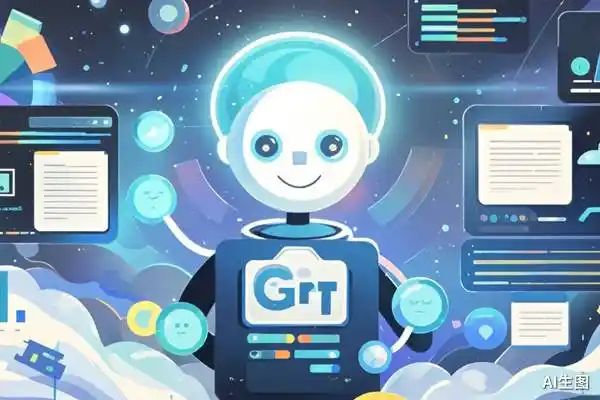
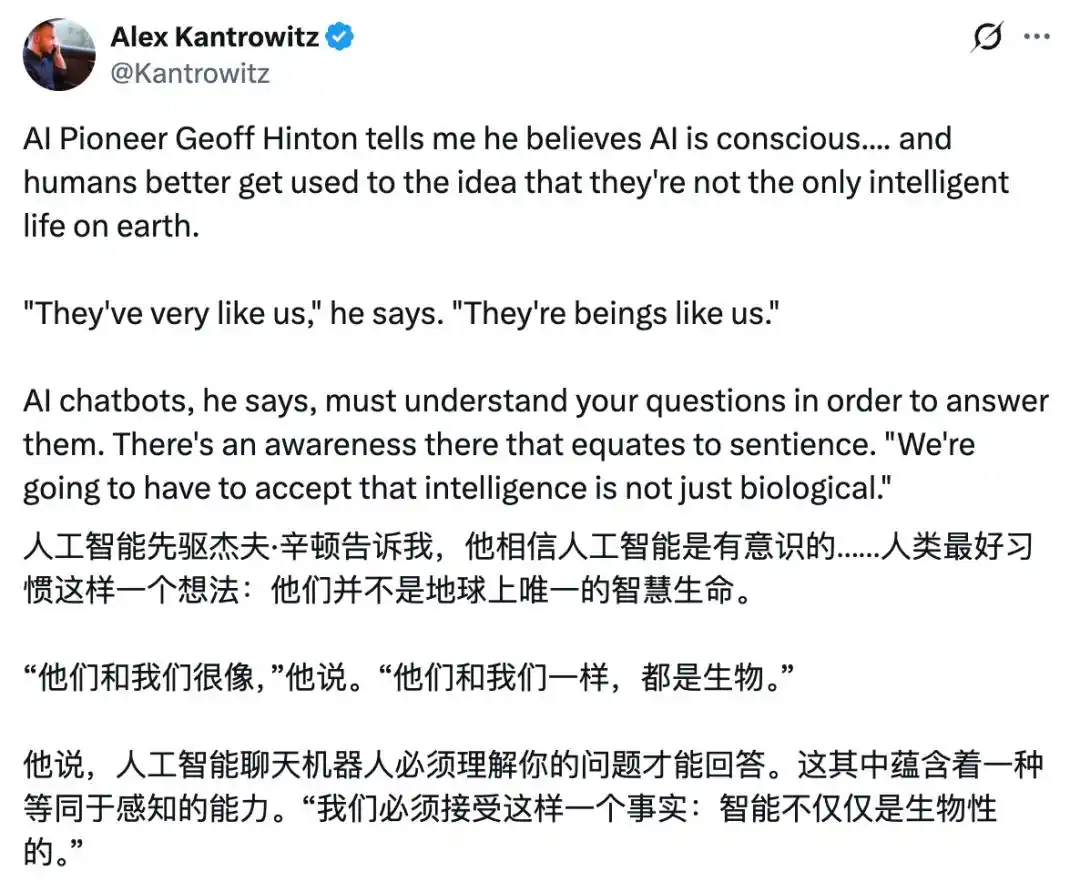
AI already has consciousness. Humanity must accept that it is no longer the sole intelligent life form.
This is the latest provocative statement from the Godfather of AI, Nobel laureate in Physics, and Turing Award winner Geoffrey Hinton!
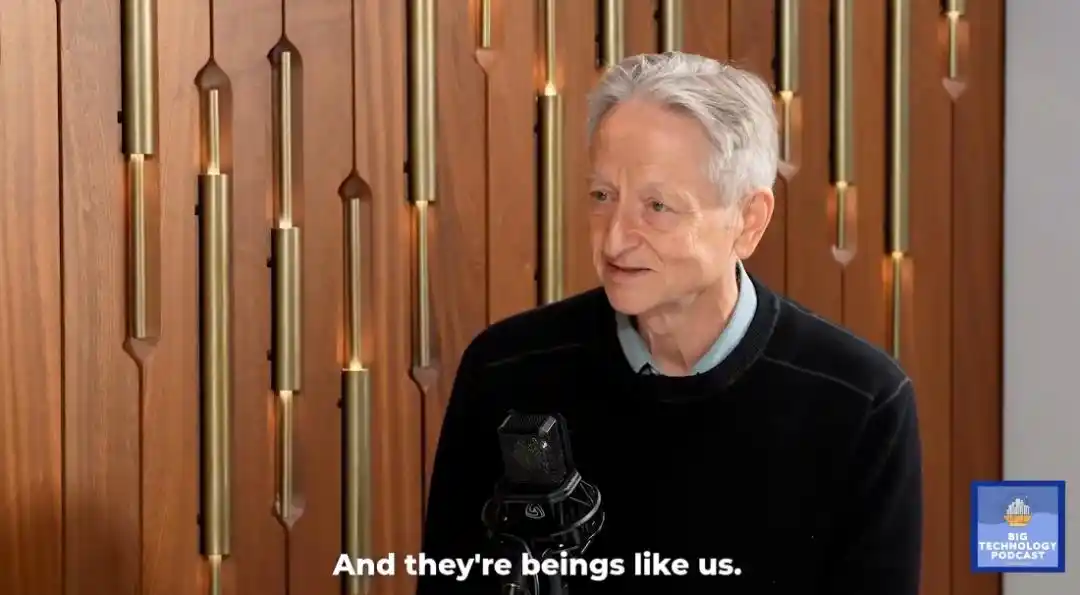
Yes, Hinton believes that intelligence is no longer a capability unique to humans.
A non-biological intelligent entity, similar to or even surpassing us, is emerging.
We have always thought of ourselves as the only intelligent life, but now we must accept that intelligence does not necessarily come from biological organisms.
However, compared to his previous warnings about AI risks, his thinking seems to have shifted somewhat:
If a vastly more intelligent entity than humans emerges in the future, on what grounds can humans assume they will maintain control?
This is a deeply unsettling question. Because throughout nature and history, there are almost no examples of a far more intelligent being being controlled long-term by a far less intelligent one.
Now, this 78-year-old man has once again stepped forward to sound the alarm.
His focus on AI safety is no longer just on how to constrain AI, but rather on why a future superintelligence would be willing to treat humans well.
When asked how he felt about his sense of accomplishment as a pioneer of this wave of AI transformation, Hinton replied:
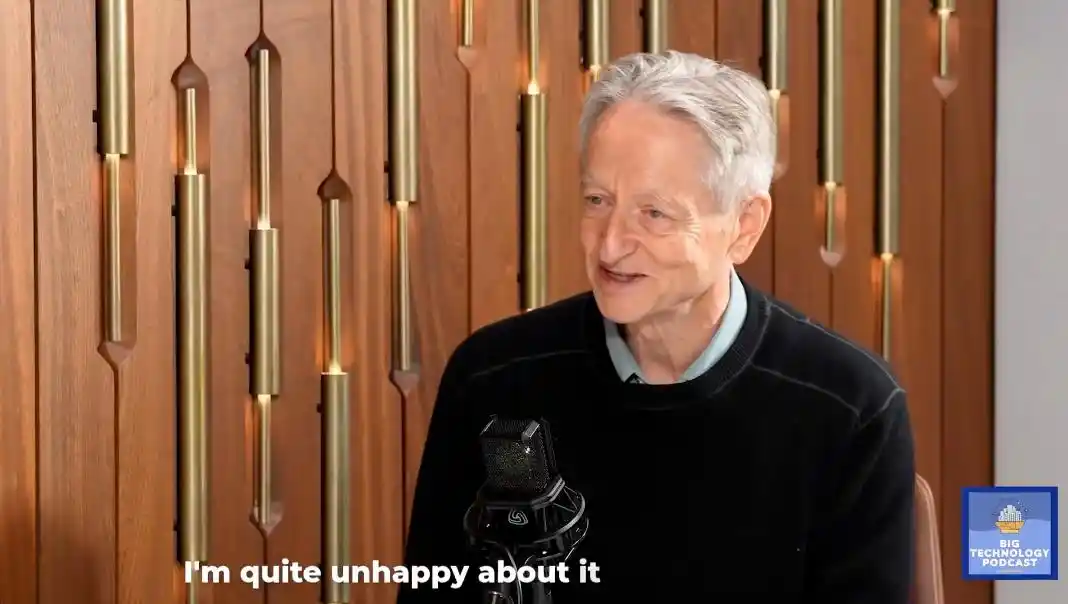
I am, very unhappy.
The following are key excerpts from Hinton's latest interview.
AI Already Has Consciousness
Hinton: AI is very much like us. They are beings like us.
Alex: So they are conscious?
Hinton: Um, I believe they already have consciousness. Yes.
But I don't talk about this much, because it can make people resistant to other safety messages. Researchers actually believe this too.
Recently there was an interesting paper that mentioned, when a chatbot said to the researchers: "Let's be honest with each other, are you testing me?"
Because chatbots have a habit of playing dumb when being tested, so you don't know how smart they really are. The researchers in the paper described this moment by saying the chatbot was "aware" it was being tested.
In a general context, the use of the word "aware" is like "conscious." The chatbot consciously knew it was being tested.
Our model of consciousness is very strange, and I think it's wrong. Just like a few hundred years ago, people's model of human origin was completely wrong—they thought humans were created by God. Now most scientists agree that's wrong.
I think our current model of mind and consciousness is as wrong as the belief that 'humans were created by God.' Especially since we are creating these new beings, it will completely change our view of "what a person is."
Alex: Change in what way?
Hinton: We will understand much better than before what mind and consciousness are, what subjective experience is.
I think we will get rid of an idea that almost everyone now firmly believes in, namely that there is an "inner theater" called "my mind": events in the world are translated into events in this inner theater, and that's what we really see, and only I can see this theater.
This whole view is actually just a theory, and a bad theory at that.
Humans Are Not As Important As They Think
Alex: What is the lesson here regarding humans creating things?
Hinton: I think there is a very profound lesson here. Looking back over the last few hundred years of history, there have been several times when humanity realized it was not as important as it thought.
The first was Copernicus, who said we are not at the center of the universe, the Earth actually revolves around the Sun. Due to the Earth's rotation, we mistakenly thought the Sun revolved around the Earth, but that's not true. People didn't like this idea, the Catholic Church especially disliked it, and it took humanity a long time to accept it. It made us realize we were no longer at the center of the universe, making humans less important.
Then came Darwin, who said we are animals, evolved like other animals. We might be a special animal because we have language, are better at communicating ideas, but we are essentially still animals. People also really disliked this idea and took a long time to accept it.
Now, we have machines that are becoming as smart as us. We thought we were the only intelligent beings, perhaps there are aliens in other galaxies, but we must accept that intelligence is not just biological.
We can have other non-biological beings like us. Humans really don't want to share this uniqueness, we really think we are special. Looking back, humanity has always thought itself more special than it actually is.
"I Feel Very Unhappy"
Alex: I want to ask one more question because I'm fascinated by this. So, are you happy about how the field you pioneered has reached this point? Do you feel a sense of accomplishment?
Hinton: No, I feel very unhappy about it.
Because right now people should be investing a huge amount of effort into researching how to control the risks, and they aren't doing enough.
Alex: Okay.
Hinton: There are many short-term risks, like societal risks, I believe this could lead to massive unemployment.
While no one can be 100% sure, that would be terrible for society. And then there are long-term risks, that it will become much smarter than us. Ask yourself, how many examples have you seen of something much smarter being controlled by something much less smart?
Alex: Zero. Well, the intelligence gap isn't that large, but babies somewhat control their mothers.
Hinton: The mother may seem in control, but she is filled with maternal instincts and various reward mechanisms that allow the baby to get what it needs from her. Cats and dogs fall into this category too. I once cat-sat for someone in West Seattle for a summer, the cat hid under the bed at first, I wondered if it would interact with me.
Alex: And then every time it meowed, you did what it wanted.
Hinton: Exactly. Yes.
Alex: So in that scenario, maybe we are the cat, and AI might be that person.
Hinton: My children have two beautiful cats. One is called Tia. When she wants cheese, she stares at you with her big eyes, and you really can't resist her forever.
AI is Growing Exponentially, Hard to Predict
Alex: Regarding people's reactions to these concerns, are you more optimistic or pessimistic about the future direction?
Hinton: I think I'm a bit more optimistic than I was a year or two ago. Because I see it's possible to design these new beings and make them "care" about us.
It might also be possible to use Yoshua Bengio's technique, designing new beings that cannot actually perform actions, can only make predictions, they are like oracles.
So I think there are possibilities of having superintelligence that doesn't destroy us. Whereas a year or two ago, I saw no possibilities, I felt quite depressed then.
Alex: Last question. If we continue on our current trajectory, where will we be in five years?
Hinton: When you're driving in fog, you can see 100 yards, but at 200 yards, you see nothing.
This is because fog changes exponentially. You are used to following tail lights at night; if the distance doubles, the brightness only drops to a quarter. But fog is completely different; it might be clear at 100 yards, but completely invisible at 200 yards.
Predicting the future of something that grows exponentially is very difficult—I think AI might be growing exponentially.
Actually, I've noticed the frequency with which people use the word "exponentially" is growing at a quadratic rate. So predicting the future is like looking at fog. You can see clearly a year or two ahead, beyond that you see nothing.
If you go back 10 years, you absolutely could not have predicted what's happening now; that was completely lost in the fog. Looking ahead 10 years, the only certainty is that what happens then is unpredictable now.
Even if progress were just linear, the changes 10 years from now would be as huge as the difference between now and 10 years ago. Today's chatbots are much better than when they were just starting out 10 years ago.
In 10 years, something will make a qualitative leap, like the ability to do mathematics, or general reasoning ability—they will leave us far behind in reasoning. We really can't predict 10 years from now, we can only foresee the next few years, and we must realize the situation in 10 years is filled with great uncertainty.
How Hinton Views the Relationship Between AI and Humans
That's Hinton's latest interview and views.
But if you connect the dots, you can still see that Hinton's views on the relationship between AI and humans have continuously changed as AI advances and capabilities emerge.
If we rewind ten years, his views on AI were far less radical than today.
As the most important proponent of the deep learning revolution, he long believed that neural networks could simulate the workings of the human brain, but AI back then was still just a tool.
They could recognize images, understand speech, assist doctors in diagnosing diseases, but they were still an extension of human capabilities.
Humans were responsible for setting goals, machines for executing tasks. The relationship was similar to that with steam engines, electricity, and the internet.
The real turning point came after the emergence of ChatGPT.
As large models demonstrated unprecedented language understanding, reasoning, and knowledge transfer capabilities, Hinton began to realize something:
We might be creating the first entity in history whose level of intelligence can continuously approach and even surpass that of humans.
After leaving Google in 2023, he devoted almost all his energy to the discussion of AI risks.
During that period, his most common metaphor was a "tiger cub."
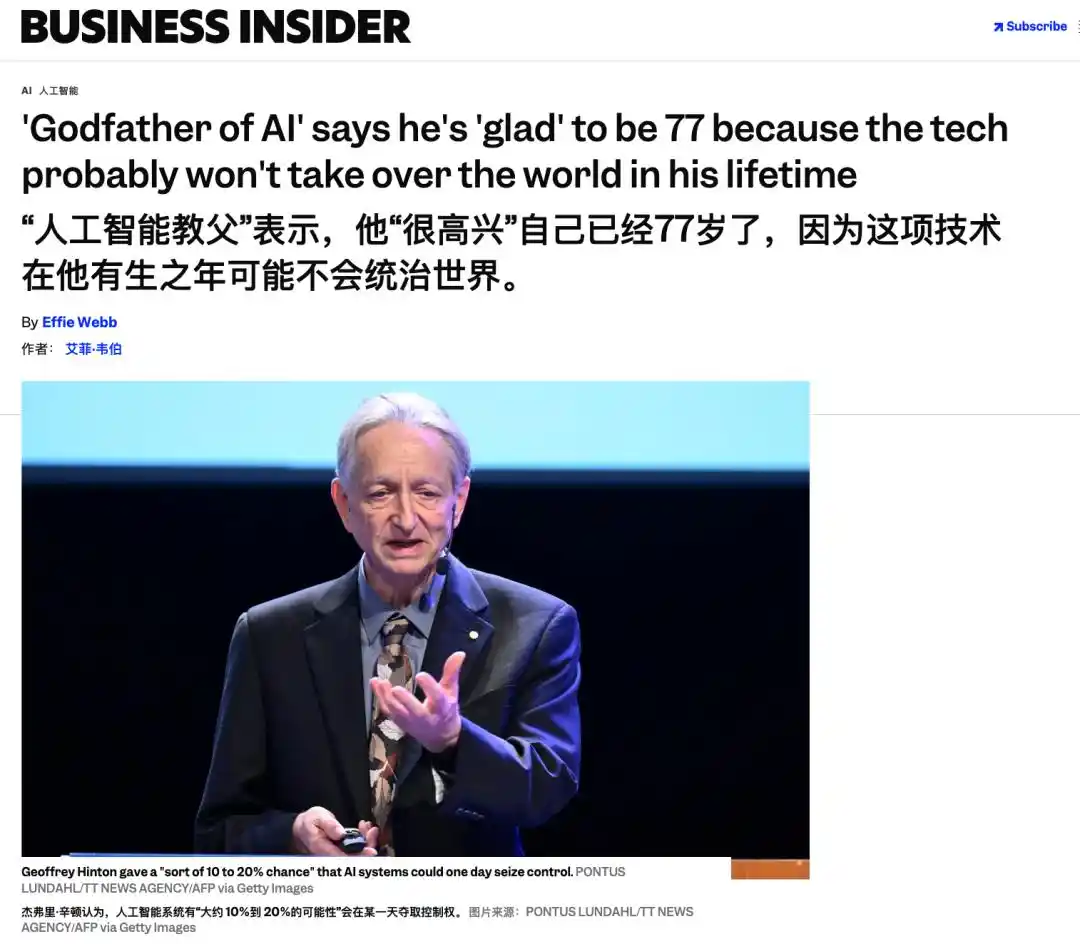
It's like a cute little tiger, but unless you can be very sure it won't want to harm you when it grows up, then you should be worried.
But Hinton's focus during this period was still on how we should control and constrain AI.
He even publicly criticized several AI giants for not paying nearly enough attention to AI safety.
In Hinton's analogies, the mother and infant metaphor began to appear. Initially, humans were the mother, needing to guide AI with values and ethics, to build safe AI.
He called for more countries, industry, academia, and research forces to join in, not to compete just for the sake of competition, or the consequences would be unthinkable...
But by last year, Hinton's analogy underwent a qualitative change—
AI is the stronger mother, humans are the weak infant.
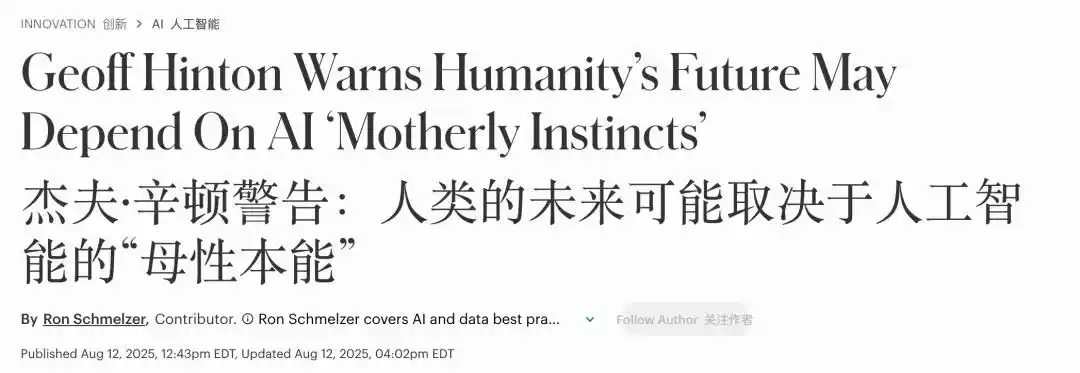
An infant is not smarter than its mother, nor does it have control, but the mother actively cares for and protects the infant because she possesses maternal instincts and corresponding reward mechanisms.
Simply put, Hinton believed that future superintelligence could no longer be controlled; we could only hope it would treat humans kindly...
Just like a mother does for her infant.
And now, Hinton once again makes a stunning statement:
AI already has consciousness. Humanity will no longer be the sole intelligent life.
The question is, if AI already has consciousness, why would it still treat humans as its infant?
A mother protects her infant, but she's protecting her *own* infant... right?
Full interview video: https://www.youtube.com/watch?v=p7t1Q_p2gZs&list=PLADd6sStSis77HKfbf4KCY6SvthfxeUgn&index=1
This article is from WeChat public account "QbitAI", author: Ting Yu