Ethereum Foundation Warns of Potential Cryptocurrency Wallet Disruptions

cryptonews.ruPublished on 2026-08-18Last updated on 2026-08-18

Abstract

The Ethereum Foundation (EF) has warned of potential disruptions to crypto wallets and related software due to the upcoming "Glamsterdam" network upgrade, which will change Ethereum's gas fee model. In an August 17 announcement, developers cautioned that wallets, indexers, and fee estimation tools, particularly those with hardcoded maximum gas limits, risk breaking and will require updates. The issue stems from EIP-8037, introducing a new "state-gas" dimension for operations that create new state, such as sending ETH to a new address. While a standard transfer to an existing address will remain 21,000 gas, sending to a new address will incur an additional cost. Developers urged a review of smart contracts and code that assume 21,000 gas covers any ETH transfer or that calculate fees based solely on gas quantity. Developers are advised to test their systems on the public testnet "Plataberget," launched on August 13, 2026, where the Glamsterdam activation is scheduled for August 20. A one-month feedback and client software update phase will precede testing on the Sepolia and Holesky testnets before the mainnet launch.

The upcoming Glamsterdam upgrade will change the gas model, and some software risks malfunctioning. The Ethereum Foundation (EF) team warned about this on August 17.

According to the developers, wallets, indexers, and fee estimation tools could be at risk. Programmers were advised to test their systems on the public testnet Plataberget.

The EF emphasized tools with a "hard-coded maximum gas limit": such solutions, they stated, will stop working and require an update.

The issue is related to EIP-8037. The proposal adds a separate state-gas dimension for operations that create new state. A regular $ETH transfer to an existing address will keep its cost at 21,000 units, but sending coins to a new address will incur an additional charge.

Developers urged a review of smart contracts that assume the logic that 21,000 units covers any $ETH transfer, as well as code that calculates fees based solely on gas quantity.

According to Forkcast, Plataberget was launched on August 13, 2026. The activation of Glamsterdam on this testnet is scheduled for August 20. Before the mainnet launch, there will be a feedback and client software update phase, estimated to last one month, followed by testing on Sepolia and Hoodi.
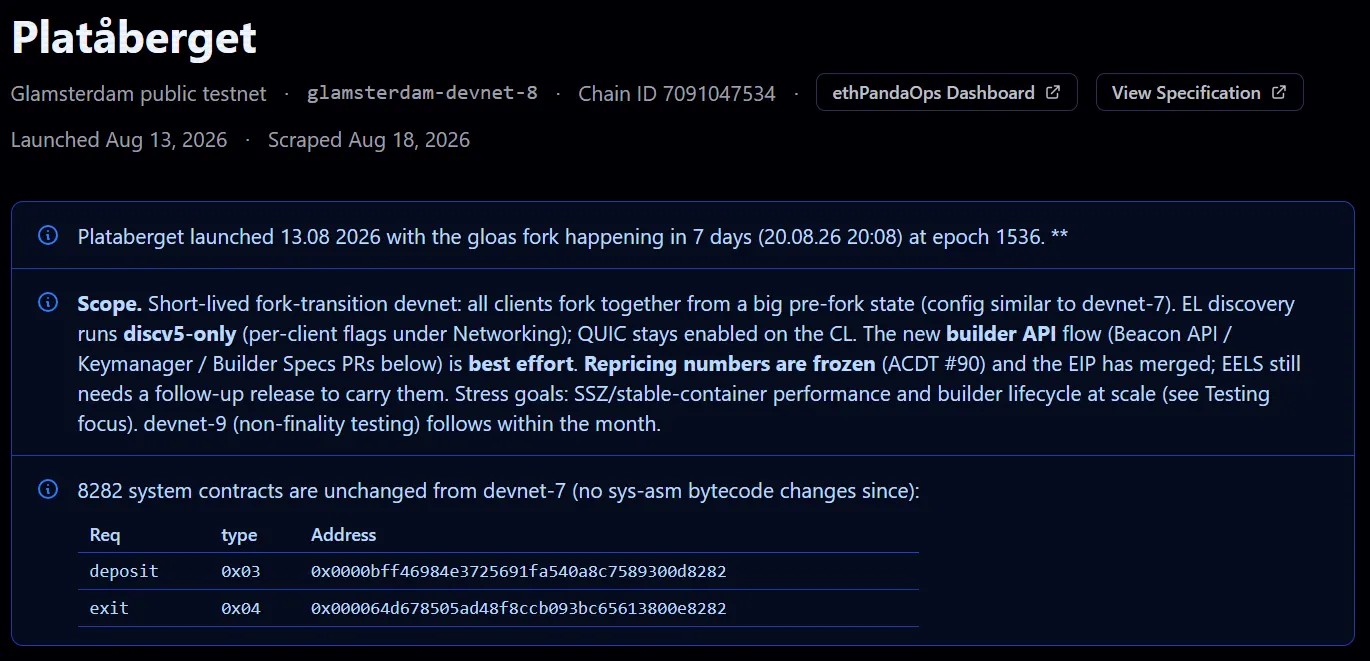
Source: Forkcast.

Recall that in August, Buterin named quantum resistance and AI as priorities for Ethereum.

The Quiet Evolution: Why Whales Are Accumulating Ethereum in Anticipation of Glamsterdam and Hegota
end-content

Trending Cryptos

Related Questions

QWhat upcoming Ethereum update has the Ethereum Foundation warned might cause wallet and software failures?

AThe upcoming Ethereum update named 'Glamsterdam'.

QAccording to the Ethereum Foundation, which specific types of software tools are most at risk from the Glamsterdam update?

AWallets, indexers, and fee estimation tools, especially those with a 'rigidly set maximum gas limit', are at risk.

QWhat key change does the EIP-8037 proposal introduce that necessitates updates to some software?

AEIP-8037 introduces a separate 'state-gas' dimension for operations that create new state, meaning sending ETH to a new address will incur an additional charge beyond the standard 21,000-unit base cost.

QOn what date was the Plataberget testnet, where developers are urged to test their systems, launched?

AThe Plataberget testnet was launched on August 13, 2026.

QWhat are the two priorities for Ethereum that Vitalik Buterin named in August, as mentioned in the article?

AVitalik Buterin named quantum resistance and AI as priorities for Ethereum.

Related Reads

Domestic RF Filters, Finally Starting to Compete?

China's domestic filter industry, particularly in the challenging BAW (Bulk Acoustic Wave) segment, has reached a significant inflection point, moving from solving the "availability" problem to entering a phase of commercial competition and scale. The market is attractive, with the global mobile terminal RF filter market projected to reach $9.2 billion in 2025, and BAW filters showing strong growth. However, the sector is historically dominated by giants like Broadcom and Qorvo, protected by deep patent walls, as evidenced by lawsuits that have bankrupted competitors like Akoustis. Previously, high-frequency BAW filter production in China was nearly zero. Now, domestic players like Nous Micro, Wuhan Memsensing, Hansky, and others are forming a genuine industrial cluster, achieving mass production and shipping hundreds of millions of chips to clients. Different business models are emerging, including IDM and fab-lite approaches through partnerships with foundries like Sai Microelectronics and Runxin Sensing. A key signal of this new competitive phase is a patent lawsuit filed by Nous Micro against Wuhan Memsensing in June 2025, alleging infringement of a core BAW resonator patent. This conflict, rather than mere internal friction, underscores that the industry now has substantial products and market stakes to contest. The challenge is no longer just technical breakthrough but transforming technological leads into sustainable commercial success through superior patents, product performance, cost control, and customer acquisition. Chinese companies are finally positioned to compete for a share of this lucrative market long held by foreign leaders.

marsbit27m ago

Domestic RF Filters, Finally Starting to Compete?

marsbit27m ago

Zhang Lei: How He Became the Biggest Money-Maker This Year

Zhang Lei's company Pinzhun Laser (频准激光) became the biggest "meat sign" (highly profitable new share) of the year on its A-share market debut. Its stock price skyrocketed nearly 600% from its IPO price, generating potential single-lot profits of over 550,000 RMB for lucky subscribers. Founded by Zhang Lei, a 2014 Ph.D. graduate from the Shanghai Institute of Optics and Fine Mechanics, Pinzhun Laser specializes in ultra-stable, narrow-linewidth lasers critical for quantum computing. Its lasers are used by leading global research teams at Harvard, Caltech, and France's PASQAL. The company later successfully applied its core frequency conversion technology to the semiconductor sector, developing deep-ultraviolet lasers for advanced chip manufacturing and inspection. This move diversified its revenue, with semiconductor sales growing rapidly to account for over 25% of its business by 2025. The company boasts gross margins consistently above 69%. Remarkably, Pinzhun Laser required only two major external funding rounds before its IPO, a testament to its early profitability. Key strategic investors in its IPO included major downstream players like BOE,佰维存储 (BIWIN), and中微半导体 (AMEC), signaling strong industry validation. The article highlights the crucial early-stage support from Hangzhou-based capital, particularly funds associated with the Hangzhou Institute of Optics and Fine Mechanics. This "patient capital" model, part of Hangzhou's broader 300-billion-yuan industrial fund strategy, focuses on partnering with scientist-entrepreneurs through the risky valley of death from lab to market. The success of Pinzhun Laser and another Hangzhou-backed firm,宇树科技 (Unitree Robotics), showcases how this supportive ecosystem helps build leading hard-tech companies.

marsbit33m ago

Zhang Lei: How He Became the Biggest Money-Maker This Year

marsbit33m ago

3-Month Loss of $10 Billion, DAT Companies Begin to Return to Rationality

During the recent earnings season, major Digital Asset Treasury (DAT) companies reported staggering combined losses of approximately $10 billion for Q2 and over $30 billion for the first half, primarily due to markdowns on their bitcoin holdings. However, contrary to expectations, their stock prices have rebounded from June lows, indicating the market had already priced in these losses. The key shift is a collective return to rationality. Companies like Strategy, Sharplink, and Metaplanet are now prioritizing a new core metric: increasing the amount of crypto assets per share. This marks a departure from last year's aggressive growth-at-all-costs narrative. To achieve this, they are adopting disciplined capital allocation—issuing stock to buy crypto when trading at a premium, and halting dilution or initiating buybacks when at a discount. Some, like Strategy, have even broken "never sell" pledges to uphold this discipline. A major tool enabling this strategy is the STRC model—perpetual preferred shares offering high dividends (e.g., 12-13%) to raise fixed-income capital for purchasing bitcoin. Strive, Bitmine, and Metaplanet have launched their own variants. Sharplink pursues a different path, staking its vast Ethereum holdings to generate native yield. While the premium of DAT stocks over their underlying crypto asset value has declined and may not fully return, the model is evolving rather than ending. Stripped of hype, DAT firms are becoming actively managed, leveraged thematic funds. Their survival through massive losses and continued institutional investment (with major funds adding billions to positions during downturns) suggests the industry is maturing into a more calculated, long-term business focused on compounding crypto per share.

marsbit37m ago

3-Month Loss of $10 Billion, DAT Companies Begin to Return to Rationality

marsbit37m ago

PI Price Forecast Remains Stable at $0.086 as Pi Network Reforms App Economy

PI price forecast remains stable around $0.086 as it continues to trade below a key descending trendline from April. The token has been consolidating in a narrow range between $0.078 and $0.086 throughout August, with major EMAs positioned above the price indicating bearish pressure. Key resistance levels are identified at the 20-day EMA ($0.08772) and the SuperTrend indicators around $0.09-$0.10. Support sits at the current price and the August range low of $0.070. Fundamentally, Pi Network announced a major change to its App Studio pricing model, set for August 24, 2026. The fixed, subsidized rate of 0.25 Pi for app creation/editing will shift to a usage-based model reflecting actual AI service costs. Subsidized rates will remain for apps demonstrating genuine user adoption. Separately, the mandatory node protocol upgrade has reached version 26.1, with only version 27.1 remaining to complete the sequence. On-chain activity shows increased transaction volume, including patterns of repeated 0.03 Pi transfers, potentially related to testing following the protocol upgrade. The bullish scenario targets a break above the $0.08772-$0.09000 resistance cluster, opening a path toward the 50-day EMA at $0.09560. The bearish risk is a breakdown below the consolidation range, potentially testing the $0.070 support level. The conclusion notes that while fundamental developments are progressing, the price chart remains technically constrained until it can decisively break above the persistent downtrend line and key moving averages.

cryptonews.ru40m ago

PI Price Forecast Remains Stable at $0.086 as Pi Network Reforms App Economy

cryptonews.ru40m ago

Trading

Spot

Hot Articles

Discussions

Welcome to the HTX Community. Here, you can stay informed about the latest platform developments and gain access to professional market insights. Users' opinions on the price of ETH (ETH) are presented below.

活动图片