Venice Token Price Forecast: VVV Eyes $15 as Revenue Surpasses $100 Million

cryptonews.ruPublished on 2026-08-18Last updated on 2026-08-18

Abstract

Venice Token (VVV) attracts attention after a sharp price rise, trading near $13.71 with a 12.29% daily gain. The rally follows co-founder Eric Voorhees reporting the platform has surpassed $100 million in annualized revenue, reaching profitability in Q1. Venice AI boasts 3.5 million users, 1.7 million daily API calls, and a token model that burns VVV for API credits, with 33.7 million tokens (42% of supply) already burned. Technically, VVV shows a bullish short-term reversal on the 4-hour chart, approaching key Fibonacci resistance at $13.50. A break above could target $14.50 and the psychological $15 level. However, momentum indicators like Stochastic RSI suggest overbought conditions, risking a pullback to support zones at $13.18-$13.00 or $12.70-$12.41. A key divergence is noted: despite the price recovery, open interest in derivatives remains low at ~$55.72 million, well below its $140 million peak, suggesting the current move is driven more by spot demand than leveraged speculation. Persistent spot net outflows also present a cautionary signal. The token's short-term direction hinges on holding above $13.50, with improved platform fundamentals acting as a potential catalyst.

Venice Token has regained attention following a sharp price increase amid accelerated growth of the Venice AI platform. Recently $VVV traded around $13.71, marking a daily increase of 12.29%. The token also rose 16.30% over seven days, according to market data. Furthermore, trading activity exceeded $20 million in the last 24 hours.

The rally gained momentum after Venice co-founder Eric Voorhees highlighted significant annualized revenue growth. It is reported that Venice surpassed $100 million in annualized revenue after recently reaching $70 million.

Venice Token leads daily gainers as co-founder reports $100 million in annualized revenue

Venice Token base:0xacfe6019ed1a7dc6f7b508c02d1b04ec88cc21bf rose about 7% to $12.64 today, topping CoinMarketCap's daily gainers among major tokens with volume up over 140%. The move... pic.twitter.com/FP6pmJH5TR

— BSCN (@BSCNews) August 17, 2026

Revenue Growth Amplifies Bullish Narrative

Venice's revenue growth provides an important fundamental backdrop for $VVV's latest recovery. Reports indicate the platform was generating over $70 million in annualized revenue by July 1. It later surpassed the $100 million annualized revenue mark in about six weeks.

Notably, the platform reportedly achieved profitability in the first quarter. Venice also claims to have approximately 3.5 million users and 1.7 million daily API calls. Furthermore, its token model creates demand through the use of API credits and $VVV burns.

The project is reported to have burned 33.7 million $VVV, representing roughly 42% of the total supply. Meanwhile, the team is reported to hold over 30 million $VVV with zero selling. These figures could strengthen a long-term scarcity narrative if platform activity continues to grow.

Venice AI [ $VVV ] just crossed $100M annualized ↓

> $70M ARR on July 1. $100M now
> Profitable since Q1
> $1B valuation, $65M from Dragonfly
> 3.5M users, 1.7M API calls daily
> 33.7M $VVV burned, 42% of supply
> $5 per $100 of API credits burns $VVV
> Team holds 30M+ $VVV, zero... https://t.co/uDXwA33wXI

— Chain INK (@0xchainink) August 17, 2026

Venice also holds a $1 billion valuation following a $65 million investment from Dragonfly. Thus, further revenue expansion could become increasingly important for the $VVV market valuation.

$VVV Technical Structure Turns Bullish

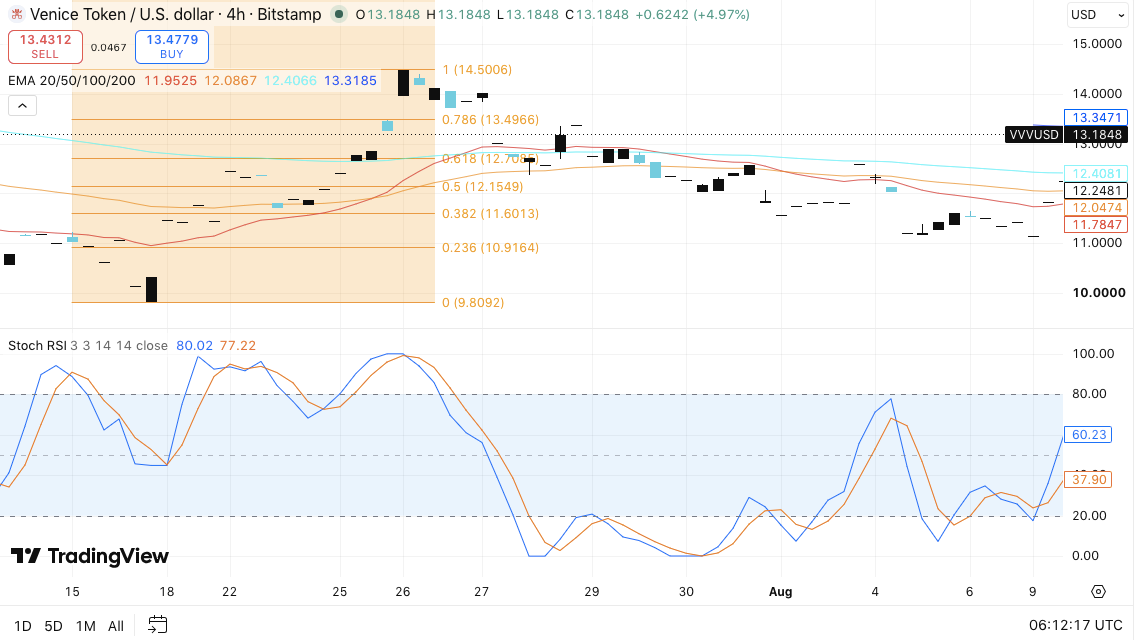
The four-hour chart for $VVV currently shows a notable short-term reversal. The token has reclaimed its 20, 50, and 100 exponential moving averages. The price is now approaching the $13.50 Fibonacci resistance zone.

This level is an immediate test for buyers following the recent gains. A sustained four-hour close above $13.50 could confirm stronger upward momentum. Consequently, the next major target lies around $14.50.
Venice Token Price Dynamics (Source: TradingView)

Moving beyond $14.50 could expose the $15 psychological level. However, traders should monitor momentum indicators closely, as the Stochastic RSI has risen sharply. The indicator is now approaching overbought territory, increasing the likelihood of short-term profit-taking.

Related: PI Price Forecast Remains Steady at $0.086 as Pi Network Reforms App Economy

$VVV could find initial support between $13.18 and $13.00 if sellers emerge. Below this zone, the $12.70–$12.41 region remains significant. The 50- and 100-EMA clusters are located in this area, providing buyers another potential defense zone.

Declining Open Interest Creates a Warning

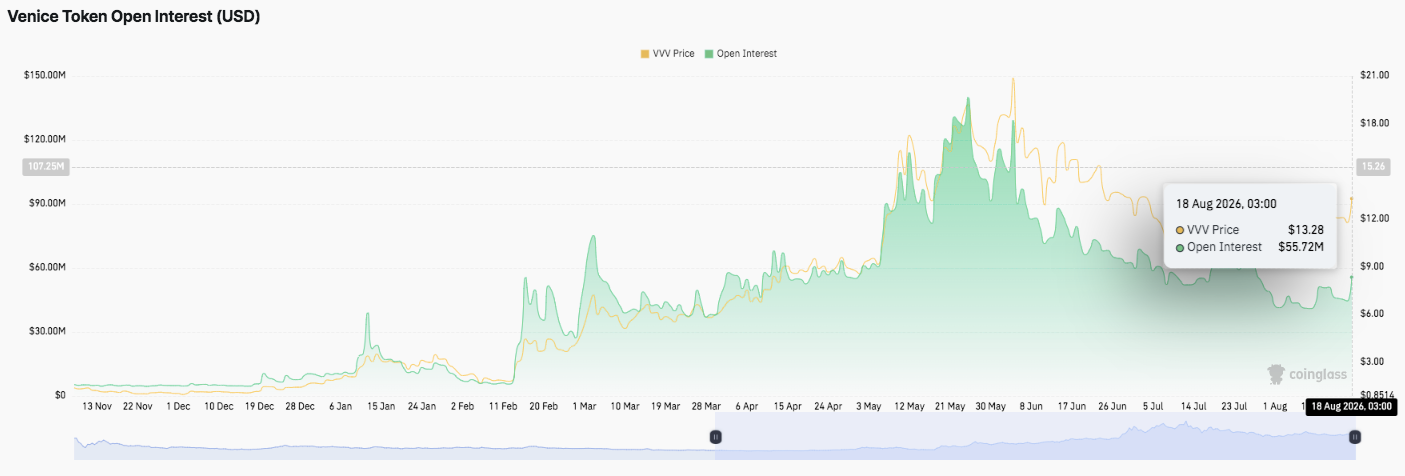
Despite stronger price movement, derivatives participation remains significantly weaker than during $VVV's early rally. Open interest surged above $120 million in May and briefly approached $140 million.

Subsequently, the metric trended lower persistently through June and July. Several pickups failed to deliver a sustainable recovery in leveraged participation.
Source: Coinglass

By August 18, open interest stood at about $55.72 million. This figure remains substantially below the previous peak, despite $VVV's recent price recovery.

This divergence creates an important signal for traders. Price has strengthened while leverage remains relatively subdued. Thus, the current uptrend may reflect improving spot demand rather than aggressive derivatives speculation.

However, rising open interest alongside further price gains could strengthen the bullish case. Such a move would indicate that new positions support the ongoing recovery.

Spot Flows Remain a Key Risk

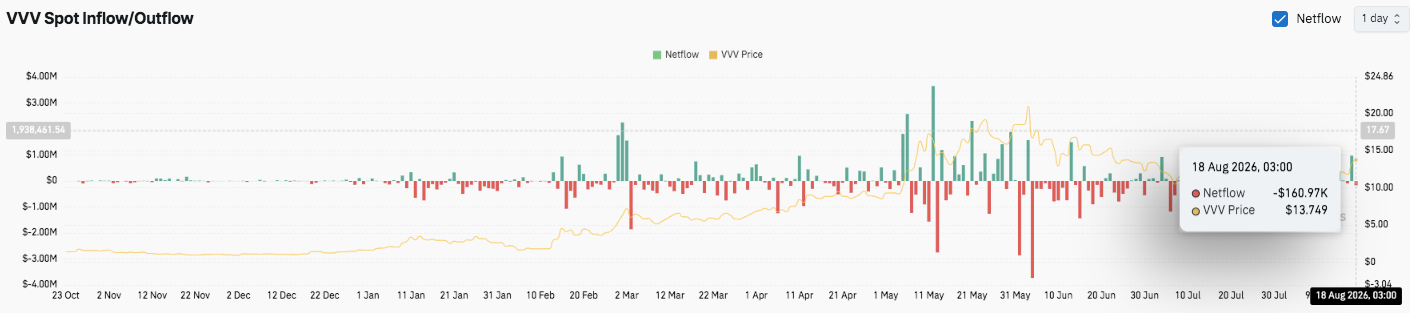
Data on $VVV spot flows provides a more cautious picture. Inflows increased in April and May as the token approached the $20 region. However, significant negative net flows emerged in late May and June.
Source: Coinglass

July continued with a mix of inflows and outflows. Nonetheless, outflow spikes typically outweighed buying activity. By August 18, the net flow was around minus $160,970, while $VVV traded around $13.75.

Venice Token Price Technical Overview

Key levels for Venice Token remain clearly defined as $VVV attempts to extend its recent recovery:

Upside Levels: Nearest resistance is $13.50, followed by $14.50 and $15.00. A decisive break above $14.50 could strengthen momentum toward the $15.00 psychological level.

Downside Levels: $13.18–$13.00 represents the first support zone, followed by $12.70–$12.41 in the area of the 50- and 100-EMA. A deeper correction could open $12.25 and $11.60.

Resistance Ceiling: $13.50 is a pivotal level capable of switching to stronger bullish momentum. A sustained 4H close above this zone could confirm the reversal and attract new buyer interest.

Will Venice Token Rise?

The short-term direction for $VVV depends on whether buyers can break through and hold above $13.50. Stronger spot market demand and rising open interest could support a move toward $14.50 and $15.00. However, persistent spot outflows and reduced open interest could stimulate profit-taking.

A failure to defend $13.00 would increase the risk of a decline toward $12.70–$12.41. For now, $VVV remains at a critical technical juncture, with improving fundamentals for Venice AI potentially serving as a catalyst for the next major move.

end-content

Related Questions

QWhat is the current price of Venice Token (VVV) and what recent growth has it experienced?

AThe Venice Token (VVV) is currently trading around $13.71. It has experienced a daily growth of 12.29% and a weekly growth of 16.30%.

QWhat key revenue milestone did Venice AI recently achieve, according to its co-founder?

AVenice AI recently surpassed the milestone of $100 million in annualized revenue, having previously reached $70 million.

QWhat is the next major technical price target for VVV if it sustains a breakout above $13.50?

AIf VVV sustains a breakout above $13.50, the next major technical price target is around $14.50, with the psychological level of $15.00 beyond that.

QHow does the current Open Interest for VVV derivatives compare to its previous peak, and what does this suggest?

AThe current Open Interest for VVV derivatives is about $55.72 million, which is significantly lower than its previous peak near $140 million. This suggests the recent price rise may be driven more by spot demand than by aggressive leveraged speculation.

QWhat are the primary support zones for VVV if the price corrects from its current level?

AIf the price corrects, the primary support zones for VVV are between $13.18 and $13.00, followed by the $12.70–$12.41 area where the 50- and 100-period EMAs are located.

Related Reads

Ondo State-based Company QQQon Raises $2.3 Million in Ethereum Investment Amid Surge in Tokenized Stocks

Company QQQon from the state of Ondo attracted $2.3 million in Ethereum investment amid the growth of tokenized stocks. This follows a single Ethereum transaction where a trader spent $2,328,595.73 to purchase 3,167.53 $QQQon tokens. Ondo Finance stated this seven-figure purchase signals tokenized stocks are moving beyond an experimental phase. Ondo Stocks, the company's tokenized ETF platform, recently surpassed $1 billion in Total Value Locked (TVL), with total trading volume reaching $27 billion since its September 2025 launch. $QQQon allows blockchain investors access to various US stocks. The large transaction indicates growing institutional interest in a market traditionally dominated by small retail trades. Furthermore, Ondo has enabled its tokens, like $QQQon and $SPYon, to be used as collateral for DeFi loans, transforming them from passive assets into productive investment tools. Ondo has expanded trading to 24/7 operations across multiple blockchains and now offers over 430 tokenized stocks and ETFs. While the tokenized stock market remains small compared to traditional equities, it is growing rapidly, valued at over $1.7 billion as of June 2026, a 149% year-over-year increase. Regulatory bodies like the SEC have emphasized that securities laws apply regardless of tokenization. Ondo's TVL has seen remarkable growth, from approximately $192 million in January 2024 to about $3.51 billion currently, an 18.3x increase, positioning it as a leading platform in the Real-World Asset (RWA) sector alongside names like BlackRock's BUIDL and Circle's USYC.

cryptonews.ru3m ago

Ondo State-based Company QQQon Raises $2.3 Million in Ethereum Investment Amid Surge in Tokenized Stocks

cryptonews.ru3m ago

Bitcoin Deposits on Sui's Hashi Bridge Surpass 1.1 Million in 3 Weeks

Analysts report that activity on the Hashi bridge testnet from Sui has remained high since its launch on July 22. In just three weeks, total deposits exceeded 1.1 million BTC, with withdrawals reaching 165,000. This rapid growth suggests early interest from retail and institutional investors in moving native Bitcoin to the Sui network without converting it into a synthetic token—a model gaining attention after major bridge hacks in recent years. First introduced by the Sui Foundation in March 2026, Hashi is a decentralized primitive designed to allow Bitcoin ($BTC) to serve as collateral for on-chain lending and borrowing markets. It has progressed from a closed devnet to the current public testnet. Notably, the Bitcoin DeFi (BTCFi) sector has faced challenges in 2026, with total value locked (TVL) in Layer-2 solutions down roughly 74% from 2025 highs. Hashi's approach of keeping BTC on its native chain, rather than "wrapping" it, is a direct response to this market skepticism. The early deposit and withdrawal figures provide Sui with an argument that this model is finding an audience despite the broader downturn. Unlike traditional wrapped-asset bridges, Hashi does not move Bitcoin out of the Bitcoin network. Users deposit native $BTC, Sui validators confirm the transaction, and the protocol mints hBTC—a representative token usable as programmable collateral. The underlying Bitcoin remains in its own chain. Security is based on a multi-layered architecture featuring a 2-of-2 multisig protected by validators using Multi-Party Computation (MPC), and a "Guardian Layer" that acts as a circuit breaker, vetting large withdrawal requests. Currently, over 25 organizations are stress-testing the system, including giants like BitGo and Cumberland, as well as SwissBorg, Fluid, and Ledger. Their involvement spans trading, custody infrastructure, and asset management platforms, indicating demand for compliant, non-custodial ways to utilize idle Bitcoin in DeFi. The protocol's revenue model relies on interest rate spreads between depositors and borrowers, rather than inflationary token emissions. If Hashi can capture even a small share of the $1.4 trillion Bitcoin market for on-chain lending, it would represent a significant example of interaction between the Bitcoin base layer and non-Bitcoin DeFi ecosystems.

cryptonews.ru3m ago

Bitcoin Deposits on Sui's Hashi Bridge Surpass 1.1 Million in 3 Weeks

cryptonews.ru3m ago

From Cold War Nuclear Wasteland to an 8-Gigawatt AI Superfactory: Huang Renxun Bets $1.5B, OpenAI Secures Exclusive 20-Year Deal

A Cold War-era uranium enrichment site in Ohio, once used for atomic bomb production, is being transformed into the world's largest AI supercomputing facility. NVIDIA, OpenAI, and SoftBank are leading this project, which plans an ultimate power capacity of 8 gigawatts—nearly two-thirds of the total power used by 82 of the world's top AI data centers today. NVIDIA's CEO Jensen Huang has committed $1.5 billion in funding and a 20-year credit guarantee for the infrastructure. OpenAI has signed a 20-year lease to fully utilize the facility's computing power. SoftBank is investing heavily in land acquisition, construction, and grid upgrades, promising to add 1 gigawatt of new power generation. Huang argues that the next major bottleneck for AI advancement is no longer chip supply, but the availability of land, power, and data center space—resources that new AI companies often lack the long-term credibility to secure. By leveraging NVIDIA's market position and credit to lock down these critical physical resources for decades, the company ensures a steady, long-term demand for its GPUs within the facility. The infrastructure, with a 20-year lifespan, will host new generations of NVIDIA hardware every few years, creating recurring revenue streams. Analysts estimate this project alone could represent a $600 billion revenue opportunity for NVIDIA from OpenAI by 2030. This move signifies a strategic shift in the AI race: competition is expanding from semiconductor technology to securing the foundational elements of power and real estate on a massive scale.

marsbit13m ago

From Cold War Nuclear Wasteland to an 8-Gigawatt AI Superfactory: Huang Renxun Bets $1.5B, OpenAI Secures Exclusive 20-Year Deal

marsbit13m ago

Harvard Halts Reduction in Bitcoin ETF Holdings, US University Funds' Crypto Exposure Enters a Holding Pattern

Harvard University's endowment fund halted its selling of the iShares Bitcoin Trust (IBIT) in Q2 2026, after reducing its position over the previous two quarters. According to its latest 13F filing, the fund held 3,044,612 IBIT shares (worth approximately $101.4 million) as of June 30, unchanged from Q1. The IBIT holding now ranks 11th in Harvard's $4.26 billion public portfolio, constituting 2.4% of its value. Its combined gold-related holdings exceed the Bitcoin ETF's value. Harvard first disclosed a Bitcoin ETF position in Q2 2025, significantly increased it in Q3 2025 as Bitcoin neared highs, but then began selling in Q4 2025 and Q1 2026 while also liquidating an Ethereum ETF. This halt in selling coincides with Harvard's broader financial pressures, including operational deficits and increased taxes on its endowment. Other U.S. university endowments, such as Dartmouth, Brown, and the University of Illinois, maintained their smaller crypto ETF positions in Q2, with any value declines attributed solely to price drops. Institutional activity elsewhere was mixed: two Abu Dhabi sovereign wealth funds held their large IBIT positions steady, while Morgan Stanley reduced and JPMorgan increased its exposure. Bitcoin's price, after hitting a low around $57,800 in early July, has traded sideways between $62,000 and $66,000, suggesting diminished selling pressure. The pause in selling by a previous active seller like Harvard, alongside steady holdings from other funds, indicates institutional selling pressure may be easing at current price levels.

marsbit13m ago

Harvard Halts Reduction in Bitcoin ETF Holdings, US University Funds' Crypto Exposure Enters a Holding Pattern

marsbit13m ago

Trading

Spot
活动图片