Hyperliquid loses mid-range support as short-term selling pressure builds

ambcryptoPublished on 2026-07-14Last updated on 2026-07-14

Abstract

Hyperliquid recently hit a record $11.07 billion in total Open Interest on its chain, with HIP-3 markets contributing another high of $3.69 billion. This occurred despite a new Ethereum Layer-2, Robinhood Chain, briefly surpassing it in daily speculative interest, fueled by viral memecoin launches. A higher timeframe analysis shows HYPE maintains a bullish swing structure, having broken past a previous high to reach $76.955. Key Fibonacci levels suggest a long-term "golden pocket" support zone lies between $32.56 and $42.05. However, in the short term, the token is trading within a range of $53.3 to $74.6 and has recently fallen below its mid-range support at $64. Technical indicators like the Chaikin Money Flow (CMF) and MACD signal increasing selling pressure and weakening bullish momentum, suggesting a potential drop toward the range's lower end near $53-$54. While the long-term uptrend appears intact, swing traders are advised to watch for a breakdown of the current range, which could lead to a deeper correction toward $32.

The Hyperliquid chain’s total Open Interest reached $11.07 billion on July 13, the highest in 2026. HIP-3 markets, or Hyperliquid Improvement Proposal 3, contributed to $3.69 billion, another record, reported Wu Blockchain in a post on X.

Just a couple of days ago, though, it was reported that the new Ethereum Layer-2, Robinhood Chain, had surpassed Hyperliquid and BNB in daily speculative interest.

Viral memecoin launches like CashCat helped fuel the Robinhood volume, and it is unclear if this enormous volume can be sustained during periods of less memecoin speculation.

Hyperliquid is a market-proven product. Will this be enough for its price trends to improve in July?

The Hyperliquid uptrend remains intact
Source: HYPE/USDT on TradingView

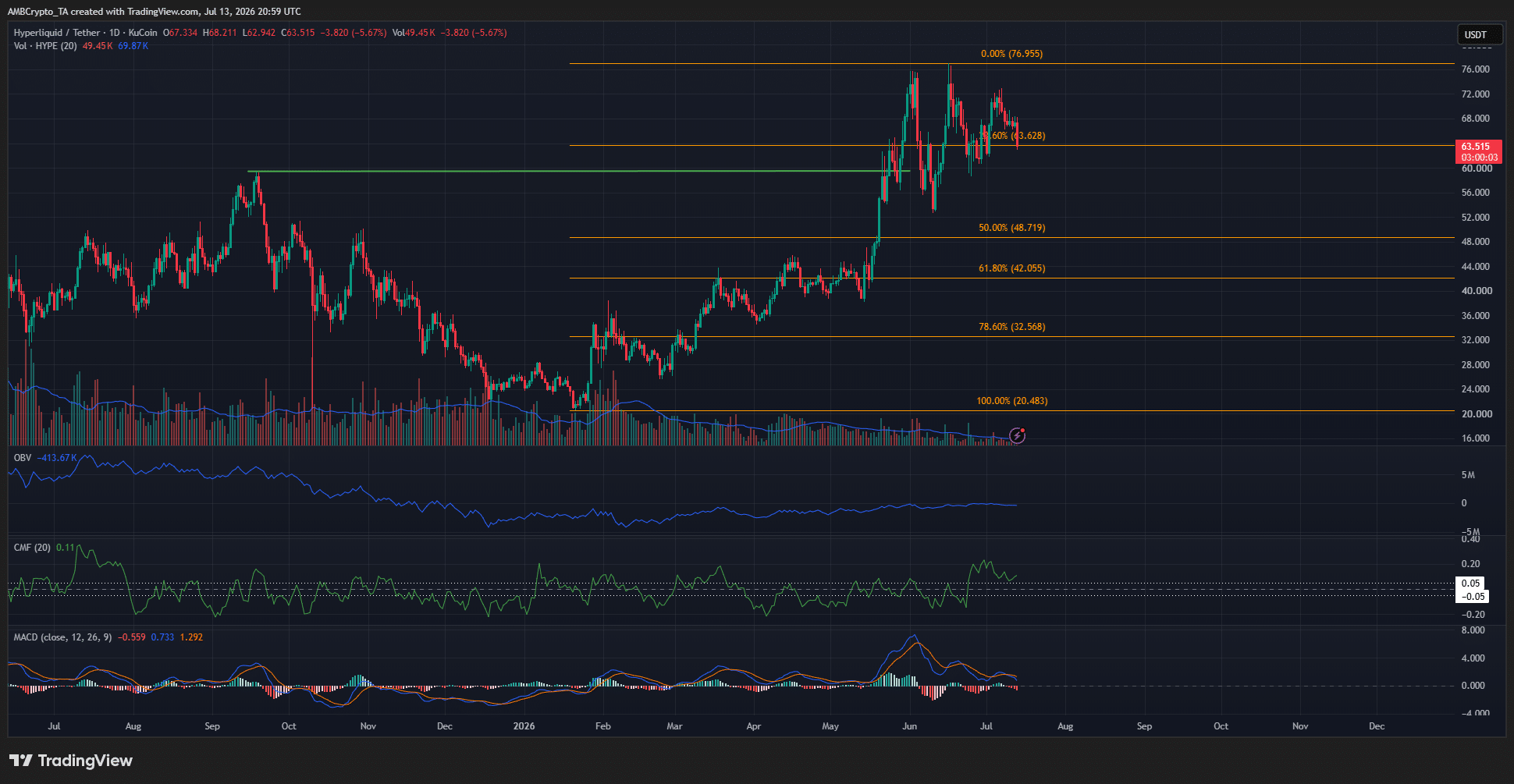
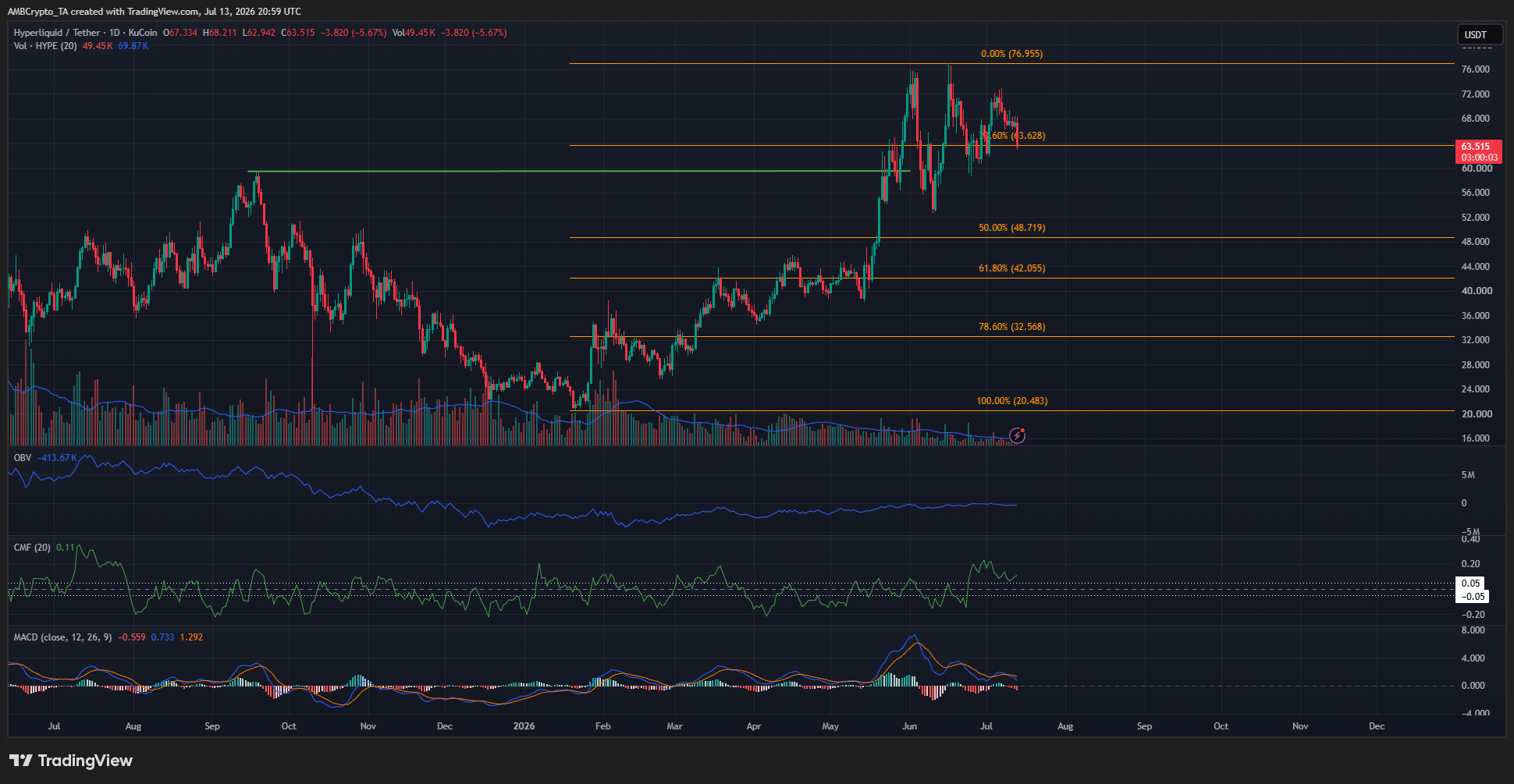
A bullish swing structure was in place for HYPE. An upward continuation was established when the previous swing high at $59.412 [green] was breached to the upside in May. Since then, the altcoin has set a new high at $76.955.

Using the move from $20.48 to $76.95, a set of Fibonacci retracement levels [orange] was plotted. It showed that the coveted golden pocket for swing traders and investors sat in the $32.56-$42.05 area.

The golden pocket outlines a high-probability trend resumption zone between the 61.8%-78.6% retracement levels. Therefore, in the long run, a correction to this region should offer an investing opportunity.

As things stand, HYPE is a long way from such a massive retracement. The CMF was above +0.05, and the OBV was climbing, to show steady buying pressure. Meanwhile, the MACD signaled waning bullish momentum.

Traders’ call to action- Respect the range
Source: HYPE/USDT on TradingView

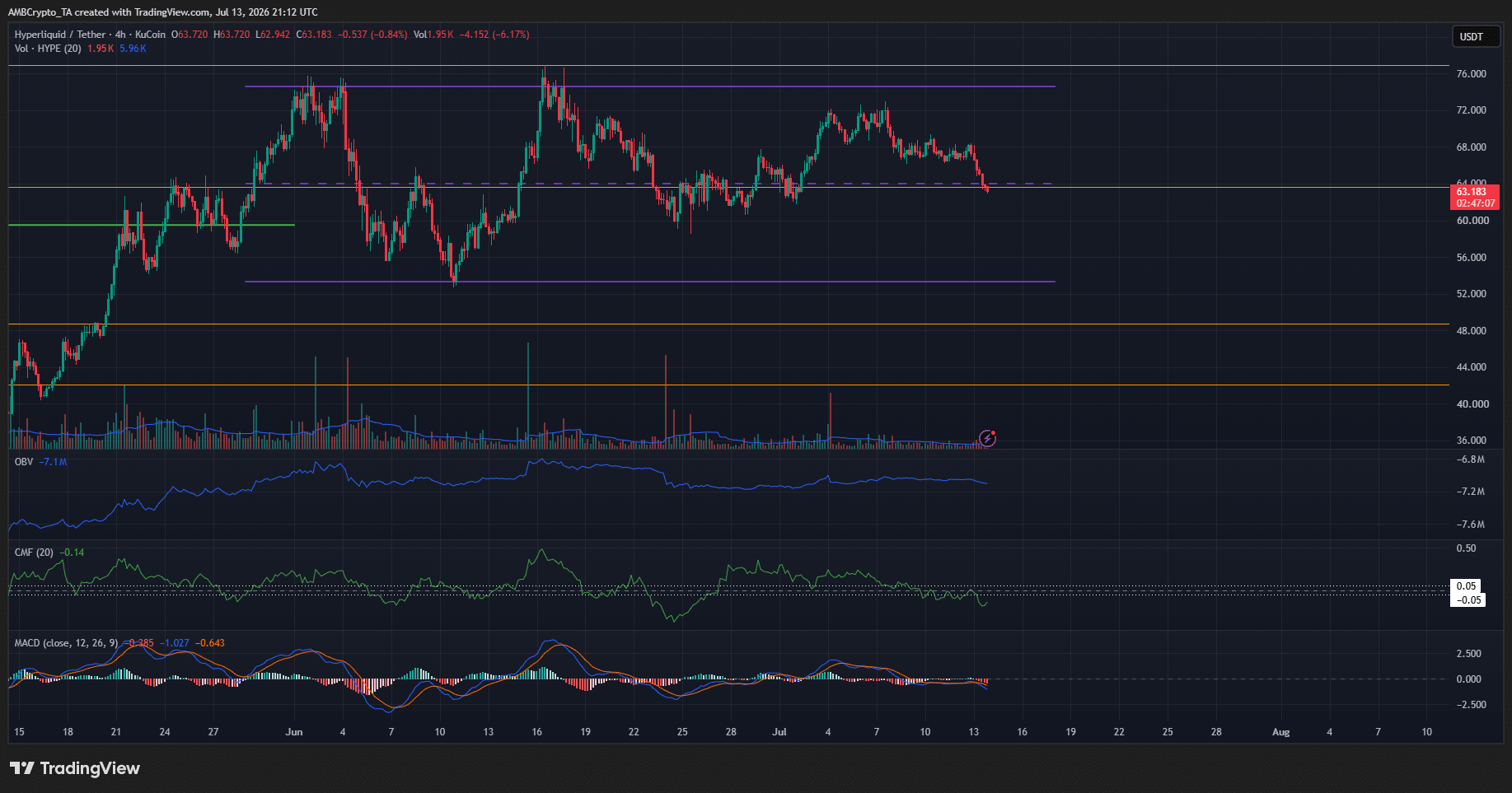
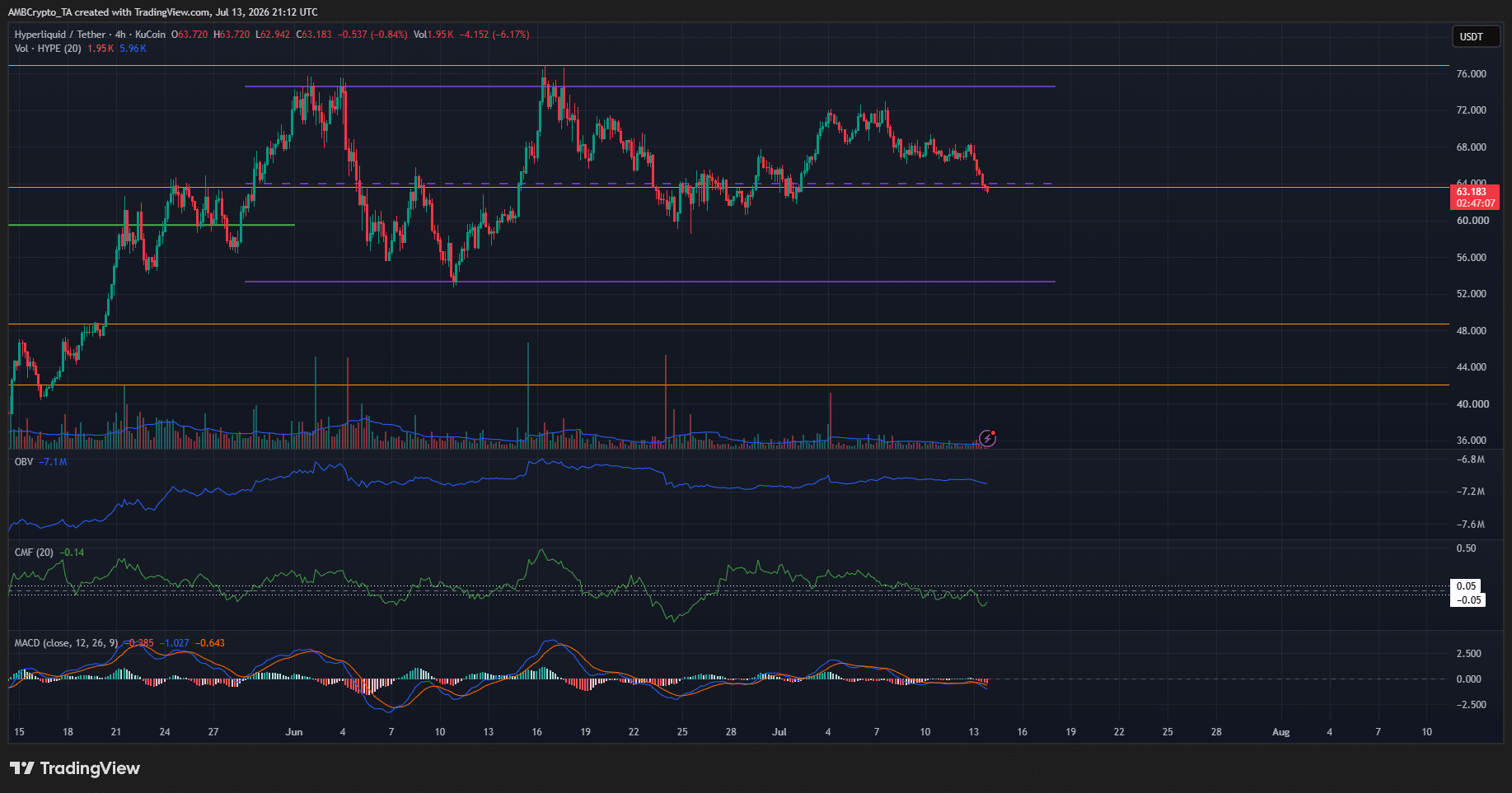
A range formation between $53.3 and $74.6 has been in place since early June. At the time of writing, the Hyperliquid token was trading below the mid-range support at $64.

This signaled a potential drop toward the lower end of the range. The CMF’s -0.14 reading showcased heavy capital outflows. The MACD has formed a bearish crossover below the zero line to signal that downward momentum was gaining strength.

Swing traders can wait for a drop toward $53-$54 before looking to buy. It is also possible that the $60 round-number level might yield a price bounce.

As things stand, traders can wait for this range to break down before they can begin anticipating a correction toward $32.


Final Summary

  • Hyperliquid reached its highest Open Interest of 2026 on Monday. Robinhood Chain’s surge in daily speculative interest recently might not be enough to topple the leading DEX.
  • The higher timeframe HYPE price trends were bullish. For now, the $53.3 and $74.6 levels were the ones swing traders should watch.


Trending Cryptos

Related Questions

QWhat record did the Hyperliquid chain achieve regarding Open Interest, and when did it happen according to the article?

AThe Hyperliquid chain achieved its highest Open Interest of 2026, reaching $11.07 billion, on July 13.

QBased on the technical analysis, what is the price range that currently defines the trading zone for the HYPE token?

AAccording to the article, a range formation between $53.3 and $74.6 has been in place since early June.

QWhat was reported as a challenge or potential competitor to Hyperliquid's recent market activity?

AIt was reported that the new Ethereum Layer-2, Robinhood Chain, had surpassed Hyperliquid and BNB in daily speculative interest.

QWhat key technical indicator was used to identify a potential long-term investment zone, and what price range does it represent?

AA set of Fibonacci retracement levels was used. The 'golden pocket' for long-term investment was identified in the area between $32.56 and $42.05, corresponding to the 61.8% to 78.6% retracement levels.

QWhat does the article suggest as a potential action for swing traders if the current price range breaks down?

AThe article suggests that if the current range (between $53.3 and $74.6) breaks down, traders can begin anticipating a correction toward the $32 area.

Related Reads

Jito Revives with New Exchange JTX Buyback: Self-Salvation or Lifeline?

Jito, a Solana-based MEV and liquid staking infrastructure protocol, has announced new governance proposal JIP-38 and the launch of a new self-custody trading platform, JTX. The proposal establishes a rigid value-capture mechanism, mandating that 100% of the DAO's share of revenue from JTX—80% of its platform fees—will be used for programmatic, on-chain verifiable open market buybacks and permanent burns of the JTO token. This commitment is set to last at least from JTX's launch until Q4 2027. The move comes as Jito faces significant challenges in its core liquid staking market, with protocol-staked SOL declining from 18 million to under 10 million. Intense competition from protocols like Sanctum and Jupiter, coupled with continuous monthly token unlocks (1.15% of max supply), has pressured JTO's price, which fell over 96% from its all-time high to a low of $0.21 earlier this year, before recovering to around $0.63. JIP-38 formalizes Jito Network as a "token-centric" network, where all major revenue streams flow to the DAO for governance by JTO holders. While the JTX buyback is a firm commitment using new revenue, decisions on other income streams and the post-2027 strategy will be determined by future governance votes. The proposal is seen as a strategic pivot to create a new revenue source and directly align token value with ecosystem growth, though its success depends heavily on JTX's ability to compete effectively in the crowded Solana trading landscape.

Foresight News13m ago

Jito Revives with New Exchange JTX Buyback: Self-Salvation or Lifeline?

Foresight News13m ago

The More Proficient AI Becomes at Answering, Why Do Humans Need Deep Thinking More? Fudan Releases the 2026 Blue Book on Intelligent Development in Humanities and Social Sciences

As AI capabilities rapidly expand, particularly in generating sophisticated text, analyzing data, and automating complex tasks, the need for human deep thinking becomes more critical, not less. The "2026 Blue Paper on Intelligent Development for Humanities and Social Sciences" from Fudan University argues that the relationship between AI and these fields is shifting from "one-way empowerment" to "bidirectional fusion." While AI transforms research methodologies, the humanities must guide its purpose, application, and governance. The core challenge is no longer processing vast information, but defining worthwhile problems, establishing genuine causal mechanisms, and constructing verifiable evidence chains. AI excels at producing coherent, fluent outputs but risks oversimplifying complex social realities into standardized formats it can easily process. For instance, in areas like climate-society systems, the difficulty lies not in handling more variables, but in understanding the fundamental mismatches between natural and social systems. Similarly, in automated research, AI can efficiently search for statistically significant results or generate papers quickly, potentially masking flawed assumptions or "packaging" statistical noise as discovery. The speed of paper production does not equate to the speed of genuine knowledge advancement. This underscores the non-transferable human responsibility for judgment. Deep thinking must be embedded into research workflows, governance systems, and organizational structures. Key principles include: * **Maintaining the Evidence Chain:** While AI can handle tasks like data processing, researchers must retain oversight over problem definition, conceptual translation into metrics, causal interpretation, and defining the scope of conclusions. Frameworks like STRIDES aim to document decisions and enable audit trails. * **Ensuring Meaningful Human Oversight:** In public governance, AI systems should operate in an "assistive" rather than an "agentic" mode. Human operators must retain genuine intervention, correction, and explanation rights to prevent "responsibility theater," where humans merely rubber-stamp algorithmic decisions. * **Translating Principles into Practice:** AI governance needs enforceable mechanisms across a system's lifecycle—pre-deployment risk assessment, runtime monitoring and human-in-the-loop controls, and post-hoc review and accountability—tailored to the level of risk involved. * **Defining Direction, Not Just Answers:** Humanities and social sciences provide the essential framework for navigating value conflicts (e.g., efficiency vs. fairness) and analyzing the social consequences of technology, questions AI alone cannot resolve. Building lasting capacity requires more than isolated projects. It demands integrated infrastructure—shared data standards, tools, interdisciplinary training, and collaborative mechanisms—as measured by initiatives like the "Chinese Universities AI4SSH Index." The ultimate imperative is clear: as AI becomes better at answering questions, humans must become more deliberate and responsible in deciding which questions are worth asking, critically evaluating the answers, and steering the technology's impact on society.

marsbit33m ago

The More Proficient AI Becomes at Answering, Why Do Humans Need Deep Thinking More? Fudan Releases the 2026 Blue Book on Intelligent Development in Humanities and Social Sciences

marsbit33m ago

Trading

Spot

Hot Articles

How to Buy T

Welcome to HTX.com! We've made purchasing Threshold Network Token (T) simple and convenient. Follow our step-by-step guide to embark on your crypto journey.Step 1: Create Your HTX AccountUse your email or phone number to sign up for a free account on HTX. Experience a hassle-free registration journey and unlock all features.Get My AccountStep 2: Go to Buy Crypto and Choose Your Payment MethodCredit/Debit Card: Use your Visa or Mastercard to buy Threshold Network Token (T) instantly.Balance: Use funds from your HTX account balance to trade seamlessly.Third Parties: We've added popular payment methods such as Google Pay and Apple Pay to enhance convenience.P2P: Trade directly with other users on HTX.Over-the-Counter (OTC): We offer tailor-made services and competitive exchange rates for traders.Step 3: Store Your Threshold Network Token (T)After purchasing your Threshold Network Token (T), store it in your HTX account. Alternatively, you can send it elsewhere via blockchain transfer or use it to trade other cryptocurrencies.Step 4: Trade Threshold Network Token (T)Easily trade Threshold Network Token (T) on HTX's spot market. Simply access your account, select your trading pair, execute your trades, and monitor in real-time. We offer a user-friendly experience for both beginners and seasoned traders.

12.4k Total ViewsPublished 2024.03.29Updated 2026.06.02

How to Buy T

Discussions

Welcome to the HTX Community. Here, you can stay informed about the latest platform developments and gain access to professional market insights. Users' opinions on the price of T (T) are presented below.

活动图片