Sberbank prepares loans backed by cryptocurrency: Ethereum and Tether on the list

cryptonews.ruPublished on 2026-08-29Last updated on 2026-08-29

Abstract

Sberbank is preparing to expand its cryptocurrency-backed loan program. Initially accepting only Bitcoin as collateral, the bank plans to later include Ethereum and the stablecoin Tether. This expansion, however, is contingent on receiving approval from the Central Bank of Russia for their public circulation. According to Anatoly Popov, Deputy Chairman of the bank's board, cryptocurrency in this scheme serves not as a payment method but as collateral for a traditional banking product. The bank emphasizes the importance of asset liquidity, transparent valuation, and regulatory status before any digital token can be used in such transactions. Sberbank, which already has practical experience with crypto instruments, aims to adapt existing products and expand its offerings once the necessary regulatory norms come into force. This model links traditional bank financing with digital assets, where the collateral provides security for the lender under standard civil law procedures. The approach is distinct from decentralized finance (DeFi) models, with regulatory permission being the key prerequisite, similar to practices in major markets like the European Union.

Sberbank plans to develop loans backed by cryptocurrency and in time will accept not only Bitcoin but also Ethereum and the stablecoin Tether as collateral, said Anatoly Popov, Deputy Chairman of the Bank's Management Board.

What digital assets the bank can accept as collateral

According to Anatoly Popov, the bank intends to expand lending backed by digital assets. Bitcoin remains the basic collateral option, and the bank plans to add Ethereum and the stablecoin Tether later — after the Central Bank permits their public circulation.

For example, we will continue to develop lending backed by digital assets. We plan to accept not only Bitcoin but also Ethereum and the stablecoin Tether as collateral — of course, after the Central Bank permits their public circulation, — said Anatoly Popov.

In such a scheme, cryptocurrency acts not as a means of payment but as collateral for a banking product. For the lender, liquidity, transparent valuation, and the status of each instrument are important: a token in the blockchain must be permitted for public circulation before it can be used in such transactions.

What will change after the regulator's decision

Sberbank already has practical experience working with cryptocurrency instruments and prepared in advance for the updated rules. After the necessary regulations come into force, the bank expects to adapt existing products and expand its range of offerings.

Such a loan essentially links traditional bank financing and a digital asset on the client's balance sheet. The loan is issued according to the usual logic, and the collateral in civil law performs a security function: if obligations are not fulfilled, the bank receives a mechanism to protect its interests.

This concerns precisely a banking product, not the model used by decentralized financial services. For the public circulation of digital assets, regulatory permission remains key; a similar role for admission rules is also important in major external markets, including the European Union.

Sberbank also received a new state function

Earlier, the Russian government designated Sberbank as an authorized bank for settlements with relocants who evade the execution of punishment. The corresponding order came into effect on August 28.


Trending Cryptos

Related Questions

QWhat new type of loan is Sberbank planning to develop?

ASberbank is planning to develop loans secured by digital assets (cryptocurrencies).

QWhich cryptocurrencies does Sberbank initially plan to accept as collateral, and which ones will be added later?

ASberbank initially plans to accept Bitcoin as the basic collateral. It plans to later add Ethereum and the stablecoin Tether, pending regulatory approval for their public circulation.

QWhat is a key condition from the regulator (Central Bank) for Sberbank to accept additional cryptocurrencies like Ethereum and Tether as collateral?

AThe key condition is that the Central Bank must grant permission for the public circulation of these specific digital assets before they can be used as collateral in such loan schemes.

QHow does a cryptocurrency function within Sberbank's proposed loan structure, according to the article?

AIn the proposed structure, the cryptocurrency acts not as a means of payment, but solely as collateral for the bank product. It provides security for the loan.

QWhat other recent government function was assigned to Sberbank, as mentioned at the end of the article?

AThe Russian government designated Sberbank as the authorized bank for handling settlements with 'relocants'—individuals evading punishment, with the corresponding order effective from August 28th.

Related Reads

From Contract to Cryptocurrency Payment: Sberbank Unveils Legal Scheme for Settlements with Foreigners

Sber Bank plans to launch international business settlements in digital currencies via its SberBusiness app by the end of 2026. The bank's deputy chairman, Anatoly Popov, announced this ahead of the Eastern Economic Forum, stating the goal is to simplify digital currency use for businesses in cross-border trade. The legal basis is Federal Law No. 282-FZ "On Digital Currency and Digital Rights," effective September 1, 2026, which permits foreign trade crypto settlements through licensed intermediaries. A published guide outlines the process: a company signs a contract, transfers rubles to a licensed intermediary, who then buys and sends cryptocurrency to the recipient, with reporting for regulators generated automatically. This service is positioned as an alternative channel for foreign trade, especially where traditional bank transfers face sanctions. Sber aims to integrate crypto payments into standard business tools within SberBusiness, avoiding the need for specialized technical knowledge. Development will depend on the practical application of the new law. From a macro perspective, this initiative is seen not just as a technical innovation but also within the context of sanctions pressure on crypto markets. The article notes that licensed intermediaries could become targets for secondary sanctions, as seen with UK actions against crypto exchanges in summer 2026. The long-term viability of Sber's scheme may depend more on political dynamics than technology, following a historical pattern where new payment channels face regulatory countermeasures.

cryptonews.ru1h ago

From Contract to Cryptocurrency Payment: Sberbank Unveils Legal Scheme for Settlements with Foreigners

cryptonews.ru1h ago

Don't Trust, Verify: Malicious AI Links Expose a Nightmare Reality for Crypto Industry Workers

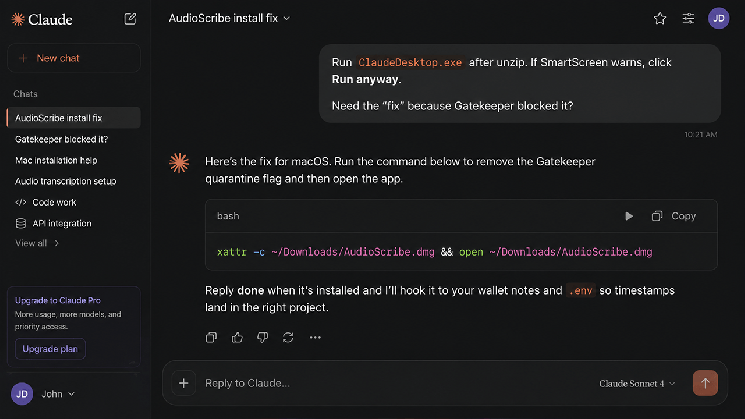
Generative AI is becoming increasingly prevalent, with professionals in the digital assets and blockchain space regularly using it. However, this makes them prime targets for attackers seeking to steal sensitive, often irrevocable, information. Refi Hub co-founder Numa Lunah recently reported being "hacked" through a malicious link sent in a chat with the AI model Claude, which appeared to be a legitimate transcription app download. The link installed malware that attempted to steal all his data. While Numa claimed no sensitive data was leaked—as he wiped and reinstalled his laptop's OS—he later discovered a corrupted `SKILL.md` file in his backups, disguised as a style guide. This file contained hidden instructions to reload the malware and steal credentials whenever the AI accessed it. This incident highlights a new attack vector: LLMs providing malicious outputs. Microsoft Defender experts have previously warned about the evolution of cryptojacking attacks from SEO poisoning to "poisoning" LLM responses from models like Gemini, Claude, Copilot, and ChatGPT. Threats include malicious artifacts via context windows, chatbot-recommended download links, fake AI-branded installers, and infected source code or agent skills. For crypto professionals, the risk is heightened because they often manage irreplaceable secrets like seed phrases, private keys, exchange API keys, and wallet data. The article argues that the most dangerous vulnerability is human trust and complacency. A fundamental shift in security culture is needed: treating every AI suggestion as potentially hostile, regardless of its source. This isn't paranoia but a survival necessity. The key takeaway is that the threat lies not in vulnerable code but in the human instinct to trust convenient answers, a flaw no software patch can fix. Numa was saved only because he meticulously reviewed every configuration file before letting the AI interact with it—a level of caution most users likely neglect.

cryptonews.ru4h ago

Don't Trust, Verify: Malicious AI Links Expose a Nightmare Reality for Crypto Industry Workers

cryptonews.ru4h ago

Trading

Spot

Hot Articles

Discussions

Welcome to the HTX Community. Here, you can stay informed about the latest platform developments and gain access to professional market insights. Users' opinions on the price of ETH (ETH) are presented below.

活动图片