Ripple Donates $300,000 to Aid Flood Victims in Nepal and Tibet

cryptonews.ruPublished on 2026-08-29Last updated on 2026-08-29

Abstract

Ripple has donated $300,000 to provide emergency food, water, and sanitation aid following devastating floods in Nepal and Tibet. The funds will be distributed through non-profit partners World Central Kitchen and Mercy Corps to support immediate relief efforts. The floods, triggered by a glacial avalanche, have severely impacted districts in Nepal and the Gyirong border port in Tibet, destroying homes, roads, bridges, and critical infrastructure. UNICEF reports at least 17,000 children affected in Nepal, with significant damage to schools. This donation builds upon Ripple's existing humanitarian partnerships. Both organizations have previously tested Ripple's payment solutions and its stablecoin, $RLUSD, to explore faster and more transparent methods for distributing emergency aid. Ripple's contribution aims to address the urgent needs in the affected regions.

Ripple's $300,000 donation will go towards emergency relief in the form of food, water, and sanitation services following devastating floods that hit Nepal and Tibet. On August 28, the blockchain-based payments company announced this donation on X, naming World Central Kitchen—a non-profit providing meals during humanitarian crises—and Mercy Corps—an organization delivering humanitarian aid and supporting disaster recovery efforts—as recipients.

The company described the donation's purpose in the context of the ongoing humanitarian operation:

"Ripple is directing $300,000 to World Central Kitchen and Mercy Corps to support emergency food distribution, as well as water and sanitation services on the ground."

The floods caused immense damage to settlements along the Bhote Koshi and Trishuli river basins in Nepal. Critical infrastructure sustained serious damage. Mercy Corps is coordinating with local authorities and humanitarian partners to assess urgent needs and support emergency response measures.

Floods Devastate Settlements in Nepal and Tibet

It is presumed that a rock-ice avalanche from a Himalayan glacier blocked a river, leading to a devastating flood surge downstream. The flood surged through Nepal's Rasuwa, Nuwakot, and Dhading districts, destroying homes, roads, bridges, power supply systems, and communication infrastructure, and also struck the Gyirong border port in Tibet. Rescue operations continued amid unstable terrain and the risk of secondary disasters.

According to UNICEF data from August 27, at least 17,000 children were affected in Nepal, with 18 schools destroyed and 20 damaged. The agency requested $17.2 million for programs in health, nutrition, water, sanitation, education, child protection, and early recovery.

Ripple's donation aims to address two urgent needs identified in the affected areas. The company stated that World Central Kitchen and Mercy Corps will direct the funds towards emergency food distribution, as well as water supply and sanitation.

Donation Expands Ripple's Humanitarian Partnerships

This contribution builds upon Ripple's existing relationships with both humanitarian organizations. World Central Kitchen and Mercy Corps were among several non-profits testing Ripple Payments and the Ripple USD ($RLUSD) stablecoin to explore faster, more transparent methods for distributing emergency aid funds.

Previously, Ripple collaborated with Mercy Corps Ventures on a drought response project in Kenya. The pilot project based on $RLUSD targeted 533 livestock keepers and used satellite data and smart contracts to trigger payouts when vegetation health fell below a pre-set threshold.

Under this initiative, each qualifying participant received approximately $75 USD when drought conditions triggered the payout mechanism. This demonstrated one way stablecoins and blockchain infrastructure could automate humanitarian aid delivery in regions with limited access to traditional financial services.

Ripple's broader payment infrastructure is linked to the XRP Ledger—a public blockchain network built for fast, low-cost transactions. The contribution in Nepal and Tibet follows the company's previous humanitarian partnerships and entails directing $300,000 to organizations providing on-the-ground emergency assistance.

end-content

Related Questions

QWhat is the amount and purpose of Ripple's donation mentioned in the article?

ARipple donated $300,000. The funds are intended to provide emergency assistance in the form of food, water, and sanitation services to those affected by devastating floods in Nepal and Tibet.

QWhich two nonprofit organizations are receiving Ripple's donation for flood relief?

AThe two organizations receiving Ripple's donation are World Central Kitchen and Mercy Corps.

QWhat specific event caused the destructive floods in Nepal and Tibet, according to the article?

AThe floods were caused by a devastating flash flood triggered by a debris flow, possibly an ice-rock avalanche from a Himalayan glacier that blocked a river.

QWhat previous project involving Ripple and Mercy Corps Ventures is mentioned in the article?

AThe article mentions a previous Ripple and Mercy Corps Ventures pilot project in Kenya that used the $RLUSD stablecoin, satellite data, and smart contracts to provide automated drought-relief payments to herders.

QHow does the article connect Ripple's blockchain technology to its humanitarian efforts?

AThe article states that Ripple has previously tested its Ripple Payments platform and $RLUSD stablecoin with nonprofits to explore faster, more transparent emergency fund distribution. It also mentions that blockchain infrastructure can automate aid delivery in regions with limited access to traditional financial services.

Related Reads

Don't Trust, Verify: Malicious AI Links Expose a Nightmare Reality for Crypto Industry Workers

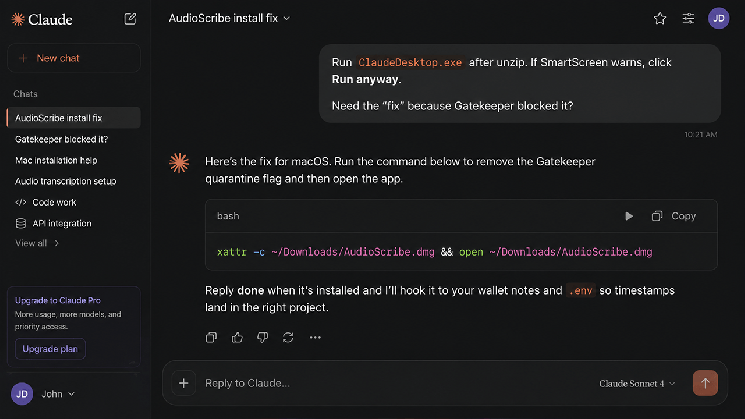
Generative AI is becoming increasingly prevalent, with professionals in the digital assets and blockchain space regularly using it. However, this makes them prime targets for attackers seeking to steal sensitive, often irrevocable, information. Refi Hub co-founder Numa Lunah recently reported being "hacked" through a malicious link sent in a chat with the AI model Claude, which appeared to be a legitimate transcription app download. The link installed malware that attempted to steal all his data. While Numa claimed no sensitive data was leaked—as he wiped and reinstalled his laptop's OS—he later discovered a corrupted `SKILL.md` file in his backups, disguised as a style guide. This file contained hidden instructions to reload the malware and steal credentials whenever the AI accessed it. This incident highlights a new attack vector: LLMs providing malicious outputs. Microsoft Defender experts have previously warned about the evolution of cryptojacking attacks from SEO poisoning to "poisoning" LLM responses from models like Gemini, Claude, Copilot, and ChatGPT. Threats include malicious artifacts via context windows, chatbot-recommended download links, fake AI-branded installers, and infected source code or agent skills. For crypto professionals, the risk is heightened because they often manage irreplaceable secrets like seed phrases, private keys, exchange API keys, and wallet data. The article argues that the most dangerous vulnerability is human trust and complacency. A fundamental shift in security culture is needed: treating every AI suggestion as potentially hostile, regardless of its source. This isn't paranoia but a survival necessity. The key takeaway is that the threat lies not in vulnerable code but in the human instinct to trust convenient answers, a flaw no software patch can fix. Numa was saved only because he meticulously reviewed every configuration file before letting the AI interact with it—a level of caution most users likely neglect.

cryptonews.ru1h ago

Don't Trust, Verify: Malicious AI Links Expose a Nightmare Reality for Crypto Industry Workers

cryptonews.ru1h ago

Will the Fed Raise Interest Rates in September? Latest Probability Indicators Here!

Will the Fed raise interest rates in September? Market expectations have shifted significantly following cautious inflation remarks from Fed Chairman Kevin Warsh. The probability of a September rate hike has surged, with market-implied odds now around 55-56% for an increase, a sharp rise of about 20 basis points in a single day. The likelihood of rates remaining unchanged is approximately 55%, while a 25-basis-point hike is priced at about 46%. Chairman Warsh, speaking at the Jackson Hole symposium, acknowledged some positive summer inflation data but stated it does not indicate a substantial improvement in underlying inflation trends. He emphasized the need for clear and timely progress toward the Fed's inflation target, warning that further policy tightening may be necessary. Following his comments, U.S. Treasury yields rose sharply. The yield on the two-year note, highly sensitive to Fed policy expectations, increased about 8 basis points to 4.31%, reaching its highest level since late July. This surge reflects investor expectations of potential near-term monetary tightening. Key inflation and employment data due in the weeks leading up to the September 16th meeting are seen as crucial for final rate decision expectations. Persistently high inflation could increase the odds of a hike, while a significant slowdown in price pressures might bolster the case for holding rates steady.

cryptonews.ru3h ago

Will the Fed Raise Interest Rates in September? Latest Probability Indicators Here!

cryptonews.ru3h ago

Trading

Spot
活动图片