Assessing community sentiment after David Sacks’s 130-day term as crypto czar ends

ambcryptoPublished on 2026-03-28Last updated on 2026-03-28

Abstract

David Sacks has concluded his 130-day term as AI and crypto czar for former President Donald Trump. His performance has received mixed reviews from the crypto community. A key achievement was helping pass the GENIUS Act, a stablecoin legislation bill. However, broader goals, such as establishing a U.S. strategic Bitcoin reserve (SBR), remain unfulfilled, drawing criticism from some community members who view this as a failure. Sacks is transitioning to a new role as co-chair of the President’s Council of Advisers on Science and Technology (PCAST), where he will advise on a wider range of tech issues. Despite his departure, advocacy for crypto policy continues within the administration.

David Sacks’s role as AI and crypto czar for President Donald Trump has ended after his 130-day term expired this month. However, his scorecard and ratings across the crypto community have been mixed.

On Thursday, the venture capitalist told Bloomberg that he will be joining the President’s Council of Advisers on Science and Technology (PCAST) as co-chair.

I think moving forward as co-chair of PCAST, I can now make recommendations on not just AI but an expanded range of technology topics.

Mixed views on David Sacks’s scorecard

As crypto czar, Sacks helped push the GENIUS Act, a stablecoin legislation bill, into law last year. This was also done in collaboration with Bo Hines, who was Trump’s chief crypto advisor at that time.

However, after Bo Hines resigned and joined Tether, Patrick Witt, the current White House crypto chief advisor, stepped up to coordinate the broader crypto market structure bill – The CLARITY Act.

In 2024, the sector had a key policy agenda it was pushing. This included an overhaul of the regulatory authorities (SEC and CFTC), the establishment of a U.S strategic Bitcoin reserve (SBR), and the adoption of clear rules via the GENIUS Act and the CLARITY Act.

As it stands, most of the agenda has been met with the CLARITY Act still in progress. However, the U.S SBR has been muted and hasn’t received much attention lately. Unfortunately, some sections of the community are using it as the main scorecard for Sacks.

According to one user, for instance, both Bo Hines and David Sacks failed to audit the current BTC stack held by the U.S government and the way forward to establishing the related reserve.
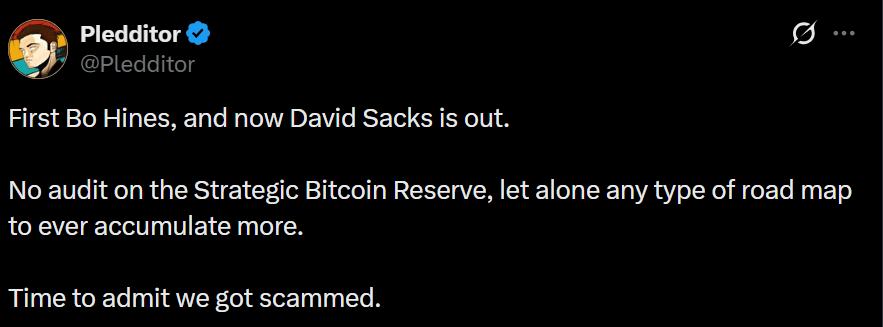
Source: X

For her part though, Jacquelyn Melinek, Founder of Token Relations, dismissed the framing as “misleading.” She added,

This is misleading. David Sacks didn’t choose to be ‘out,’ it’s just his term finished. There are other people still at the WH advocating for digital assets and policy. Breathe.

Meanwhile, the chance for a U.S SBR before 2027 was below 30% on the predictions site Polymarket.


Final Summary

  • David Sacks’s AI and crypto czar term has expired as he steps up to the President’s tech council.
  • However, his crypto scorecard elicited mixed reactions despite helping fast-track the GENIUS Act – A stablecoin law.

Related Questions

QWhat was David Sacks' role and for how long did he serve?

ADavid Sacks served as AI and crypto czar for President Donald Trump for a 130-day term.

QWhat is David Sacks' new position after his term as crypto czar ended?

AHe will be joining the President’s Council of Advisers on Science and Technology (PCAST) as co-chair.

QWhat was a key legislative achievement credited to David Sacks during his term?

AHe helped push the GENIUS Act, a stablecoin legislation bill, into law.

QAccording to the article, what is the main point of criticism some in the community have against Sacks?

ASome criticize him for failing to audit the U.S. government's Bitcoin holdings and establish a U.S. strategic Bitcoin reserve (SBR).

QHow did Jacquelyn Melinek respond to the criticism of David Sacks' departure?

AShe dismissed the framing as 'misleading,' stating his term simply finished and that there are other people still advocating for digital assets policy at the White House.

Related Reads

The Small-Town Youth Labeling AI Giants

In China's hinterland cities like Datong, Shanxi, thousands of young people are working as data annotators—the invisible workforce behind AI development. They perform repetitive tasks like drawing bounding boxes on images or rating AI-generated responses, earning piece-rate wages as low as a few cents per task. These workers, mostly from rural areas or small towns, endure intense labor conditions: strict monitoring, high error tolerance thresholds, and mental exhaustion. Despite the cognitive nature of their work, they are often paid meager salaries, with some earning as little as ¥30 ($4) for a day’s work. As AI industry evolves, even highly educated workers—including master’s graduates—are being drawn into similar precarious freelance roles, evaluating complex AI outputs under vague and shifting standards. Yet the industry is structured through layers of outsourcing, where most profits flow to tech giants like OpenAI and Microsoft, while annotators see dwindling incomes. Worse, as AI models become more self-sufficient, the demand for human annotators is declining. Companies like Li Auto have slashed annotation costs by using AI-powered tools that complete in hours what used to take humans years. These annotators, who helped train the very systems now replacing them, face an uncertain future—a stark contrast to the booming valuations and optimistic narratives of the global AI industry. No one seems to see a problem with any of this.

marsbit16m ago

The Small-Town Youth Labeling AI Giants

marsbit16m ago

Meeting at the Pinnacle of Generalist: 30 Billion in 30 Days, What Did Qianxun AI Do Right?

Qianxun Intelligence, a Chinese embodied AI and robotics startup, completed two major funding rounds totaling 3 billion RMB within 30 days in early 2026, backed by prominent investors including Shunwei Capital (Lei Jun) and Yunfeng Capital (Jack Ma). Founded in January 2024 by a team with expertise in robotics, AI, and commercialization, the company focuses on developing general-purpose embodied AI models. Its open-source model, Spirit v1.5, surpassed competitors in performance benchmarks, demonstrating strong zero-shot generalization capabilities for complex tasks. The company follows a scaling law approach similar to large language models (LLMs), leveraging massive diverse datasets—including internet videos, wearable device data, and teleoperation data—to train its Vision-Language-Action (VLA) model. Qianxun employs a multi-source data engine, collecting over 200,000 hours of real-world interaction data, with plans to reach 1 million hours by 2026. It uses low-cost wearable devices for efficient data acquisition and emphasizes real-world deployment for continuous data feedback. The company has deployed robots like "Xiao Mo" in industrial settings (e.g., battery production lines for CATL) and commercial scenarios (e.g., as baristas in JD.com malls), using operational data to refine its models. This "commercialize while iterating" strategy supports both revenue generation and model improvement, positioning Qianxun to compete globally in embodied AI.

marsbit48m ago

Meeting at the Pinnacle of Generalist: 30 Billion in 30 Days, What Did Qianxun AI Do Right?

marsbit48m ago

Trading

Spot
Futures

Hot Articles

Discussions

Welcome to the HTX Community. Here, you can stay informed about the latest platform developments and gain access to professional market insights. Users' opinions on the price of AI (AI) are presented below.

活动图片