The AI programming track has already worn people numb.
Just now, Cognition, the developer of Devin, delivered a new report card: Annualized recurring revenue (ARR) is approaching $10 billion, nearly doubling from the last funding round.
Behind this report card is a new funding round that hasn't been officially announced yet—with a valuation target heading straight for $40 billion.
Three months ago, that number was still at $26 billion, a 54% increase......
This means Cognition will officially surpass the $29.3 billion valuation Cursor obtained in the private market before its acquisition by SpaceX.
Previously, Cursor was hailed as the "fastest-growing software company in history."
And now, before Cursor could even get comfortable with its own valuation, it's already being caught up by AI programmer Devin.
What gives this company the right?
3 Seconds to Set Up a Complete Development Environment
Cognition's revenue multiple has been narrowing.
Calculated based on the new $40 billion valuation, Cognition's revenue multiple is about 40x; three months ago, this multiple was 52.
This metric is typically used to measure how aggressively investors value a company's future growth. A narrowing multiple means that the company's actual revenue growth is outpacing the speed at which investors are raising its valuation.
In other words, Cognition's valuation surge comes not just from narrative, but also from real revenue growth.
The new technology Cognition announced concurrently might explain these high expectations:
According to Cognition, Devin's cloud intelligence is reflected in its ability to open several systems in one go:
macOS, Linux, Windows, Android, plus any sandbox and server environment......
Each new work session starts up a corresponding environment.
The configuration process is as easy as saying it: give Devin an instruction, and Devin handles the rest.
It takes only 3 seconds for the system to create a snapshot, including the code repository, development tools, environment variables, and dependencies.
In contrast, setting up a complete local development environment might take engineers days to resolve issues like dependency conflicts and version compatibility.
3 seconds...... that's like being able to summon an engineer infinitely.
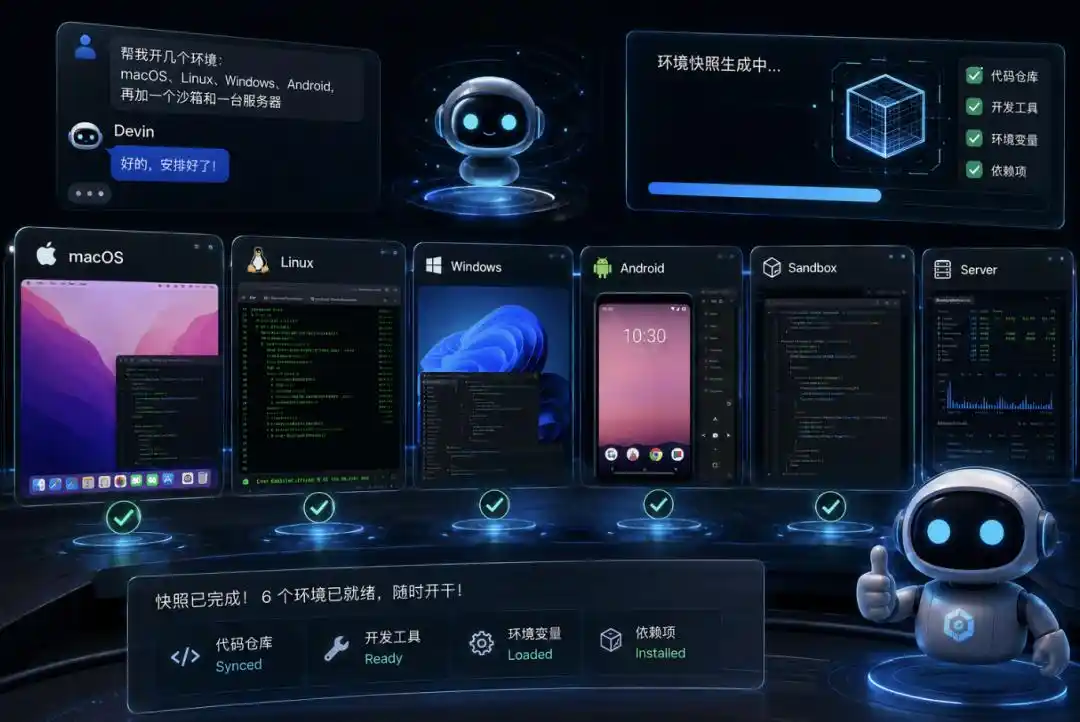
△ Image generated by AI
As model companies like Anthropic and OpenAI also develop towards agents capable of running independently for hours or even days, writing error-free code has become the baseline requirement and minimum passing grade for this track.
Environment configuration speed and multi-platform coverage are perhaps becoming the concrete metrics for competition among programming agent products in the next phase.
Diverging Paths from Cursor: How to "Grow Even Faster"
In reality, Cognition was founded in 2023, less than 3 years ago, following the same script of "starting by writing code in a small apartment."
(Although by now, this isn't really surprising anymore......)
Cognition's three co-founders all come from the International Olympiad in Informatics (IOI) system.
Reportedly, its early startup team has collectively won 10 competition gold medals.
A true gold medal team!
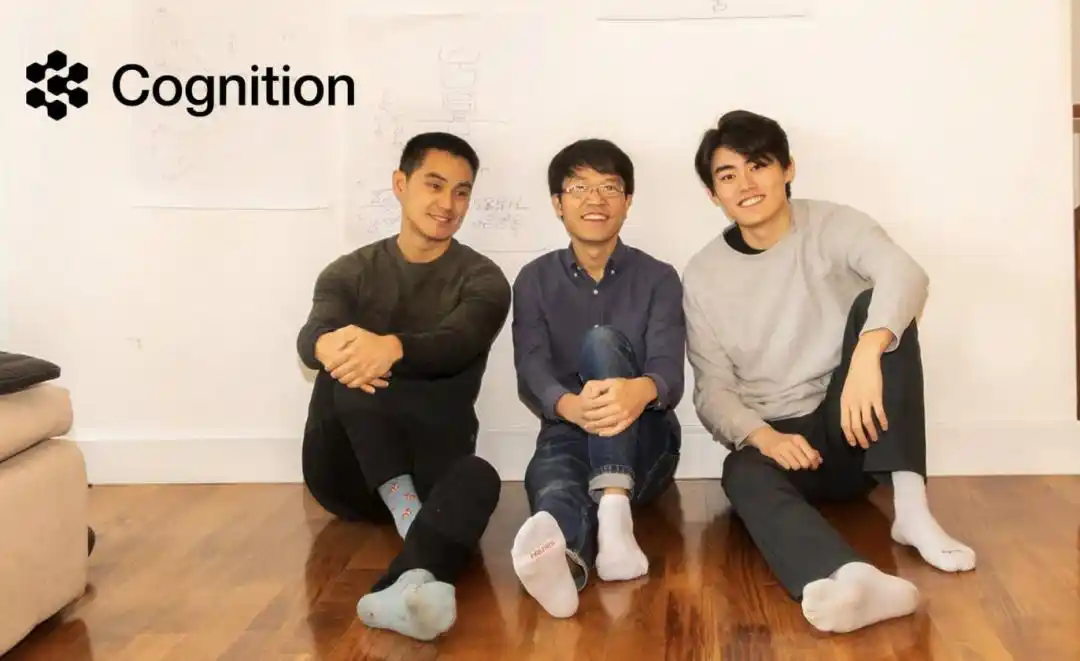
△ Cognition team photo
CEO Scott Wu graduated from Harvard University, majoring in Economics, won three IOI gold medals, and achieved the "Legendary Grandmaster" rank on the programming competition platform Codeforces, with a peak rating of about 3350.
CTO Steven Hao graduated from MIT in Mathematics and Computer Science, won a gold medal in the 2014 IOI, ranking 6th globally.
CPO Walden Yan dropped out of Harvard University in 2023 to start this venture, previously worked briefly at Cursor, and is also a gold medalist in IOI 2020.
Also in the AI programming product space, Devin's product path was completely different from Cursor's from the start.
Cursor took the native editor route: developers are present throughout the integrated development environment, with the AI providing code suggestions that the developer confirms line by line. It is essentially an efficiency tool for speeding up coding.
Devin, however, follows a full agent route. Developers hand it a task, and it autonomously completes the subsequent process, including reading tickets, exploring the codebase structure, writing code, running tests, finding and fixing bugs, and ultimately submitting code change requests.
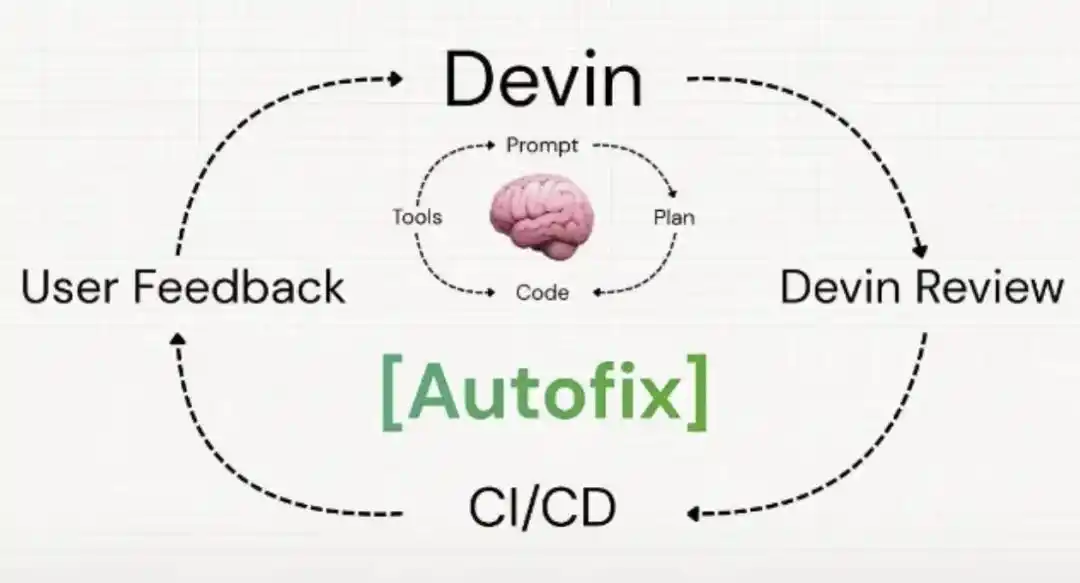
△
Cognition's CEO discussed this difference in a previous interview, stating that—
Tools like Copilot address the problem of "making developers type faster at the keyboard"; while Devin represents an asynchronous paradigm, where developers define the task intent and review execution plans, with the specific execution happening elsewhere.
AI Programming is Getting More Crowded: Funding Frenzy, Big Tech Battles, M&A Consolidation
Cognition's massive funding round is not an isolated incident. From a macro perspective, it might be a snapshot under the combined trends of capital concentration, fierce competition among players, and accelerated mergers and acquisitions in the AI programming track.
Looking at market size, the AI programming assistant market reached $12.8 billion in 2026 and is projected to grow to $30.1 billion by 2032.
In relevant industry landscape assessments, Anthropic, Cursor, GitHub, and OpenAI are listed as "Leaders";
while AWS, Google, Alibaba Cloud, and Cognition are listed as "Challengers".
Looking at player composition, large model companies are directly entering the product space, no longer just providing APIs to third parties.
Claude Code reached $2.5 billion in ARR within 9 months of launch;
SpaceX acquired Cursor in an all-stock transaction valued at $60 billion, the largest startup acquisition on record.
Looking at capital flow, concentration within the track is also increasing.
According to statistics, the AI programming tools track saw 23 disclosed funding rounds in the past year, totaling $5.21 billion. Cursor alone accounted for 44% of the disclosed capital, with the top three deals making up 71% combined.
Capital is concentrating towards a few leading companies rather than being evenly distributed across the track, which is also one of the backdrops for frequent M&A activity:
Earlier this year, Google secured the founders and core team of AI programming company Windsurf in a $2.4 billion licensing and talent deal, after which Cognition purchased Windsurf's remaining products, brand, and team.

The arms race around AI Coding continues to sprint forward. The gates to a trillion-dollar market are slowly opening. The valuation chase between Cognition and Cursor is merely the opening act in this wave of intelligence......
This article is from the WeChat public account "QbitAI", author: Focus on Frontier Technology