Early Bitcoin Users Show Activity: $500M Worth of 6,427 BTC Moved in August

cryptonews.ruPublished on 2026-08-30Last updated on 2026-08-30

Abstract

Early Bitcoin users have become significantly active, moving 6,427 BTC worth approximately $500 million in August. This follows reports of losses from a Coldcard firmware vulnerability and data leaks from wallet manufacturers Safepal and Trezor in July, potentially prompting holders to reassess their storage strategies. August saw a dramatic surge compared to July, with daily dormant BTC movement averaging 214.25 BTC—5.3 times higher than July's 40.78 BTC. A total of 188 transactions moved dormant coins, including eight from wallets created in 2010 or 2011. The most activity came from wallets created between 2012 and 2017, with 2014-vintage wallets dominating. Notably, the 2014 cohort split into two groups with distinct behaviors: one moved coins gradually over several days, while another group of 25 addresses emptied nearly identical amounts of ~50 BTC within one hour on August 19, suggesting coordinated action by a single entity. While a direct link to security incidents is unconfirmed, this coordinated movement of old coins indicates early users and large holders may be proactively consolidating assets, viewing old keys as potential liabilities. The true motives remain unknown, with only blockchain movements as evidence.

It all began on July 30, when Bitcoin.com News reported the first data on losses caused by a vulnerability in the Coldcard firmware, with the total losses ultimately increasing to approximately 2,000 $BTC. At the same time, last month, two hardware wallet manufacturers—Safepal and Trezor—reported data leaks that exposed customer information, including names, email addresses, phone numbers, and delivery addresses.

While a direct link cannot be established, the wave of early users moving old bitcoins may reflect heightened caution and broader efforts to reassess and reorganize their storage schemes. In the first ten days of August, the number of transactions involving "dormant" bitcoins exceeded the July figures. In July, a total of 30 transactions were recorded from wallets created between 2010 and 2017, moving 1,264.16 $BTC.

Dormant Bitcoin Activity in August Significantly Surpassed July Figures

Over the past 30 days of August, a significant average of 214.25 $BTC per day was recorded. This is 5.3 times higher than July's average of 40.78 $BTC per day. Btcparser.com recorded 188 individual transactions that moved 6,427.59 "dormant" bitcoins. During this activity, eight transfers from old wallets created in 2010 or 2011 were recorded. In two 2010 transfers, 50 $BTC were moved, while six 2011 transfers moved 155.57 $BTC.
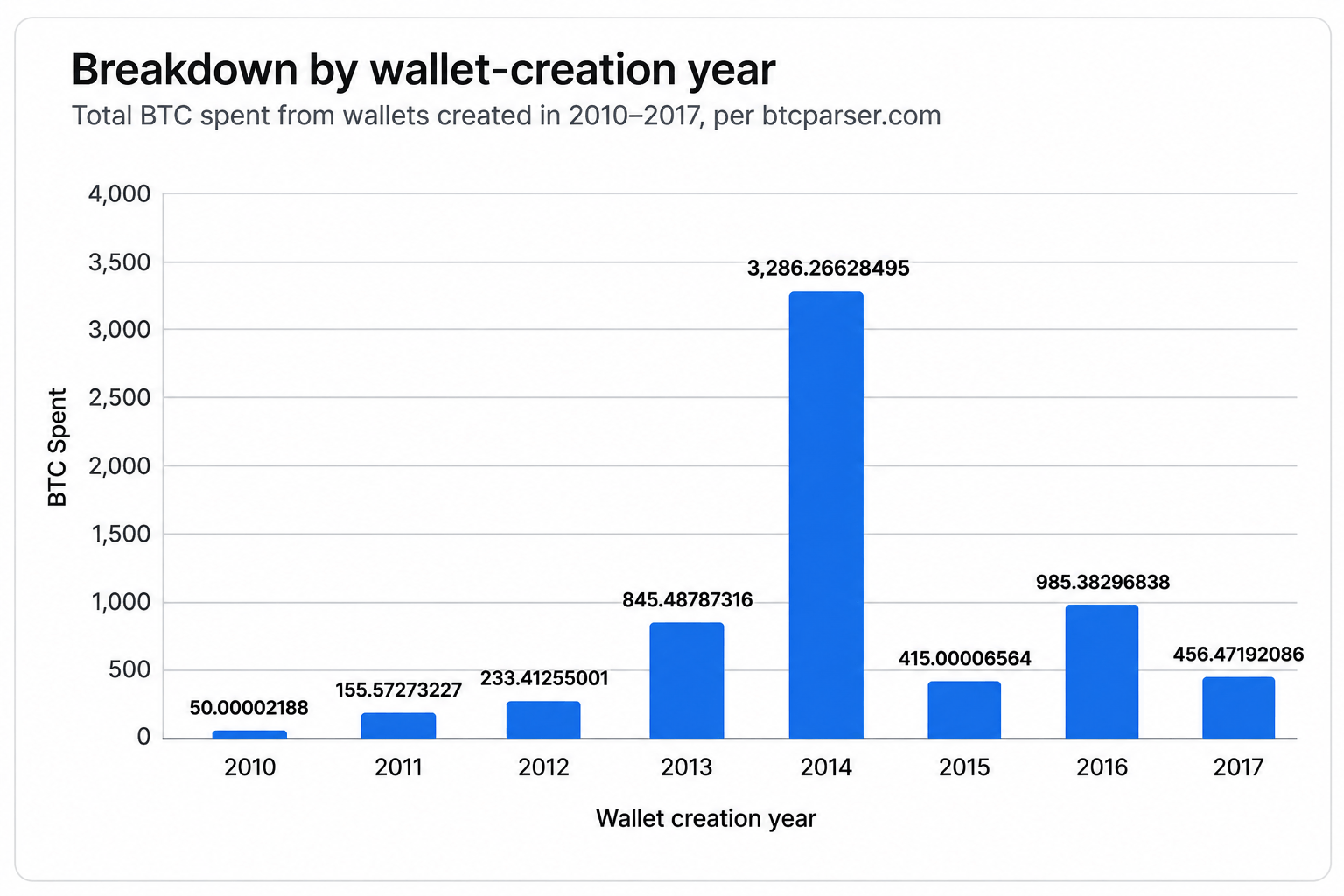
Movement of inactive bitcoins detected by btcparser.com between August 1 and 30. Transactions from 2014 wallets showed the highest activity.

The majority of the activity came from wallets created between 2012 and 2017, with the 2014 wallet group dominating. Data shows that 94 transactions from bitcoin addresses created in 2014 moved approximately 3,286.26 $BTC between August 1 and 30, while 2016 wallets took second place: 985.38 $BTC changed hands across 29 transactions. Wallets from 2013 ranked third, recording 16 separate transfers totaling 845.48 $BTC.

2012 wallets moved 233.41 $BTC, 2015 addresses moved around 415 $BTC, and 2017 wallets moved 456.47 $BTC across 26 operations. However, the overall 2014 figure did not represent one broad wave of inactive bitcoin movement. It breaks down into two distinct groups with noticeably different behaviors, which is perhaps the most intriguing pattern in the dataset.

Two 2014 Groups Exhibit Starkly Different Behaviors

The first group consists of 64 addresses created between January 27 and February 4, 2014, which collectively transferred 1,672 $BTC. The coins were not moved all at once but gradually over 11 separate days from August 3 to 13, with a few later straggler transactions and individual transfers ranging from 0.31 $BTC to 33 $BTC. The second group tells a completely different story. Twenty-five addresses created between November 30 and December 26, 2014, moved 1,514 $BTC in nearly identical batches of approximately 50 $BTC each, with 22 of the 25 addresses being emptied on August 19 within about one hour.
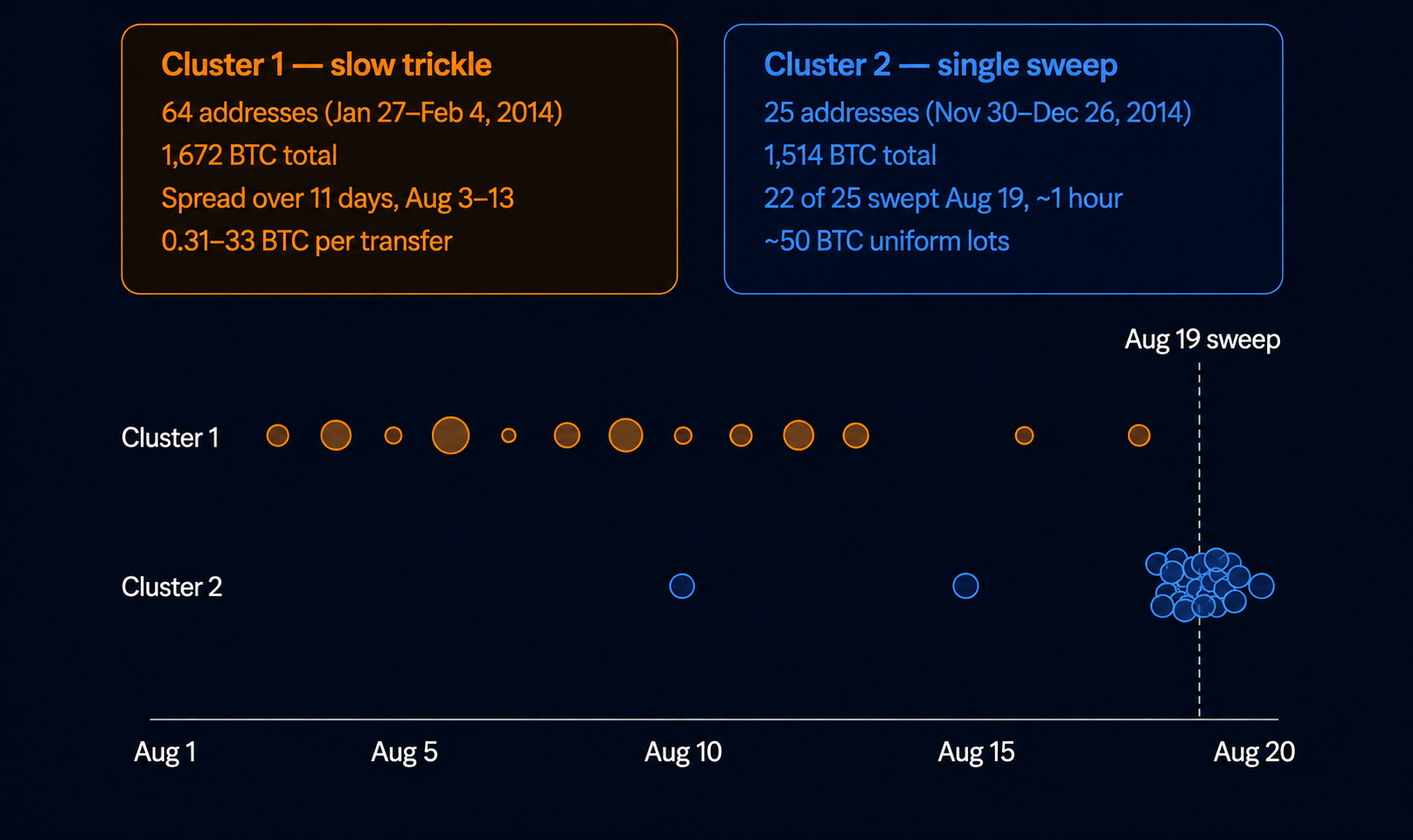
These two 2014 groups show interesting patterns.

This level of coordination makes it unlikely that several unrelated owners independently moved decade-old coins on the same day and instead points to a single custodian or key owner executing a pre-planned batch withdrawal. It appears these wallets were funded simultaneously in late 2014, possibly reflecting an exchange cold storage reorganization, the release of funds from escrow, or a mass paper wallet distribution.

Bitcoin's "Sleeping Giants" Leave No Trace of Their Motives on the Blockchain

Certainly, the deeper essence of the issue may extend beyond technical vulnerabilities to a breach of trust strong enough to compel even early users to reconsider their passive storage approach. The coordinated series of transactions from old bitcoin addresses indicates that large holders may be proactively consolidating their legacy assets, increasingly viewing old keys as operational liabilities rather than digital trophies. The true motives remain unknown, and the only evidence capable of revealing this story remains the on-chain movements themselves.


Trending Cryptos

Related Questions

QWhat does the article report about early Bitcoin users' activity in August, particularly regarding 'dormant' bitcoins?

AThe article reports that early Bitcoin users moved a significant amount of 'dormant' bitcoins in August. Specifically, 6,427.59 BTC, worth approximately $500 million, were moved in 188 separate transactions. This activity far exceeded that of July, with a daily average moving volume 5.3 times higher in August.

QAccording to the article, what potential reason is suggested for the wave of early users moving their old bitcoins?

AThe article suggests that while a direct link cannot be established, this wave of activity may reflect increased caution and broader efforts by early users to reassess and reorganize their storage schemes. This is discussed in the context of reported firmware vulnerabilities in hardware wallets (like Coldcard) and data breaches (like those from Safepal and Trezor) that occurred around the same time.

QWhich year's wallets dominated the 'dormant' bitcoin movement in August, and what was the total amount moved from them?

AWallets created in 2014 dominated the movement. Data shows that approximately 3,286.26 BTC were moved from these addresses in 94 transactions during August.

QWhat interesting behavioral pattern is highlighted regarding the 2014 wallet group activity?

AThe 2014 wallet activity broke into two distinct groups with different behaviors. One group of 64 addresses moved coins gradually over 11 days. The second, more coordinated group of 25 addresses moved their coins in nearly identical batches of about 50 BTC, with 22 of the 25 addresses being emptied within about one hour on August 19th, suggesting a single entity executing a planned batch withdrawal.

QWhat does the article conclude about the true motives behind these large movements of old bitcoins?

AThe article concludes that the true motives remain unknown. It suggests that the coordinated series of transactions indicates large holders may be proactively consolidating outdated assets, increasingly viewing old keys as operational liabilities rather than digital trophies. However, the only evidence to tell this story remains the blockchain movements themselves.

Related Reads

Yi Lihua: The Cryptocurrency Bull Market is Starting, and Tokenized Stocks are Expanding the Industry's Field

I Li Hua, founder of LD Capital, believes a crypto bull market may start soon, with blockchain finance and tokenized stocks seen as key sources of new opportunity. A genuine bull market is defined not by a single price spike but by a sustained uptrend driven by capital inflow, liquidity, and trust in infrastructure. He suggests the market is approaching a new bullish cycle rather than being in a fully confirmed phase. To identify a real bull trend, one should monitor Bitcoin/Ethereum momentum, trading volume, capital flows, liquidity, and interest in infrastructure projects—not just one asset's rise. Preparation involves a clear strategy with defined asset allocation, entry/exit points, and risk limits before market hype peaks. Risks include overheating, exaggerated expectations, and over-reliance on news cycles. I Li Hua warns the industry has become too focused on conflicts, personal attacks, and speculative narratives rather than products and technology, harming its reputation. He emphasizes returning to innovation as crypto's core driver. Tokenized stocks are highlighted as crucial for the next cycle, opening new horizons by treating tokens as accounting assets and expanding digital finance. The broader market context includes renewed interest in blockchain finance beyond just Bitcoin/Ethereum, affecting segments like derivatives platforms, with AI noted as another significant, larger-scale trend to watch amid U.S. political volatility. The focus should remain on real technological value and long-term potential.

cryptonews.ru1h ago

Yi Lihua: The Cryptocurrency Bull Market is Starting, and Tokenized Stocks are Expanding the Industry's Field

cryptonews.ru1h ago

Trading

Spot

Hot Articles

What is $BITCOIN

DIGITAL GOLD ($BITCOIN): A Comprehensive Analysis Introduction to DIGITAL GOLD ($BITCOIN) DIGITAL GOLD ($BITCOIN) is a blockchain-based project operating on the Solana network, which aims to combine the characteristics of traditional precious metals with the innovation of decentralized technologies. While it shares a name with Bitcoin, often referred to as “digital gold” due to its perception as a store of value, DIGITAL GOLD is a separate token designed to create a unique ecosystem within the Web3 landscape. Its goal is to position itself as a viable alternative digital asset, although specifics regarding its applications and functionalities are still developing. What is DIGITAL GOLD ($BITCOIN)? DIGITAL GOLD ($BITCOIN) is a cryptocurrency token explicitly designed for use on the Solana blockchain. In contrast to Bitcoin, which provides a widely recognized value storage role, this token appears to focus on broader applications and characteristics. Notable aspects include: Blockchain Infrastructure: The token is built on the Solana blockchain, known for its capacity to handle high-speed and low-cost transactions. Supply Dynamics: DIGITAL GOLD has a maximum supply capped at 100 quadrillion tokens (100P $BITCOIN), although details regarding its circulating supply are currently undisclosed. Utility: While precise functionalities are not explicitly outlined, there are indications that the token could be utilized for various applications, potentially involving decentralized applications (dApps) or asset tokenization strategies. Who is the Creator of DIGITAL GOLD ($BITCOIN)? At present, the identity of the creators and development team behind DIGITAL GOLD ($BITCOIN) remains unknown. This situation is typical among many innovative projects within the blockchain space, particularly those aligning with decentralized finance and meme coin phenomena. While such anonymity may foster a community-driven culture, it intensifies concerns about governance and accountability. Who are the Investors of DIGITAL GOLD ($BITCOIN)? The available information indicates that DIGITAL GOLD ($BITCOIN) does not have any known institutional backers or prominent venture capital investments. The project seems to operate on a peer-to-peer model focused on community support and adoption rather than traditional funding routes. Its activity and liquidity are primarily situated on decentralized exchanges (DEXs), such as PumpSwap, rather than established centralized trading platforms, further highlighting its grassroots approach. How DIGITAL GOLD ($BITCOIN) Works The operational mechanics of DIGITAL GOLD ($BITCOIN) can be elaborated on based on its blockchain design and network attributes: Consensus Mechanism: By leveraging Solana’s unique proof-of-history (PoH) combined with a proof-of-stake (PoS) model, the project ensures efficient transaction validation contributing to the network's high performance. Tokenomics: While specific deflationary mechanisms have not been extensively detailed, the vast maximum token supply implies that it may cater to microtransactions or niche use cases that are still to be defined. Interoperability: There exists the potential for integration with Solana’s broader ecosystem, including various decentralized finance (DeFi) platforms. However, the details regarding specific integrations remain unspecified. Timeline of Key Events Here is a timeline that highlights significant milestones concerning DIGITAL GOLD ($BITCOIN): 2023: The initial deployment of the token occurs on the Solana blockchain, marked by its contract address. 2024: DIGITAL GOLD gains visibility as it becomes available for trading on decentralized exchanges like PumpSwap, allowing users to trade it against SOL. 2025: The project witnesses sporadic trading activity and potential interest in community-led engagements, although no noteworthy partnerships or technical advancements have been documented as of yet. Critical Analysis Strengths Scalability: The underlying Solana infrastructure supports high transaction volumes, which could enhance the utility of $BITCOIN in various transaction scenarios. Accessibility: The potential low trading price per token could attract retail investors, facilitating wider participation due to fractional ownership opportunities. Risks Lack of Transparency: The absence of publicly known backers, developers, or an audit process may yield skepticism regarding the project's sustainability and trustworthiness. Market Volatility: The trading activity is heavily reliant on speculative behavior, which can result in significant price volatility and uncertainty for investors. Conclusion DIGITAL GOLD ($BITCOIN) emerges as an intriguing yet ambiguous project within the rapidly evolving Solana ecosystem. While it attempts to leverage the “digital gold” narrative, its departure from Bitcoin's established role as a store of value underscores the need for a clearer differentiation of its intended utility and governance structure. Future acceptance and adoption will likely depend on addressing the current opacity and defining its operational and economic strategies more explicitly. Note: This report encompasses synthesised information available as of October 2023, and developments may have transpired beyond the research period.

2.4k Total ViewsPublished 2025.05.13Updated 2025.05.13

What is $BITCOIN

Discussions

Welcome to the HTX Community. Here, you can stay informed about the latest platform developments and gain access to professional market insights. Users' opinions on the price of BTC (BTC) are presented below.

活动图片