Li Feifei's Latest Article: When Video Generation, Robotics, and NVIDIA All Claim to Have 'World Models,' We Need a Taxonomy

链捕手Published on 2026-07-05Last updated on 2026-07-05

Abstract

"World Model" has become a widely used yet ambiguous term in AI. Drawing from the classic POMDP framework (agent → action → state → observation), this article proposes a functional taxonomy to clarify the concept. It identifies three distinct types, categorized by their output in the perception-action loop: 1. **Renderers**: Output visual observations (pixels). These models, like advanced video generators, prioritize visual fidelity but often lack underlying physical accuracy. 2. **Simulators**: Output the state of the world (geometry, physics, dynamics). They provide a structurally accurate representation for professionals (e.g., architects) and serve as training environments for robots and AI agents. 3. **Planners**: Output actions. Given an observation and a goal, they determine what an agent should do next, closing the perception-action loop (e.g., vision-language-action models). While renderers are currently the most commercially mature and planners are the most aspirational, the article argues that **simulators are the crucial, underappreciated hub**. By working at the level of geometry and physics, a simulator can project upwards to create visuals for humans and downwards to predict action consequences for agents. The future lies in the convergence of these three functions. Emerging research and products, like World Labs' Marble model which outputs both visual splats and physical collision meshes, are beginning to blur these boundaries. The logical endpoint is a ...

Author: Li Feifei

Translation: Jiayang

'World model' is probably the hottest and most confusing concept in the AI field since 2025. When Sora emerged, OpenAI called it a world simulator; Genie lets you walk around in generated scenes and is also called a world model; robotics companies say they're working on world models; NVIDIA says Omniverse is the infrastructure for world models; even game engines have been pulled into this narrative. Everyone is using the same term, but they're talking about completely different things.

Today, Li Feifei published a new article on her personal Substack to clarify this concept. She first returns to the most classic diagram in reinforcement learning textbooks (the POMDP closed loop: agent → action → state → observation → agent), then points out that what are now called 'world models' are actually three different projections of this closed loop. Those outputting pixels (observations) are renderers, those outputting states are simulators, and those outputting actions are planners. The classification criteria are very simple: it depends on which part of the loop you output.
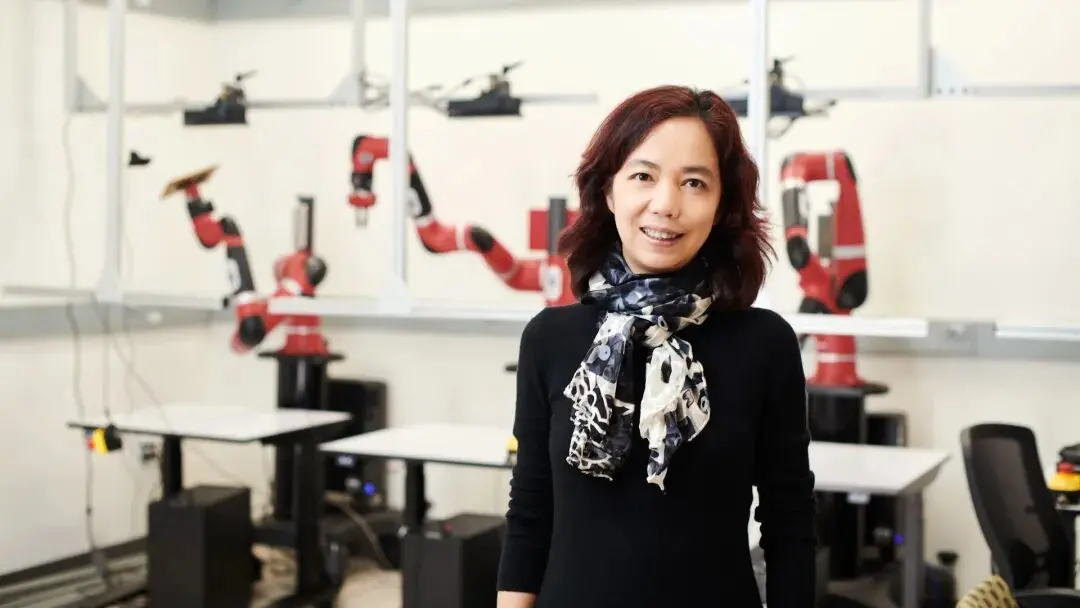
(Source: MIT Technology Review)

She assesses that among the three, renderers are the most commercially mature but have a ceiling (looking good does not equal physical correctness); planners are the most exciting but furthest from real-world deployment (the chasm between lab demos and practical usability remains vast); and simulators are the severely underestimated critical hub. Because simulators operate at the level of geometry, physics, and dynamics, they can project upwards into pixels for human consumption and also derive action consequences downwards for robot use. Mastering simulation simultaneously provides the foundation for rendering and planning; the reverse is not true.

This article is, of course, also a product manifesto for World Labs. Their Marble already outputs both Gaussian splats and collision meshes, attempting to unify renderer and simulator into a single model. The ultimate vision described at the end of the article is a unified world foundation model that can freely switch between rendering, simulation, and planning based on downstream needs. Whether this vision can be realized is another matter, but as an analytical framework, the tripartite classification of renderer/simulator/planner may indeed help cut through some of the noise surrounding the current 'world model' concept.

The full translation follows.

"The world is all that is the case." — Ludwig Wittgenstein, Tractatus Logico-Philosophicus, 1921

The world is not made of words.

In an earlier article, we proposed that spatial intelligence is the next frontier for AI, and world models are the path toward it. Here, the World Labs team and I want to delve one level deeper: among the many things currently labeled as "world models," which functional modules truly constitute this capability, and what are their respective purposes?

Language models have endowed machines with powerful mastery over concepts, vocabulary, and reasoning. But the physical world, whether virtual or real, operates on a completely different substrate. Language models learn the statistical structure of text; world models learn the statistical structure of space and time: how light falls on a surface, what a garden looks like from an angle never captured by a camera, how objects respond to forces and follow physical laws.

This makes "world model" one of the most important and simultaneously most abused terms in today's AI field. Computer vision, robotics, reinforcement learning, and generative AI all claim to be building world models, but each refers to something drastically different. A video model that generates gorgeous but physically impossible flames, a language model that improvises playable games, a physics engine that faithfully simulates a combustion process—they are all called by the same name.

The ancient Greeks could never agree on what the world was made of—be it fire, water, or indivisible atoms—because "the world" has never been a single thing. It has always been a substitute term used by a thinker to reason about a certain totality. AI inherits the same problem, and it happens precisely at the moment when the field needs precision the most.

The Loop Behind the Taxonomy

To clear up this confusion, we can start with a diagram older than all the technologies mentioned above. All reinforcement learning textbooks, including the classic by Sutton and Barto, have used variations of the same diagram for decades to describe how an agent interacts with the world. Its formal name is the Partially Observable Markov Decision Process (POMDP), and the term "world model" was originally defined within this tradition.

An agent (which can be a human, a robot, or a software system) takes an action. These actions change the state of the world. But the agent can never directly see the state itself; what it receives are observations: photons hitting the retina, sensor readings, pixels in a video frame. New observations guide new actions, and the cycle repeats.

The word "state" needs to be unpacked because its meaning shifts across different domains. This is not the chemist's state, not the distinction between solid, liquid, and gas. This is the physicist's and roboticist's state: a complete description of everything happening in the world at a given moment, including every object, every position, every velocity, every property. The state is the underlying reality of the world, in principle complete, but forever unobservable directly by any agent within it. Observations are the agent's partial view of this reality. Actions are the agent's response accordingly.

This closed loop (agent → action → state → observation → agent) is precisely the structure that gives the term "world model" its technical meaning. The phrase itself is even older, traceable to Kenneth Craik's 1943 proposal that the mind reasons by running "small-scale models" of reality, and by the late 1980s and early 1990s, the concept was introduced into neural networks. This loop also explains what people mean when they use the term today. The various things now called world models are actually different projections of the same closed loop, each outputting a different component of the loop.

Three Functions of World Models

The first type of world model is the Renderer. A renderer outputs observations, specifically pixels for the human eye, and the most important quality metric is visual fidelity. A video model that transforms text prompts into cinematic aerial shots is a renderer; interactive systems like Google's Genie 3 or World Labs' own RTFM are also renderers, generating visuals in real-time based on user input. Such models lack an explicit understanding of 3D structure. They generate what a viewer would see, not what things are like in themselves. The building in an aerial shot might look flawless from above, but try navigating the city below, and they will collapse.

The second type is the Simulator. A simulator outputs states: a geometrically, physically, or kinematically faithful representation of the world upon which both humans and computer programs can compute and interact. The renderer's contract is purely visual, while the simulator's contract is structural, demanding geometry that holds up under scrutiny, physics that obey Newton's laws, and dynamics that behave as expected by physical principles. Simulators serve two classes of users. Professionals like architects, designers, filmmakers, and game developers require accuracy beyond visual plausibility. Computer programs like reinforcement learning agents, robot controllers, and autonomous vehicles treat the simulator as a training ground to interact with the world at scale, testing scenarios that are either dangerous, expensive, or simply impossible to execute in reality.

The third type is the Planner. A planner outputs actions. Given an observation and a goal, the planner answers the question: what should the agent do next? In many ways, the planner is the inverse of the renderer. The renderer takes actions as input and produces observations; the planner takes observations as input and produces actions, thereby closing the perception-action loop. Vision-Language-Action models (VLA), model-based systems, and the new wave of World Action Models are all different attempts at planners: enabling systems to decide what a robot should do in an unstructured world.

These three categories cover most of the work currently being implemented, and the distinction is useful in practice. But these categories are not fundamentally separate. They share the same underlying knowledge about how the world works: geometry, physics, dynamics. A model that can render a cup from any angle should, in principle, also be able to simulate what happens if the cup is pushed and plan a hand to pick it up. Increasingly, the most interesting research is deliberately blurring the boundaries between these three.
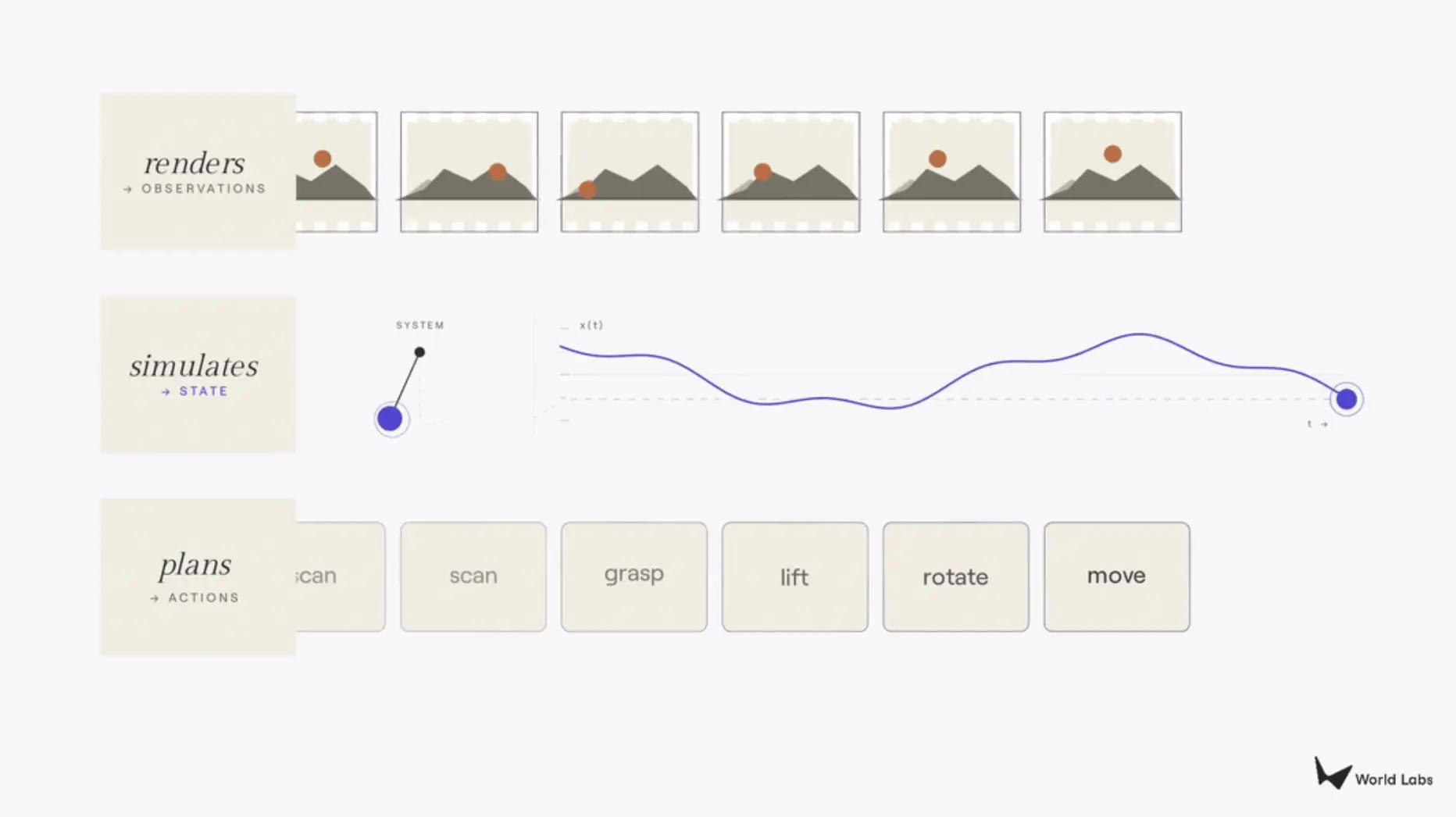
Illustration | Three Types of World Models (Source: Substack)

Why Simulation Is the Key Hub

Among the three categories, simulators receive the least public attention yet are the most important of the three. This article seeks to correct that asymmetry.

Renderers are currently the most commercially mature. Numerous image or text-to-video products are rapidly expanding in consumer and enterprise markets. Google's Nano Banana model has brought renderer-level image generation capabilities to potentially hundreds of millions of users. The technology is real, and the market is real. However, renderers optimize for visual plausibility rather than physical accuracy, and this ceiling is important. Their outputs are beautiful, but you cannot use them to design a building or train a robot.

Planners are the most exciting and least mature, closely tied to the rapidly evolving field of robot learning. The past two years have produced many robot demos that look impressive in videos, but we need to be honest about what these demos actually show. Almost all demos are confined to highly constrained lab environments with limited objects and short task durations. None have been validated against the complexity, diversity, and duration required for real-world deployment. The gap from a stunning demo video to a robot that works reliably in a kitchen, warehouse, or operating room remains vast.

Nevertheless, the scale of commercial bets is substantial. A wave of well-funded new entrants is racing to launch general-purpose planning systems, while large infrastructure players are layering planning capabilities atop broader simulation stacks.

Simulation is the bridge connecting the two. If language is an abstraction of the world and pixels are a projection of the world, then geometry, physics, and dynamics are the world itself. A simulator must operate at this level: it is the structural skeleton from which visual appearances (for renderers) and action consequences (for planners) can both be derived.

A model that masters simulation can project its understanding into pixels for human consumption and into action predictions for embodied agents. A model that masters only rendering or only planning can do neither. The commercial space here is immense. NVIDIA's Omniverse alone, according to the company's estimate, targets a market opportunity exceeding a trillion dollars, covering factories, warehouses, supply chains, and digital twins. Robot training, autonomous vehicle testing, architectural visualization, engineering design, drug discovery—all rely on some form of simulation.

The most difficult open questions in the field are also concentrated here. 3D data with explicit geometry, material properties, and physical annotations is orders of magnitude scarcer than internet videos used for renderer training. The sim-to-real gap (the difference between how objects behave in simulation versus the real world) persists. Generative simulators introduce new risks on top of this: AI-generated geometry might look correct but actually contain self-intersections or incorrect scales, leading to absurd results in physics simulation. The computational cost of large-scale multi-physics simulation (rigid bodies, deformable objects, fluids, cloth all interacting simultaneously) remains orders of magnitude higher than simulation in a single domain.

At World Labs, Marble is our first step in this direction. It takes multimodal input (text, image, video, or spatial sketches) and generates explorable 3D environments, simultaneously outputting Gaussian splats for visual exploration and collision meshes for physics engines. But Marble is only the first chapter of a long arc. As the boundaries between rendering, simulation, and planning begin to dissolve, the entire field is writing this story.

The Boundaries Are Blurring, and What Comes Next

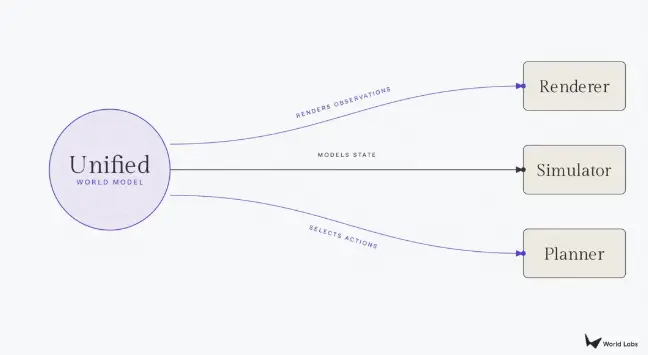
The most important trend in the field right now is that the three categories are beginning to merge. The underlying consensus is that the knowledge required to render a world, simulate it, and act within it is largely the same. Continuing with the previous example, a model that truly understands how a cup sits on a table (its geometry, material properties, response to forces, etc.) should be able to render that cup from any angle, simulate what happens if the cup is pushed, and plan a hand to pick it up. The three categories are three projections of the same underlying understanding.

For instance, a small but growing body of work from various robotics labs has recently shown the possibility, at least conceptually, that a pre-trained video renderer can serve as the backbone for joint world prediction and action prediction, allowing a single model to simultaneously imagine "what will happen" and "what to do," thus bridging renderers and planners. World Labs' Marble can already output both Gaussian splats and collision meshes from a single model, dissolving the boundary between renderer and simulator. At every level, the move is from passive output to interactive systems: renderers become responsive to action conditioning, simulators generate worlds that are more controllable and editable, and planners begin deliberative reasoning rather than merely reacting.

The logical endpoint is a unified world model: a foundation model capable of rendering photorealistic views, generating physically accurate structures, planning action sequences, and switching between different output modalities based on the needs of downstream users. We will still face a series of formidable challenges. The data landscape is extremely uneven, with renderers sitting on vast amounts of internet video, while simulators and planners face severe shortages of 3D assets and robot demonstration data. Optimization for visual beauty may come at the expense of precision needed for robotics or high-fidelity simulation. Reconciling these tensions within a single architecture is the central open problem in world model research today, and what World Labs is committed to solving as Marble continues to evolve.
(Source: Substack)

But the overall direction is clear. From the late 1980s to today, the field's bet has always been the same: that if the world model is rich enough, everything an agent needs to see the world, build it, and act within it is contained therein. This bet is now driving a generation of research. And what truly gives it weight is the already-occurring convergence: the three threads of rendering, simulation, and planning, each already supporting industries worth billions, started as independent research directions and are now beginning to merge. When the boundaries disappear, the confluence of the three will redefine something larger: the relationship between machine intelligence and the physical world it inhabits, which is the long-term trajectory of spatial intelligence.

Language has given machines a way to talk about the world. World models are the path by which machines finally come to understand, imagine, reason, and interact with it.

Reference: 1.https://drfeifei.substack.com/p/a-functional-taxonomy-of-world-models

Trending Cryptos

Related Questions

QAccording to Fei-Fei Li's article, what are the three main functional categories of 'world models' in AI, and what do they primarily output?

AAccording to Fei-Fei Li, the three functional categories are: 1. Renderers, which output observations (e.g., pixels for human consumption). 2. Simulators, which output the world's state (a geometrically, physically accurate representation). 3. Planners, which output actions (deciding what an agent should do next).

QWhy does the article argue that the simulator is the 'key hub' among the three categories of world models?

AThe article argues the simulator is the key hub because it works at the foundational level of geometry, physics, and dynamics—the 'skeleton' of the world. From an accurate simulation, one can derive visual outputs for renderers and action consequences for planners, but a model that only knows rendering or planning cannot achieve the other.

QWhat is the POMDP loop, and how does it provide the framework for defining the different types of world models?

AThe POMDP (Partially Observable Markov Decision Process) loop describes an agent taking an action, which changes the world's state. The agent then receives an observation (a partial view of the state), which informs its next action. World models are different projections of this loop: renderers output observations, simulators output states, and planners output actions.

QWhat is the main limitation of current renderer-type world models, despite their commercial maturity?

AThe main limitation is that they optimize for visual fidelity, not physical accuracy. Their output can look beautiful but may not be physically correct, making them unsuitable for tasks like architectural design or training robots, which require structural and physical correctness.

QWhat is the 'logical end point' or ultimate vision for world models described in the article, and what is a key challenge in achieving it?

AThe ultimate vision is a unified world foundation model capable of rendering photorealistic views, generating physically accurate structures, and planning action sequences, switching between these outputs based on downstream needs. A key challenge is the extremely uneven data landscape, with abundant internet video for renderers but severe scarcity of high-quality 3D and robotics demonstration data for simulators and planners.

Related Reads

Li Fei-Fei's Latest Long-Form Article: When Video Generation, Robotics, and NVIDIA All Call Themselves World Models, We Need a Taxonomy

In a new article, Dr. Fei-Fei Li addresses the widespread and often inconsistent use of the term "world model" in AI. She proposes a clear, functional taxonomy rooted in the classic Partially Observable Markov Decision Process (POMDP) loop (agent → action → state → observation → agent). According to this framework, current systems called "world models" are different projections of this loop, categorized by their primary output: 1. **Renderers**: Output observations (pixels). Their goal is visual fidelity for human consumption (e.g., video generation models like Sora). They are the most commercially mature but are limited by a focus on appearance over physical accuracy. 2. **Simulators**: Output states (geometric, physical, dynamic representations). They provide a structurally accurate world for both human professionals (e.g., architects) and computational agents (e.g., robots for training). Li argues simulators are the crucial, underappreciated bridge, as they can underpin both rendering and planning. 3. **Planners**: Output actions. Given an observation and a goal, they decide what an agent should do next (e.g., robotic action models). This area is highly promising but remains the least mature for real-world deployment. Li highlights a key trend: the boundaries between these three categories are beginning to blur, as they all rely on a shared underlying understanding of geometry, physics, and dynamics. The logical endpoint is a unified world foundation model capable of switching between rendering, simulation, and planning based on downstream needs. This convergence, she concludes, is central to advancing spatial intelligence—enabling machines not just to talk about the world, but to truly understand, imagine, and interact with it.

marsbit2h ago

Li Fei-Fei's Latest Long-Form Article: When Video Generation, Robotics, and NVIDIA All Call Themselves World Models, We Need a Taxonomy

marsbit2h ago

Forbes Feature: Stablecoin Cross-Border Payments Are Faster, But Not Yet Cheaper

A Forbes feature delves into the state of stablecoin-based cross-border payments, noting rapid growth but a key shortfall: while faster and more accessible, they are not yet cheaper. At a recent industry conference in Mexico City, optimism about technology, regulation, and volume was tempered by discussions with practitioners. The core issue is liquidity. Traditional FX brokers charge 60-70 basis points, and stablecoins promise to slash this to 2-5 basis points. However, this theoretical cost advantage cannot be realized until deep liquidity pools are established at scale, requiring significant institutional capital inflow. A major adoption barrier is trust. Businesses often rely on long-standing relationships with traditional brokers, valuing reliability over marginal cost savings. This shift will be gradual. Furthermore, successful companies in the space are not positioning themselves as replacements for legacy systems like SWIFT, but as complements. They leverage stablecoins for speed while using traditional rails for their standardization and reliability in ensuring accurate payment details—a critical factor for supplier payments to avoid customs issues. Companies like Caliza, experiencing high monthly growth, exemplify this hybrid approach. The industry anticipates consolidation, as long-term viability will depend on securing the essential trifecta: proper licensing, robust fiat on/off-ramps, and deep liquidity. Without these, firms risk being mere intermediaries rather than building sustainable businesses.

marsbit2h ago

Forbes Feature: Stablecoin Cross-Border Payments Are Faster, But Not Yet Cheaper

marsbit2h ago

Trading

Spot

Hot Articles

What is SONIC

Sonic: Pioneering the Future of Gaming in Web3 Introduction to Sonic In the ever-evolving landscape of Web3, the gaming industry stands out as one of the most dynamic and promising sectors. At the forefront of this revolution is Sonic, a project designed to amplify the gaming ecosystem on the Solana blockchain. Leveraging cutting-edge technology, Sonic aims to deliver an unparalleled gaming experience by efficiently processing millions of requests per second, ensuring that players enjoy seamless gameplay while maintaining low transaction costs. This article delves into the intricate details of Sonic, exploring its creators, funding sources, operational mechanics, and the timeline of significant events that have shaped its journey. What is Sonic? Sonic is an innovative layer-2 network that operates atop the Solana blockchain, specifically tailored to enhance the existing Solana gaming ecosystem. It accomplishes this through a customised, VM-agnostic game engine paired with a HyperGrid interpreter, facilitating sovereign game economies that roll up back to the Solana platform. The primary goals of Sonic include: Enhanced Gaming Experiences: Sonic is committed to offering lightning-fast on-chain gameplay, allowing players and developers to engage with games at previously unattainable speeds. Atomic Interoperability: This feature enables transactions to be executed within Sonic without the need to redeploy Solana programmes and accounts. This makes the process more efficient and directly benefits from Solana Layer1 services and liquidity. Seamless Deployment: Sonic allows developers to write for Ethereum Virtual Machine (EVM) based systems and execute them on Solana’s SVM infrastructure. This interoperability is crucial for attracting a broader range of dApps and decentralised applications to the platform. Support for Developers: By offering native composable gaming primitives and extensible data types - dining within the Entity-Component-System (ECS) framework - game creators can craft intricate business logic with ease. Overall, Sonic's unique approach not only caters to players but also provides an accessible and low-cost environment for developers to innovate and thrive. Creator of Sonic The information regarding the creator of Sonic is somewhat ambiguous. However, it is known that Sonic's SVM is owned by the company Mirror World. The absence of detailed information about the individuals behind Sonic reflects a common trend in several Web3 projects, where collective efforts and partnerships often overshadow individual contributions. Investors of Sonic Sonic has garnered considerable attention and support from various investors within the crypto and gaming sectors. Notably, the project raised an impressive $12 million during its Series A funding round. The round was led by BITKRAFT Ventures, with other notable investors including Galaxy, Okx Ventures, Interactive, Big Brain Holdings, and Mirana. This financial backing signifies the confidence that investment foundations have in Sonic’s potential to revolutionise the Web3 gaming landscape, further validating its innovative approaches and technologies. How Does Sonic Work? Sonic utilises the HyperGrid framework, a sophisticated parallel processing mechanism that enhances its scalability and customisability. Here are the core features that set Sonic apart: Lightning Speed at Low Costs: Sonic offers one of the fastest on-chain gaming experiences compared to other Layer-1 solutions, powered by the scalability of Solana’s virtual machine (SVM). Atomic Interoperability: Sonic enables transaction execution without redeployment of Solana programmes and accounts, effectively streamlining the interaction between users and the blockchain. EVM Compatibility: Developers can effortlessly migrate decentralised applications from EVM chains to the Solana environment using Sonic’s HyperGrid interpreter, increasing the accessibility and integration of various dApps. Ecosystem Support for Developers: By exposing native composable gaming primitives, Sonic facilitates a sandbox-like environment where developers can experiment and implement business logic, greatly enhancing the overall development experience. Monetisation Infrastructure: Sonic natively supports growth and monetisation efforts, providing frameworks for traffic generation, payments, and settlements, thereby ensuring that gaming projects are not only viable but also sustainable financially. Timeline of Sonic The evolution of Sonic has been marked by several key milestones. Below is a brief timeline highlighting critical events in the project's history: 2022: The Sonic cryptocurrency was officially launched, marking the beginning of its journey in the Web3 gaming arena. 2024: June: Sonic SVM successfully raised $12 million in a Series A funding round. This investment allowed Sonic to further develop its platform and expand its offerings. August: The launch of the Sonic Odyssey testnet provided users with the first opportunity to engage with the platform, offering interactive activities such as collecting rings—a nod to gaming nostalgia. October: SonicX, an innovative crypto game integrated with Solana, made its debut on TikTok, capturing the attention of over 120,000 users within a short span. This integration illustrated Sonic’s commitment to reaching a broader, global audience and showcased the potential of blockchain gaming. Key Points Sonic SVM is a revolutionary layer-2 network on Solana explicitly designed to enhance the GameFi landscape, demonstrating great potential for future development. HyperGrid Framework empowers Sonic by introducing horizontal scaling capabilities, ensuring that the network can handle the demands of Web3 gaming. Integration with Social Platforms: The successful launch of SonicX on TikTok displays Sonic’s strategy to leverage social media platforms to engage users, exponentially increasing the exposure and reach of its projects. Investment Confidence: The substantial funding from BITKRAFT Ventures, among others, emphasizes the robust backing Sonic has, paving the way for its ambitious future. In conclusion, Sonic encapsulates the essence of Web3 gaming innovation, striking a balance between cutting-edge technology, developer-centric tools, and community engagement. As the project continues to evolve, it is poised to redefine the gaming landscape, making it a notable entity for gamers and developers alike. As Sonic moves forward, it will undoubtedly attract greater interest and participation, solidifying its place within the broader narrative of blockchain gaming.

1.7k Total ViewsPublished 2024.04.04Updated 2024.12.03

What is SONIC

What is $S$

Understanding SPERO: A Comprehensive Overview Introduction to SPERO As the landscape of innovation continues to evolve, the emergence of web3 technologies and cryptocurrency projects plays a pivotal role in shaping the digital future. One project that has garnered attention in this dynamic field is SPERO, denoted as SPERO,$$s$. This article aims to gather and present detailed information about SPERO, to help enthusiasts and investors understand its foundations, objectives, and innovations within the web3 and crypto domains. What is SPERO,$$s$? SPERO,$$s$ is a unique project within the crypto space that seeks to leverage the principles of decentralisation and blockchain technology to create an ecosystem that promotes engagement, utility, and financial inclusion. The project is tailored to facilitate peer-to-peer interactions in new ways, providing users with innovative financial solutions and services. At its core, SPERO,$$s$ aims to empower individuals by providing tools and platforms that enhance user experience in the cryptocurrency space. This includes enabling more flexible transaction methods, fostering community-driven initiatives, and creating pathways for financial opportunities through decentralised applications (dApps). The underlying vision of SPERO,$$s$ revolves around inclusiveness, aiming to bridge gaps within traditional finance while harnessing the benefits of blockchain technology. Who is the Creator of SPERO,$$s$? The identity of the creator of SPERO,$$s$ remains somewhat obscure, as there are limited publicly available resources providing detailed background information on its founder(s). This lack of transparency can stem from the project's commitment to decentralisation—an ethos that many web3 projects share, prioritising collective contributions over individual recognition. By centring discussions around the community and its collective goals, SPERO,$$s$ embodies the essence of empowerment without singling out specific individuals. As such, understanding the ethos and mission of SPERO remains more important than identifying a singular creator. Who are the Investors of SPERO,$$s$? SPERO,$$s$ is supported by a diverse array of investors ranging from venture capitalists to angel investors dedicated to fostering innovation in the crypto sector. The focus of these investors generally aligns with SPERO's mission—prioritising projects that promise societal technological advancement, financial inclusivity, and decentralised governance. These investor foundations are typically interested in projects that not only offer innovative products but also contribute positively to the blockchain community and its ecosystems. The backing from these investors reinforces SPERO,$$s$ as a noteworthy contender in the rapidly evolving domain of crypto projects. How Does SPERO,$$s$ Work? SPERO,$$s$ employs a multi-faceted framework that distinguishes it from conventional cryptocurrency projects. Here are some of the key features that underline its uniqueness and innovation: Decentralised Governance: SPERO,$$s$ integrates decentralised governance models, empowering users to participate actively in decision-making processes regarding the project’s future. This approach fosters a sense of ownership and accountability among community members. Token Utility: SPERO,$$s$ utilises its own cryptocurrency token, designed to serve various functions within the ecosystem. These tokens enable transactions, rewards, and the facilitation of services offered on the platform, enhancing overall engagement and utility. Layered Architecture: The technical architecture of SPERO,$$s$ supports modularity and scalability, allowing for seamless integration of additional features and applications as the project evolves. This adaptability is paramount for sustaining relevance in the ever-changing crypto landscape. Community Engagement: The project emphasises community-driven initiatives, employing mechanisms that incentivise collaboration and feedback. By nurturing a strong community, SPERO,$$s$ can better address user needs and adapt to market trends. Focus on Inclusion: By offering low transaction fees and user-friendly interfaces, SPERO,$$s$ aims to attract a diverse user base, including individuals who may not previously have engaged in the crypto space. This commitment to inclusion aligns with its overarching mission of empowerment through accessibility. Timeline of SPERO,$$s$ Understanding a project's history provides crucial insights into its development trajectory and milestones. Below is a suggested timeline mapping significant events in the evolution of SPERO,$$s$: Conceptualisation and Ideation Phase: The initial ideas forming the basis of SPERO,$$s$ were conceived, aligning closely with the principles of decentralisation and community focus within the blockchain industry. Launch of Project Whitepaper: Following the conceptual phase, a comprehensive whitepaper detailing the vision, goals, and technological infrastructure of SPERO,$$s$ was released to garner community interest and feedback. Community Building and Early Engagements: Active outreach efforts were made to build a community of early adopters and potential investors, facilitating discussions around the project’s goals and garnering support. Token Generation Event: SPERO,$$s$ conducted a token generation event (TGE) to distribute its native tokens to early supporters and establish initial liquidity within the ecosystem. Launch of Initial dApp: The first decentralised application (dApp) associated with SPERO,$$s$ went live, allowing users to engage with the platform's core functionalities. Ongoing Development and Partnerships: Continuous updates and enhancements to the project's offerings, including strategic partnerships with other players in the blockchain space, have shaped SPERO,$$s$ into a competitive and evolving player in the crypto market. Conclusion SPERO,$$s$ stands as a testament to the potential of web3 and cryptocurrency to revolutionise financial systems and empower individuals. With a commitment to decentralised governance, community engagement, and innovatively designed functionalities, it paves the way toward a more inclusive financial landscape. As with any investment in the rapidly evolving crypto space, potential investors and users are encouraged to research thoroughly and engage thoughtfully with the ongoing developments within SPERO,$$s$. The project showcases the innovative spirit of the crypto industry, inviting further exploration into its myriad possibilities. While the journey of SPERO,$$s$ is still unfolding, its foundational principles may indeed influence the future of how we interact with technology, finance, and each other in interconnected digital ecosystems.

92 Total ViewsPublished 2024.12.17Updated 2024.12.17

What is $S$

What is AGENT S

Agent S: The Future of Autonomous Interaction in Web3 Introduction In the ever-evolving landscape of Web3 and cryptocurrency, innovations are constantly redefining how individuals interact with digital platforms. One such pioneering project, Agent S, promises to revolutionise human-computer interaction through its open agentic framework. By paving the way for autonomous interactions, Agent S aims to simplify complex tasks, offering transformative applications in artificial intelligence (AI). This detailed exploration will delve into the project's intricacies, its unique features, and the implications for the cryptocurrency domain. What is Agent S? Agent S stands as a groundbreaking open agentic framework, specifically designed to tackle three fundamental challenges in the automation of computer tasks: Acquiring Domain-Specific Knowledge: The framework intelligently learns from various external knowledge sources and internal experiences. This dual approach empowers it to build a rich repository of domain-specific knowledge, enhancing its performance in task execution. Planning Over Long Task Horizons: Agent S employs experience-augmented hierarchical planning, a strategic approach that facilitates efficient breakdown and execution of intricate tasks. This feature significantly enhances its ability to manage multiple subtasks efficiently and effectively. Handling Dynamic, Non-Uniform Interfaces: The project introduces the Agent-Computer Interface (ACI), an innovative solution that enhances the interaction between agents and users. Utilizing Multimodal Large Language Models (MLLMs), Agent S can navigate and manipulate diverse graphical user interfaces seamlessly. Through these pioneering features, Agent S provides a robust framework that addresses the complexities involved in automating human interaction with machines, setting the stage for myriad applications in AI and beyond. Who is the Creator of Agent S? While the concept of Agent S is fundamentally innovative, specific information about its creator remains elusive. The creator is currently unknown, which highlights either the nascent stage of the project or the strategic choice to keep founding members under wraps. Regardless of anonymity, the focus remains on the framework's capabilities and potential. Who are the Investors of Agent S? As Agent S is relatively new in the cryptographic ecosystem, detailed information regarding its investors and financial backers is not explicitly documented. The lack of publicly available insights into the investment foundations or organisations supporting the project raises questions about its funding structure and development roadmap. Understanding the backing is crucial for gauging the project's sustainability and potential market impact. How Does Agent S Work? At the core of Agent S lies cutting-edge technology that enables it to function effectively in diverse settings. Its operational model is built around several key features: Human-like Computer Interaction: The framework offers advanced AI planning, striving to make interactions with computers more intuitive. By mimicking human behaviour in tasks execution, it promises to elevate user experiences. Narrative Memory: Employed to leverage high-level experiences, Agent S utilises narrative memory to keep track of task histories, thereby enhancing its decision-making processes. Episodic Memory: This feature provides users with step-by-step guidance, allowing the framework to offer contextual support as tasks unfold. Support for OpenACI: With the ability to run locally, Agent S allows users to maintain control over their interactions and workflows, aligning with the decentralised ethos of Web3. Easy Integration with External APIs: Its versatility and compatibility with various AI platforms ensure that Agent S can fit seamlessly into existing technological ecosystems, making it an appealing choice for developers and organisations. These functionalities collectively contribute to Agent S's unique position within the crypto space, as it automates complex, multi-step tasks with minimal human intervention. As the project evolves, its potential applications in Web3 could redefine how digital interactions unfold. Timeline of Agent S The development and milestones of Agent S can be encapsulated in a timeline that highlights its significant events: September 27, 2024: The concept of Agent S was launched in a comprehensive research paper titled “An Open Agentic Framework that Uses Computers Like a Human,” showcasing the groundwork for the project. October 10, 2024: The research paper was made publicly available on arXiv, offering an in-depth exploration of the framework and its performance evaluation based on the OSWorld benchmark. October 12, 2024: A video presentation was released, providing a visual insight into the capabilities and features of Agent S, further engaging potential users and investors. These markers in the timeline not only illustrate the progress of Agent S but also indicate its commitment to transparency and community engagement. Key Points About Agent S As the Agent S framework continues to evolve, several key attributes stand out, underscoring its innovative nature and potential: Innovative Framework: Designed to provide an intuitive use of computers akin to human interaction, Agent S brings a novel approach to task automation. Autonomous Interaction: The ability to interact autonomously with computers through GUI signifies a leap towards more intelligent and efficient computing solutions. Complex Task Automation: With its robust methodology, it can automate complex, multi-step tasks, making processes faster and less error-prone. Continuous Improvement: The learning mechanisms enable Agent S to improve from past experiences, continually enhancing its performance and efficacy. Versatility: Its adaptability across different operating environments like OSWorld and WindowsAgentArena ensures that it can serve a broad range of applications. As Agent S positions itself in the Web3 and crypto landscape, its potential to enhance interaction capabilities and automate processes signifies a significant advancement in AI technologies. Through its innovative framework, Agent S exemplifies the future of digital interactions, promising a more seamless and efficient experience for users across various industries. Conclusion Agent S represents a bold leap forward in the marriage of AI and Web3, with the capacity to redefine how we interact with technology. While still in its early stages, the possibilities for its application are vast and compelling. Through its comprehensive framework addressing critical challenges, Agent S aims to bring autonomous interactions to the forefront of the digital experience. As we move deeper into the realms of cryptocurrency and decentralisation, projects like Agent S will undoubtedly play a crucial role in shaping the future of technology and human-computer collaboration.

762 Total ViewsPublished 2025.01.14Updated 2025.01.14

What is AGENT S

Discussions

Welcome to the HTX Community. Here, you can stay informed about the latest platform developments and gain access to professional market insights. Users' opinions on the price of S (S) are presented below.

活动图片