Preferred Stock Is Not the Trigger for Corporate Bankruptcy, MicroStrategy's Dollar Reserves Can Cover Dividend and Interest Payments Until February 2027

marsbitPublished on 2026-06-24Last updated on 2026-06-24

Abstract

Preferred Shares Are Not the Catalyst for Corporate Bankruptcy; MicroStrategy's Dollar Reserves Can Cover Dividend and Interest Payments Until February 2027. This article analyzes the nature of preferred shares used by MicroStrategy (MSTR). Legally equity but economically similar to debt, these shares, including its Bitcoin-linked STR convertible preferred notes (STRC), offer fixed or floating dividends. Crucially, MicroStrategy's preferred shares lack rigid redemption clauses, meaning they are not classified as traditional debt. This eliminates principal repayment pressure and means missed dividends do not constitute default or trigger bankruptcy, creating a "self-contradictory virtuous cycle." The article clarifies that if funds are short, MicroStrategy can defer or suspend preferred share dividends (except for non-cumulative types like STRD) without immediate risk. The real potential crisis point lies with its convertible bonds. If a prolonged bear market prevents conversion, MicroStrategy might need to sell Bitcoin to repay these bonds starting from the earliest maturity in September 2027, potentially creating a downward spiral. Preferred dividend suspensions would only exacerbate market panic in such a scenario. Recent financial activity shows MicroStrategy strengthened its position through four weeks of common stock (MSTR) issuances, raising over $851 million without issuing new preferred shares. It increased its dollar reserves to approximately $1.4 billion, which i...

Author: TVBee

┈➤ Preferred Stock: Both Genius and Rogue

Preferred stock is a very special financing instrument. Its legal status is equity, but economically it carries strong debt-like attributes.

In financial treatment, some are accounted for as liabilities, while others are accounted for as equity.

╰✦ The Debt-Like Aspect

Preferred stockholders do not receive high dividends just because the company makes huge profits. Instead, they receive dividends periodically at a certain dividend rate, similar to debt interest.

STRC is an exception; its dividend rate is floating, but within a certain period, its dividend rate is also fixed.

On the other hand, STRC and common stock dividends work in opposite directions.

When an ordinary company performs well, common stock may pay more dividends. However, when BTC rises, STRC's dividend rate does not need to increase.

Conversely, when BTC falls, MicroStrategy may need to raise STRC's dividend rate to facilitate financing by issuing STRC.

Therefore, STRC, like MicroStrategy's other preferred stocks with fixed dividend rates, has the face of equity but carries strong debt-like attributes underneath.

╰✦ The Equity-Like Aspect

Unless it contains some rigid redemption and payment terms or other debt-like clauses (such preferred stock is classified as a liability in finance), preferred stock is typically included in equity accounts in finance: there is no principal repayment pressure before the company's bankruptcy liquidation, and preferred stock dividends are not mandatory liabilities.

This is the magic of Saylor using preferred stock for financing. Without rigid redemption and payment terms, these types of preferred stock for MicroStrategy are not liabilities in the traditional financial sense.

Thus, MicroStrategy's preferred stock:

Not considered traditional debt → Principal cannot cause insolvency, → Merely suspending dividends does not cause debt default → Does not trigger bankruptcy liquidation → No principal repayment pressure

Equity-class preferred stock itself forms a self-contradictory virtuous cycle, somewhat genius.

Therefore, preferred stock is also jokingly called "perpetual rogue leverage."

┈➤ Can't Afford Preferred Stock Dividends? They Can Accumulate

If, in the short term, MicroStrategy lacks sufficient funds to pay preferred stock dividends, it can simply defer them. STRD dividends are non-cumulative; they can even be suspended outright without accrual.

After BTC resumes its upward trend, MicroStrategy can continue issuing common stock, MSTR, to raise funds for making up the deferred preferred stock dividends.

┈➤ The Key to MicroStrategy's Bankruptcy Lies in Convertible Bonds

Unless BTC remains bearish for an extended period, market sentiment turns very pessimistic, and MicroStrategy is unable to raise funds by issuing MSTR for a long time, until the convertible bonds mature. If the conversion conditions are not met, MicroStrategy would need to repay the convertible bonds. At that point, MicroStrategy might be forced to sell BTC, creating a vicious cycle of selling pressure.

It is during such a convertible bond-induced vicious cycle that preferred stock dividends would exacerbate this death spiral.

Therefore, suspending preferred stock dividends would trigger emotional panic in the BTC market. However, convertible bonds are what would trigger a real crisis.

But the earliest date MicroStrategy's convertible bonds face repayment is September 16, 2027. By that time, the bear market will most likely have ended.

┈➤ MicroStrategy's Dollar Reserves

From June 15 to 21, MicroStrategy raised $335.5 million, all from the issuance of MSTR common stock, with no increase in preferred stock issuance.

After purchasing 520 BTC, its dollar reserves increased from $1.1 billion to $1.4 billion.

Preferred stock dividends can be covered in full until February 2027, and for about half of March 2027.
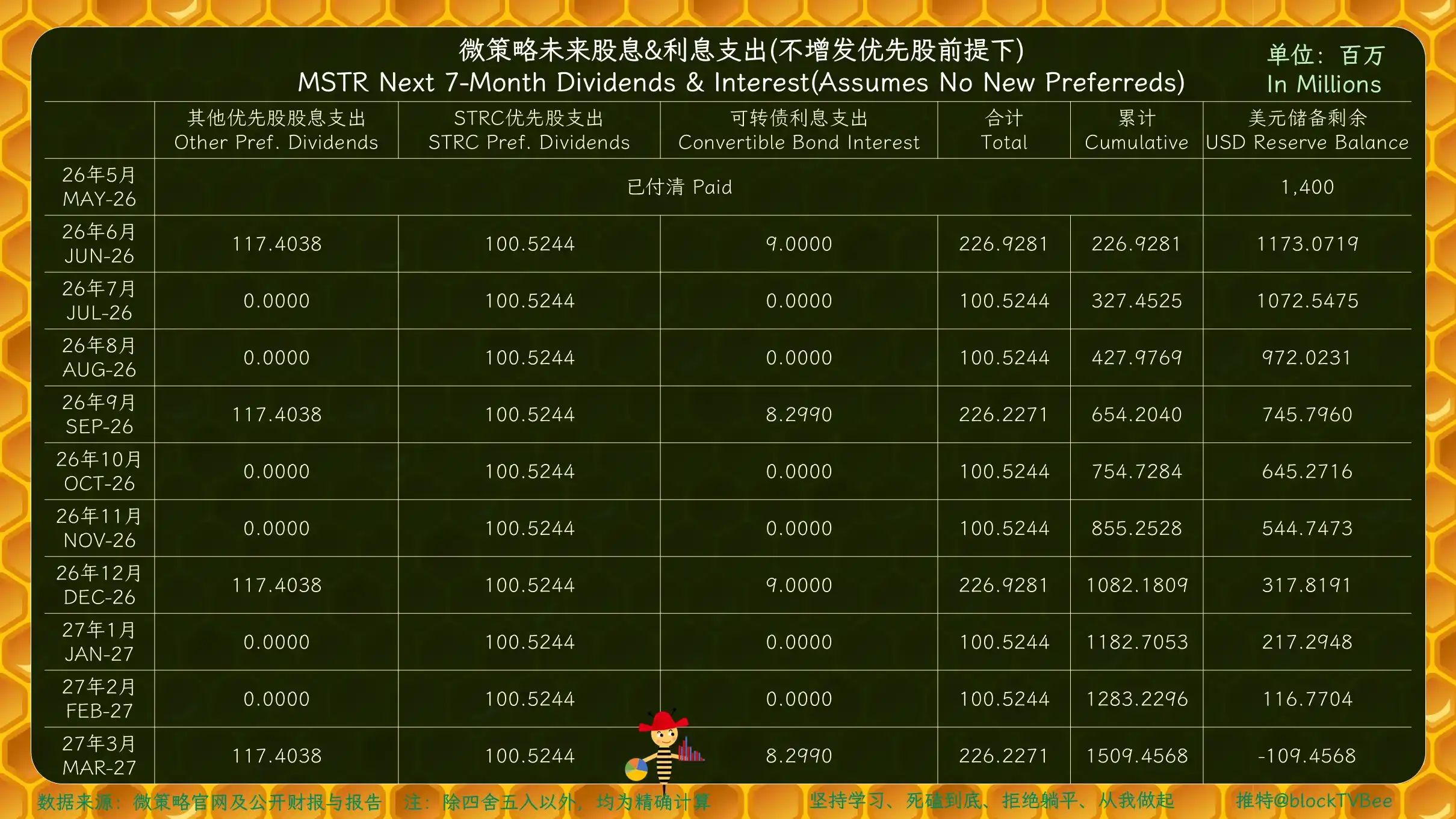
First, over the last 4 weeks, MicroStrategy has not issued any additional preferred stock at all, meaning it has not increased future dividend payments or expanded risk.

Second, over the last 4 weeks, MicroStrategy has strengthened its financing efforts by issuing common stock $MSTR, raising $128.3 million, $181 million, $209 million, and $333.5 million sequentially.

Third, over the last 4 weeks, MicroStrategy's BTC purchases were -32, 1550, 1587, and 520 BTC respectively. Although financing increased, BTC purchases did not rise proportionally, which is somewhat unfavorable for $MSTR in the short term but enhances the overall safety of the MicroStrategy system in the long run.

By March next year, the BTC bear market will most likely have ended. Once BTC and MSTR enter an upward trend, MicroStrategy can continue issuing MSTR to raise funds and use a portion to replenish its dollar reserves to cover future preferred stock dividend payments.

As BTC and MSTR rise, the expenditure and pressure from preferred stock dividends will gradually diminish.


Trending Cryptos

Related Questions

QWhat is the key characteristic of convertible preferred stock mentioned in the article that makes it a clever financing tool for MicroStrategy?

AThe key characteristic is that these preferred stocks do not have rigid redemption or payment clauses. Therefore, they are not classified as traditional debt on the balance sheet. This means there is no principal repayment pressure, missed dividends do not trigger a debt default, and they do not directly lead to bankruptcy liquidation, creating a self-contradictory but virtuous cycle.

QAccording to the article, what happens if MicroStrategy cannot pay dividends on its preferred stock in the short term?

AIf MicroStrategy lacks sufficient funds to pay preferred stock dividends in the short term, it can defer or suspend the payments. For cumulative preferred stock, the unpaid dividends accumulate. For non-cumulative stock like STRD, dividends can simply be suspended without accruing. It can later resume or pay back dividends when funds are available, for example, by issuing more common stock after a Bitcoin price recovery.

QWhat is identified as the primary potential trigger for a real financial crisis at MicroStrategy, according to the article?

AThe article identifies convertible bonds (可转债) as the primary potential trigger for a real financial crisis. If a prolonged bear market prevents the bonds from meeting conversion conditions by their maturity dates (the earliest being September 16, 2027), MicroStrategy would be forced to repay them, potentially triggering a sell-off of Bitcoin and creating a downward spiral. Preferred stock dividends would only exacerbate this crisis, not initiate it.

QHow did MicroStrategy's recent financing activities (last 4 weeks) impact its financial safety, as described in the article?

AAccording to the article, MicroStrategy's recent activities increased its financial safety in three ways: 1) It did not issue any new preferred stock, avoiding an increase in future dividend obligations. 2) It significantly increased financing by issuing common stock (MSTR), raising hundreds of millions of dollars. 3) It increased its US dollar reserve (from $1.1B to $1.4B in the example week) more than its Bitcoin purchases, which is seen as bolstering the system's long-term safety despite being potentially negative for MSTR's stock price in the short term.

QUntil when can MicroStrategy's current US dollar reserves cover all its preferred stock dividend payments, based on the article's analysis?

ABased on the article's analysis, MicroStrategy's current US dollar reserves can cover all preferred stock dividend payments until February 2027, and approximately half of the payments due in March 2027.

Related Reads

Research Report Analysis: AI Triggers MLCC Supercycle, How Many Years of Gains Can Samsung Electro-Mechanics Enjoy?

Title: Analyst Report: AI Ignites MLCC Super Cycle, How Many Years of Benefits Can Samsung Electro-Mechanics Reap? Summary: Morgan Stanley has sharply raised its target price for Samsung Electro-Mechanics from 920,000 KRW to 2,560,000 KRW, recasting the MLCC (Multi-Layer Ceramic Capacitor) industry from cyclical to structurally bullish. The core thesis is that AI servers demand 10-15 times more MLCCs than traditional servers, with a single AI server requiring up to 440,000 units compared to just 30,000 for a standard server. This drives not only higher volumes but also a shift to more advanced, higher-value MLCCs, boosting Average Selling Prices (ASP). The current supply crunch is seen as structural, not a temporary cyclical mismatch, driven by capacity constraints meeting sustained new demand. High-end MLCC production lines are fully booked, with new lines taking two years to build. Morgan Stanley forecasts MLCC price increases of 30% in H2 2026 and another 30-50% in 2027. Samsung Electro-Mechanics is positioned as the primary beneficiary through three channels: 1) Direct MLCC price hikes, especially for high-margin AI-use MLCCs, driving significant operating margin expansion from 15.7% (present) to 24.5% by 2027. 2) Strong growth in its ABF substrate business from saturated AI/ASIC chip orders. 3) Future revenue streams from new product lines like silicon capacitors and glass substrates. The firm's ROE is projected to surge from 7.5% in FY25 to 32.2% by FY28, with an increased dividend payout. Risks include potential smartphone demand weakness or execution issues in China, while upside catalysts are further price increases and confirmation of higher MLCC content in next-gen AI platforms like Rubin/VR200. The story transforms Samsung Electro-Mechanics from a traditional component supplier into a key AI infrastructure player, with its growth narrative supported by current supply constraints and pricing power.

marsbit22m ago

Research Report Analysis: AI Triggers MLCC Supercycle, How Many Years of Gains Can Samsung Electro-Mechanics Enjoy?

marsbit22m ago

Trading

Spot
Futures

Hot Articles

How to Buy GENIUS

Welcome to HTX.com! We've made purchasing Genius (GENIUS) simple and convenient. Follow our step-by-step guide to embark on your crypto journey.Step 1: Create Your HTX AccountUse your email or phone number to sign up for a free account on HTX. Experience a hassle-free registration journey and unlock all features.Get My AccountStep 2: Go to Buy Crypto and Choose Your Payment MethodCredit/Debit Card: Use your Visa or Mastercard to buy Genius (GENIUS) instantly.Balance: Use funds from your HTX account balance to trade seamlessly.Third Parties: We've added popular payment methods such as Google Pay and Apple Pay to enhance convenience.P2P: Trade directly with other users on HTX.Over-the-Counter (OTC): We offer tailor-made services and competitive exchange rates for traders.Step 3: Store Your Genius (GENIUS)After purchasing your Genius (GENIUS), store it in your HTX account. Alternatively, you can send it elsewhere via blockchain transfer or use it to trade other cryptocurrencies.Step 4: Trade Genius (GENIUS)Easily trade Genius (GENIUS) on HTX's spot market. Simply access your account, select your trading pair, execute your trades, and monitor in real-time. We offer a user-friendly experience for both beginners and seasoned traders.

3.0k Total ViewsPublished 2026.04.29Updated 2026.06.02

How to Buy GENIUS

Discussions

Welcome to the HTX Community. Here, you can stay informed about the latest platform developments and gain access to professional market insights. Users' opinions on the price of GENIUS (GENIUS) are presented below.

活动图片