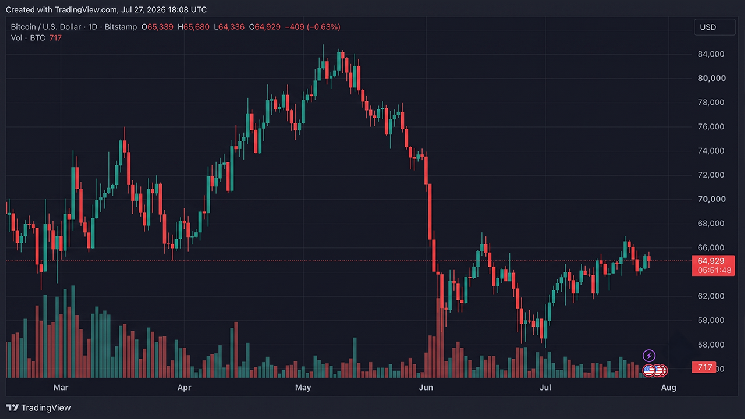
Ethereum ETFs Attracted $104 Million, With Weekly Inflows Tripling Bitcoin's Cumulative Inflows

cryptonews.ruPublished on 2026-07-27Last updated on 2026-07-27

Abstract

Cryptocurrency ETF investors started the week with strong purchases but ended with a significant market exit. From July 20-24, U.S. spot Bitcoin ETFs attracted $33.79 million in net inflows, while Ether ETFs garnered $103.90 million—approximately triple the Bitcoin total. XRP ETFs saw $8.15 million, and Solana products attracted $7.2 million. Hype (HYPE) ETFs experienced an outflow of $8.61 million. Bitcoin ETFs opened with three strong sessions but faced major outflows on Thursday ($225M) and Friday ($240M), reducing the net weekly gain. IBIT (BlackRock) and GBTC (Grayscale) recorded outflows, while ARKB (ARK 21Shares) and Bitcoin Mini Trust (Grayscale) led inflows. The weekly Bitcoin inflow fell 55% from the prior week. Ether ETFs demonstrated stronger, consistent demand throughout the week, highlighting sustained institutional interest driven by its utility in DeFi, stablecoins, and corporate treasury strategies. Altcoin ETF flows were more muted, with XRP and Solana seeing mixed results and HYPE ETFs facing continued outflows. The week's two-phase pattern reflected shifting risk sentiment, with early crypto demand giving way to caution amid concerns over AI spending reports and rising oil prices. Analysts note that low-cost crypto ETFs are increasing competitive pressure on traditional high-margin crypto exchanges.

Investors in cryptocurrency exchange-traded funds (ETFs) started the week with confident purchases and ended it with a mass market exit. The reversal was sharp but not strong enough to completely negate the early gains of funds investing in Bitcoin and Ethereum.

From July 20 to 24, U.S. spot Bitcoin ETFs attracted $33.79 million in net inflows. Ethereum funds attracted $103.90 million, roughly three times the total amount for Bitcoin. $XRP ETFs attracted $8.15 million, while Solana products attracted $7.2 million.

ETFs on $HYPE went in the opposite direction, recording a net outflow of $8.61 million.
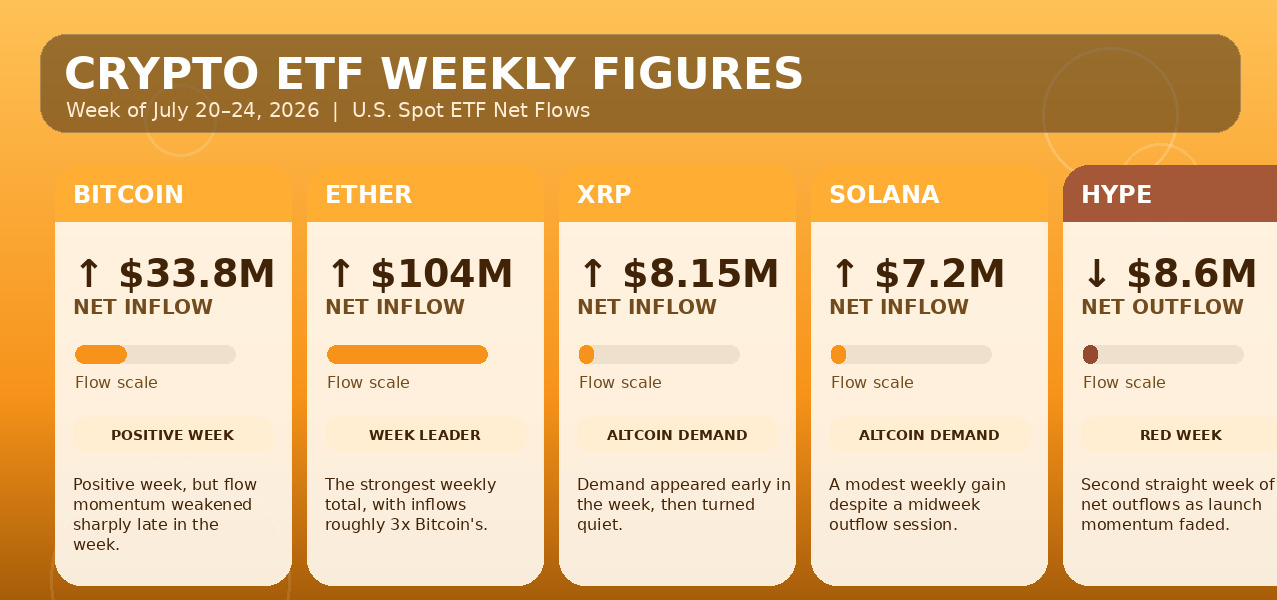
Overview of Weekly Fund Flows into U.S. Spot Cryptocurrency ETFs

Bitcoin's Early Gains Fade

Bitcoin ETFs opened the week with three strong sessions. On Monday, these products attracted $227 million, on Tuesday $203 million, and on Wednesday $69 million, extending the inflow streak that began last week.

On Thursday, the trend changed: an outflow of $225 million was recorded. Another $240 million left the funds on Friday, reducing the total weekly inflow to just under $34 million.

BlackRock's IBIT fund ended the week with a net outflow of $95.5 million, while Grayscale's GBTC fund lost $83.7 million. WisdomTree's BTCW and Franklin Templeton's EZBC funds also recorded outflows of $5.1 million and $5.6 million, respectively.

The ARK 21Shares ARKB fund led the leaders with an inflow of $78.1 million. Grayscale's Bitcoin Mini Trust fund attracted $85.8 million, and Fidelity's FBTC fund attracted $35.2 million. Morgan Stanley's MSBT fund attracted $15.7 million, and Bitwise's BITB fund attracted $7.2 million.

The weekly inflow into Bitcoin funds decreased by approximately 55% compared to $75.67 million last week. Against the backdrop of total assets under management of $77.82 billion, these inflows amounted to only about 0.04% of the total assets.

Ethereum Leads as Altcoin Investors Become More Selective

Ethereum ETFs showed stronger weekly results. On Monday, they recorded an inflow of $38 million, on Tuesday $37 million, on Wednesday $73 million, and on Thursday $26 million.
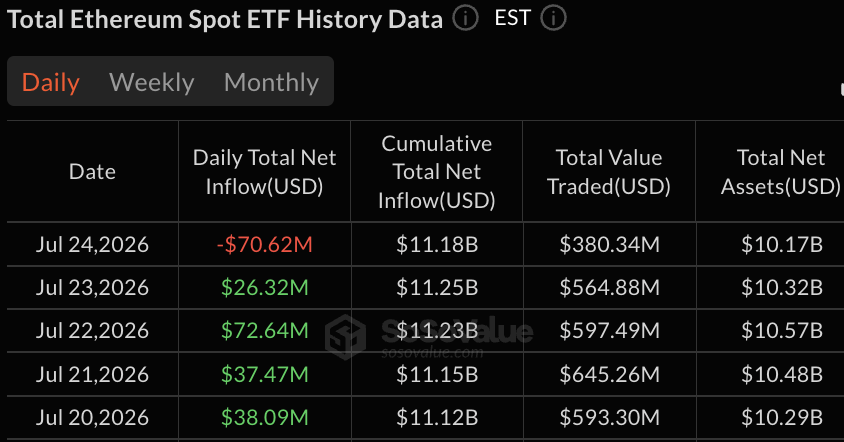
Weekly inflows into Ethereum ETFs. Source: Sosovalue

These results indicate that institutional demand remains concentrated on Ethereum. Its appeal extends beyond price exposure and is linked to activity in stablecoins, decentralized finance, on-chain settlements, and corporate treasury strategies.

Inflows into altcoin ETFs were more modest. $XRP funds attracted $2.49 million on Monday and $5.66 million on Tuesday, ending the week at $8.15 million. Solana ETFs attracted $2.64 million and $5.83 million in the first two trading days, then lost $1.27 million on Wednesday. No further inflows followed.

$HYPE funds continued to struggle. After a quiet Monday, they lost about $698,000 on Tuesday, $1.02 million on Thursday, and $6.89 million on Friday.

The week's two-phase dynamic reflected broader shifts in risk appetite. Early demand for cryptocurrency was replaced by caution, as technology company reports renewed concerns about AI spending, and rising oil prices exacerbated risks related to inflation and bond yields.

The rise of ETFs is also changing cryptocurrency trading itself. Bloomberg ETF analyst Eric Balchunas argues that low-cost funds threaten high-margin intermediaries, as investors can access cryptocurrencies through ETFs for just a few basis points. For traditional exchanges, the competitive pressure is no longer theoretical.
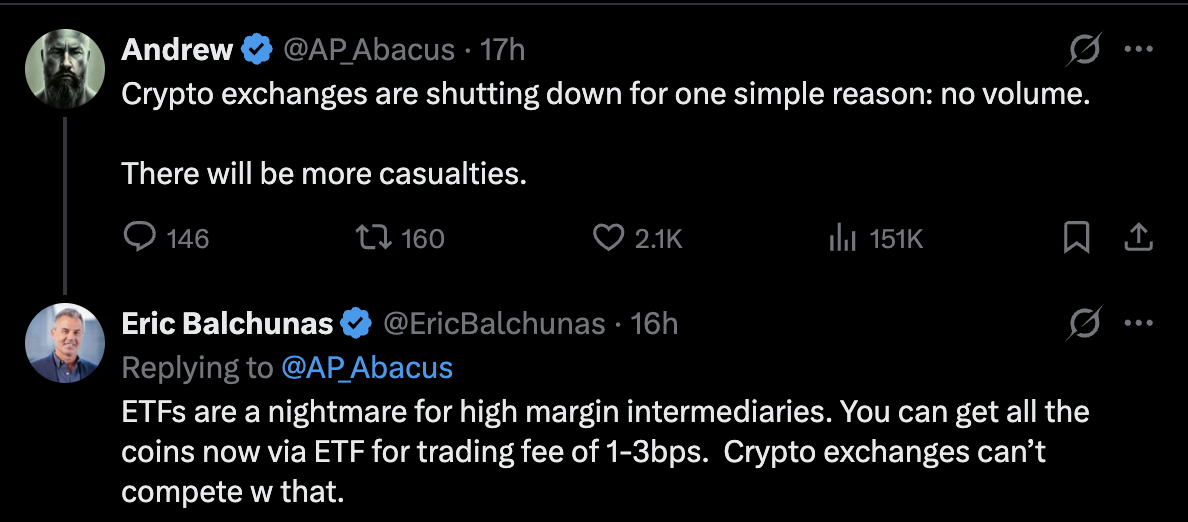
Source: Eric Balchunas on X
end-content

Trending Cryptos

Related Questions

QWhat were the net inflows for spot Bitcoin ETFs in the U.S. for the week of July 20-24?

AU.S. spot Bitcoin ETFs had net inflows of $33.79 million for the week of July 20-24.

QHow did the weekly inflows for Ether (ETH) ETFs compare to Bitcoin ETFs in the same period?

AEther (ETH) ETFs attracted approximately three times more than Bitcoin ETFs, with net inflows of $103.90 million compared to Bitcoin's $33.79 million.

QWhich specific Bitcoin ETF had the largest net inflow for the week, and how much was it?

AThe ARKB ETF from ARK 21Shares had the largest net inflow among Bitcoin ETFs for the week, at $78.1 million.

QWhat was the trend in daily flows for Bitcoin ETFs during the week of July 20-24?

ABitcoin ETFs started the week with three strong days of inflows ($227M Mon, $203M Tue, $69M Wed) but experienced significant outflows on Thursday ($225M) and Friday ($240M), resulting in a much lower net weekly total.

QAccording to the article, why is institutional demand concentrated on Ether (ETH) beyond just price exposure?

AInstitutional demand for Ether is concentrated because its appeal extends beyond price exposure and is linked to activity in stablecoins, decentralized finance, blockchain settlements, and corporate treasury strategies.

Related Reads

Trading

Spot

Hot Articles

What is $BITCOIN

DIGITAL GOLD ($BITCOIN): A Comprehensive Analysis Introduction to DIGITAL GOLD ($BITCOIN) DIGITAL GOLD ($BITCOIN) is a blockchain-based project operating on the Solana network, which aims to combine the characteristics of traditional precious metals with the innovation of decentralized technologies. While it shares a name with Bitcoin, often referred to as “digital gold” due to its perception as a store of value, DIGITAL GOLD is a separate token designed to create a unique ecosystem within the Web3 landscape. Its goal is to position itself as a viable alternative digital asset, although specifics regarding its applications and functionalities are still developing. What is DIGITAL GOLD ($BITCOIN)? DIGITAL GOLD ($BITCOIN) is a cryptocurrency token explicitly designed for use on the Solana blockchain. In contrast to Bitcoin, which provides a widely recognized value storage role, this token appears to focus on broader applications and characteristics. Notable aspects include: Blockchain Infrastructure: The token is built on the Solana blockchain, known for its capacity to handle high-speed and low-cost transactions. Supply Dynamics: DIGITAL GOLD has a maximum supply capped at 100 quadrillion tokens (100P $BITCOIN), although details regarding its circulating supply are currently undisclosed. Utility: While precise functionalities are not explicitly outlined, there are indications that the token could be utilized for various applications, potentially involving decentralized applications (dApps) or asset tokenization strategies. Who is the Creator of DIGITAL GOLD ($BITCOIN)? At present, the identity of the creators and development team behind DIGITAL GOLD ($BITCOIN) remains unknown. This situation is typical among many innovative projects within the blockchain space, particularly those aligning with decentralized finance and meme coin phenomena. While such anonymity may foster a community-driven culture, it intensifies concerns about governance and accountability. Who are the Investors of DIGITAL GOLD ($BITCOIN)? The available information indicates that DIGITAL GOLD ($BITCOIN) does not have any known institutional backers or prominent venture capital investments. The project seems to operate on a peer-to-peer model focused on community support and adoption rather than traditional funding routes. Its activity and liquidity are primarily situated on decentralized exchanges (DEXs), such as PumpSwap, rather than established centralized trading platforms, further highlighting its grassroots approach. How DIGITAL GOLD ($BITCOIN) Works The operational mechanics of DIGITAL GOLD ($BITCOIN) can be elaborated on based on its blockchain design and network attributes: Consensus Mechanism: By leveraging Solana’s unique proof-of-history (PoH) combined with a proof-of-stake (PoS) model, the project ensures efficient transaction validation contributing to the network's high performance. Tokenomics: While specific deflationary mechanisms have not been extensively detailed, the vast maximum token supply implies that it may cater to microtransactions or niche use cases that are still to be defined. Interoperability: There exists the potential for integration with Solana’s broader ecosystem, including various decentralized finance (DeFi) platforms. However, the details regarding specific integrations remain unspecified. Timeline of Key Events Here is a timeline that highlights significant milestones concerning DIGITAL GOLD ($BITCOIN): 2023: The initial deployment of the token occurs on the Solana blockchain, marked by its contract address. 2024: DIGITAL GOLD gains visibility as it becomes available for trading on decentralized exchanges like PumpSwap, allowing users to trade it against SOL. 2025: The project witnesses sporadic trading activity and potential interest in community-led engagements, although no noteworthy partnerships or technical advancements have been documented as of yet. Critical Analysis Strengths Scalability: The underlying Solana infrastructure supports high transaction volumes, which could enhance the utility of $BITCOIN in various transaction scenarios. Accessibility: The potential low trading price per token could attract retail investors, facilitating wider participation due to fractional ownership opportunities. Risks Lack of Transparency: The absence of publicly known backers, developers, or an audit process may yield skepticism regarding the project's sustainability and trustworthiness. Market Volatility: The trading activity is heavily reliant on speculative behavior, which can result in significant price volatility and uncertainty for investors. Conclusion DIGITAL GOLD ($BITCOIN) emerges as an intriguing yet ambiguous project within the rapidly evolving Solana ecosystem. While it attempts to leverage the “digital gold” narrative, its departure from Bitcoin's established role as a store of value underscores the need for a clearer differentiation of its intended utility and governance structure. Future acceptance and adoption will likely depend on addressing the current opacity and defining its operational and economic strategies more explicitly. Note: This report encompasses synthesised information available as of October 2023, and developments may have transpired beyond the research period.

1.1k Total ViewsPublished 2025.05.13Updated 2025.05.13

What is $BITCOIN

Discussions

Welcome to the HTX Community. Here, you can stay informed about the latest platform developments and gain access to professional market insights. Users' opinions on the price of BTC (BTC) are presented below.

活动图片