Securitize Capital becomes SEC-registered investment adviser

cointelegraphPublished on 2026-07-27Last updated on 2026-07-27

Abstract

Securitize Capital, a subsidiary of tokenization platform Securitize, has registered with the U.S. Securities and Exchange Commission as an investment adviser. This registration allows the firm to expand its regulated advisory services for institutional clients. It adds to Securitize's existing regulated offerings, which include a broker-dealer and transfer agent. CEO Carlos Domingo stated this enhances their ability to help institutions manage investment strategies for on-chain capital markets. Previously an exempt reporting adviser, the firm is now subject to stricter compliance and disclosure rules. Securitize is noted as the largest tokenization platform by on-chain asset value, managing approximately $4.8 billion in tokenized assets for major firms like BlackRock and KKR. The company began trading on the NYSE in early July following a merger, though its share price has declined significantly since its debut.

Securitize Capital, a subsidiary of tokenized asset platform Securitize, has registered with the US Securities and Exchange Commission (SEC) as an investment adviser, allowing the company to expand its regulated investment advisory business for institutional clients, Securitize said Monday.

The registration adds investment advisory capabilities to Securitize’s existing regulated businesses, which include an SEC-registered broker-dealer, alternative trading system, transfer agent and fund administration services.

CEO Carlos Domingo said the registration strengthens Securitize’s ability to help institutions develop and manage investment strategies for onchain capital markets. Securitize Capital previously operated as an exempt reporting adviser and is now subject to additional disclosure, compliance, recordkeeping and examination requirements under the Investment Advisers Act.

Securitize is the largest tokenization platform by onchain asset value, with around $4.8 billion in tokenized assets across funds from BlackRock, Apollo, KKR, VanEck, Hamilton Lane and other asset managers.

The company began trading on the New York Stock Exchange under the ticker SECZ on July 2 after completing a merger with Cantor Equity Partners II. Shares have since fallen about 46% from their first-day closing price.
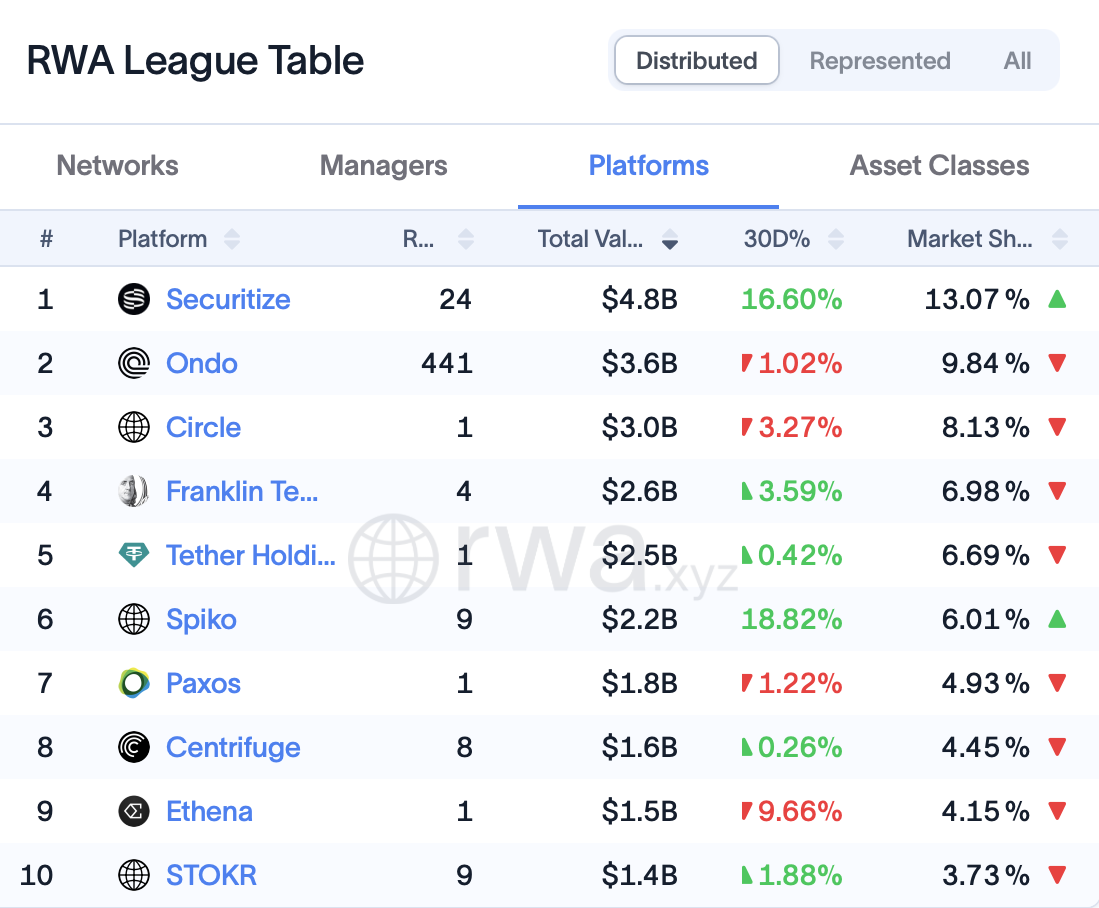
Top RWA tokenization platforms. Source: RWA.xyz

Magazine: CLARITY hopes fade, BitMEX shuts as lawsuit looms: Hodler’s Digest, July 26

Related Questions

QWhat is the primary significance of Securitize Capital's recent SEC registration?

AThe primary significance is that Securitize Capital has become a registered investment adviser with the SEC. This allows the company to expand its regulated investment advisory services for institutional clients and strengthens its ability to help institutions develop and manage investment strategies for onchain capital markets.

QWhat regulated services did Securitize already offer before this registration as an investment adviser?

ABefore registering as an investment adviser, Securitize's existing regulated businesses included an SEC-registered broker-dealer, an alternative trading system, a transfer agent, and fund administration services.

QHow does the status change for Securitize Capital from being an exempt reporting adviser to a registered investment adviser?

AAs a registered investment adviser, Securitize Capital is now subject to additional disclosure, compliance, recordkeeping, and examination requirements under the Investment Advisers Act, compared to its previous status as an exempt reporting adviser.

QAccording to the article, what makes Securitize the largest tokenization platform?

ASecuritize is the largest tokenization platform by onchain asset value, with approximately $4.8 billion in tokenized assets across funds from major asset managers like BlackRock, Apollo, KKR, VanEck, and Hamilton Lane.

QWhat was the performance of Securitize's stock (SECZ) after it began trading on the NYSE?

AAfter beginning to trade on the New York Stock Exchange under the ticker SECZ on July 2 following a merger, the company's shares have fallen about 46% from their first-day closing price.

Related Reads

Has Bitcoin Bottomed, or Is a 'Shakeout' Approaching? What's the Situation with XRP?

Cryptocurrency analytics platform Santiment shared key insights on Bitcoin and altcoin markets, highlighting significant signals from on-chain data. Analysis shows Bitcoin's 365-day MVRV ratio has fallen to -26%, indicating substantial losses for long-term holders, a level historically associated with market bottom formations and long-term buying opportunities. While short-term MVRV is near breakeven, suggesting no clear directional signal, the annual perspective points to a bottom before bullish cycles. On-chain data reveals divergent behavior: large wallets (10-10,000 BTC) have been accumulating, adding ~18,500 BTC in 10 days, while smaller retail investors continue buying dips. Analysts caution that high retail demand can sometimes create a risk of a final market shakeout or correction. The altcoin market shows a mixed picture. Ethereum's 365-day MVRV is around -33%, but recent monthly gains combined with overly optimistic social sentiment pose a short-term correction risk. XRP is in oversold territory with 30-day and 365-day MVRVs at -57.5% and -45.5% respectively, signaling potential for a strong mid-to-long term rebound. Social activity and optimism are rising for Solana, while investor sentiment remains calmer towards Cardano. Future direction for Bitcoin and altcoins depends not only on on-chain metrics but also on macroeconomic and regulatory developments. The Federal Reserve's interest rate decision and upcoming policy rulings are increasing market volatility expectations, while uncertainty around the U.S. Congressional clarity process continues to pressure pricing. *This is not investment advice.

cryptonews.ru1h ago

Has Bitcoin Bottomed, or Is a 'Shakeout' Approaching? What's the Situation with XRP?

cryptonews.ru1h ago

Bank of Korea Reveals Results of Tokenized Deposit Testing

The Bank of Korea has announced the results of its pilot test for tokenized deposits. Involving 28 central banks and international financial organizations, the project saw participation from major South Korean banks including KB Kookmin Bank, NH NongHyup Bank, Shinhan Bank, Woori Bank, and Hana Bank. Transactions, from payment orders to final settlement, were completed in real time, averaging just 80 seconds. The test involved 30 transactions across 17 different scenarios—such as corporate and interbank transfers—and was conducted in six currencies, including the Korean won, US dollar, and euro, with a total transaction value reaching approximately $995,000. The central bank reported that the platform operated stably throughout, despite being only partially connected to the existing banking infrastructure. Settlements using tokenized deposits were executed seamlessly, quickly, and transparently. An internal transfer of 20 million won (about $13,890) between NH NongHyup Bank and Shinhan Bank was also successfully processed via the Project Agora platform, which involved connecting to the Bank of Korea's CBDC test platform, Project Hangang. Additionally, KB Kookmin Bank and Japan's MUFG Bank tested cross-border payments using these deposit tokens—digital certificates issued by commercial banks within the pilot, not directly by the central bank. The Bank of Korea plans to continue testing payments with tokenized deposits. This follows last year's pledge by South Korean authorities to tighten regulations for won-based stablecoins, which will require approval from both the central bank and the Financial Services Commission.

cryptonews.ru3h ago

Bank of Korea Reveals Results of Tokenized Deposit Testing

cryptonews.ru3h ago

Trading

Spot
活动图片