BlackRock Invests $431 Million in Bitcoin and Ethereum ETFs

cryptonews.ruPublished on 2026-08-26Last updated on 2026-08-26

Abstract

BlackRock invested $284.42 million into its Bitcoin ETF (IBIT) and $146.44 million into its Ethereum ETF (ETHA) on a day of strong institutional inflows into cryptocurrency funds. Bitcoin ETFs collectively attracted $314.37 million, bringing total net assets for the category to $99.05 billion, nearing the $100 billion milestone. Ethereum ETFs saw net inflows of $179.80 million. Demand also extended to altcoin ETFs: Solana funds attracted $32.25 million, XRP funds $23.87 million, and Hyperliquid (HYPE) funds $7.51 million. The session, which saw no outflows from major Bitcoin or Ethereum products, highlighted broad institutional interest beyond the two largest cryptocurrencies.

The active demand observed at the end of August showed no signs of abating.

Money continued to flow into cryptocurrency ETFs across the board: the assets of Bitcoin funds approached the $100 billion mark, and Ethereum-based products brought in another significant inflow. Funds investing in less popular tokens also attracted fresh capital, making this trading session one of the most active for fund inflows this month.

Bitcoin ETFs attracted $314.37 million, with BlackRock's IBIT leading in this regard. IBIT attracted $284.42 million, accounting for over 90% of the total daily volume. It was followed by Fidelity's FBTC with $15.45 million, and Grayscale's Bitcoin Mini Trust attracted $6.98 million.
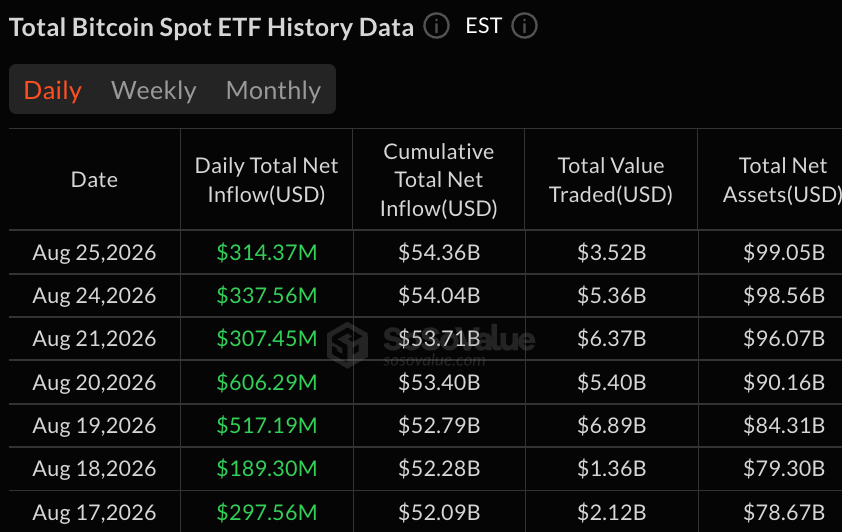
The seven-day inflow into Bitcoin ETFs reached $2.57 billion. Source: Sosovalue

Morgan Stanley's MSBT fund attracted $4.52 million, and Bitwise's BITB attracted $3 million. No Bitcoin fund recorded an outflow. Trading volume reached $3.52 billion, and total net assets grew to $99.05 billion, leaving this category just a few billion short of the $100 billion mark.

Ethereum ETFs also continued their successful streak, recording a net inflow of $179.80 million.

The leader was BlackRock's ETHA ETF with an inflow of $146.44 million. Fidelity's FETH ETF attracted $25.75 million, and BlackRock's ETHB ETF attracted $7.61 million. No outflows were recorded. Ethereum ETF trading volume reached $980.49 million, and net assets at the end of the day were $14.88 billion.

Solana, $XRP and $HYPE Support Market Breadth

Solana ETFs attracted $32.25 million. The leader was Bitwise's BSOL with $20.43 million, followed by Grayscale's GSOL with $5.20 million and Fidelity's FSOL with $4.93 million. Franklin Templeton's SOEZ fund attracted $1.70 million. Solana ETF assets at the end of the day were $1.27 billion with a trading volume of $86.15 million.

$XRP funds attracted $23.87 million across four products. The leader was the Bitwise fund with $11.02 million, followed by Franklin Templeton's XRPZ with $6.39 million. Grayscale's GXRP and Canary's XRPC funds attracted $4.28 million and $2.19 million respectively.

$HYPE ETF funds attracted $7.51 million, with the leader being 21Shares' THYP fund with an inflow of $4.28 million. Grayscale's HYPG fund attracted $2.31 million, and Bitwise's BHYP attracted about $922,000.

The growing ETF market was supplemented with another product on Tuesday. Grayscale launched its Zcash ETF on the NYSE Arca exchange following the conversion of the Grayscale Zcash Trust. As of August 24, the fund's assets were approximately $314 million, and its portfolio held roughly 387,200 ZEC.

This session confirmed the strength of the current institutional demand, which is spreading not only to Bitcoin and Ethereum but also to an increasingly wide spectrum of digital assets.

end-content

Trending Cryptos

Related Questions

QHow much did Bitcoin ETFs attract on the day, and which specific ETF from BlackRock was the leader?

ABitcoin ETFs attracted $314.37 million on the day. The leading ETF was BlackRock's IBIT, which attracted $284.42 million, accounting for over 90% of the total daily inflow.

QWhat were the net inflows for Ether (Ethereum) ETFs, and which fund was the leader?

AEther (Ethereum) ETFs saw net inflows of $179.80 million. The leader was BlackRock's ETHA ETF with an inflow of $146.44 million.

QHow much did the ETFs for the less popular tokens Solana, XRP, and HYPE attract, and what was the leading fund for Solana?

ASolana ETFs attracted $32.25 million, XRP ETFs attracted $23.87 million, and HYPE ETFs attracted $7.51 million. The leading Solana ETF was BSOL from Bitwise, which attracted $20.43 million.

QWhat new ETF product did Grayscale launch, and what was its asset size as of August 24th?

AGrayscale launched its Zcash ETF on the NYSE Arca. As of August 24, the fund's assets were approximately $314 million, and its portfolio held about 387,200 ZEC.

QWhat milestone are the total net assets of Bitcoin ETFs approaching, and what was the total at the end of the day?

AThe total net assets of Bitcoin ETFs are approaching the $100 billion mark. At the end of the day, they stood at $99.05 billion.

Related Reads

How 5G Will Be Launched in Russia: The Digital Ministry's Proposal and the Roadmap to 2035

Russia's Ministry of Digital Development has proposed a plan for launching 5G networks. It allows the "Big Four" mobile operators (Beeline, Megafon, MTS, T2) to deploy 5G on existing 4G/LTE base stations and frequencies, and will allocate them the new 4.63–4.99 GHz band. A key element is "technological neutrality," permitting the use of foreign equipment until September 2026. The new 4.63–4.99 GHz band is intended for more advanced services and industrial applications. However, a phased transition to Russian-made base stations will begin in 2027, with a target of at least 50% domestic equipment by 2030. The rollout timeline aims for 5G in cities with over 1 million people by the end of 2027, expanding to 84 cities by 2035. Initial "5G Ready" service, operating over existing infrastructure, will offer minimal speed improvements. Significant speed gains (4-10x over LTE) will require the new band and corresponding equipment. The plan addresses long-standing regulatory delays, including the military's hold on the global standard 3.4–3.8 GHz band. This forced Russia to adopt the 4.63–4.99 GHz range, overlapping with a Chinese band, making Chinese equipment a potential transitional solution. The success of the rollout will depend on equipment supply and the pace of production localization, while a challenge lies in smartphone compatibility with this non-standard frequency band.

cryptonews.ru1h ago

How 5G Will Be Launched in Russia: The Digital Ministry's Proposal and the Roadmap to 2035

cryptonews.ru1h ago

The Federal Reserve Bank of Dallas Announces a Colossal $700 Billion Allocation! How Will This Affect Bitcoin?

The Federal Reserve Bank of Dallas warns that the growing adoption of tokenized deposits in the banking sector could pose unforeseen risks to the financial system. Tokenized deposits, which transfer traditional bank deposits to blockchain infrastructure, offer features like instant settlement and programmable payments. While issued by regulated banks and maintaining deposit characteristics, they could enable customers to move funds between banks much faster in search of higher yields. This would significantly weaken banks' liquidity management and lending capacity. The Fed's analysis estimates that an increase in deposit interest rate sensitivity by 10% could reduce the interest rate risk banks can bear by approximately $700 billion over ten years. Similarly, a 10% shortening of the average deposit maturity could reduce the banking system's capacity to convert deposits into loans by about $580 billion. This acceleration of deposit movement could force banks to rely on more expensive wholesale funding, increasing borrowing costs for consumers and businesses and potentially making traditional banks resemble non-bank financial institutions. While the report does not directly address Bitcoin, the described shifts could have long-term implications. Firstly, the tokenization of deposits by banks could promote institutional adoption of blockchain-based financial infrastructure, indirectly legitimizing digital asset classes like Bitcoin. Secondly, faster-moving deposits and resulting higher funding costs could increase the price of liquidity in the financial system. This could create near-term headwinds for risk assets, including Bitcoin, due to tighter financial conditions and potential selling pressure. The report concludes that widespread adoption of this technology could impact many areas, from payment systems to monetary policy transmission mechanisms.

cryptonews.ru1h ago

The Federal Reserve Bank of Dallas Announces a Colossal $700 Billion Allocation! How Will This Affect Bitcoin?

cryptonews.ru1h ago

Trading

Spot

Hot Articles

Discussions

Welcome to the HTX Community. Here, you can stay informed about the latest platform developments and gain access to professional market insights. Users' opinions on the price of ETH (ETH) are presented below.

活动图片