Bittensor jumps 28% as Anthropic restrictions fuel TAO’s $300 test

ambcryptoPublished on 2026-06-15Last updated on 2026-06-15

Abstract

Bittensor (TAO) surged 28% weekly, recovering from key support near $180.9 as buyers gained momentum. The price broke through resistance and the 20-day SMA, reaching ~$267.4 with strong volume and improving technical indicators like RSI and MACD. The rally was fueled in part by news that Anthropic restricted access to some AI models for foreign nationals, highlighting a weakness in centralized AI and boosting demand for decentralized AI projects like Bittensor. Attention now turns to the $280-$300.6 resistance zone. Maintaining support above the $244.7-$255 range is crucial for the bullish structure; losing it could lead to a retracement toward $210-$220. The sustainability of the move depends on continued demand beyond the initial headline-driven boost.

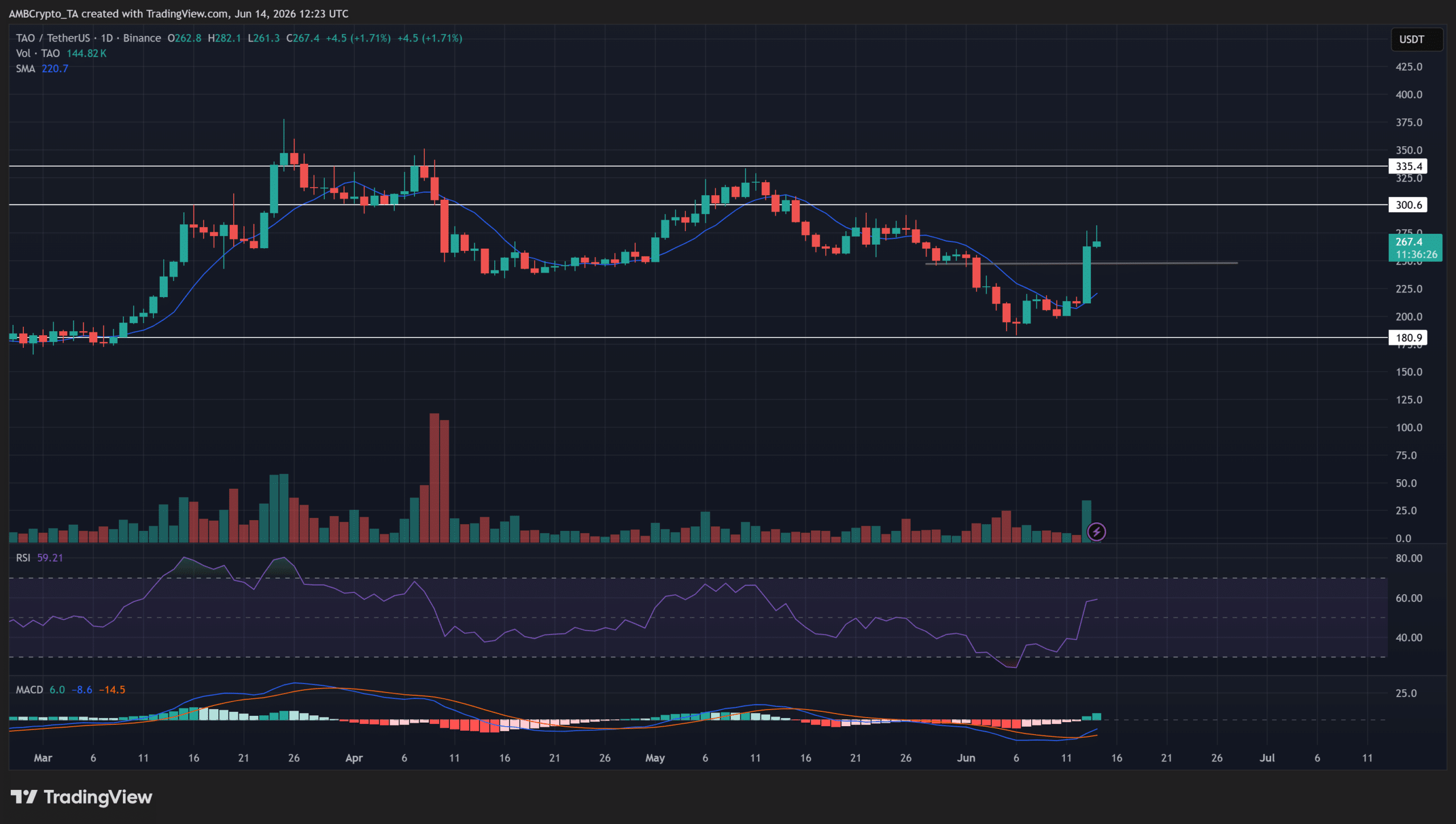
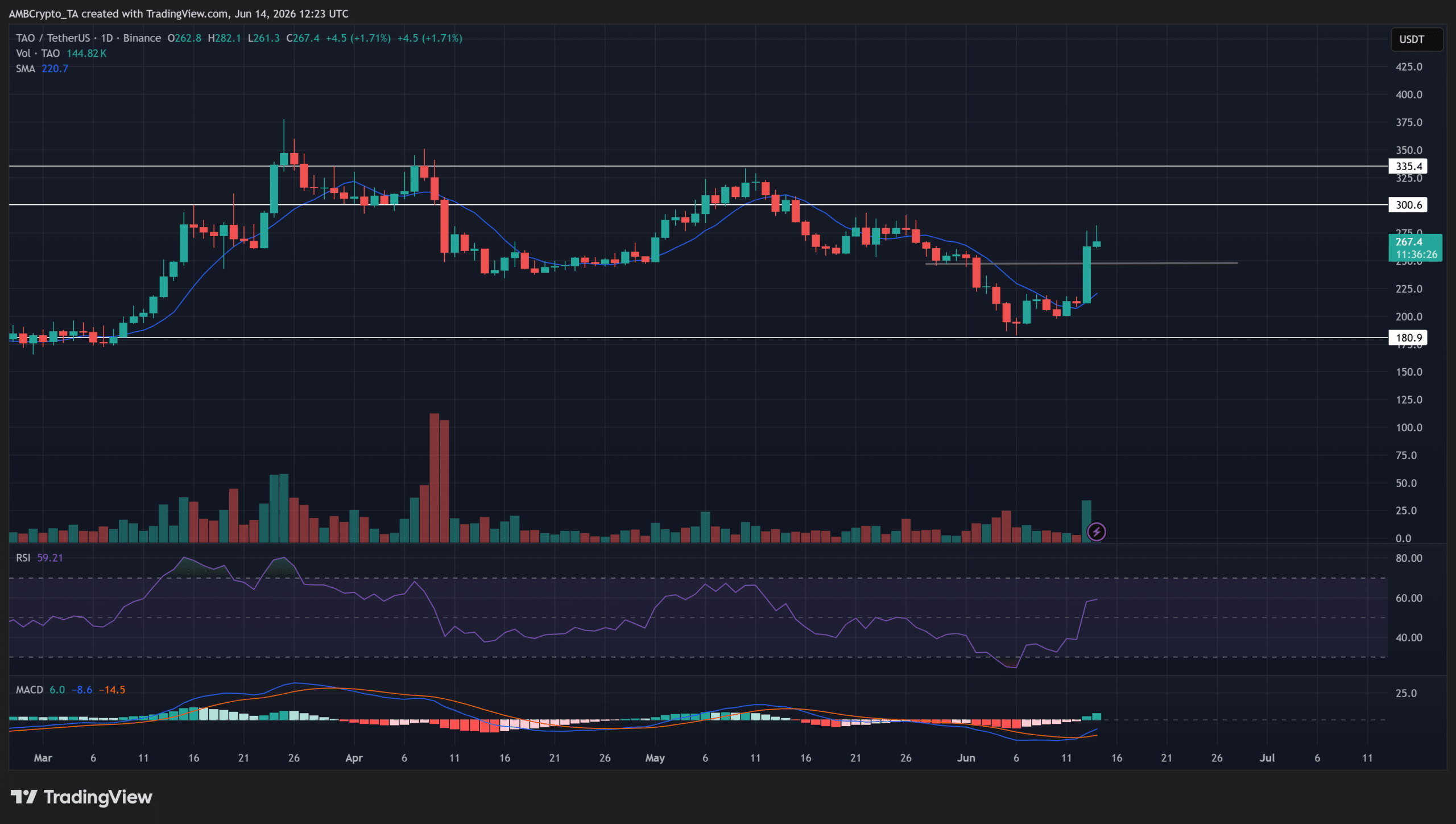
Bittensor [TAO] gained 9% in the last 24 hours, extending its weekly gain to 28% as buyers continued rebuilding momentum. The recovery began near the key $180.9 support zone.

There, repeated selling attempts failed to generate fresh downside pressure.

As sellers lost control, buyers gradually absorbed available supply and stabilized price action. This transition was followed by a brief consolidation phase, which suggested accumulation rather than continued distribution.
Source: TAO/USDT on TradingView

Momentum then accelerated sharply, lifting TAO from roughly $215 to $267.4 within two sessions. In the process, price reclaimed the 20-day SMA at $220.70 and pushed through a resistance area that had limited advances for weeks.

Volume expanded aggressively during the breakout, producing its strongest positive reading in nearly two months.

Meanwhile, RSI climbed to 59.2 from below 40, while MACD continued strengthening. Attention now turns to the $280-$300.6 region, where buyers and sellers will likely contest the recovery’s strength.

Anthropic’s move fuels TAO demand

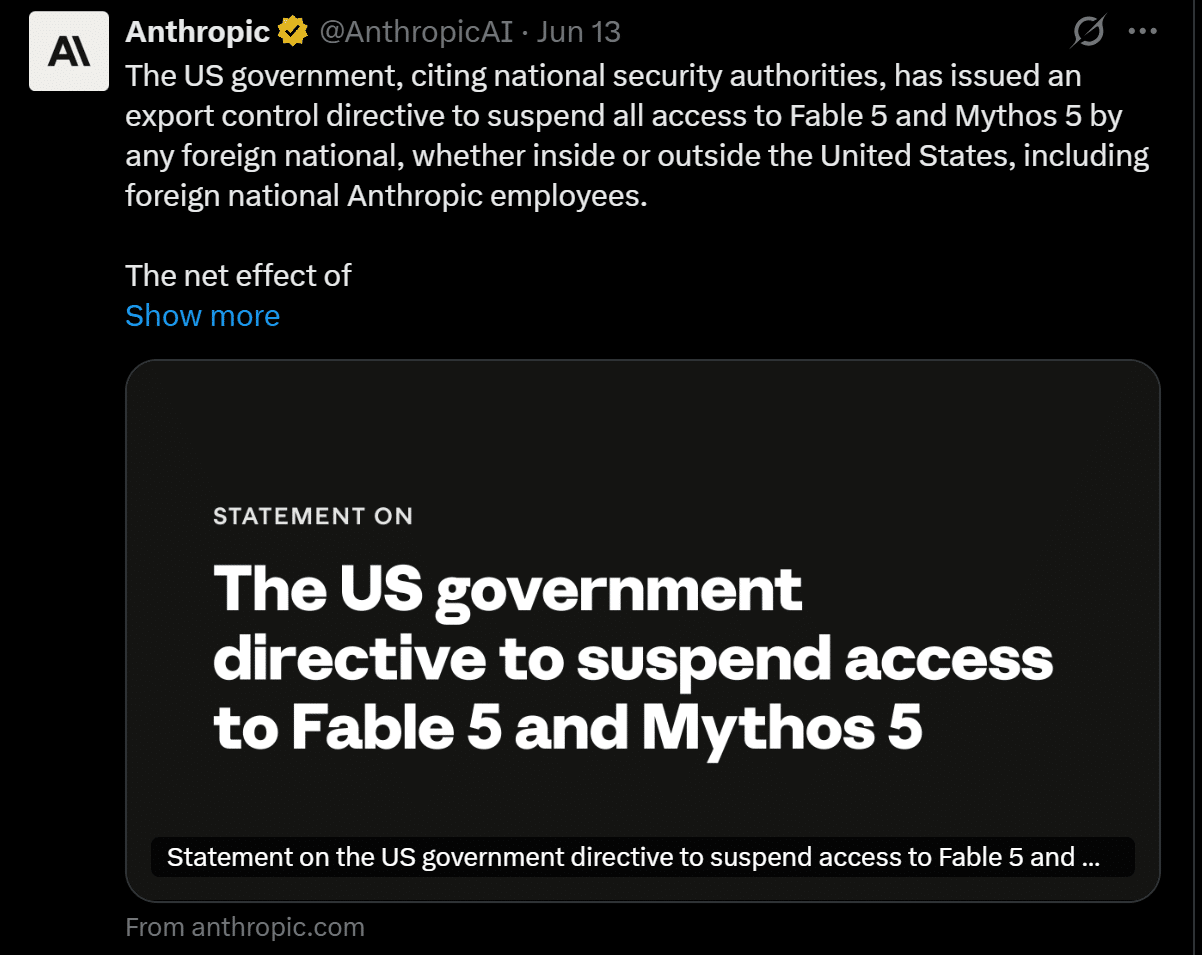
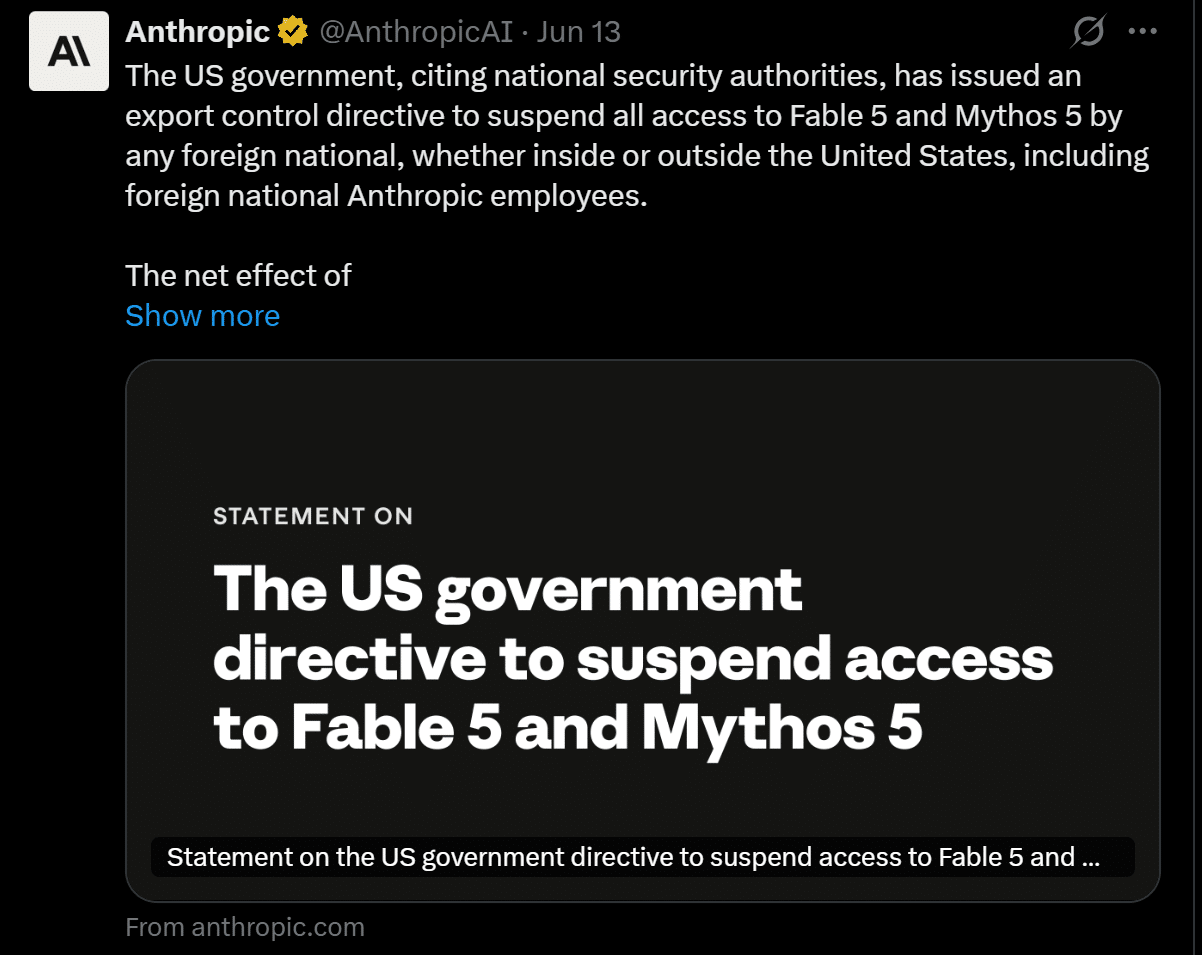
Bittensor’s rally did not emerge in isolation. Anthropic announced that access to Fable 5 and Mythos 5 would be suspended for foreign nationals following a U.S. government directive. The decision immediately highlighted a key weakness of centralized AI systems.
Source: X

Access could be restricted by regulation, regardless of demand. That narrative quickly spilled into crypto markets. As a result, traders rotated toward decentralized AI projects, helping TAO extend its advance toward the $272-$279 range.

Volume climbed above $560 million, reinforcing the strength of the move. This reaction suggests buyers were responding to more than technical momentum alone.

However, the durability of the rally now depends on whether demand continues after the headline impact fades.

Can bulls force a break above $300?

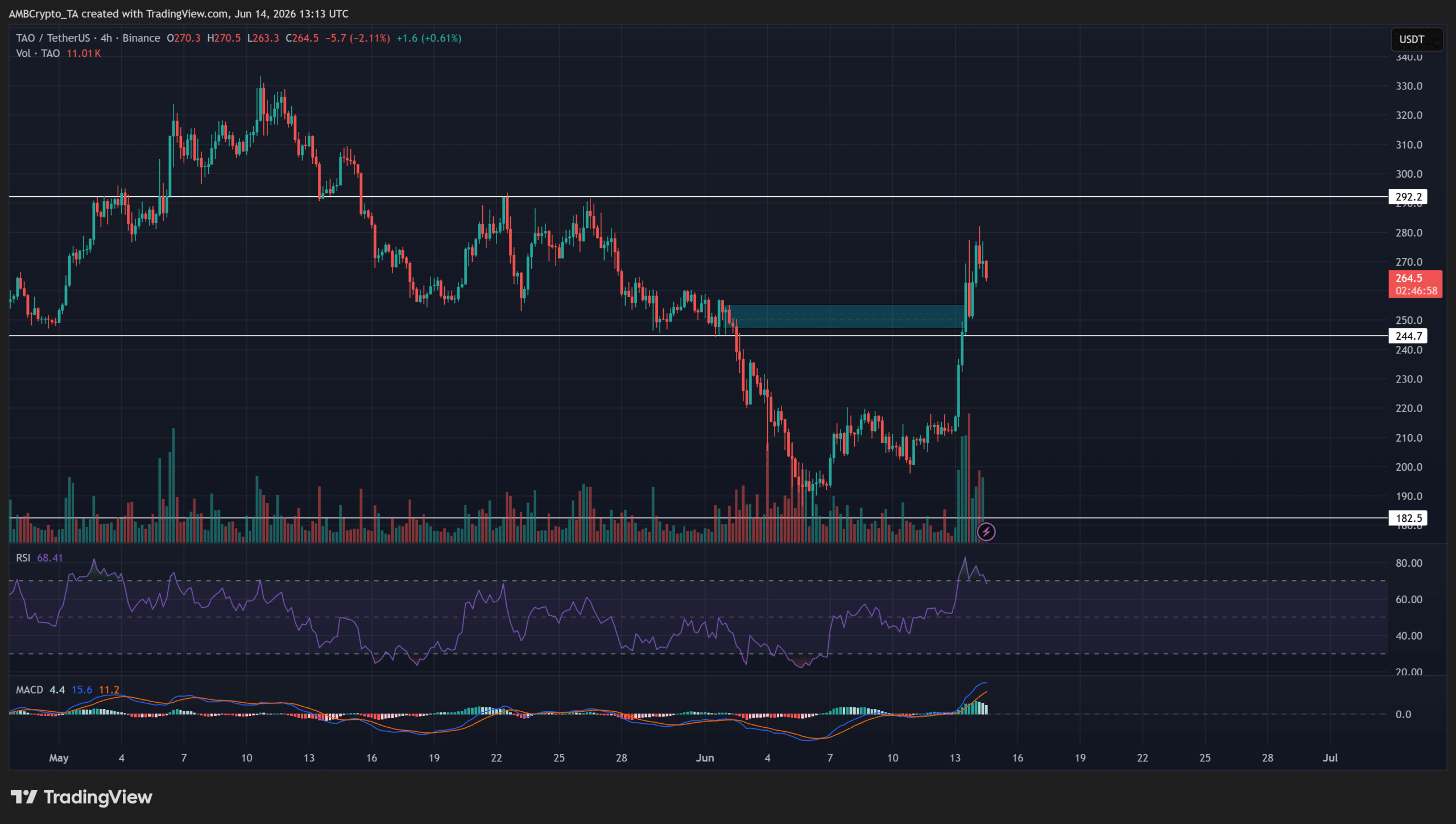
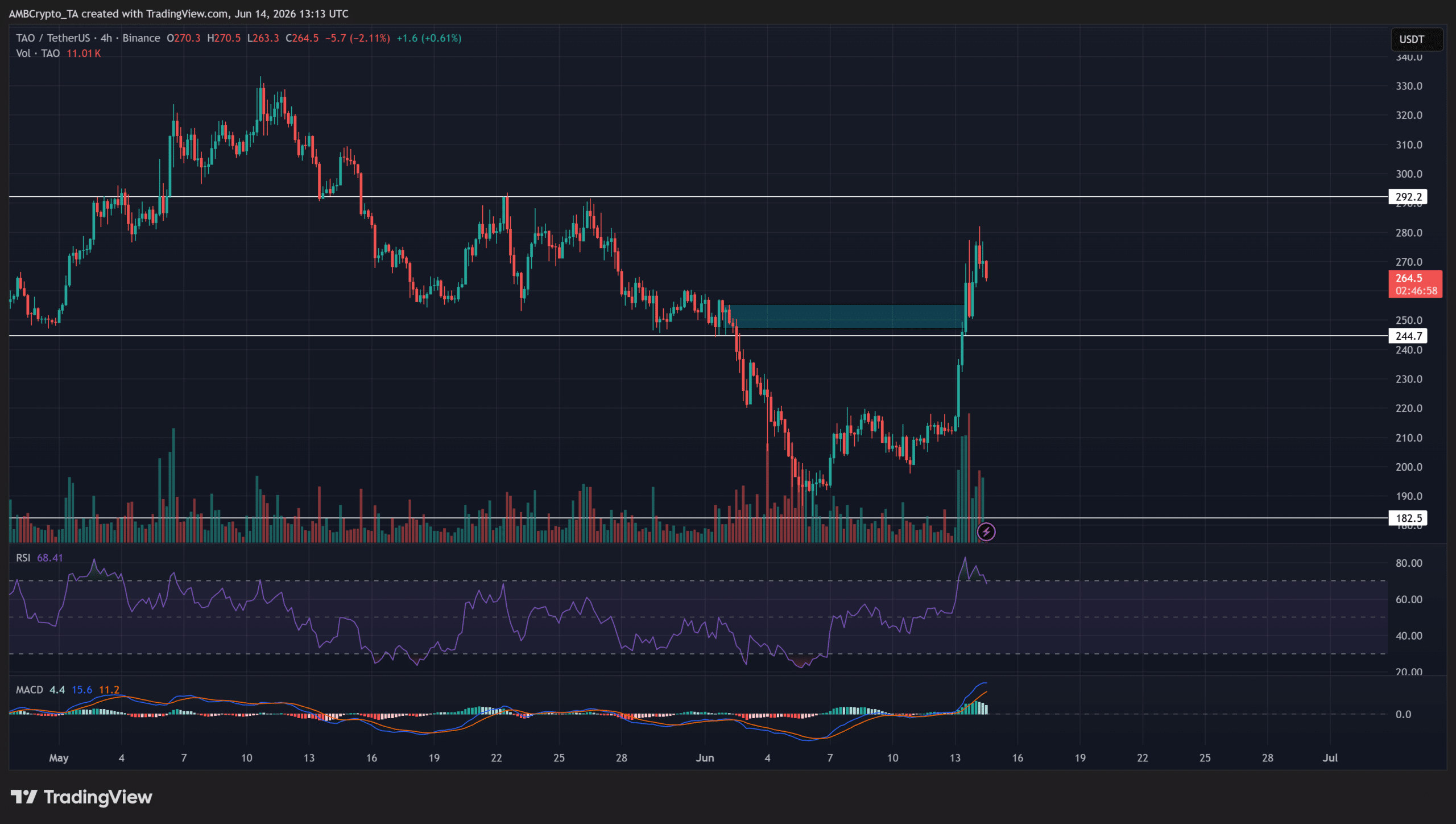
TAO’s sharp rebound has shifted attention toward whether buyers can maintain control above newly reclaimed levels. After rallying from the $182.5 liquidity sweep to $292.2, the price encountered resistance near a key May supply zone and began pulling back.
Source: TAO/USDT on TradingView

That reaction places the former $244.7-$255 consolidation range in focus. The area previously acted as resistance before the breakout and now serves as the market’s most important support zone.

Holding above it would preserve the recovery structure and keep $300 within reach. Losing it would expose TAO to a deeper retracement toward $210-$220 support.


Final Summary

  • Bittensor [TAO] reclaimed key resistance levels as rising volume and AI-driven demand strengthened the recovery structure.
  • TAO now faces a decisive $300 test, with support holding critical to preserving recent gains.

Trending Cryptos

Related Questions

QWhat was the main catalyst for Bittensor's (TAO) recent 28% price rally, according to the article?

AThe main catalyst was an announcement from Anthropic restricting access to its AI models (Fable 5 and Mythos 5) for foreign nationals. This highlighted a weakness in centralized AI systems and drove demand towards decentralized AI projects like Bittensor, fueling TAO's price surge.

QFrom which key support level did TAO's recovery begin, and to what level did it initially rally?

ATAO's recovery began near the key $180.9 support zone. Momentum then accelerated sharply, lifting the price from roughly $215 to $267.4 within two trading sessions.

QWhat is the critical support zone that TAO must hold to maintain its recovery structure and keep the $300 price target in reach?

AThe critical support zone is the former consolidation range of $244.7 to $255. This area previously acted as resistance before the breakout and is now the most important support zone. Holding above it is necessary to preserve the recovery structure.

QHow did technical indicators like RSI and volume behave during TAO's price breakout?

ADuring the breakout, the Relative Strength Index (RSI) climbed from below 40 to 59.2, indicating strengthening momentum. Volume also expanded aggressively, producing its strongest positive reading in nearly two months, reinforcing the strength of the move.

QWhat factor does the article suggest will determine the durability of TAO's rally beyond the initial headline impact?

AThe durability of the rally depends on whether demand for TAO continues after the initial impact of the Anthropic news headline fades. Sustained demand is needed to maintain the upward momentum.

Related Reads

Polymarket's Sixth Anniversary: Bathroom, Exile, and Homecoming

Polymarket, a prediction market platform, recently celebrated its sixth anniversary. Born during New York's COVID-19 lockdown, founder Shayne Coplan built the initial product from his bathroom. The platform allows users to trade on the outcomes of real-world events, aiming to aggregate information faster than traditional media or polls. Its early years involved navigating regulatory challenges, most notably a 2022 CFTC order and penalty for offering unregistered event contracts, which led to a ban on U.S. users. Despite this "exile," the platform persisted, gaining significant traction during major news events like the 2024 U.S. presidential election, where its markets often preceded mainstream narratives. A pivotal shift occurred in 2025. Following the conclusion of a DOJ/CFTC investigation, Polymarket strategically acquired a CFTC-regulated exchange (QCX) to re-enter the U.S. market legally. It secured a massive strategic investment from Intercontinental Exchange (ICE), NYSE's parent company, and formed high-profile partnerships with sports leagues like the NHL, UFC, and MLB, as well as media outlets including Google and the Wall Street Journal. Now valued in the tens of billions, Polymarket stands at the intersection of crypto, finance, media, and sports. Its journey reflects a constant tension between innovative information aggregation and regulatory scrutiny, evolving from a fringe crypto experiment into a mainstream, albeit still contested, financial and data infrastructure.

marsbit24m ago

Polymarket's Sixth Anniversary: Bathroom, Exile, and Homecoming

marsbit24m ago

The 'Side Hustle Survival' of DAT Companies: After the Accumulation Flywheel Stops, They Begin Self-Rescue

"Metaplanet's 'Side Hustle Survival': After the 'Crypto Hoarding Flywheel' Stops, They Begin Self-Rescue" The article discusses the strategic pivot of Digital Asset Treasury (DAT) companies as the once-lucrative model of hoarding cryptocurrencies, pioneered by MicroStrategy, faces challenges. With the crypto bear market and the rise of ETFs offering direct, low-premium exposure, many DAT firms are abandoning the passive treasury model. Prominent examples include ETHZilla, which sold ETH to repay debt and shifted to RWA tokenization, and others like Prenetics Global exiting completely. Facing stalled growth, remaining companies are pursuing two main survival paths. The first path is transforming into institutional crypto asset management platforms and yield funds. SharpLink Gaming exemplifies this by staking 100% of its ETH and partnering with Galaxy Digital to launch a yield fund. GameSquare is taking a more aggressive approach, using AI-driven algorithms across DeFi protocols to seek higher returns. The second path involves becoming blockchain infrastructure operators, particularly in the Solana ecosystem. Companies like DeFi Development and SOL Strategies are moving beyond holding SOL to operating validator networks and launching liquid staking tokens, building fee-based revenue models from ecosystem participation. The article notes these transitions reflect a broader industry maturation, shifting from financial engineering to building operational moats through technology, network effects, and deep ecosystem integration. However, risks remain, including DeFi protocol vulnerabilities and dependence on specific blockchain networks' health. Ultimately, this collective shift signals that in crypto, sustainable value comes not from capital games but from active participation, cash flow generation, and providing real utility—a necessary, if painful, step towards industry maturity.

marsbit25m ago

The 'Side Hustle Survival' of DAT Companies: After the Accumulation Flywheel Stops, They Begin Self-Rescue

marsbit25m ago

Annual Revenue of 13 Billion, Paying 17.2 Billion to Microsoft: The Truth Behind AI's Money-Burning in OpenAI's Leaked Ledger

Leaked OpenAI financial documents from June 2026 revealed that in 2025, the company achieved $13.07 billion in revenue, a 253% growth from 2024. However, this was accompanied by an operational loss of $20.92 billion and a net loss of roughly $8 billion. Despite ChatGPT surpassing 900 million weekly active users, the "burn rate" remained high: for every $1 earned, $1.60 was spent. The cost structure shows $34 billion in total costs. R&D was the largest expense at $19.18 billion, which included $10.59 billion paid to Microsoft. Compute costs for model inference were $7.5 billion, with sales and marketing at $5.73 billion. Notably, total payments to Microsoft reached $17.2 billion, accounting for over 50% of OpenAI's total costs and exceeding its annual revenue, highlighting a significant structural burden. This high-cost, high-loss model is an industry-wide trend. xAI reported a 2025 operational loss of $6.4 billion against $3.2 billion in revenue, spending $3 for every $1 earned. Anthropic, with a reported $90 billion annualized revenue by late 2025, also faced pressure with a 40% gross margin, lower than expected due to high inference costs. Combined, these top three firms' operational losses surpassed $30 billion in 2025. OpenAI's vast user base presents a monetization challenge. With only about 50 million of its 900 million weekly users paying (a ~5.6% conversion rate), the compute cost of serving free users is substantial. This contrasts with strategies like Anthropic's, which focuses on premium pricing for enterprise clients. The industry's path to profitability hinges on dramatically reducing marginal costs, particularly for inference, through innovations in specialized chips or model efficiency. Until then, massive capital inflows—like OpenAI's $122 billion funding round in March 2026—remain essential to fund the relentless pursuit of scale and advanced capabilities.

marsbit37m ago

Annual Revenue of 13 Billion, Paying 17.2 Billion to Microsoft: The Truth Behind AI's Money-Burning in OpenAI's Leaked Ledger

marsbit37m ago

Trading

Spot
Futures

Hot Articles

How to Buy GAIN

Welcome to HTX.com! We've made purchasing GriffinAI (GAIN) simple and convenient. Follow our step-by-step guide to embark on your crypto journey.Step 1: Create Your HTX AccountUse your email or phone number to sign up for a free account on HTX. Experience a hassle-free registration journey and unlock all features.Get My AccountStep 2: Go to Buy Crypto and Choose Your Payment MethodCredit/Debit Card: Use your Visa or Mastercard to buy GriffinAI (GAIN) instantly.Balance: Use funds from your HTX account balance to trade seamlessly.Third Parties: We've added popular payment methods such as Google Pay and Apple Pay to enhance convenience.P2P: Trade directly with other users on HTX.Over-the-Counter (OTC): We offer tailor-made services and competitive exchange rates for traders.Step 3: Store Your GriffinAI (GAIN)After purchasing your GriffinAI (GAIN), store it in your HTX account. Alternatively, you can send it elsewhere via blockchain transfer or use it to trade other cryptocurrencies.Step 4: Trade GriffinAI (GAIN)Easily trade GriffinAI (GAIN) on HTX's spot market. Simply access your account, select your trading pair, execute your trades, and monitor in real-time. We offer a user-friendly experience for both beginners and seasoned traders.

3.4k Total ViewsPublished 2025.09.24Updated 2026.06.02

How to Buy GAIN

Discussions

Welcome to the HTX Community. Here, you can stay informed about the latest platform developments and gain access to professional market insights. Users' opinions on the price of GAIN (GAIN) are presented below.

活动图片