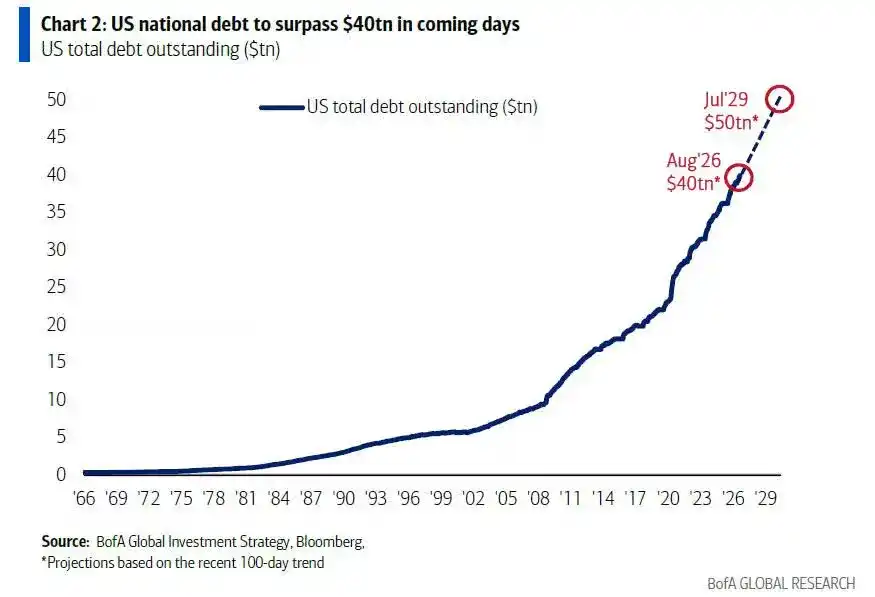
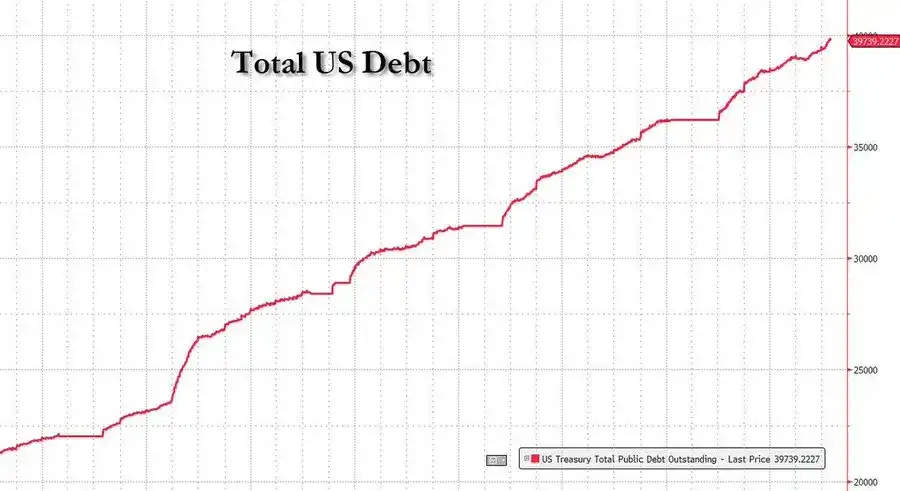
US Treasury debt is only $65 billion away from $40 trillion. As of last Friday's close, this 'largest integer milestone in history' is within reach. In his latest Flow Show report, titled "Strife Begins at Forty," Bank of America's chief investment strategist, Michael Hartnett, identifies this moment as the core narrative for the current market.
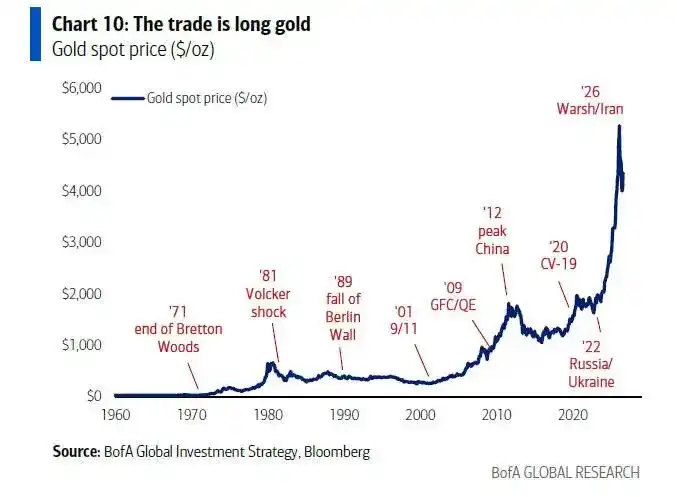
Hartnett points out that not only will US debt exceed $40 trillion in the coming days, but it is also on track to reach $50 trillion around 2029. In such an environment, Hartnett believes that going long on gold is the optimal solution now. Gold remains the best tool to hedge against dollar depreciation, bond collapse, and asset inflation.
Debt Interest Now the "Largest Expenditure," Bond Market Under Pressure
Over the past 12 months, US interest payments on debt have reached $1.4 trillion, nearing the point of surpassing Social Security as the federal government's largest single expenditure.
Hartnett clearly states that this trend will not reverse—unless the 5-year Treasury yield falls below 3.25%. This is almost impossible without a significant deflationary shock or recession.
Meanwhile, the 30-year Treasury was issued last week with a yield of 5.126%, a 25-year high. Hartnett summarizes this absurdity in one sentence: "The stock market hit an all-time high on the same day the Treasury issued debt at a 25-year high yield—that's reality."
AI Funding Frenzy Is "Crowding Out" Treasury Buyers
Pressure on the bond market isn't just from the government. Data from Nomura strategist Charlie McElligott shows:
Total corporate bond supply has surged 61% year-over-year.
The issuance scale of AI/hyperscale data center/data center-related bonds (investment-grade + loans) has reached approximately 12 times the average annual level of 2015-2024. Year-to-date, it has reached $269 billion, double that of all of 2025.
The flood of corporate bonds into the market is structurally steepening the US Treasury yield curve (bear steepening), crowding out funds that would otherwise buy long-term Treasuries. CTA trend strategies show an overall "short" signal for G10 bonds, with nominal positions at the 12th percentile since 2010 and short-term rate positions at the 10th percentile.
The result is a vicious cycle: credit spreads widen → long-duration buyers are crowded out → yield curve bear steepens → market concerns about "loss of control" intensify.
Asset Allocation Principles: Gold Is the Core Answer
In his report, Hartnett reiterates his key asset allocation frameworks for the 2020s and reinforces them for 2026:
ABB (Away From Bonds), ABD (Away From the Dollar), AI (All In on AI), etc.
These principles share a common underlying logic: policymakers view "nominal GDP prosperity" as the way out of the debt problem and consider the stock market "too big to fail." That's why, as Hartnett wrote last week: "Wall Street is trading without fear."
He summarizes the current market sentiment: "Massive EPS growth, $10 trillion in wealth added in 2026, AI capex over $1 trillion in 2027... The gate for bulls is wide open. The only constraints are bonds (yield spike), voters (socialist waves), and the fact that everyone is already positioned for the upside."
Going Long on Gold: The Optimal Solution Against Dollar Depreciation
Within the "ABD (Away From the Dollar)" framework, Hartnett provides a clear trading direction: go long on gold.
His logic is direct: gold remains the best hedging tool against dollar depreciation, bond collapse, asset inflation, and the political tug-of-war between capitalist populism and socialist populism in the 2020s.
The logic for a weaker dollar is equally clear. The US government has signaled through yen intervention—it does not want the 10-year Treasury yield to break above 5%. With mid-term elections approaching, CPI is expected to operate within the 2.8%-3.6% range, and core CPI within 2.1%-2.6%, leaving policymakers with limited tolerance for further yield increases.
Hartnett believes that the hawkish stance from Warsh at the Jackson Hole meeting on August 28th, combined with the potential Bank of Japan rate hike on September 18th, could jointly signal "mission accomplished," providing the basis for suppressing yields and ending yen depreciation risks.
Under the "Away From Bonds" Framework, Which Assets Are Quietly Outperforming?
Within the "ABB (Away From Bonds)" framework, Hartnett points out an interesting phenomenon: despite higher yields in 2026, long-duration, previously neglected assets—REITs, biotech (XBI), regional banks (KRE), and small-cap stocks—are quietly outperforming the broader market.
The market is "pricing in" a peak in yields through action. Hartnett believes that another significant spike in yields would be "too dangerous to be allowed" by authorities, which is why these assets are finding support.
The Other Side of the AI Trade: Short AI Bonds
Within the "All In on AI" framework, Hartnett offers a counter-intuitive trade: short AI bonds.
The logic: over $1 trillion in capital expenditure plus negative free cash flow means AI companies must continue large-scale bond issuance to finance themselves. This trade, first proposed by Hartnett at the end of 2025, he says, has been "far more profitable" in 2026 than going long AI stocks.
He believes the optimal bubble strategy is to simultaneously go long on "arrogance" (AI) and "humiliation" (neglected cyclical assets). Drawing a historical analogy: Emerging markets during the 1999 dot-com bubble, and oil during the 2007/08 subprime/China bubble, were beneficiaries of "humiliation assets" in the late stages of those bubbles.
Future Key Catalysts: Elections and Policy Are the Biggest Variables
Hartnett lists key market events for the coming months:
August 28: Warsh speaks at Jackson Hole
September 4: August Nonfarm Payrolls data
September 11: August CPI data
September 16: FOMC meeting (35% probability of a rate hike)
September 18: Bank of Japan meeting (74% probability of a rate hike)
September 24: Major US-China diplomatic event
October 4: Brazilian election
Hartnett's final judgment is clear: If Republicans retain the Senate and Abbott retains the Texas governorship, he expects the stock market (especially the AI sector) to surge further into bubble territory by 2027. If Democrats win the Senate and the Texas governorship on November 3rd, then stocks, the dollar, and bond yields will face a sharp decline of over 10% before year-end.