Wall Street Morning Report: S&P Earnings Growth Hits 30-Year High, Nvidia Becomes SpaceX's 6th Largest Shareholder

marsbitPublished on 2026-08-17Last updated on 2026-08-17

Abstract

Wall Street Morning Report: S&P 500 earnings growth hits a 30-year high; Nvidia becomes SpaceX's 6th largest shareholder. Market Summary: U.S. stocks ended slightly lower on Friday after record highs, with the S&P 500 posting a weekly gain. Weaker-than-expected July retail sales data significantly reduced market expectations for a September Fed rate hike. Key Themes: * **Macro & Rates:** The probability of the Fed holding rates steady in September rose to ~70%. Geopolitical tensions in the Middle East supported oil prices near $90. Focus this week is on a $16B 20-year Treasury auction testing investor demand amid high yields. * **Corporate Earnings:** S&P 500 Q2 earnings grew 31%, the fastest pace since 1992 excluding recession recoveries, driving a valuation reset. * **AI & Tech Sector Rotation:** The AI investment narrative faces scrutiny over financing and return timelines. Semiconductor stocks saw divergence: memory (SanDisk, Micron) and optical communication (Applied Optoelectronics) surged, while Broadcom fell sharply on credit rating downgrade concerns over AI leasing exposure. * **Notable Moves:** Nvidia disclosed a ~$21B stake in SpaceX. AMD rose 6.5% after a record debt issuance. Reddit rallied ahead of its S&P 500 inclusion. This Week's Highlights: * **Fed Minutes (Thu):** Key for gauging policy divergence and September rate outlook. * **Key Earnings:** Alibaba, Walmart, Nvidia, AMD. * **Events:** Seoul AI Summit, World Robot Conference, potential恒...

From Monday to Friday mornings, focusing on macroeconomics, U.S. stocks, AI, precious metals, crude oil, and more. PANews presents a market review with data and trend analysis for seizing opportunities.

Sharp Consumer Braking Weakens September Rate Hike Expectations; 20-Year Treasury Auction in Focus This Week
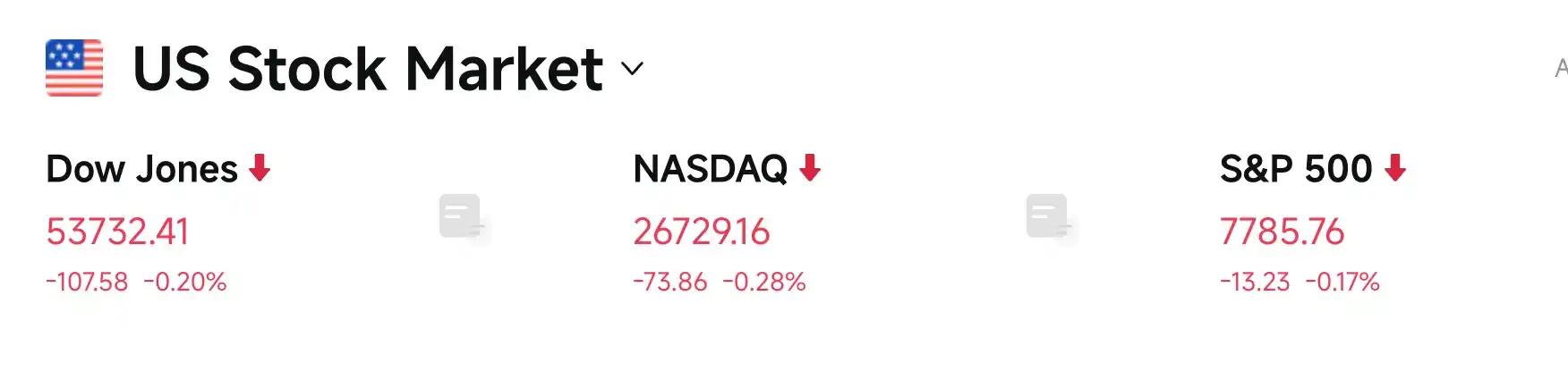
The three major U.S. stock indices closed slightly lower last Friday, with the Dow Jones down 0.2%, the S&P 500 down 0.17% (retreating from the previous day's record high), and the Nasdaq down 0.28%. For the week, the Dow fell 0.56%, the S&P gained 0.36%, the Nasdaq gained 0.14%, and the Russell 2000 gained 1.12%, also hitting a new closing record.
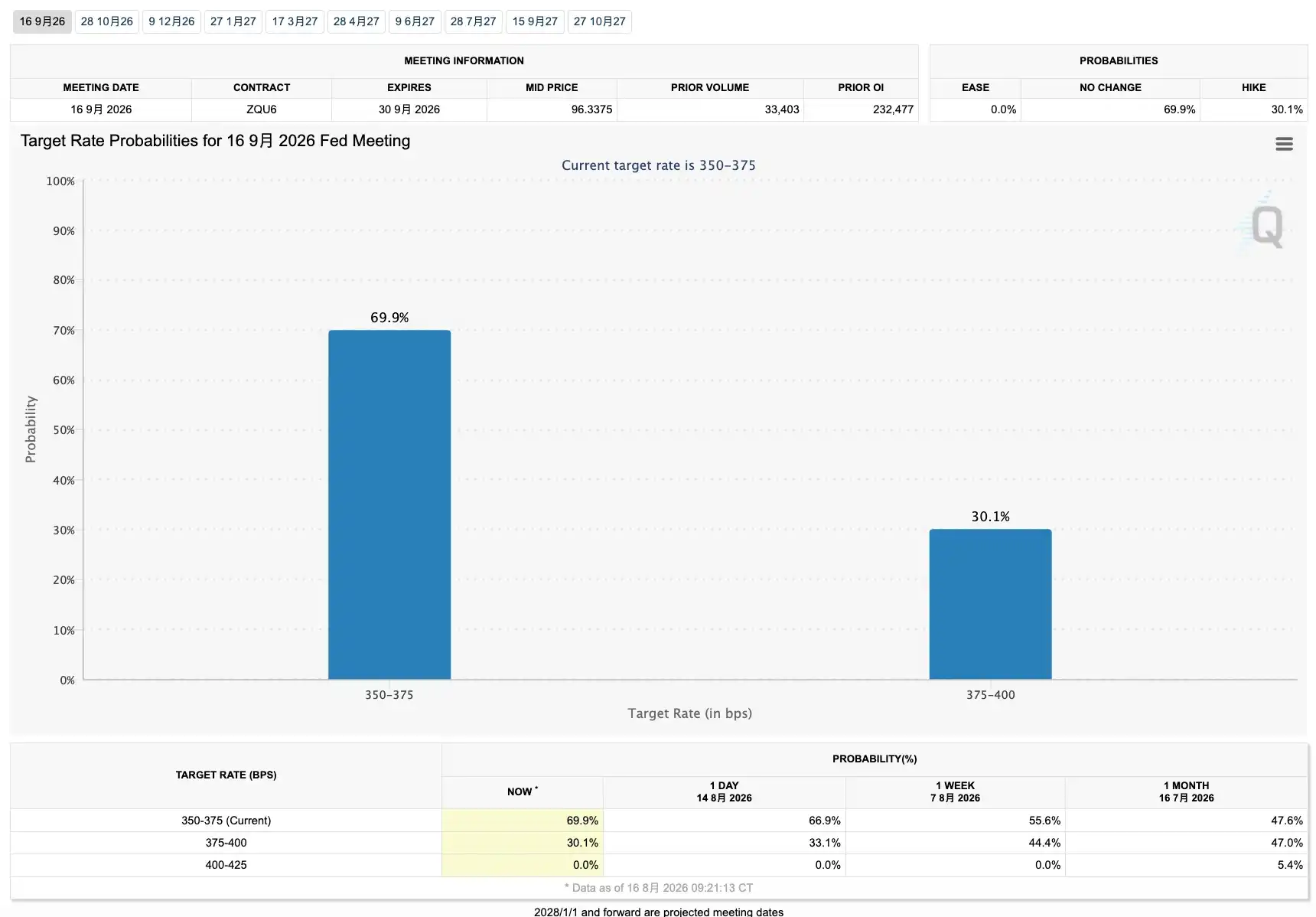
U.S. July retail sales unexpectedly fell 0.6% month-on-month, the largest drop in over a year, far worse than the expected slight increase; the control group sales fell 0.4%. Combined with the previously mild CPI and PPI, CME FedWatch shows a significant drop in market expectations for a September rate hike, with bets on holding steady rising to about 70%.

The market is beginning to believe the Fed's rate hikes are nearing an end but is unwilling to declare inflation dead. Fiscal supply and oil price premiums are still demanding higher term premiums. Collin Martin, Head of Fixed Income Strategy at Charles Schwab, pointed out that a single month's data does not constitute a trend, and a September hike is less likely but not completely ruled out. Tony Pasquariello, Head of Goldman Sachs' Hedge Fund Business, emphasized that massive deficits and AI capital expenditures under full employment remain powerful tailwinds.

Brent crude oil is approaching the $90 mark, up about 6% for the week; WTI is around $83. Ships were attacked again in the Strait of Hormuz, with traffic nearly stalled. The U.S. stated it could maintain a maritime blockade on Iran indefinitely. President Trump and Treasury Secretary Besant previewed "unprecedented" economic measures against Iran, jointly supporting geopolitical risk premiums. Although Middle Eastern oil producers still maintain relatively high export flows through covert shipments, supply chain uncertainty remains. Trump also directed the Department of Defense to "significantly reduce" the scale of U.S.-South Korea joint military exercises, calling them costly and sending inappropriate signals of hostility to North Korea, and mentioned South Korea's refusal to participate in promoting Iranian denuclearization. This statement increases volatility in the Asia-Pacific security narrative, but the South Korean stock market was closed for a holiday, delaying the reaction.

Short-term U.S. Treasuries benefited, with the 2-year yield falling near a one-month low; the 10-year yield closed around 4.68%, and the 30-year yield rose to a 19-year high near 5.25%. This week's 20-year U.S. Treasury auction will be an important stress test. The U.S. Treasury plans to issue $16 billion in 20-year Treasury bonds, with a pre-issuance yield of about 5.27%; if the final yield is close to this level, it will be the highest since this maturity was reintroduced in 2020. Additionally, ultra-long European bond yields hit multi-year highs, further reminding of discount rate pressure on global duration assets. The yields on 30-year German and French bonds rose to 2011 highs, with inflation expectations, fiscal deficits, and supply issues amplified by thin summer liquidity.

Storage and Optical Communication Surge; AI Financing Narrative Faces Credit Repricing

S&P 500 index second-quarter earnings grew 31% year-on-year, significantly exceeding Wall Street's previous expectation of 23%, marking the strongest earnings growth rate since 1992, excluding recession recovery periods. Keith Lerner, Chief Strategist at Truist, stated that earnings growth has pushed the S&P 500's P/E ratio down from about 26x at the start of the year to below 22x, achieving a healthier valuation reset. Ned Davis analyst Ed Clissold pointed out that the outperformance of small- and mid-cap stocks indicates growth is spreading from tech giants to broader sectors.

The sustainability of AI capital expenditures is being re-examined. Goldman Sachs expects global AI data center capital expenditures to potentially reach $1 trillion by 2026, while Bank of America sees a path to $1.2 trillion by 2027. However, bottlenecks in power, chips, construction, regulation, and financing raise concerns. Maria Llerena, Research Director at Domini Impact Investments, warned that if the 10-year Treasury yield rises to 5%, it would challenge tech valuations; Keith Lerner believes the real risk lies in a rapid surge in yields and delayed returns on AI investments.

Last Friday, semiconductors saw sharp internal divergence. Storage concepts surged across the board: SanDisk jumped over 7%, up over 35% for the week; Seagate, Western Digital, and Micron followed. In optical communications, Applied Optoelectronics soared over 15%, with Lumentum and Corning also strong. AMD rose 6.5%, benefiting from a record investment-grade bond issuance and analysts raising expectations for the server CPU market.

Meanwhile, Broadcom fell nearly 6%, Applied Materials dropped over 5%, with KLA and Intel also under pressure. Market concerns shifted from "peak demand" to "seller financing guarantee exposure." Bank of America credit analysts downgraded Broadcom's bonds, estimating its AI compute leasing-related residual value guarantees could accumulate massive exposure in extreme scenarios.

The "Magnificent Seven" were mixed: Tesla and Apple rose slightly, Amazon, Meta, and Microsoft retreated modestly, and Nvidia was almost flat. Nvidia disclosed for the first time that it holds approximately $21 billion worth of SpaceX shares, becoming the latter's sixth-largest shareholder, while also holding about $30 billion in Intel shares. Tiger Global's Q2 13F filing showed a clear pattern of "reducing mega-caps, adding new players": selling Alphabet, Broadcom, etc., and establishing new positions in Cerebras, AMD, Seagate, and Visa, while increasing holdings in Intel.

Anthropic's CEO published a rare blog post over the weekend, emphasizing that AI must win trust by delivering on promises with verifiable scientific breakthroughs (like cancer treatment), not grand narratives. Meanwhile, data center demand is spilling over into power generation and energy storage equipment, with Caterpillar, Cummins, Eaton, etc., expanding capacity, and Ford shifting some battery production to energy storage. Goldman Sachs estimates the global space economy will reach $1.8 trillion by 2035, with launch costs falling 95% within a generation; SpaceX and others have become institutional asset classes.

Specific Company Actions and Stock Price Movements:
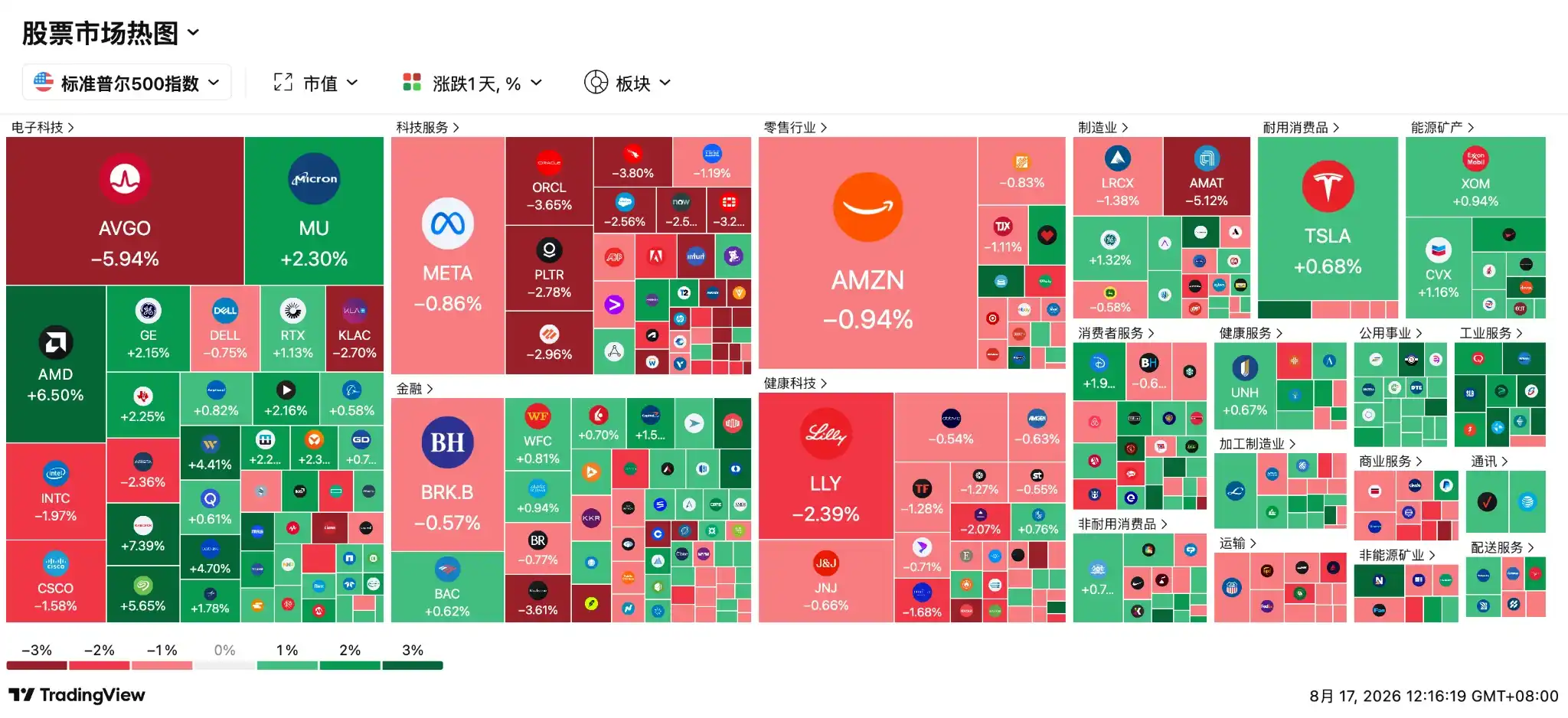
  • SanDisk up 7.39%, up over 35% for the week: JPMorgan upgraded it to Overweight. The company's Investor Day provided long-term targets of mid-to-high double-digit revenue growth and 80% gross margin, igniting narratives of storage shortages and HBM acyclicality. Micron up 2.3% (New Street Research upgraded Micron to "Buy," significantly raising the target price to $1,250, optimistic about AI's structural reshaping of HBM and DRAM capacity, expecting Micron's market cap to potentially reach $2-3 trillion by 2030.) Related sectors: Seagate up 5.65%, Western Digital up 4.41%.

  • Broadcom down 5.94%: Cumulatively down over 20% from June highs, mainly due to Bank of America downgrading its bonds. The market is extremely concerned about its residual value guarantee exposure for AI compute leasing, which could reach $370 billion by 2029, with potential default risks being repriced by the bond market. Related sectors: Applied Materials down 5.12% (earnings beat expectations but fell short of overly high ones), KLA down about 2.7%, Philadelphia Semiconductor Index down 0.31%.

  • Drone stocks collectively strong: The White House announced the U.S. will impose tariffs on imported drones and components, boosting local drone supply chains. Unusual Machines surged 25.04%, Red Cat Holdings up 8.8%, Draganfly up 5.84%.

  • Applied Optoelectronics surged 15.53%, benefiting from strong data center optical module demand and compute network upgrades. Related optical communication sectors: Lumentum up 5.19%, Corning up 4.70%, Credo Technology down 2.29%, Marvell Technology slightly down 0.07%.

  • Nvidia slightly down 0.06%, SpaceX slightly down 0.91%: Nvidia disclosed for the first time that it holds nearly $21 billion in SpaceX stock, becoming its sixth-largest shareholder. Meanwhile, due to investor concerns about risk exposure, the financial guarantee scale for the Nvidia-OpenAI 5 GW data center project in Ohio was slashed from $250 billion to below $120 billion. Nvidia also formed a $500 billion compute financing platform with financial giants like Blackstone and Apollo to move risk off its balance sheet. Trump advisor David Sacks warned that excessive expansion of GPU securitization could lead to risks similar to "dark fiber," i.e., "dark GPU" risks.

  • AMD up 6.5%, completing a record $4.75 billion bond issuance: Bank of America analysts raised their 2030 server CPU market size expectation to $210 billion and named AMD a top pick; Tiger Global established a $390 million position in AMD in Q2.

  • Oracle closed down 3.70%. Pipeline operator Energy Transfer disclosed that the "Green Chile" natural gas pipeline, supplying Oracle's Project Jupiter (a key node for Stargate) $165 billion AI data center, is delayed by six months to February 2027 due to land permit issues.

  • Nebius up 8.88%, up 47.73% for the week: Wedbush reiterated its optimistic view of benefiting from AI data center price increases, and Citi raised its target price from $278 to $324. The market views Nebius as a high-beta play on AI compute leasing and new cloud infrastructure.

  • Reddit up about 12.63%, confirmed to join the S&P 500 before the market opens on August 18th, driven by passive fund buying.

Focus for This Week:

August 17th (Monday)

  • 08:00 South Korean Market Holiday: Supplemental holiday for Liberation Day. The South Korean market is closed. Short-term liquidity in the Asia-Pacific semiconductor chain decreases; sentiment reactions for Samsung Electronics, SK Hynix, etc., will be delayed until Tuesday.

  • Central Bank Overnight Reverse Repo Operations August 17-19: Daily operations up to 600 billion yuan, using fixed-rate, quantity bidding. If liquidity injection increases significantly, it will ease funding pressure and support bonds, interbank rates, and high-dividend assets.

August 18th (Tuesday)

  • Reddit Officially Added to S&P 500 Index: Index fund passive buying may continue to support RDDT short-term performance, but focus will shift to fundamentals post-inclusion, especially advertising growth, AI data licensing revenue, and user activity.

  • Xiaomi Corp. (19:30 call), Baidu (20:00 call), China Unicom, GigaDevice earnings: For Xiaomi, focus on smartphone premiumization, auto business gross margin, delivery pace, and AI investment. For Baidu, focus on AI Cloud, ERNIE commercialization, search advertising recovery, and autonomous driving progress. GigaDevice will test domestic memory cycle and MCU demand. China Unicom will be watched for cloud-network integration, compute network, and dividend stability.

August 19th (Wednesday)

  • U.S. Tariffs on Some Canadian Products: The White House announced on July 20th it would impose an additional 50% tariff on some Canadian dairy, alcohol, apparel, and furniture products, citing Canada's "discriminatory measures" in auto trade with the U.S.

  • Seoul AI Summit August 19-21: Tech leaders from Google DeepMind, Google Cloud, Microsoft Research, Nvidia, LG AI Research, Hyundai Motor, etc., will attend. Market attention on new partnerships in large models, AI cloud, autonomous driving, AI chips, and enterprise applications; related signals may catalyze global AI software, cloud computing, chip, and robotics chains.

  • World Robot Conference August 19-23 in Beijing: Humanoid and industrial robot solutions from companies like Unitree, Ubtech, SIASUN, Galaxy General, and Tiangang will be showcased. If mass production progress, order wins, or cost reductions exceed expectations, A-share robotics chain components (reducers, servos, motors, sensors, controllers) and OEMs may see sentiment-driven rallies.

  • HKEX, Kuaishou (19:00 call), Hengrui Medicine, ZTO Express, Kingsoft Software, Kingsoft Cloud, Weibo earnings: For Kuaishou, focus on e-commerce GMV, advertising recovery, profit margins, and AI video tools. For HKEX, watch trading volume, IPO pipeline, and derivatives business. Hengrui Medicine validates innovative drug overseas expansion and R&D delivery. Kingsoft Cloud serves as an observation point for elasticity in Chinese concept stock AI cloud demand.

August 20th (Thursday)

  • 02:00 Fed July FOMC Meeting Minutes: The July meeting saw three dissenting votes to maintain rates, the largest split since 2016. If the minutes show hawkish strength is concentrated among a few officials, expectations for a September pause will solidify further, potentially leading to lower U.S. Treasury yields and a weaker dollar, benefiting gold, the Nasdaq, and high-valuation growth stocks. If more officials were close to supporting a hike, the market will reprice tightening risks, pressuring AI/tech valuations.

  • 09:00 China One-Year Loan Prime Rate (LPR) Announcement: If earlier July economic data was weak, whether the LPR is cut will be a test of policy stance. A rate cut would benefit the property chain, consumption, Hong Kong internet stocks, and high-dividend assets. If unchanged, the market may shift to waiting for RRR cuts, fiscal expansion, or further property policy easing.

  • 20:30 U.S. Initial Jobless Claims: Employment data will influence Fed pricing alongside the previously weak non-farm payrolls. If claims rise, it will strengthen expectations for economic cooling and a September pause; if employment remains strong, confidence in "holding steady" may decline.

  • Alibaba (20:00 call), Pop Mart, NetEase, Walmart, Ping An of China, China Telecom, AIA, Li Ning, Futu Holdings earnings: Alibaba is the top focus among Chinese concept stocks; the market watches e-commerce GMV, Cloud Intelligence revenue, AI investment, and Tongyi Qianwen commercialization. For Pop Mart, focus on IP overseas expansion, store expansion, and gross margin. NetEase validates game revenue and AI tools. Walmart is a core barometer of U.S. consumer resilience.

August 21st (Friday)

  • 07:30 Japan July Core CPI: If inflation exceeds expectations, expectations for a September Bank of Japan rate hike will rise, potentially causing volatility in the yen and global yield curves. If inflation moderates, it will ease pressure from global carry trade unwinding and reduce upward pressure on global long-term rates.

  • 08:00 South Korea August 1-20 Export Data: The previous reading showed a year-on-year surge of 52.3%, mainly driven by storage price increases and AI chip exports. This data is a leading indicator for the global semiconductor cycle and AI capex sustainability, directly impacting sentiment for Samsung, SK Hynix, Micron, TSMC, AMD, Nvidia, and A-share semiconductor chains.

  • Q2 Hang Seng Index Series Review Results Announcement: CICC predicts Zijin Gold International, Zhipu AI, MINIMAX-W, etc., are top candidates for potential inclusion. If inclusion expectations materialize, it will bring passive fund allocation and short-term liquidity catalysts. If expectations are dashed, related stocks may see profit-taking pressure.

  • NYMEX WTI Crude Oil September Contract Rollover: Amid Hormuz risks and U.S. sanctions expectations on Iran, the rollover could amplify near-month contract volatility. If the spot premium widens, it indicates tight physical supply. If the spread narrows, upward momentum for oil prices may weaken.

  • ZTE, Zijin Mining, InnoLight, Changfei Fiber, KE Holdings, Sinopec earnings: InnoLight and Changfei Fiber will validate AI optical module and fiber demand. ZTE is watched for compute network and carrier capex. Zijin Mining is driven by gold and copper prices. KE Holdings reflects recovery in China's property transaction chain. Sinopec is directly impacted by oil prices and refining spreads.

August 22nd (Saturday)

  • 2nd World Humanoid Robot Sports Games August 22-26: New events like robot tug-of-war, pitching arrows, and weightlifting will showcase humanoid robots' motion control, stability, endurance, and scenario adaptability. If on-site performance exceeds expectations, theme-driven capital may continue chasing robotics OEMs, reducers, servo systems, sensors, and AI control algorithms.

Trending Cryptos

Related Questions

QAccording to the article, what is the year-over-year profit growth rate of the S&P 500 in Q2, and how does it compare to recent history?

AThe S&P 500's year-over-year profit growth in the second quarter was 31%. This significantly exceeded Wall Street's prior expectation of 23% and represents the strongest profit growth pace since 1992 when excluding periods of recession recovery.

QWhat key investment did NVIDIA disclose, making it a major shareholder in a private company?

ANVIDIA disclosed for the first time that it holds approximately $21 billion worth of shares in SpaceX, making it the sixth-largest shareholder of the private space company.

QWhat specific event is putting the AI financing narrative under scrutiny, particularly for Broadcom?

AThe AI financing narrative is facing scrutiny over 'seller financing guarantee exposure.' Specifically, Bank of America credit analysts downgraded Broadcom's bond rating due to concerns about the massive potential exposure—estimated at up to $370 billion by 2029—from its residual value guarantees for AI computing power leases.

QBased on the retail sales data and market reaction, what is the current market expectation for the Federal Reserve's September interest rate decision?

AFollowing the unexpectedly weak U.S. July retail sales data, combined with prior mild CPI and PPI reports, market expectations for a September Fed rate hike have significantly diminished. The CME FedWatch tool indicates that bets on the Fed holding rates steady have risen to approximately 70%.

QWhich semiconductor sectors showed strong performance last Friday, and which specific company's investor day triggered a rally in memory stocks?

AMemory and optical communication semiconductor sectors showed strong performance. SanDisk's stock surged over 7% (and over 35% for the week), leading the rally in memory stocks like Seagate, Western Digital, and Micron. This was triggered by SanDisk's investor day, where the company presented long-term targets for mid-to-high double-digit revenue growth and 80% gross margins, igniting narratives about memory shortages and the anti-cyclical nature of HBM.

Related Reads

Novig Sues Wisconsin as Sports Prediction Market Dispute Heats Up

Novig, a sports event prediction market operator, has filed a lawsuit against Wisconsin's attorney general. The legal dispute centers on whether prediction markets fall under federal derivatives regulations or state gambling laws. The lawsuit, filed in a U.S. district court, seeks a declaratory judgment after Novig began offering event contracts to Wisconsin residents. This case is part of a broader conflict. In April, Wisconsin sued other prediction market platforms like Kalshi and Polymarket, alleging their sports-related contracts violate state gambling laws. Novig argues its contracts are "swaps" regulated exclusively by the federal Commodity Futures Trading Commission (CFTC), under the Commodity Exchange Act. Wisconsin contends they are sports betting. Federal courts have issued conflicting rulings on similar cases, creating legal uncertainty. The outcome is significant as prediction markets are a fast-growing sector, with trading volume reaching $9.5 billion on a single day in August. These markets are also increasingly intertwined with cryptocurrency infrastructure. Simultaneously, Novig is pursuing a nationwide legal strategy, having filed similar lawsuits in four other states. The company also recently secured a marketing partnership with the New York Mets, marking the first such deal with an MLB team. The Wisconsin case's resolution will influence whether prediction markets can operate as national financial products or remain constrained by individual state laws.

cryptonews.ru4m ago

Novig Sues Wisconsin as Sports Prediction Market Dispute Heats Up

cryptonews.ru4m ago

Держатели XRP могут торговать опционами на платформе Derive, используя FXRP в качестве залога

XRP holders can now trade options on the Derive platform using FXRP as collateral, as announced by Flare on August 12. This integration allows users to open positions from self-custody wallets while the underlying XRP backing the FXRP remains on the XRP Ledger. According to DeFi analyst Will Procheska, this provides XRP's dedicated holder base with a permissionless options market for generating yield or hedging. Derive's platform combines protocol-level settlements with an order book managed by Derive Trading Co., enabling users to retain asset control while professional market-makers provide liquidity. XRP options on Derive are cash-settled in USDC, so profits or obligations adjust the trader's USDC balance without transferring XRP or FXRP. The platform's portfolio margin system assesses overall account risk but may still trigger liquidations if margin levels fall below requirements. The launch expands Flare's XRPFi ecosystem. FXRP, introduced via the FAssets system in September 2025, creates an on-chain representation of XRP for use in smart contracts. It has since been integrated into spot trading and, more recently, permissionless lending markets on Morpho. This addition of options on Derive offers XRP holders hedging and premium-earning capabilities comparable to other major assets. While regulated XRP options debuted on CME Group in October 2025, Derive provides a decentralized alternative with USDC settlement and direct wallet access. The platform also supports perpetual futures, offering further trading strategies. Flare and Derive are exploring automated "strategy vaults" to simplify yield-generating options approaches for users.

cryptonews.ru4m ago

Держатели XRP могут торговать опционами на платформе Derive, используя FXRP в качестве залога

cryptonews.ru4m ago

Trading

Spot

Hot Articles

What is SONIC

Sonic: Pioneering the Future of Gaming in Web3 Introduction to Sonic In the ever-evolving landscape of Web3, the gaming industry stands out as one of the most dynamic and promising sectors. At the forefront of this revolution is Sonic, a project designed to amplify the gaming ecosystem on the Solana blockchain. Leveraging cutting-edge technology, Sonic aims to deliver an unparalleled gaming experience by efficiently processing millions of requests per second, ensuring that players enjoy seamless gameplay while maintaining low transaction costs. This article delves into the intricate details of Sonic, exploring its creators, funding sources, operational mechanics, and the timeline of significant events that have shaped its journey. What is Sonic? Sonic is an innovative layer-2 network that operates atop the Solana blockchain, specifically tailored to enhance the existing Solana gaming ecosystem. It accomplishes this through a customised, VM-agnostic game engine paired with a HyperGrid interpreter, facilitating sovereign game economies that roll up back to the Solana platform. The primary goals of Sonic include: Enhanced Gaming Experiences: Sonic is committed to offering lightning-fast on-chain gameplay, allowing players and developers to engage with games at previously unattainable speeds. Atomic Interoperability: This feature enables transactions to be executed within Sonic without the need to redeploy Solana programmes and accounts. This makes the process more efficient and directly benefits from Solana Layer1 services and liquidity. Seamless Deployment: Sonic allows developers to write for Ethereum Virtual Machine (EVM) based systems and execute them on Solana’s SVM infrastructure. This interoperability is crucial for attracting a broader range of dApps and decentralised applications to the platform. Support for Developers: By offering native composable gaming primitives and extensible data types - dining within the Entity-Component-System (ECS) framework - game creators can craft intricate business logic with ease. Overall, Sonic's unique approach not only caters to players but also provides an accessible and low-cost environment for developers to innovate and thrive. Creator of Sonic The information regarding the creator of Sonic is somewhat ambiguous. However, it is known that Sonic's SVM is owned by the company Mirror World. The absence of detailed information about the individuals behind Sonic reflects a common trend in several Web3 projects, where collective efforts and partnerships often overshadow individual contributions. Investors of Sonic Sonic has garnered considerable attention and support from various investors within the crypto and gaming sectors. Notably, the project raised an impressive $12 million during its Series A funding round. The round was led by BITKRAFT Ventures, with other notable investors including Galaxy, Okx Ventures, Interactive, Big Brain Holdings, and Mirana. This financial backing signifies the confidence that investment foundations have in Sonic’s potential to revolutionise the Web3 gaming landscape, further validating its innovative approaches and technologies. How Does Sonic Work? Sonic utilises the HyperGrid framework, a sophisticated parallel processing mechanism that enhances its scalability and customisability. Here are the core features that set Sonic apart: Lightning Speed at Low Costs: Sonic offers one of the fastest on-chain gaming experiences compared to other Layer-1 solutions, powered by the scalability of Solana’s virtual machine (SVM). Atomic Interoperability: Sonic enables transaction execution without redeployment of Solana programmes and accounts, effectively streamlining the interaction between users and the blockchain. EVM Compatibility: Developers can effortlessly migrate decentralised applications from EVM chains to the Solana environment using Sonic’s HyperGrid interpreter, increasing the accessibility and integration of various dApps. Ecosystem Support for Developers: By exposing native composable gaming primitives, Sonic facilitates a sandbox-like environment where developers can experiment and implement business logic, greatly enhancing the overall development experience. Monetisation Infrastructure: Sonic natively supports growth and monetisation efforts, providing frameworks for traffic generation, payments, and settlements, thereby ensuring that gaming projects are not only viable but also sustainable financially. Timeline of Sonic The evolution of Sonic has been marked by several key milestones. Below is a brief timeline highlighting critical events in the project's history: 2022: The Sonic cryptocurrency was officially launched, marking the beginning of its journey in the Web3 gaming arena. 2024: June: Sonic SVM successfully raised $12 million in a Series A funding round. This investment allowed Sonic to further develop its platform and expand its offerings. August: The launch of the Sonic Odyssey testnet provided users with the first opportunity to engage with the platform, offering interactive activities such as collecting rings—a nod to gaming nostalgia. October: SonicX, an innovative crypto game integrated with Solana, made its debut on TikTok, capturing the attention of over 120,000 users within a short span. This integration illustrated Sonic’s commitment to reaching a broader, global audience and showcased the potential of blockchain gaming. Key Points Sonic SVM is a revolutionary layer-2 network on Solana explicitly designed to enhance the GameFi landscape, demonstrating great potential for future development. HyperGrid Framework empowers Sonic by introducing horizontal scaling capabilities, ensuring that the network can handle the demands of Web3 gaming. Integration with Social Platforms: The successful launch of SonicX on TikTok displays Sonic’s strategy to leverage social media platforms to engage users, exponentially increasing the exposure and reach of its projects. Investment Confidence: The substantial funding from BITKRAFT Ventures, among others, emphasizes the robust backing Sonic has, paving the way for its ambitious future. In conclusion, Sonic encapsulates the essence of Web3 gaming innovation, striking a balance between cutting-edge technology, developer-centric tools, and community engagement. As the project continues to evolve, it is poised to redefine the gaming landscape, making it a notable entity for gamers and developers alike. As Sonic moves forward, it will undoubtedly attract greater interest and participation, solidifying its place within the broader narrative of blockchain gaming.

2.4k Total ViewsPublished 2024.04.04Updated 2024.12.03

What is SONIC

What is $S$

Understanding SPERO: A Comprehensive Overview Introduction to SPERO As the landscape of innovation continues to evolve, the emergence of web3 technologies and cryptocurrency projects plays a pivotal role in shaping the digital future. One project that has garnered attention in this dynamic field is SPERO, denoted as SPERO,$$s$. This article aims to gather and present detailed information about SPERO, to help enthusiasts and investors understand its foundations, objectives, and innovations within the web3 and crypto domains. What is SPERO,$$s$? SPERO,$$s$ is a unique project within the crypto space that seeks to leverage the principles of decentralisation and blockchain technology to create an ecosystem that promotes engagement, utility, and financial inclusion. The project is tailored to facilitate peer-to-peer interactions in new ways, providing users with innovative financial solutions and services. At its core, SPERO,$$s$ aims to empower individuals by providing tools and platforms that enhance user experience in the cryptocurrency space. This includes enabling more flexible transaction methods, fostering community-driven initiatives, and creating pathways for financial opportunities through decentralised applications (dApps). The underlying vision of SPERO,$$s$ revolves around inclusiveness, aiming to bridge gaps within traditional finance while harnessing the benefits of blockchain technology. Who is the Creator of SPERO,$$s$? The identity of the creator of SPERO,$$s$ remains somewhat obscure, as there are limited publicly available resources providing detailed background information on its founder(s). This lack of transparency can stem from the project's commitment to decentralisation—an ethos that many web3 projects share, prioritising collective contributions over individual recognition. By centring discussions around the community and its collective goals, SPERO,$$s$ embodies the essence of empowerment without singling out specific individuals. As such, understanding the ethos and mission of SPERO remains more important than identifying a singular creator. Who are the Investors of SPERO,$$s$? SPERO,$$s$ is supported by a diverse array of investors ranging from venture capitalists to angel investors dedicated to fostering innovation in the crypto sector. The focus of these investors generally aligns with SPERO's mission—prioritising projects that promise societal technological advancement, financial inclusivity, and decentralised governance. These investor foundations are typically interested in projects that not only offer innovative products but also contribute positively to the blockchain community and its ecosystems. The backing from these investors reinforces SPERO,$$s$ as a noteworthy contender in the rapidly evolving domain of crypto projects. How Does SPERO,$$s$ Work? SPERO,$$s$ employs a multi-faceted framework that distinguishes it from conventional cryptocurrency projects. Here are some of the key features that underline its uniqueness and innovation: Decentralised Governance: SPERO,$$s$ integrates decentralised governance models, empowering users to participate actively in decision-making processes regarding the project’s future. This approach fosters a sense of ownership and accountability among community members. Token Utility: SPERO,$$s$ utilises its own cryptocurrency token, designed to serve various functions within the ecosystem. These tokens enable transactions, rewards, and the facilitation of services offered on the platform, enhancing overall engagement and utility. Layered Architecture: The technical architecture of SPERO,$$s$ supports modularity and scalability, allowing for seamless integration of additional features and applications as the project evolves. This adaptability is paramount for sustaining relevance in the ever-changing crypto landscape. Community Engagement: The project emphasises community-driven initiatives, employing mechanisms that incentivise collaboration and feedback. By nurturing a strong community, SPERO,$$s$ can better address user needs and adapt to market trends. Focus on Inclusion: By offering low transaction fees and user-friendly interfaces, SPERO,$$s$ aims to attract a diverse user base, including individuals who may not previously have engaged in the crypto space. This commitment to inclusion aligns with its overarching mission of empowerment through accessibility. Timeline of SPERO,$$s$ Understanding a project's history provides crucial insights into its development trajectory and milestones. Below is a suggested timeline mapping significant events in the evolution of SPERO,$$s$: Conceptualisation and Ideation Phase: The initial ideas forming the basis of SPERO,$$s$ were conceived, aligning closely with the principles of decentralisation and community focus within the blockchain industry. Launch of Project Whitepaper: Following the conceptual phase, a comprehensive whitepaper detailing the vision, goals, and technological infrastructure of SPERO,$$s$ was released to garner community interest and feedback. Community Building and Early Engagements: Active outreach efforts were made to build a community of early adopters and potential investors, facilitating discussions around the project’s goals and garnering support. Token Generation Event: SPERO,$$s$ conducted a token generation event (TGE) to distribute its native tokens to early supporters and establish initial liquidity within the ecosystem. Launch of Initial dApp: The first decentralised application (dApp) associated with SPERO,$$s$ went live, allowing users to engage with the platform's core functionalities. Ongoing Development and Partnerships: Continuous updates and enhancements to the project's offerings, including strategic partnerships with other players in the blockchain space, have shaped SPERO,$$s$ into a competitive and evolving player in the crypto market. Conclusion SPERO,$$s$ stands as a testament to the potential of web3 and cryptocurrency to revolutionise financial systems and empower individuals. With a commitment to decentralised governance, community engagement, and innovatively designed functionalities, it paves the way toward a more inclusive financial landscape. As with any investment in the rapidly evolving crypto space, potential investors and users are encouraged to research thoroughly and engage thoughtfully with the ongoing developments within SPERO,$$s$. The project showcases the innovative spirit of the crypto industry, inviting further exploration into its myriad possibilities. While the journey of SPERO,$$s$ is still unfolding, its foundational principles may indeed influence the future of how we interact with technology, finance, and each other in interconnected digital ecosystems.

407 Total ViewsPublished 2024.12.17Updated 2024.12.17

What is $S$

What is AGENT S

Agent S: The Future of Autonomous Interaction in Web3 Introduction In the ever-evolving landscape of Web3 and cryptocurrency, innovations are constantly redefining how individuals interact with digital platforms. One such pioneering project, Agent S, promises to revolutionise human-computer interaction through its open agentic framework. By paving the way for autonomous interactions, Agent S aims to simplify complex tasks, offering transformative applications in artificial intelligence (AI). This detailed exploration will delve into the project's intricacies, its unique features, and the implications for the cryptocurrency domain. What is Agent S? Agent S stands as a groundbreaking open agentic framework, specifically designed to tackle three fundamental challenges in the automation of computer tasks: Acquiring Domain-Specific Knowledge: The framework intelligently learns from various external knowledge sources and internal experiences. This dual approach empowers it to build a rich repository of domain-specific knowledge, enhancing its performance in task execution. Planning Over Long Task Horizons: Agent S employs experience-augmented hierarchical planning, a strategic approach that facilitates efficient breakdown and execution of intricate tasks. This feature significantly enhances its ability to manage multiple subtasks efficiently and effectively. Handling Dynamic, Non-Uniform Interfaces: The project introduces the Agent-Computer Interface (ACI), an innovative solution that enhances the interaction between agents and users. Utilizing Multimodal Large Language Models (MLLMs), Agent S can navigate and manipulate diverse graphical user interfaces seamlessly. Through these pioneering features, Agent S provides a robust framework that addresses the complexities involved in automating human interaction with machines, setting the stage for myriad applications in AI and beyond. Who is the Creator of Agent S? While the concept of Agent S is fundamentally innovative, specific information about its creator remains elusive. The creator is currently unknown, which highlights either the nascent stage of the project or the strategic choice to keep founding members under wraps. Regardless of anonymity, the focus remains on the framework's capabilities and potential. Who are the Investors of Agent S? As Agent S is relatively new in the cryptographic ecosystem, detailed information regarding its investors and financial backers is not explicitly documented. The lack of publicly available insights into the investment foundations or organisations supporting the project raises questions about its funding structure and development roadmap. Understanding the backing is crucial for gauging the project's sustainability and potential market impact. How Does Agent S Work? At the core of Agent S lies cutting-edge technology that enables it to function effectively in diverse settings. Its operational model is built around several key features: Human-like Computer Interaction: The framework offers advanced AI planning, striving to make interactions with computers more intuitive. By mimicking human behaviour in tasks execution, it promises to elevate user experiences. Narrative Memory: Employed to leverage high-level experiences, Agent S utilises narrative memory to keep track of task histories, thereby enhancing its decision-making processes. Episodic Memory: This feature provides users with step-by-step guidance, allowing the framework to offer contextual support as tasks unfold. Support for OpenACI: With the ability to run locally, Agent S allows users to maintain control over their interactions and workflows, aligning with the decentralised ethos of Web3. Easy Integration with External APIs: Its versatility and compatibility with various AI platforms ensure that Agent S can fit seamlessly into existing technological ecosystems, making it an appealing choice for developers and organisations. These functionalities collectively contribute to Agent S's unique position within the crypto space, as it automates complex, multi-step tasks with minimal human intervention. As the project evolves, its potential applications in Web3 could redefine how digital interactions unfold. Timeline of Agent S The development and milestones of Agent S can be encapsulated in a timeline that highlights its significant events: September 27, 2024: The concept of Agent S was launched in a comprehensive research paper titled “An Open Agentic Framework that Uses Computers Like a Human,” showcasing the groundwork for the project. October 10, 2024: The research paper was made publicly available on arXiv, offering an in-depth exploration of the framework and its performance evaluation based on the OSWorld benchmark. October 12, 2024: A video presentation was released, providing a visual insight into the capabilities and features of Agent S, further engaging potential users and investors. These markers in the timeline not only illustrate the progress of Agent S but also indicate its commitment to transparency and community engagement. Key Points About Agent S As the Agent S framework continues to evolve, several key attributes stand out, underscoring its innovative nature and potential: Innovative Framework: Designed to provide an intuitive use of computers akin to human interaction, Agent S brings a novel approach to task automation. Autonomous Interaction: The ability to interact autonomously with computers through GUI signifies a leap towards more intelligent and efficient computing solutions. Complex Task Automation: With its robust methodology, it can automate complex, multi-step tasks, making processes faster and less error-prone. Continuous Improvement: The learning mechanisms enable Agent S to improve from past experiences, continually enhancing its performance and efficacy. Versatility: Its adaptability across different operating environments like OSWorld and WindowsAgentArena ensures that it can serve a broad range of applications. As Agent S positions itself in the Web3 and crypto landscape, its potential to enhance interaction capabilities and automate processes signifies a significant advancement in AI technologies. Through its innovative framework, Agent S exemplifies the future of digital interactions, promising a more seamless and efficient experience for users across various industries. Conclusion Agent S represents a bold leap forward in the marriage of AI and Web3, with the capacity to redefine how we interact with technology. While still in its early stages, the possibilities for its application are vast and compelling. Through its comprehensive framework addressing critical challenges, Agent S aims to bring autonomous interactions to the forefront of the digital experience. As we move deeper into the realms of cryptocurrency and decentralisation, projects like Agent S will undoubtedly play a crucial role in shaping the future of technology and human-computer collaboration.

1.1k Total ViewsPublished 2025.01.14Updated 2025.01.14

What is AGENT S

Discussions

Welcome to the HTX Community. Here, you can stay informed about the latest platform developments and gain access to professional market insights. Users' opinions on the price of S (S) are presented below.

活动图片