Author: ETH Daily News
Compiled by: TechFlow Deep Tide
Deep Tide TechFlow Introduction: EIP-8363 proposes burning validator rewards, reducing the staking yield to zero to compress the scale of staking. However, this analysis suggests that the new proposal not only fails to solve oligopoly but will also cause independent stakers to fall into losses first and may trigger a chain reaction of DeFi lending and deleveraging. For ETH holders or DeFi users, this is a risk in the economic model change that must be taken seriously.

Understanding the Issuance Burn Proposal
Gradual issuance burn compresses the unprofitable range for staking, but independent stakers may still be the first to experience negative returns.
Happy Monday, August 10, 2026.
The issuance burn proposal (EIP-8363) has dominated timelines over the past week. Proposed on August 4, 2026, it aims to burn validator consensus layer rewards along a new issuance curve, reducing issuance to 0% once 50% of all ETH is staked. This is an economic change, not a technical one. Related discussions have been confusing.
Important note: This is not a technical explanation, only my (incomplete) understanding.
Current situation: With a minimum issuance floor of 1.5% annualized yield, the supply of staked ETH is growing and will continue to grow.
EIP-8363: Under this proposal, the supply of staked ETH will not exceed 50%, as issuance will be 0% at that point (no incentive to stake).
Difference: The new proposal compresses the unprofitable ETH staking range from 70 million-100 million ETH to 50 million-60 million ETH (<50%).
My judgment: EIP-8363 attempts to address real issues, but the cost outweighs the benefits.
What It Does
Gradual issuance burn reduces issuance by burning a portion of validator rewards. It will burn the base reward along a gradual curve, reaching a 100% burn ratio (0% issuance) when the staked supply hits 50%. This change will be implemented gradually over an 18-month transition period. The proposal aims to suppress the staked ETH supply from exceeding 50%, helping to maintain a balanced staking ratio.
Why It Was Proposed
The publicly stated goals of EIP-8363 are to enhance credible neutrality and capture resistance. The current issuance curve has a floor of 1.5% annualized yield, even if 100% of ETH is staked. Since everyone has an incentive to keep staking ETH, more staking share tends to concentrate with large operators, custodians, and liquid staking providers. The proposal (paraphrased) argues:
Too big to fail: If a major operator gets slashed or exploits the system, it could become too big to fail, and the network would have a moral obligation to compensate its users via a hard fork.
Weakened social slashing: Large operators could collude to circumvent social slashing events. The social layer would find it harder to coordinate a fork.
Dilution: As more ETH is issued, the total ETH supply increases, diluting everyone's real yield. The proposal argues independent stakers are hit especially hard and suggests ETH holders are overpaying for security through dilution.
Forced staking: The increasing ETH supply forces non-staking holders to either stake or face dilution risk. This reduces available ETH in the market.
LST replaces ETH: As more ETH gets staked, LSTs become the default asset in DeFi. This introduces systemic risk due to increased smart contract risk, governance risk, and issuer risk.
Dependency: Apps and protocols issuing derivatives gain outsized political and economic leverage over the network.
The Same Endgame
Both the current situation and issuance burn lead to unfavorable final states. Issuance burn is framed as slightly better than the status quo because it compresses the ETH staking range where independent stakers, institutions, and LSTs become unprofitable. But both lead to the same place, with large staking entities retaining advantages.
The capture resistance issue persists. In both scenarios, independent stakers would be the first to hit negative real returns. Professional staking operators always have economies of scale: lower fixed costs, more MEV opportunities, better uptime, bulk discounts. In fact, MaxEB (EIP-7251) has further reduced operational overhead for large stakers.
This is the crux of the debate: What's the difference between ETH staking becoming unprofitable at 70 million-100 million ETH (current) vs. around 50 million-60 million ETH (issuance burn)?
Issuance-driven base staking yield drives demand for ETH, incentivizing entities from digital asset finance firms, institutions, ETFs, liquid staking protocols, to individual holders to buy and stake ETH. Staked ETH reduces circulating supply, easing sell pressure on the asset. Reducing issuance would have the opposite effect.
With lower yield, currently profitable validators would fall into losses sooner and need to exit. As noted, independent stakers would be the first among all stakers to reach negative real returns. I disagree with the claim that this proposal specifically protects independent stakers. When other opportunities offer better returns, stakers will be incentivized to unstake and take their gains to seek profits elsewhere.
Businesses Forced to Close
Some businesses are built on Ethereum's yield. They buy ETH, participate in network validation, and provide real services. They are using the network as designed. Declining yield squeezes their profit margins, and we will see businesses shut down and unstake ETH. This would also create significant selling pressure on ETH.
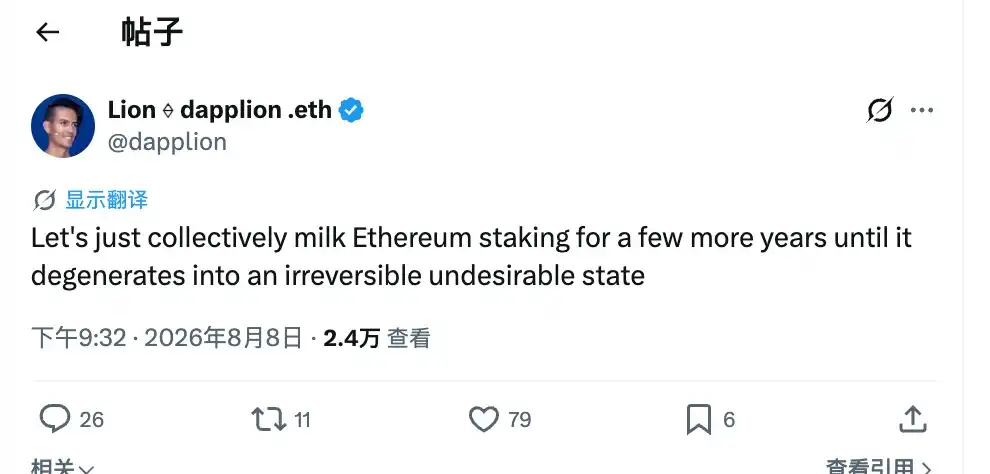
Some supporters of this EIP describe businesses built on Ethereum's yield as "extracting" from the network or receiving a "systemic subsidy." This rhetoric dismisses the real work being done: teams like Obol building DVT infrastructure, or public goods funding mechanisms like Octant—they are solving hard problems, not extracting rents.
Impact on DeFi
The entire Ethereum DeFi ecosystem utilizes the base staking yield. A sudden drop in ETH staking yield would directly reduce the lending rate for ETH across all of DeFi. Currently, market participants borrow ETH to stake, lend ETH to capture yield, and use ETH as collateral to borrow stablecoins and buy more ETH.
Reducing staking yield reverses these incentives. Market participants would borrow ETH to sell. They would stop lending ETH due to low yield and switch to stablecoins as collateral instead of ETH. This would trigger a massive unwind of staking yield strategies: DeFi vaults would see outflows, DeFi Total Value Locked would drop, and demand for ETH would decline.
Not all DeFi users are yield farmers. DeFi provides financial services access to users worldwide. Many rely on it for savings, investment, and hedging against local currency inflation. They too would be hit by falling yield. A sudden change of this magnitude has far-reaching consequences. More concerning is the turmoil it could unleash.
Based on Expectations
One reason this EIP is controversial is that it's based on expectations. How the market reaches equilibrium in two years under either curve remains unknown.
The new curve reaches equilibrium when real yield is greater than 0%, so self-funded stakers can still sustain themselves.
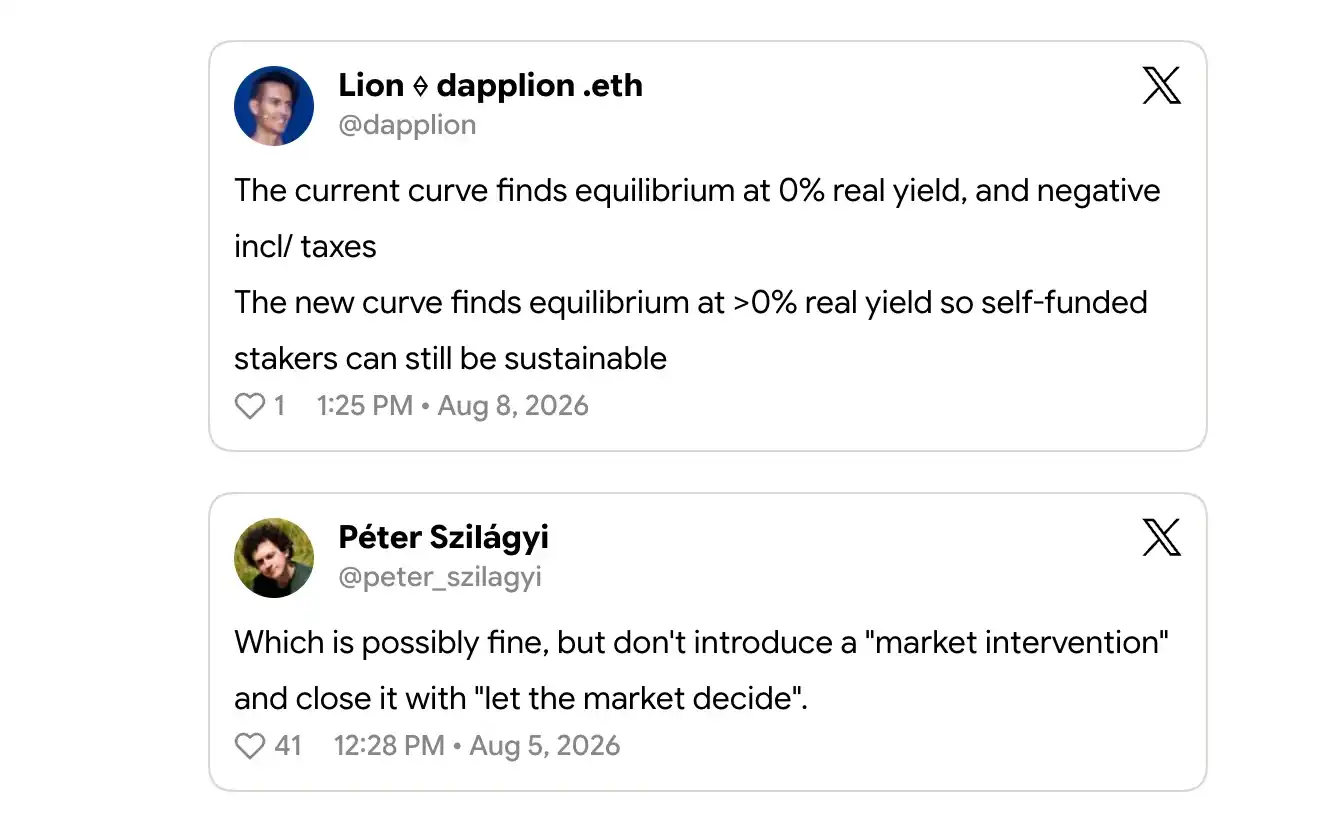
A key argument from supporters is that under the new proposal, the market will find equilibrium above 0%. Analysis by pa7x1 ("Shape of Future Issuance Curves") shows that under the current curve, independent stakers hit negative real returns first when 70 million ETH is staked. This expectation is based on cost estimates. Under the new proposal, independent stakers hit negative real returns when less than 60 million ETH is staked. If actual costs are higher than estimated, this threshold could arrive even sooner.
The Longer-Term Roadmap
I haven't seen discussion about EIP-8363's relation to the target validator set of 128,000. The Ethereum roadmap includes changes to reduce the number of validators. A smaller validator set helps reduce the load of signatures, attestations, and state on the consensus layer. MaxEB (EIP-7251) aims to ease this burden by consolidating validators. This long-term series of improvements helps Ethereum move closer to single-slot finality.
Issuance burn effectively caps the amount of staked ETH, thereby reducing the number of validators. It's unclear if reducing the validator set is an indirect goal of the issuance burn proposal. Clarification from researchers would be helpful.
I think the goal of a balanced staking ratio is good.
I think it alleviates, but does not solve, the problems it claims to address.
I think the cost outweighs the benefits.