According to the strategy, MSTR has outperformed Bitcoin in returns over any four-year holding period

cryptonews.ruPublished on 2026-08-04Last updated on 2026-08-04

Abstract

MicroStrategy's CEO Phong Le stated that since adopting its Bitcoin-focused strategy, the company's stock (MSTR) has outperformed Bitcoin's returns over every rolling four-year holding period. This analysis, comparing investment start dates from August 2020 to August 2022, offers a broader view than a single entry point. The company suggests its ability to raise capital effectively through equity and convertible note offerings—used to acquire more Bitcoin—creates value beyond its underlying assets, leading investors to value MSTR above its Bitcoin holdings' market value. Institutional investors, including major firms like Capital Group and BlackRock, increased their aggregate positions in MSTR by 27% in Q1. The company's Q2 report showed it held 843,775 Bitcoin as of July 27, with a year-to-date Bitcoin return of 4.5%, and raised $17.06 billion in capital programs in 2026. However, its financing model carries balance sheet and share dilution risks. The company recently completed its third Bitcoin sale of the year to meet obligations on preferred securities, reducing its holdings slightly, a move criticized by some, like economist Peter Schiff, as extracting value from shareholders. MicroStrategy maintains a significant Bitcoin reserve and has approved separate buyback programs.

On August 3, Phong Le, CEO of Strategy Inc. (Nasdaq: MSTR), stated that since adopting its Bitcoin-focused investment strategy, MSTR has outperformed Bitcoin in returns over every rolling four-year holding period. The company compared the annualized returns of investments made between August 2020 and August 2022, showing that the stock yielded higher returns than Bitcoin over each rolling four-year investment period.

Le stated:

"Since adopting the Bitcoin-focused strategy, MSTR shares have delivered higher returns than $BTC over every four-year holding period. This is by design and aligns with our long-term vision."

Rolling holding periods allow for comparing returns based on multiple investment start dates, rather than relying on a single entry point, providing a broader view of long-term performance. Bitcoin's historical four-year cycle is often linked to halving events, so Strategy's analysis using a rolling window represents an alternative approach to assessing long-term returns.

Le's comments also align with the view of Strategy's Executive Chairman Michael Saylor that institutional capital, exchange-traded funds (ETFs), and corporate treasury adoption of Bitcoin are shifting the cryptocurrency's historical trading patterns. In his recent remarks, he describes a market increasingly driven by sustained demand rather than traditional four-year cycles.

Institutional Investor Share Continues to Grow

In the first quarter, institutional investors continued to build positions in MSTR stock: 13 of the 15 largest shareholders of Strategy increased their aggregate holdings by 27%. Capital Group, Vanguard, BlackRock, Fidelity, and State Street were among the largest firms to boost their investments, according to Phong Le's May 20 update on institutional investor portfolios for Q1.
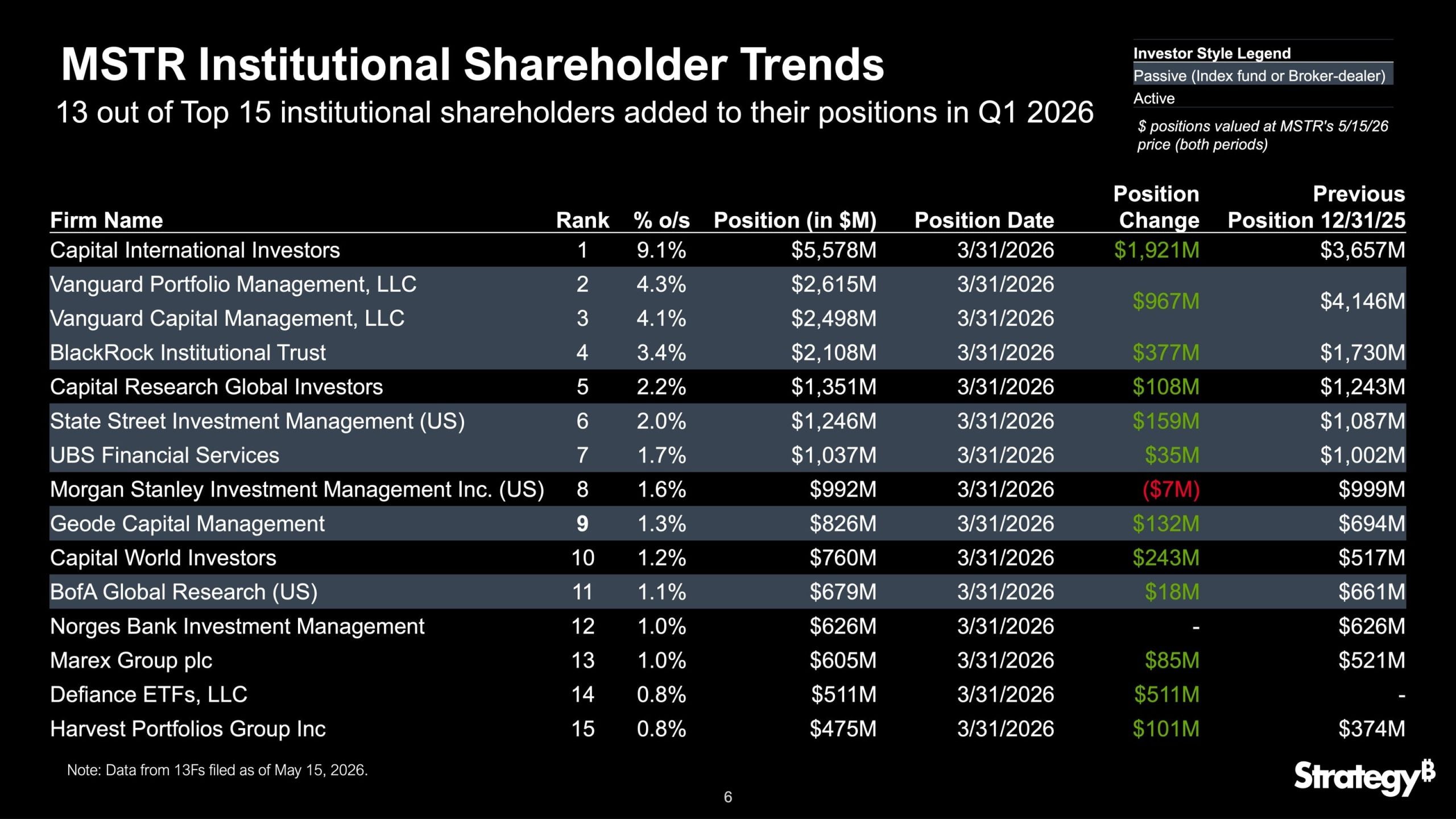
Institutional investment in MSTR. Source: Strategy CEO Phong Le via X.

These holdings facilitate broader indirect exposure to the Bitcoin market through mutual funds, pension plans, retirement accounts, and exchange-traded funds (ETFs) serving millions of investors.

Investors are increasingly valuing MSTR above the market value of its Bitcoin assets, reflecting Strategy's ability to issue equity and preferred securities, effectively raise capital, and use those funds to acquire additional Bitcoin. The company asserts that these financing capabilities create value beyond the underlying assets.

Second Quarter Results Demonstrate Strategy's Capital Market Scale

In its Q2 earnings report, Strategy reported holding 843,775 bitcoins as of July 27, year-to-date $BTC returns of 4.5% as of July 26, and raising $17.06 billion under its capital-raising programs in 2026.

The company's financing model also carries balance sheet risks and share dilution risks alongside the potential to increase Bitcoin-per-share. The latest filing with the U.S. Securities and Exchange Commission (SEC) notes that changes in Bitcoin prices, capital market conditions, financing costs, and future securities offerings could materially affect the company's financial results and shareholder interests.

Investors can track $BTC returns, $BTC appreciation, Bitcoin per diluted share, leverage level, and premium to net asset value to assess whether the company's financial strategy is leading to an increasing Bitcoin share over time. The latest performance metrics are updated concurrently with changes in the company's Bitcoin reserves and capital structure.

Bitcoin Sales Intensify Debate on Preferred Financing Methods

Following the Q2 report, Strategy completed its third Bitcoin sale of 2026 to fulfill obligations related to preferred securities. This transaction reduced the company's holdings from 843,775 to 842,138 bitcoins, with the majority of its accumulated assets preserved.

This use of treasury assets has intensified scrutiny of the financing model built on preferred equity, share issuance, and allocation of Bitcoin-backed capital. Economist Peter Schiff argues that selling Bitcoin to finance preferred stock dividends erodes value from MSTR shareholders, questioning management's claim that diversified financing supports long-term treasury expansion.

Current obligations demonstrate how the company's preferred securities can influence capital allocation, even as it retains a significant Bitcoin reserve. Preferred dividend payments are backed by a $3.75 billion reserve covering over 2.1 years of dividends and interest. Strategy has also authorized separate $1 billion share repurchase programs for MSTR and its digital credit securities, with the MSTR program remaining unused as of July 26.


Trending Cryptos

Related Questions

QAccording to the CEO of Strategy Inc., since the adoption of their Bitcoin investment strategy, how has MSTR's stock performance compared to Bitcoin over any rolling four-year holding period?

AAccording to CEO Phong Le, since Strategy Inc. adopted its Bitcoin investment strategy, MSTR's stock has outperformed Bitcoin in every rolling four-year holding period.

QWhat specific alternative analysis method does the article mention Strategy using, given Bitcoin's typical four-year halving cycle?

AThe article mentions that Strategy uses a 'sliding window' analysis of rolling holding periods, which allows comparison based on multiple investment start dates rather than a single entry point, providing a broader view of long-term performance.

QWhat point of view regarding Bitcoin market cycles did Phong Le's comments align with, according to the article?

AHis comments aligned with the viewpoint of Executive Chairman Michael Saylor that institutional capital, ETFs, and corporate treasury adoption are changing historical Bitcoin trading patterns toward a market driven more by sustained demand than traditional four-year cycles.

QIn Q1, what was the general trend among the 15 largest shareholders of Strategy regarding their MSTR positions?

AIn Q1, 13 of Strategy's 15 largest shareholders increased their aggregate positions in MSTR by 27%.

QFollowing the Q2 report, why did Strategy complete a Bitcoin sale, and what is a key criticism of this action mentioned in the article?

AStrategy completed a Bitcoin sale to meet obligations related to preferred securities. A key criticism, from economist Peter Schiff, is that selling Bitcoin to finance these preferred dividends removes value from MSTR shareholders, questioning management's claim that diversified financing aids long-term treasury expansion.

Related Reads

After Memes, Solana Foundation's 'Survival Roadmap'

**Title:** After Memes, Solana Foundation's "Survival Roadmap" **Summary:** Solana Foundation's recent hiring spree for senior roles in stablecoins, AI, Asian institutional growth, and DeFi signals a strategic pivot away from its meme-driven past. This move comes as the blockchain faces a 43% quarterly drop in real economic value and declining application revenue, despite maintaining high network activity. While meme platforms like Pump.fun still dominate fee generation, new demand is emerging in tokenized equities (with $5.8B volume in Q2, a 114% increase) and institutional adoption (7 global systemically important banks are now active on Solana). The foundation's new hires aim to bridge a critical gap: transforming this growing non-speculative demand into sustainable, fee-generating activity. The stablecoin lead seeks "step-change growth" for a sector lagging behind competitors. The Asia-focused roles aim to convert institutional interest into concrete pipelines, leveraging upcoming network upgrades for millisecond settlement. The AI ecosystem role is tied to new stablecoin payment channels for AI agents, a nascent but promising revenue stream. The core challenge is clear: reduce reliance on volatile meme trading income and successfully monetize the rising institutional and real-world asset activity. The success of this "survival roadmap" will be measured by whether projects from these new focus areas can break into Solana's top revenue rankings, displacing the current meme-centric leaders.

marsbit13m ago

After Memes, Solana Foundation's 'Survival Roadmap'

marsbit13m ago

Anchorage Unveils Plan to Protect Against Quantum Threats

Regulated crypto bank Anchorage Digital has presented a strategy for preparing institutional assets for the post-quantum era, including implementing hybrid protection for internal TLS connections. The bank highlights that for cryptocurrencies, the main quantum risk lies in digital signatures, as Shor's algorithm could theoretically derive a private key from a public one. To mitigate this, Anchorage uses Bitcoin addresses based on a hash of the public key, which keeps the key hidden until a transaction is sent, and practices minimal address reuse. Internally, the company has deployed post-quantum key encapsulation for employee devices on ChromeOS and is implementing post-quantum cryptography within its hardware security modules (HSMs). A key proposal is the "Post-Quantum Turnstile" mechanism, which uses STARK zero-knowledge proofs to allow users to migrate signing rights to a post-quantum key without exposing their old private or public key. This could help secure an estimated two-thirds of circulating coins that might otherwise become inaccessible if the network phases out classical signatures. Furthermore, Anchorage open-sourced its Rust implementation of the SQIsign digital signature scheme, which it claims offers signatures about seven times smaller than the Falcon algorithm. This comes amid warnings that around 6 million BTC in addresses with exposed public keys could be vulnerable to future quantum attacks.

cryptonews.ru46m ago

Anchorage Unveils Plan to Protect Against Quantum Threats

cryptonews.ru46m ago

Trading

Spot

Hot Articles

What is $BITCOIN

DIGITAL GOLD ($BITCOIN): A Comprehensive Analysis Introduction to DIGITAL GOLD ($BITCOIN) DIGITAL GOLD ($BITCOIN) is a blockchain-based project operating on the Solana network, which aims to combine the characteristics of traditional precious metals with the innovation of decentralized technologies. While it shares a name with Bitcoin, often referred to as “digital gold” due to its perception as a store of value, DIGITAL GOLD is a separate token designed to create a unique ecosystem within the Web3 landscape. Its goal is to position itself as a viable alternative digital asset, although specifics regarding its applications and functionalities are still developing. What is DIGITAL GOLD ($BITCOIN)? DIGITAL GOLD ($BITCOIN) is a cryptocurrency token explicitly designed for use on the Solana blockchain. In contrast to Bitcoin, which provides a widely recognized value storage role, this token appears to focus on broader applications and characteristics. Notable aspects include: Blockchain Infrastructure: The token is built on the Solana blockchain, known for its capacity to handle high-speed and low-cost transactions. Supply Dynamics: DIGITAL GOLD has a maximum supply capped at 100 quadrillion tokens (100P $BITCOIN), although details regarding its circulating supply are currently undisclosed. Utility: While precise functionalities are not explicitly outlined, there are indications that the token could be utilized for various applications, potentially involving decentralized applications (dApps) or asset tokenization strategies. Who is the Creator of DIGITAL GOLD ($BITCOIN)? At present, the identity of the creators and development team behind DIGITAL GOLD ($BITCOIN) remains unknown. This situation is typical among many innovative projects within the blockchain space, particularly those aligning with decentralized finance and meme coin phenomena. While such anonymity may foster a community-driven culture, it intensifies concerns about governance and accountability. Who are the Investors of DIGITAL GOLD ($BITCOIN)? The available information indicates that DIGITAL GOLD ($BITCOIN) does not have any known institutional backers or prominent venture capital investments. The project seems to operate on a peer-to-peer model focused on community support and adoption rather than traditional funding routes. Its activity and liquidity are primarily situated on decentralized exchanges (DEXs), such as PumpSwap, rather than established centralized trading platforms, further highlighting its grassroots approach. How DIGITAL GOLD ($BITCOIN) Works The operational mechanics of DIGITAL GOLD ($BITCOIN) can be elaborated on based on its blockchain design and network attributes: Consensus Mechanism: By leveraging Solana’s unique proof-of-history (PoH) combined with a proof-of-stake (PoS) model, the project ensures efficient transaction validation contributing to the network's high performance. Tokenomics: While specific deflationary mechanisms have not been extensively detailed, the vast maximum token supply implies that it may cater to microtransactions or niche use cases that are still to be defined. Interoperability: There exists the potential for integration with Solana’s broader ecosystem, including various decentralized finance (DeFi) platforms. However, the details regarding specific integrations remain unspecified. Timeline of Key Events Here is a timeline that highlights significant milestones concerning DIGITAL GOLD ($BITCOIN): 2023: The initial deployment of the token occurs on the Solana blockchain, marked by its contract address. 2024: DIGITAL GOLD gains visibility as it becomes available for trading on decentralized exchanges like PumpSwap, allowing users to trade it against SOL. 2025: The project witnesses sporadic trading activity and potential interest in community-led engagements, although no noteworthy partnerships or technical advancements have been documented as of yet. Critical Analysis Strengths Scalability: The underlying Solana infrastructure supports high transaction volumes, which could enhance the utility of $BITCOIN in various transaction scenarios. Accessibility: The potential low trading price per token could attract retail investors, facilitating wider participation due to fractional ownership opportunities. Risks Lack of Transparency: The absence of publicly known backers, developers, or an audit process may yield skepticism regarding the project's sustainability and trustworthiness. Market Volatility: The trading activity is heavily reliant on speculative behavior, which can result in significant price volatility and uncertainty for investors. Conclusion DIGITAL GOLD ($BITCOIN) emerges as an intriguing yet ambiguous project within the rapidly evolving Solana ecosystem. While it attempts to leverage the “digital gold” narrative, its departure from Bitcoin's established role as a store of value underscores the need for a clearer differentiation of its intended utility and governance structure. Future acceptance and adoption will likely depend on addressing the current opacity and defining its operational and economic strategies more explicitly. Note: This report encompasses synthesised information available as of October 2023, and developments may have transpired beyond the research period.

1.5k Total ViewsPublished 2025.05.13Updated 2025.05.13

What is $BITCOIN

Discussions

Welcome to the HTX Community. Here, you can stay informed about the latest platform developments and gain access to professional market insights. Users' opinions on the price of BTC (BTC) are presented below.

活动图片