ETH 'Bears' Lose $113M as Ethereum Price Surges Above $1,980, Aims for $2,000 Breakout

cryptonews.ruPublished on 2026-07-27Last updated on 2026-07-27

Abstract

On Monday, Ethereum (ETH) approached $2,000, surging 4.5% amid increased ETF inflows and staking activity, reaching a high of $1,980. This rally recovered losses since July 22 and boosted its market cap to $237 billion. The price jump led to the liquidation of $113 million in short positions over 24 hours, compared to $10 million in long positions, with ETH shorts accounting for a third of all liquidated shorts. Key drivers include sustained inflows into spot ETH ETFs, which attracted nearly $104 million from July 20-24, and Circle's final OCC approval to establish a national trust bank. This approval for the issuer of USDC, a key Ethereum-based stablecoin, is seen as structurally positive for the network. Furthermore, the queue for Ethereum validator withdrawals has reportedly emptied, removing bottlenecks and ensuring stable market liquidity. Despite the bullish momentum, some technical analysts caution that this may be a temporary rally within a broader downtrend. One forecast suggests a potential final drop to the $1,300-$1,450 range for accumulation before a true trend reversal, with recovery targets at $2,450 and a longer-term macroeconomic target of $3,950.

On Monday, ether ($ETH) approached the $2,000 mark following a 4.5% surge amid increased inflows into exchange-traded funds (ETFs) and staking activity. According to Bitstamp data, $ETH reached a high of $1,980, more than $100 above its level 24 hours earlier, becoming one of the day's top gainers.

This surge essentially recouped losses $ETH had suffered since July 22, when it fell below the $1,900 level. The increase also boosted its market capitalization to $237 billion, resulting in a nearly 6% gain over seven days. Although the digital asset's year-to-date losses remain in the double digits, the momentum on July 27 created conditions for a return to the $2,000 level for the first time since June 2.

Meanwhile, the jump in $ETH proved especially brutal for "bears," as evidenced by $113 million in liquidated short positions over 24 hours compared to $10 million in long positions. According to Coinglass data, liquidated short positions for $ETH alone accounted for one-third of all liquidated short positions during this period.

Although $ETH's rise occurred alongside gains in the rest of the cryptocurrency market, analysts singled out the consistent inflows into spot $ETH ETFs over recent days as a key factor. Data shows that from July 20 to 24, ETFs attracted nearly $104 million, indicating strong institutional support for this digital asset.

Overall market sentiment was also bolstered by Circle receiving final approval from the U.S. Office of the Comptroller of the Currency (OCC) to form a national trust bank. Since USDC—Circle's flagship dollar-pegged token—operates primarily on Ethereum as its main settlement layer, the issuer's transition to federal oversight creates significant structural incentives for the network's development. Analysts note that the OCC approval lowers regulatory barriers for institutional players, ensuring long-term liquidity and accelerating enterprise adoption of technology in Ethereum's decentralized finance (DeFi) ecosystem.

Adding further momentum to the rise is the reported emptying of the Ethereum validator withdrawal queue, marking a critical turning point for the health of the network's proof-of-stake (PoS) mechanism. As blockchain data shows that there is not a single validator queued for $ETH withdrawal, withdrawal bottlenecks have virtually disappeared. The absence of delays allows capital to flow seamlessly and instantly into and out of staking protocols, reassuring investors that market liquidity remains absolutely stable.

Despite the recent bullish momentum, some technical analysts urge caution, viewing the current price movement as a temporary relief rally within a broader downtrend. According to technical analysis published by BitcoinpulseX, $ETH is forming a series of bear flags that indicate the current bounce may ultimately fail.

The forecast suggests one final capitulation move into the $1,300 to $1,450 range, where prolonged accumulation is expected to occur before a true trend reversal sets in. If this bottom holds, technical targets project a recovery to the $2,450 mark, with a macroeconomic target set at $3,950.


Trending Cryptos

Related Questions

QAccording to the article, what two main factors contributed to the 4.5% price jump of Ethereum (ETH) on Monday?

AThe article states the price jump was driven by 1) inflows into spot Exchange-Traded Funds (ETFs) and 2) activity in the staking sector.

QWhat significant loss did ETH 'bears' suffer due to the price surge, and how does this compare to losses for 'bulls'?

ABears (short positions) suffered $113 million in liquidations over 24 hours, while bulls (long positions) lost only $10 million.

QHow did the regulatory approval for Circle's national trust bank potentially benefit the Ethereum network structurally?

ACircle's approval from the OCC (Office of the Comptroller of the Currency) lowers regulatory barriers for institutional players. Since Circle's USDC stablecoin operates primarily on Ethereum, this provides long-term liquidity and accelerates enterprise adoption within the Ethereum DeFi ecosystem.

QWhat important development occurred in Ethereum's Proof-of-Stake mechanism, as indicated by the article, and why is it significant for investors?

AThe queue for Ethereum validators to withdraw their staked ETH emptied. This is significant because it removes withdrawal bottlenecks, allowing capital to move instantly into and out of staking protocols, assuring investors of stable market liquidity.

QDespite the bullish momentum, what is the cautious technical analysis viewpoint presented in the article regarding ETH's future price movement?

ASome technical analysts view the current price movement as a temporary relief rally within a broader downtrend. They see ETH forming bearish flag patterns, which could lead to a final capitulation move to a range of $1,300-$1,450 before a true trend reversal and potential recovery.

Related Reads

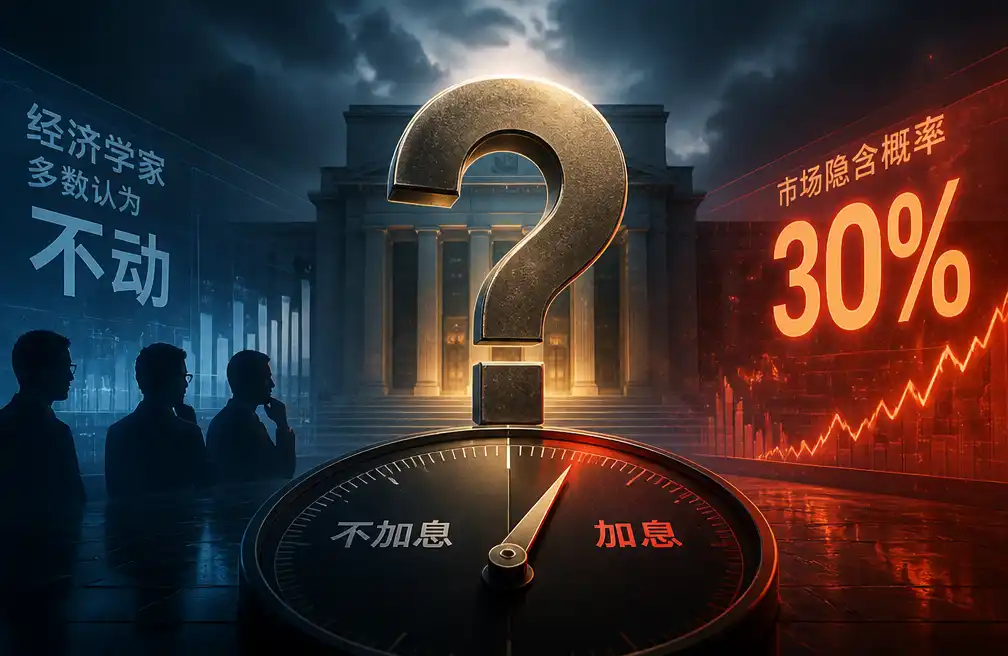
To Hike or Not Tonight: Economists Unanimous on 'No', Markets Price in a 30% Chance

Federal funds futures are repricing ahead of the July FOMC decision, as traders pay a higher premium for the risk of a surprise rate hike or more hawkish signals. This contrasts with economists, where a Reuters survey of 104 analysts unanimously expects rates to remain unchanged at 3.50%-3.75%, with 78 foreseeing no change through year-end. Yet, futures markets have priced in about a 30% probability of a 25-basis-point hike. The core debate, especially under new Fed Chair Kevin Warsh, centers on how the Fed will respond to the oil price shock from Middle East tensions. The market is not necessarily predicting a hike tonight but is hedging against two tail risks: an immediate rate increase, or a hold combined with communication that seriously opens the door for a September hike. This hedging activity has driven up open interest in Fed funds futures. Analysts are divided on how to weight the oil price surge in the Fed's reaction function. Hawkish voices (e.g., BofA) worry that completely dismissing the price pressure could challenge the Fed's inflation credibility in Warsh's first major test. Dovish views (e.g., Citi) argue the shock is primarily supply-driven and that overreacting with rate hikes could unnecessarily hurt growth, unless clear signs of secondary inflation emerge. Warsh's new tenure amplifies policy path uncertainty, as markets lack a stable baseline for his communication style. This environment forces traders to price in a wider range of outcomes, explaining the divergence between unanimous economist forecasts and market hedging. The key focus will be on Warsh's post-meeting commentary. If he downplays the oil shock and stresses anchored long-term expectations, hawkish pricing may recede. If he emphasizes the risk of broader price spillovers and prioritizes returning to 2% inflation, the market will interpret this as reopening the door for a September hike. This would sustain support for the USD, keep pressure on JPY (testing intervention thresholds), and challenge risk assets like stocks and crypto through higher discount rates and weaker sentiment. The baseline remains no action in July, but the communication will determine how far this repricing extends.

marsbit47m ago

To Hike or Not Tonight: Economists Unanimous on 'No', Markets Price in a 30% Chance

marsbit47m ago

The Semiconductor Industry's Most Obscure Chokepoint Material: It Has Multiplied in Price Unnoticed, and China Just Banned Its Export

"Helium: The Silent Choke Point in Semiconductors" Helium, despite being the universe's second most abundant element, is critically scarce on Earth. It cannot be synthesized artificially and escapes Earth's gravity once released, making it a non-renewable resource. Yet, it is indispensable for advanced semiconductor manufacturing, requiring ultra-high purity (99.9999%) for processes like wafer etching, leak detection, and thermal management in lithography tools, with no viable substitutes. This low-profile resource, whose price has doubled unnoticed, suddenly gained attention when China imposed an export ban on July 10th. The ban is a response to a severe global shortage triggered months earlier. In March, missile attacks damaged the world's largest helium production hub in Qatar's Ras Laffan, halting a third of global supply with repairs expected to take 3-5 years. Concurrently, Russia tightened export controls, and the US sold off its federal helium reserve. Approximately 200 specialized transport containers, each worth ~$1 million, were stranded with perishable cargo. Global spot prices skyrocketed, and chipmakers like TSMC warned of potential impacts. China, which imports over 84% of its helium (primarily from Qatar and Russia), faces a severe squeeze. Despite being helium-poor, China has developed domestic extraction technology over five years, processing byproduct gases from LNG plants to produce ultra-pure helium. Domestic output, while still only covering less than 20% of demand, enabled the recent export ban aimed at securing domestic supply for its own expanding chip industry. The industry now faces "Helium Shortage 5.0." With key global sources constrained for years, this invisible gas—once wasted on party balloons—has become a critical, geopolitically charged bottleneck for chips, healthcare (MRI machines), and beyond, forcing the world to finally treat it as the finite strategic resource it is.

marsbit1h ago

The Semiconductor Industry's Most Obscure Chokepoint Material: It Has Multiplied in Price Unnoticed, and China Just Banned Its Export

marsbit1h ago

Trading

Spot

Hot Articles

Discussions

Welcome to the HTX Community. Here, you can stay informed about the latest platform developments and gain access to professional market insights. Users' opinions on the price of ETH (ETH) are presented below.

活动图片