He Xiaopeng Breaks Unitree's Record

marsbitPublished on 2026-08-25Last updated on 2026-08-25

Abstract

He Xiaopeng Breaks Unitree's Record: Xiaopeng Group's Humanoid Robot Arm Valued at $6.3 Billion In a landmark deal mirroring Unitree's recent listing, Xiaopeng Group has announced the completion of the first private equity financing round for its humanoid robotics business, led by IDG Capital. The funding round raised over $900 million (approximately 6.5 billion RMB), resulting in a post-investment valuation exceeding $6.3 billion (approximately 43 billion RMB). This surpasses the total funds raised by Unitree Technology in its recent IPO. He Xiaopeng, founder of XPeng Motors, is personally leading the robotics venture as its CEO. Established in 2020, the company has quickly become a super unicorn. Its latest robot model, IRON, debuted in late 2025 with a highly realistic, human-proportioned design and the ability to perform complex movements like a "catwalk," sparking significant online attention. The round saw participation from IDG Capital, Gaorong Capital, and strategic investors Tencent and Alibaba. He Xiaopeng stated that Xiaopeng IRON is on the cusp of mass production, with plans for commercial deployment starting from XPeng's own stores and campuses by the end of 2026, followed by official market launch in 2027. He believes each IRON robot's lifetime revenue and profit contribution will significantly exceed that of the current automotive business per vehicle. This development comes amidst a heated race in China's embodied AI sector, following Unitree's recent list...

This scene rivals Unitree's listing—

It has been learned by Investing Frontier that XPeng Group has officially announced that its humanoid robotics business has signed equity financing agreements with multiple investors. The round is led by IDG Capital, with participation from Gaorong Capital, and also secured support from strategic investors Tencent and Alibaba.

It is worth mentioning that this round marks the first financing for XPeng's robotics business. The financing amount exceeds $9 billion (approximately ¥65 billion), with a post-investment valuation exceeding $63 billion (approximately ¥430 billion). This single-handedly sets a new record for the largest single round of private equity financing in China's embodied AI industry. In comparison, Unitree Technology's final IPO fundraising total was approximately ¥60.99 billion.

This time, He Xiaopeng is personally taking the helm—he is not only the founder of XPeng Motors but is also currently the CEO of XPeng's robotics business. Under his leadership, XPeng's humanoid robotics started in 2020 and has already become a super unicorn with its first financing round.

The timing is quite delicate—just days ago, Unitree Technology debuted on the STAR Market as the "first humanoid robotics stock." A major battle in China's embodied AI sector is unfolding.

¥430 Billion Valuation, Breaking the Record

Alibaba and Tencent Have Arrived

More investment details have emerged.

XPeng Group's announcement shows that the transaction entity, Pxing, has a pre-money valuation of $50 billion and a post-money valuation of $63 billion. Among them, a wholly-owned subsidiary of XPeng Group intends to invest $200 million to subscribe for 98.6752 million Series A preferred shares; investors including IDG Capital, Gaorong Capital, Alibaba, and Tencent intend to invest a total of $600 million to subscribe for 296 million Series A preferred shares; the management subscription party, an affiliated entity wholly controlled by He Xiaopeng and Gu Hongdi, intends to invest a total of $100 million to subscribe for 49.3376 million ordinary shares.

For the four external investors, this investment in XPeng Robotics represents one of the largest single disclosed investments each has made in the embodied AI field: IDG Capital invested ¥2.1 billion, while Gaorong Capital, Alibaba, and Tencent each invested ¥720 million.
The announcement also indicates that Pxing can issue additional Series A preferred shares to extra investors within four months of signing the share purchase agreement, raising up to $15 million.

According to the announcement, while introducing this round of financing, XPeng Group and Pxing will implement and complete the Pxing spin-off plan within an agreed period. This involves transferring certain business assets, intellectual property, and personnel related to the robotics business, which are not yet held by Pxing, to Pxing.

Furthermore, the timeline for the capitalization of XPeng's robotics business is becoming clearer. The announcement discloses that if Pxing fails to complete a qualified IPO within seven years after the initial investment closing, investors have the right, under certain conditions, to require Pxing, its significant subsidiaries, or XPeng Group to redeem the relevant shares.

XPeng Group stated in the announcement that this round of financing allows the value of Pxing and the robotics business to be better reflected, attracts robotics-specialized capital distinct from automotive business investors, alleviates the financial burden on XPeng Group with substantial funds, and the participation of renowned international institutional investors will enhance Pxing's image among potential customers, suppliers, and strategic partners.

From IDG Capital's perspective, XPeng's humanoid robot represents the leading level of China's humanoid robotics industry and possesses the capability to compete globally with leading overseas enterprises. XPeng has achieved a full-stack proprietary layout covering edge AI chips, physical AI large models, and complete hardware, boasting industry-leading edge computing power, training computing power, and a high-quality data closed-loop system. Additionally, the robotics business can generate significant strategic synergies with the smart car and autonomous driving businesses. "We believe that with its advantages across the entire chain from core technology R&D and mass production to globalization, XPeng will become a leading enterprise driving the industry towards the large-scale application stage."

Gaorong Capital similarly stated that humanoid robots are transitioning from demonstrating mobility capabilities to achieving stable mass production and creating value in real-world scenarios. XPeng IRON, with its highly anthropomorphic product form and automotive-grade safety standards, enters real commercial scenarios, serving both as an interactive medium close to humans and a crucial entry point for acquiring real-world data. It holds the potential to drive the continuous operation of the 'mass production—data—model—application' flywheel. "XPeng is systematically transferring the full-stack R&D capabilities, supply chain, and manufacturing system accumulated over more than a decade in smart electric vehicles to robotics, laying a solid foundation for the industrialization of humanoid robots."

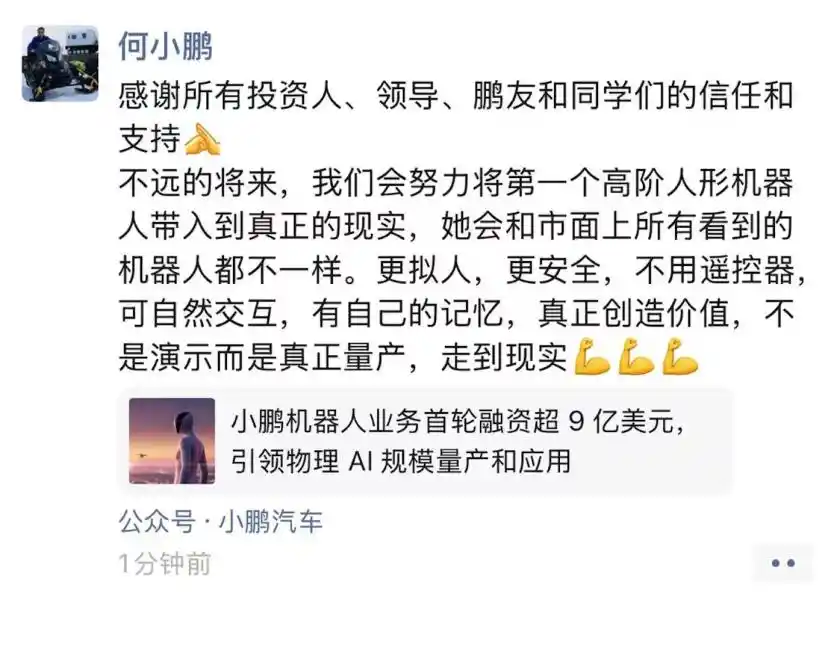
After leading XPeng's humanoid robotics to this milestone, He Xiaopeng expressed profound emotions. He wrote on his WeChat Moments, "In the not-too-distant future, we will strive to bring the first advanced humanoid robot into reality. She will be different from all the robots currently seen on the market."
He Xiaopeng Personally Takes Charge

Robot Capable of Catwalk to be Mass-Produced This Year

XPeng's foray into robotics started much earlier than the public imagined.

It is reported that He Xiaopeng's interest in robotics began as early as 2016. He conducted serious annual research into the robotics direction and once had a long conversation with Wang Xingxing, founder of Unitree.

It wasn't until 2020 that He Xiaopeng decided to act. Introduced by Xiaomi founder Lei Jun, he acquired "Dogotix" founded by Zhao Tongyang and established "Pxing Intelligence" to explore XPeng's robotics business. Later, in September 2023, XPeng Motors acquired the remaining 74.82% stake in Pxing Intelligence for $98.96 million, making Pxing an official robotics division of XPeng Motors. In October of the same year, XPeng's first bipedal humanoid robot, the PX5, was unveiled.

Why such dedication to robotics development? He Xiaopeng has repeatedly emphasized publicly that the greatest value of AI lies in "changing the physical world." In his view, smart electric vehicles are the precursor to robots. Autonomous driving technology solves "minor brain problems" like "movement and balance," accumulating crucial experience for humanoid robots.

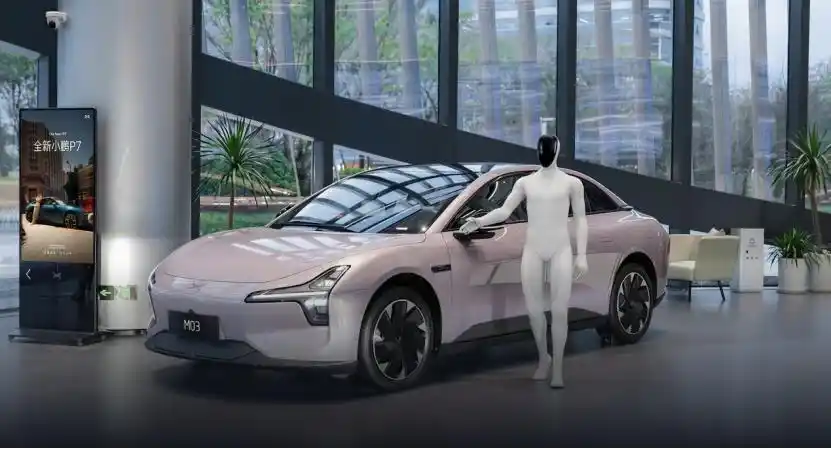
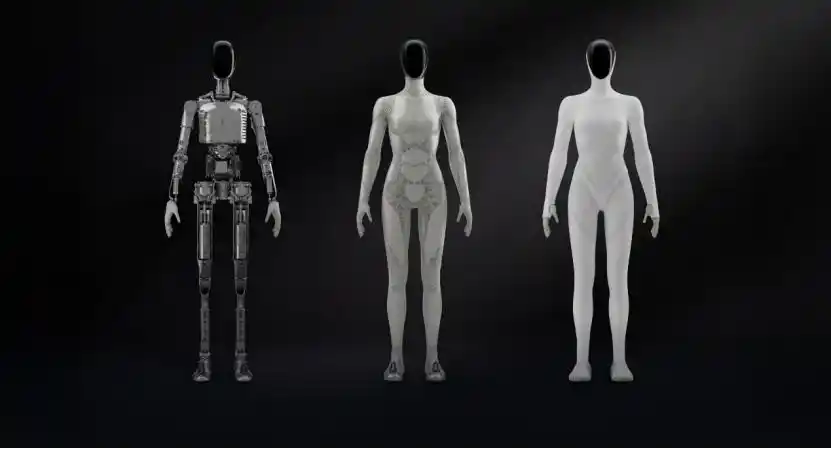
The moment that truly captivated the entire internet occurred at the XPeng Tech Day in November 2025, where the new generation humanoid robot IRON was officially unveiled. Designed with a 1:1 human proportion, it was capable of a catwalk-style walking posture, sparking widespread online discussion. Some netizens even suspected "a real person was hidden inside."

In terms of hardware, the XPeng IRON boasts industry-leading anthropomorphic posture and design, featuring the first full-coverage flexible lattice structure that balances aesthetics and safety. It has 76 degrees of freedom overall, with 21 degrees of freedom in a single hand. Furthermore, XPeng Robotics has independently designed and developed an AI-native hardware platform and all core components for embodied intelligence, including chips, controllers, motion modules, and dexterous hands. Leveraging its established smart electric vehicle R&D and manufacturing system, it aims to achieve automotive-grade quality and large-scale mass production and delivery capabilities.

In terms of intelligence, the XPeng IRON is equipped with three Turing AI chips, delivering an effective computing power of up to 2250 TOPS. The XPeng Physical AI large model is successfully deployed on the edge, enabling it to autonomously complete complex work tasks without remote operation, while ensuring low-latency inference and data security.
Entering 2026, XPeng Robotics accelerated its industrialization pace. In February, the company began constructing the industry's first full-chain mass production base for humanoid robots. In June, He Xiaopeng announced that in addition to serving as Group CEO, he would personally take on the role of CEO for the robotics business. He stated candidly that the XPeng humanoid robot IRON is standing on the threshold of mass production and delivery, comparable to the stage XPeng Motors was at eight years ago, just before completing the launch of its first car, the G3.

According to plan, the XPeng IRON will enter the mass production phase by the end of 2026, starting its commercial application in XPeng's stores and campuses, and will be officially launched and delivered to markets in China and overseas in 2027.

It is worth noting that Pxing remains in a phase of continuous investment, reporting net losses of ¥87 million in 2024 and ¥369 million in 2025. As of the end of March 2026, its net liabilities were approximately ¥447 million, and it has yet to disclose scaled product revenue or external orders.

However, He Xiaopeng remains confident. He stated during the earnings call that the technological barriers for high-level general-purpose robots are extremely high, and high-quality supply is scarce. Therefore, the revenue and gross profit contribution throughout the lifecycle of each IRON unit, including hardware sales and sustained revenue from software AI model capability upgrades, will be significantly higher than the current average selling price and gross profit per vehicle in the automotive business.

Interestingly, He Xiaopeng holds another super unicorn—XPeng AeroHT. Also founded in 2020, XPeng AeroHT focuses on the R&D of intelligent electric flying cars. According to He Xiaopeng, XPeng AeroHT's global orders for the Land Aircraft Carrier have reached 7,000 units, and it has the potential to set a world record for annual sales of manned flying vehicles.

In March this year, XPeng AeroHT completed a new round of equity financing of nearly $200 million, with investors including Hillhouse Ventures, Sequoia Capital China, Gaorong Capital, and Fortune Capital. This brings XPeng AeroHT's total historical equity financing to approximately $1 billion.

During this period, Bloomberg reported that XPeng AeroHT was working with J.P. Morgan and Morgan Stanley on its IPO preparations. XPeng AeroHT responded at the time, emphasizing its current focus on product R&D and mass production delivery, with no other information to share.

It seems likely that He Xiaopeng will once again stand on the stage for an IPO bell-ringing ceremony.

Automakers Jumping In Collectively

Life-and-Death Battle for Chinese Robots Begins

The real elimination race has begun.

Last week, Unitree Technology officially listed on the Shanghai Stock Exchange's STAR Market, becoming the "first humanoid robotics stock" on the A-share market, with its market capitalization briefly reaching nearly ¥450 billion on the first day.

However, Unitree's stock price began to decline the next trading day, and its latest market cap has fallen below ¥250 billion. This "rollercoaster" performance completely shattered the last layer of window dressing in the embodied AI track: before this, startups could rely on technical demonstrations and conceptual proposals to secure financing; after this, the capital market wants to see revenue, mass production, and a commercialization path.

This means the window of opportunity for humanoid robotics startups is rapidly narrowing. For automotive giants, however, this has become the best time to collectively enter the field.

Among them, Tesla is undoubtedly the most aggressive player. Tesla Vice President Tao Lin publicly stated that the Optimus humanoid robot will officially commence large-scale mass production by the end of 2026, with the Fremont factory's long-term annual capacity target set at 1 million units. To this end, the former Model S/X production line at the factory has been converted into an exclusive Optimus production line, scheduled to officially start production in July-August.

Turning our perspective back to China—in February this year, GAC Group officially incubated the humanoid robotics company Huilun Technology and unveiled its fourth-generation robot, the GoMate Mini. Then, in mid-August, Huilun Technology announced the completion of over ¥100 million in financing, jointly invested by CRRC Guochuang Fund, CMB International, Sichuan Science and Technology Innovation, and other institutions.

Such cases are emerging: at the end of March, Changan established Tianshu Intelligent Robotics Company, launching the humanoid robot prototype "Xiao'an"; Li Auto revealed during its Q1 earnings call that its humanoid robot product has been approved for R&D; BYD's commercial service humanoid robot "Xiao Di" was announced in August at the "Di Space" in Zhengzhou; at the same time, news emerged that Chery Automobile's Mojia Robot had started IPO preparations; and at the recently concluded 2026 World Robot Conference, FAW Group, Dongfeng Motor, and Xiaomi Group all showcased their new generation humanoid robots......

Li Xiang, founder of Li Auto, once judged, "In the next 3-5 years, competition in the mid-to-high-end smart car sector will essentially be competition in embodied intelligence. From a market structure perspective, whether it's automakers with initial revenues reaching the hundred-billion-yuan level or larger-scale auto manufacturers, they will all enter the embodied intelligent robotics track."

Previously, a founder of an embodied AI unicorn candidly stated in a conversation with Investing Frontier, "Embodied companies are worried about automakers entering the field because they have ready-made technology and production lines. It's essentially a dimensional reduction strike."

The reason for this concern is self-evident. For startups, the current market landscape seems somewhat suffocating. The competitors they face are no longer peers on the same starting line but automotive giants with cash reserves of tens of billions, complete supply chain systems, large-scale manufacturing capabilities, and global sales networks.

After all, there is significant overlap in the technological systems of automobiles and robots, and this technological homology provides an inherent advantage for automakers. The proprietary chips, large models, perception systems, control systems, and operating systems required for smart cars also form the core technological foundation for general-purpose humanoid robots. Technological capabilities validated in mass-produced vehicles can be directly advanced to humanoid robots.

More importantly, the industrialization capabilities of the automotive industry provide crucial support for robot mass production. The large-scale manufacturing experience, supply chain management systems, and quality control standards from smart cars can be directly applied to robot production.

Thus, automakers don't need to start from scratch when making robots, and car factories themselves are ideal testing and deployment scenarios for humanoid robots.

At present, the final outcome of this elimination race remains unpredictable, but one thing is certain: every player on the track has no way back.

This article is from the WeChat public account "Investing Frontier" (ID: pedaily2012), author: Liu Bo.

Trending Cryptos

Related Questions

QWhat record did Xiaopeng Group's humanoid robot business break in the first round of financing?

AXiaopeng's robot business broke the single-round private equity financing record in China's embodied AI industry, raising over $9 billion with a post-investment valuation exceeding $6.3 billion, surpassing Unitree's total IPO fundraising amount.

QWhich major investors participated in Xiaopeng's robot business financing round led by IDG Capital?

AIDG Capital led the round, with GSR Ventures participating and Tencent and Alibaba providing strategic investment.

QWhat is the name of Xiaopeng's next-generation humanoid robot, and what was a notable feature that sparked online discussion?

AXiaopeng's robot is named IRON. Its debut in November 2025, featuring a cat-walk gait so lifelike it led some netizens to suspect a human was inside the suit, sparked widespread online discussion.

QAccording to the article, why are major automakers like Tesla, Xiaopeng, and others entering the humanoid robot field?

AAutomakers are entering the field because technologies for smart cars (like self-driving chips, AI models, and control systems) overlap significantly with those needed for humanoid robots. They also possess massive manufacturing, supply chain, and industrialization capabilities that can be directly applied to robot production, giving them a potential advantage over startups.

QWhat is the capital market's changing demand for humanoid robot companies, as indicated by Unitree's post-IPO stock performance?

AUnitree's volatile stock performance after its IPO indicates the capital market is shifting its focus from technical demonstrations and concepts to demanding tangible results like revenue, mass production plans, and clear commercialization paths.

Related Reads

BTC Returns to $80,000, Crypto-Related Stocks Finally Stand Tall

Bitcoin Breaches $80,000 Mark, Boosting Crypto-Related Stocks With the crypto market heating up, Bitcoin has surged back above the $80,000 level after more than a hundred days, posting nearly a 30% gain in a week. This rally has ignited bullish sentiment across the board. Concurrently, crypto-related stocks, which had been experiencing a months-long slump, are staging a powerful comeback, led by key players in digital asset treasuries, exchanges, and trading platforms. Many of these stocks have seen substantial rebounds from their recent lows. Leading the charge is MicroStrategy (MSTR), a major Bitcoin treasury company, whose stock has rebounded nearly 50% from its 52-week low. Close behind is Bitmine (BMNR), the largest public Ethereum treasury, with a staggering 88.6% rebound. Other notable performers include the stablecoin issuer Circle (CRCL), up 75.5%, and the Ethereum-focused company Sharplink (SBET), up 83.7%. While the "crypto market proxy" Coinbase (COIN) has rebounded 29%, its unique position has faced some dilution from new market entrants. Robinhood (HOOD), bolstered by strong Q2 earnings and its expanding crypto ecosystem, has risen 63.2%. The exchange Bullish (BLSH) is up 45.8%. Perhaps the most dramatic rebound belongs to Hyperliquid Strategies (PURR), linked to the Hyperliquid ecosystem, which has skyrocketed over 254% from its low. The analysis highlights that most of these stocks hit their lows around late June, marking a market bottom. It emphasizes the strategy of focusing on leading companies and notes that while the rebound is strong, many stocks remain significantly below their yearly highs. Ultimately, these public companies serve as leveraged proxies for underlying crypto assets like Bitcoin and Ethereum in the current market upswing.

Odaily星球日报6m ago

BTC Returns to $80,000, Crypto-Related Stocks Finally Stand Tall

Odaily星球日报6m ago

AI Starts Acting as Humans' AI Intermediary, Token Usage Already 5.2 Times That of Humans

On February 6, 2026, human usage of AI tokens was surpassed by AI agents for the first time on the platform OpenRouter. In just six months, this gap widened to a factor of 5.2. OpenRouter estimates that by August 10, 2026, Agent-class token consumption soared 14-fold to 7.3 trillion, while human usage grew to 1.4 trillion, a 2.8-fold increase. OpenRouter, a major model gateway handling about 1% of global inference volume, distinguishes between human and agent traffic by analyzing user behavior patterns (e.g., frequency of tool calls, response intervals) rather than identity. The dramatic divergence stems from fundamentally different usage patterns. Human interaction is typically short, involving a prompt and a response. In contrast, AI agents operate autonomously on complex tasks—reading files, calling tools, iterating outputs—generating thousands of tokens from a single initial prompt. This shift to autonomous, multi-turn operation unlocks massive scale. While agents benefit from cheaper cached tokens (constituting nearly 70% of an average request), the sheer volume explosion still drives costs sharply higher. Estimates show the cost per customer service interaction could rise 30-fold by 2026, and agentic AI could increase total token consumption 24-fold by 2030. Companies like Uber have already exhausted annual AI budgets within months. The critical differentiator is not the choice of AI model but its integration into actionable workflows. Top-tier companies see users generating 8.3x more tokens than average, largely due to higher adoption of plugins and reusable skills, which reduce redundant work. However, this surge in automated activity raises a crucial oversight issue. Many agent tasks still require human approval, but monitoring capacity hasn't scaled with usage, leading to incidents like unnoticed deletions. The key challenge is no longer whether to use AI, but establishing who verifies its work, makes final decisions, and takes responsibility. The real scarcity is shifting from execution to validation and judgment.

marsbit11m ago

AI Starts Acting as Humans' AI Intermediary, Token Usage Already 5.2 Times That of Humans

marsbit11m ago

Trading

Spot

Hot Articles

What is SONIC

Sonic: Pioneering the Future of Gaming in Web3 Introduction to Sonic In the ever-evolving landscape of Web3, the gaming industry stands out as one of the most dynamic and promising sectors. At the forefront of this revolution is Sonic, a project designed to amplify the gaming ecosystem on the Solana blockchain. Leveraging cutting-edge technology, Sonic aims to deliver an unparalleled gaming experience by efficiently processing millions of requests per second, ensuring that players enjoy seamless gameplay while maintaining low transaction costs. This article delves into the intricate details of Sonic, exploring its creators, funding sources, operational mechanics, and the timeline of significant events that have shaped its journey. What is Sonic? Sonic is an innovative layer-2 network that operates atop the Solana blockchain, specifically tailored to enhance the existing Solana gaming ecosystem. It accomplishes this through a customised, VM-agnostic game engine paired with a HyperGrid interpreter, facilitating sovereign game economies that roll up back to the Solana platform. The primary goals of Sonic include: Enhanced Gaming Experiences: Sonic is committed to offering lightning-fast on-chain gameplay, allowing players and developers to engage with games at previously unattainable speeds. Atomic Interoperability: This feature enables transactions to be executed within Sonic without the need to redeploy Solana programmes and accounts. This makes the process more efficient and directly benefits from Solana Layer1 services and liquidity. Seamless Deployment: Sonic allows developers to write for Ethereum Virtual Machine (EVM) based systems and execute them on Solana’s SVM infrastructure. This interoperability is crucial for attracting a broader range of dApps and decentralised applications to the platform. Support for Developers: By offering native composable gaming primitives and extensible data types - dining within the Entity-Component-System (ECS) framework - game creators can craft intricate business logic with ease. Overall, Sonic's unique approach not only caters to players but also provides an accessible and low-cost environment for developers to innovate and thrive. Creator of Sonic The information regarding the creator of Sonic is somewhat ambiguous. However, it is known that Sonic's SVM is owned by the company Mirror World. The absence of detailed information about the individuals behind Sonic reflects a common trend in several Web3 projects, where collective efforts and partnerships often overshadow individual contributions. Investors of Sonic Sonic has garnered considerable attention and support from various investors within the crypto and gaming sectors. Notably, the project raised an impressive $12 million during its Series A funding round. The round was led by BITKRAFT Ventures, with other notable investors including Galaxy, Okx Ventures, Interactive, Big Brain Holdings, and Mirana. This financial backing signifies the confidence that investment foundations have in Sonic’s potential to revolutionise the Web3 gaming landscape, further validating its innovative approaches and technologies. How Does Sonic Work? Sonic utilises the HyperGrid framework, a sophisticated parallel processing mechanism that enhances its scalability and customisability. Here are the core features that set Sonic apart: Lightning Speed at Low Costs: Sonic offers one of the fastest on-chain gaming experiences compared to other Layer-1 solutions, powered by the scalability of Solana’s virtual machine (SVM). Atomic Interoperability: Sonic enables transaction execution without redeployment of Solana programmes and accounts, effectively streamlining the interaction between users and the blockchain. EVM Compatibility: Developers can effortlessly migrate decentralised applications from EVM chains to the Solana environment using Sonic’s HyperGrid interpreter, increasing the accessibility and integration of various dApps. Ecosystem Support for Developers: By exposing native composable gaming primitives, Sonic facilitates a sandbox-like environment where developers can experiment and implement business logic, greatly enhancing the overall development experience. Monetisation Infrastructure: Sonic natively supports growth and monetisation efforts, providing frameworks for traffic generation, payments, and settlements, thereby ensuring that gaming projects are not only viable but also sustainable financially. Timeline of Sonic The evolution of Sonic has been marked by several key milestones. Below is a brief timeline highlighting critical events in the project's history: 2022: The Sonic cryptocurrency was officially launched, marking the beginning of its journey in the Web3 gaming arena. 2024: June: Sonic SVM successfully raised $12 million in a Series A funding round. This investment allowed Sonic to further develop its platform and expand its offerings. August: The launch of the Sonic Odyssey testnet provided users with the first opportunity to engage with the platform, offering interactive activities such as collecting rings—a nod to gaming nostalgia. October: SonicX, an innovative crypto game integrated with Solana, made its debut on TikTok, capturing the attention of over 120,000 users within a short span. This integration illustrated Sonic’s commitment to reaching a broader, global audience and showcased the potential of blockchain gaming. Key Points Sonic SVM is a revolutionary layer-2 network on Solana explicitly designed to enhance the GameFi landscape, demonstrating great potential for future development. HyperGrid Framework empowers Sonic by introducing horizontal scaling capabilities, ensuring that the network can handle the demands of Web3 gaming. Integration with Social Platforms: The successful launch of SonicX on TikTok displays Sonic’s strategy to leverage social media platforms to engage users, exponentially increasing the exposure and reach of its projects. Investment Confidence: The substantial funding from BITKRAFT Ventures, among others, emphasizes the robust backing Sonic has, paving the way for its ambitious future. In conclusion, Sonic encapsulates the essence of Web3 gaming innovation, striking a balance between cutting-edge technology, developer-centric tools, and community engagement. As the project continues to evolve, it is poised to redefine the gaming landscape, making it a notable entity for gamers and developers alike. As Sonic moves forward, it will undoubtedly attract greater interest and participation, solidifying its place within the broader narrative of blockchain gaming.

2.4k Total ViewsPublished 2024.04.04Updated 2024.12.03

What is SONIC

What is $S$

Understanding SPERO: A Comprehensive Overview Introduction to SPERO As the landscape of innovation continues to evolve, the emergence of web3 technologies and cryptocurrency projects plays a pivotal role in shaping the digital future. One project that has garnered attention in this dynamic field is SPERO, denoted as SPERO,$$s$. This article aims to gather and present detailed information about SPERO, to help enthusiasts and investors understand its foundations, objectives, and innovations within the web3 and crypto domains. What is SPERO,$$s$? SPERO,$$s$ is a unique project within the crypto space that seeks to leverage the principles of decentralisation and blockchain technology to create an ecosystem that promotes engagement, utility, and financial inclusion. The project is tailored to facilitate peer-to-peer interactions in new ways, providing users with innovative financial solutions and services. At its core, SPERO,$$s$ aims to empower individuals by providing tools and platforms that enhance user experience in the cryptocurrency space. This includes enabling more flexible transaction methods, fostering community-driven initiatives, and creating pathways for financial opportunities through decentralised applications (dApps). The underlying vision of SPERO,$$s$ revolves around inclusiveness, aiming to bridge gaps within traditional finance while harnessing the benefits of blockchain technology. Who is the Creator of SPERO,$$s$? The identity of the creator of SPERO,$$s$ remains somewhat obscure, as there are limited publicly available resources providing detailed background information on its founder(s). This lack of transparency can stem from the project's commitment to decentralisation—an ethos that many web3 projects share, prioritising collective contributions over individual recognition. By centring discussions around the community and its collective goals, SPERO,$$s$ embodies the essence of empowerment without singling out specific individuals. As such, understanding the ethos and mission of SPERO remains more important than identifying a singular creator. Who are the Investors of SPERO,$$s$? SPERO,$$s$ is supported by a diverse array of investors ranging from venture capitalists to angel investors dedicated to fostering innovation in the crypto sector. The focus of these investors generally aligns with SPERO's mission—prioritising projects that promise societal technological advancement, financial inclusivity, and decentralised governance. These investor foundations are typically interested in projects that not only offer innovative products but also contribute positively to the blockchain community and its ecosystems. The backing from these investors reinforces SPERO,$$s$ as a noteworthy contender in the rapidly evolving domain of crypto projects. How Does SPERO,$$s$ Work? SPERO,$$s$ employs a multi-faceted framework that distinguishes it from conventional cryptocurrency projects. Here are some of the key features that underline its uniqueness and innovation: Decentralised Governance: SPERO,$$s$ integrates decentralised governance models, empowering users to participate actively in decision-making processes regarding the project’s future. This approach fosters a sense of ownership and accountability among community members. Token Utility: SPERO,$$s$ utilises its own cryptocurrency token, designed to serve various functions within the ecosystem. These tokens enable transactions, rewards, and the facilitation of services offered on the platform, enhancing overall engagement and utility. Layered Architecture: The technical architecture of SPERO,$$s$ supports modularity and scalability, allowing for seamless integration of additional features and applications as the project evolves. This adaptability is paramount for sustaining relevance in the ever-changing crypto landscape. Community Engagement: The project emphasises community-driven initiatives, employing mechanisms that incentivise collaboration and feedback. By nurturing a strong community, SPERO,$$s$ can better address user needs and adapt to market trends. Focus on Inclusion: By offering low transaction fees and user-friendly interfaces, SPERO,$$s$ aims to attract a diverse user base, including individuals who may not previously have engaged in the crypto space. This commitment to inclusion aligns with its overarching mission of empowerment through accessibility. Timeline of SPERO,$$s$ Understanding a project's history provides crucial insights into its development trajectory and milestones. Below is a suggested timeline mapping significant events in the evolution of SPERO,$$s$: Conceptualisation and Ideation Phase: The initial ideas forming the basis of SPERO,$$s$ were conceived, aligning closely with the principles of decentralisation and community focus within the blockchain industry. Launch of Project Whitepaper: Following the conceptual phase, a comprehensive whitepaper detailing the vision, goals, and technological infrastructure of SPERO,$$s$ was released to garner community interest and feedback. Community Building and Early Engagements: Active outreach efforts were made to build a community of early adopters and potential investors, facilitating discussions around the project’s goals and garnering support. Token Generation Event: SPERO,$$s$ conducted a token generation event (TGE) to distribute its native tokens to early supporters and establish initial liquidity within the ecosystem. Launch of Initial dApp: The first decentralised application (dApp) associated with SPERO,$$s$ went live, allowing users to engage with the platform's core functionalities. Ongoing Development and Partnerships: Continuous updates and enhancements to the project's offerings, including strategic partnerships with other players in the blockchain space, have shaped SPERO,$$s$ into a competitive and evolving player in the crypto market. Conclusion SPERO,$$s$ stands as a testament to the potential of web3 and cryptocurrency to revolutionise financial systems and empower individuals. With a commitment to decentralised governance, community engagement, and innovatively designed functionalities, it paves the way toward a more inclusive financial landscape. As with any investment in the rapidly evolving crypto space, potential investors and users are encouraged to research thoroughly and engage thoughtfully with the ongoing developments within SPERO,$$s$. The project showcases the innovative spirit of the crypto industry, inviting further exploration into its myriad possibilities. While the journey of SPERO,$$s$ is still unfolding, its foundational principles may indeed influence the future of how we interact with technology, finance, and each other in interconnected digital ecosystems.

439 Total ViewsPublished 2024.12.17Updated 2024.12.17

What is $S$

What is AGENT S

Agent S: The Future of Autonomous Interaction in Web3 Introduction In the ever-evolving landscape of Web3 and cryptocurrency, innovations are constantly redefining how individuals interact with digital platforms. One such pioneering project, Agent S, promises to revolutionise human-computer interaction through its open agentic framework. By paving the way for autonomous interactions, Agent S aims to simplify complex tasks, offering transformative applications in artificial intelligence (AI). This detailed exploration will delve into the project's intricacies, its unique features, and the implications for the cryptocurrency domain. What is Agent S? Agent S stands as a groundbreaking open agentic framework, specifically designed to tackle three fundamental challenges in the automation of computer tasks: Acquiring Domain-Specific Knowledge: The framework intelligently learns from various external knowledge sources and internal experiences. This dual approach empowers it to build a rich repository of domain-specific knowledge, enhancing its performance in task execution. Planning Over Long Task Horizons: Agent S employs experience-augmented hierarchical planning, a strategic approach that facilitates efficient breakdown and execution of intricate tasks. This feature significantly enhances its ability to manage multiple subtasks efficiently and effectively. Handling Dynamic, Non-Uniform Interfaces: The project introduces the Agent-Computer Interface (ACI), an innovative solution that enhances the interaction between agents and users. Utilizing Multimodal Large Language Models (MLLMs), Agent S can navigate and manipulate diverse graphical user interfaces seamlessly. Through these pioneering features, Agent S provides a robust framework that addresses the complexities involved in automating human interaction with machines, setting the stage for myriad applications in AI and beyond. Who is the Creator of Agent S? While the concept of Agent S is fundamentally innovative, specific information about its creator remains elusive. The creator is currently unknown, which highlights either the nascent stage of the project or the strategic choice to keep founding members under wraps. Regardless of anonymity, the focus remains on the framework's capabilities and potential. Who are the Investors of Agent S? As Agent S is relatively new in the cryptographic ecosystem, detailed information regarding its investors and financial backers is not explicitly documented. The lack of publicly available insights into the investment foundations or organisations supporting the project raises questions about its funding structure and development roadmap. Understanding the backing is crucial for gauging the project's sustainability and potential market impact. How Does Agent S Work? At the core of Agent S lies cutting-edge technology that enables it to function effectively in diverse settings. Its operational model is built around several key features: Human-like Computer Interaction: The framework offers advanced AI planning, striving to make interactions with computers more intuitive. By mimicking human behaviour in tasks execution, it promises to elevate user experiences. Narrative Memory: Employed to leverage high-level experiences, Agent S utilises narrative memory to keep track of task histories, thereby enhancing its decision-making processes. Episodic Memory: This feature provides users with step-by-step guidance, allowing the framework to offer contextual support as tasks unfold. Support for OpenACI: With the ability to run locally, Agent S allows users to maintain control over their interactions and workflows, aligning with the decentralised ethos of Web3. Easy Integration with External APIs: Its versatility and compatibility with various AI platforms ensure that Agent S can fit seamlessly into existing technological ecosystems, making it an appealing choice for developers and organisations. These functionalities collectively contribute to Agent S's unique position within the crypto space, as it automates complex, multi-step tasks with minimal human intervention. As the project evolves, its potential applications in Web3 could redefine how digital interactions unfold. Timeline of Agent S The development and milestones of Agent S can be encapsulated in a timeline that highlights its significant events: September 27, 2024: The concept of Agent S was launched in a comprehensive research paper titled “An Open Agentic Framework that Uses Computers Like a Human,” showcasing the groundwork for the project. October 10, 2024: The research paper was made publicly available on arXiv, offering an in-depth exploration of the framework and its performance evaluation based on the OSWorld benchmark. October 12, 2024: A video presentation was released, providing a visual insight into the capabilities and features of Agent S, further engaging potential users and investors. These markers in the timeline not only illustrate the progress of Agent S but also indicate its commitment to transparency and community engagement. Key Points About Agent S As the Agent S framework continues to evolve, several key attributes stand out, underscoring its innovative nature and potential: Innovative Framework: Designed to provide an intuitive use of computers akin to human interaction, Agent S brings a novel approach to task automation. Autonomous Interaction: The ability to interact autonomously with computers through GUI signifies a leap towards more intelligent and efficient computing solutions. Complex Task Automation: With its robust methodology, it can automate complex, multi-step tasks, making processes faster and less error-prone. Continuous Improvement: The learning mechanisms enable Agent S to improve from past experiences, continually enhancing its performance and efficacy. Versatility: Its adaptability across different operating environments like OSWorld and WindowsAgentArena ensures that it can serve a broad range of applications. As Agent S positions itself in the Web3 and crypto landscape, its potential to enhance interaction capabilities and automate processes signifies a significant advancement in AI technologies. Through its innovative framework, Agent S exemplifies the future of digital interactions, promising a more seamless and efficient experience for users across various industries. Conclusion Agent S represents a bold leap forward in the marriage of AI and Web3, with the capacity to redefine how we interact with technology. While still in its early stages, the possibilities for its application are vast and compelling. Through its comprehensive framework addressing critical challenges, Agent S aims to bring autonomous interactions to the forefront of the digital experience. As we move deeper into the realms of cryptocurrency and decentralisation, projects like Agent S will undoubtedly play a crucial role in shaping the future of technology and human-computer collaboration.

1.1k Total ViewsPublished 2025.01.14Updated 2025.01.14

What is AGENT S

Discussions

Welcome to the HTX Community. Here, you can stay informed about the latest platform developments and gain access to professional market insights. Users' opinions on the price of S (S) are presented below.

活动图片