Why Is DeFi Insurance Unpopular?

Foresight NewsPublished on 2026-06-23Last updated on 2026-06-23

Abstract

The article explores the core reasons why DeFi insurance remains largely unutilized despite its potential to eliminate traditional insurance inefficiencies and malicious claim denials through automated smart contracts. Key points include: 1. **Low Adoption & Minimal Payouts:** Leading provider Nexus Mutual has paid only ~$18M in claims since 2019, dwarfed by single hack losses (e.g., Kelp DAO's $292M loss). 2. **High Correlation Risk:** Unlike traditional insurance (e.g., house fires), DeFi risks (oracle failures, bridge hacks) are systemic and can simultaneously impact multiple protocols, threatening to drain entire insurance pools. 3. **Prohibitive Cost vs. Reward:** For many protocols (Aave, Morpho, Compound), insurance premiums (1.5%-6%) consume a significant portion or even all of the native yield (3%-4%), leaving investors with meager returns. In some cases (Maple Finance, Ethena), premiums can even result in net-negative yields. 4. **Inadequate Capacity:** The total DeFi insurance pool (e.g., Nexus Mutual's $81.56M) is minuscule compared to the hundreds of billions in total value locked (TVL), creating a massive supply-demand gap. 5. **Structural Flaws:** The claims assessment model (e.g., Nexus Mutual's member voting) creates a conflict of interest, as voters bear the loss if a claim is paid. There is also no regulatory mandate forcing DeFi protocols to obtain insurance. The industry is adapting by focusing on preventative measures (e.g., bug bounty coverage) a...


Authored by: Thejaswini M A

Compiled by: Luffy, Foresight News


"Insurance is nothing but a scam," is almost a consensus in the market.


People think this way for a reason. Cigna, a U.S. insurance company, developed an algorithm that could directly deny claims without reviewing medical records. UnitedHealth, when the time set by its algorithm expired, directly stopped paying for care, completely disregarding the opinions of attending physicians. The traditional insurance business model has always been: collect client funds first, take a hefty cut, and then set up barriers at every step to impede claims.


Today, bank deposits are insured by the Federal Deposit Insurance Corporation (FDIC), but the coverage limit is only $250,000, a standard that has remained largely unchanged since its establishment in 1934. Brokerage accounts are protected by the Securities Investor Protection Corporation (SIPC) with a limit of $500,000; once account assets exceed this figure, the protection becomes meaningless. The public perception of security is far lower than reality, with coverage limits set entirely at the discretion of insurance companies.


DeFi insurance was supposed to completely solve this pain point: eliminate intermediaries, with payouts automatically executed as long as the smart contract's preset conditions are triggered, completely removing the possibility of malicious claim denials.


But the reality is that almost no one is buying. Insurance premiums would severely erode investment returns, and after deducting premiums, the remaining yield simply cannot match the investment risks users bear.


This article will explain this market situation and why, even though everyone wants to solve the problem, it's difficult to reverse the core root cause of the predicament.


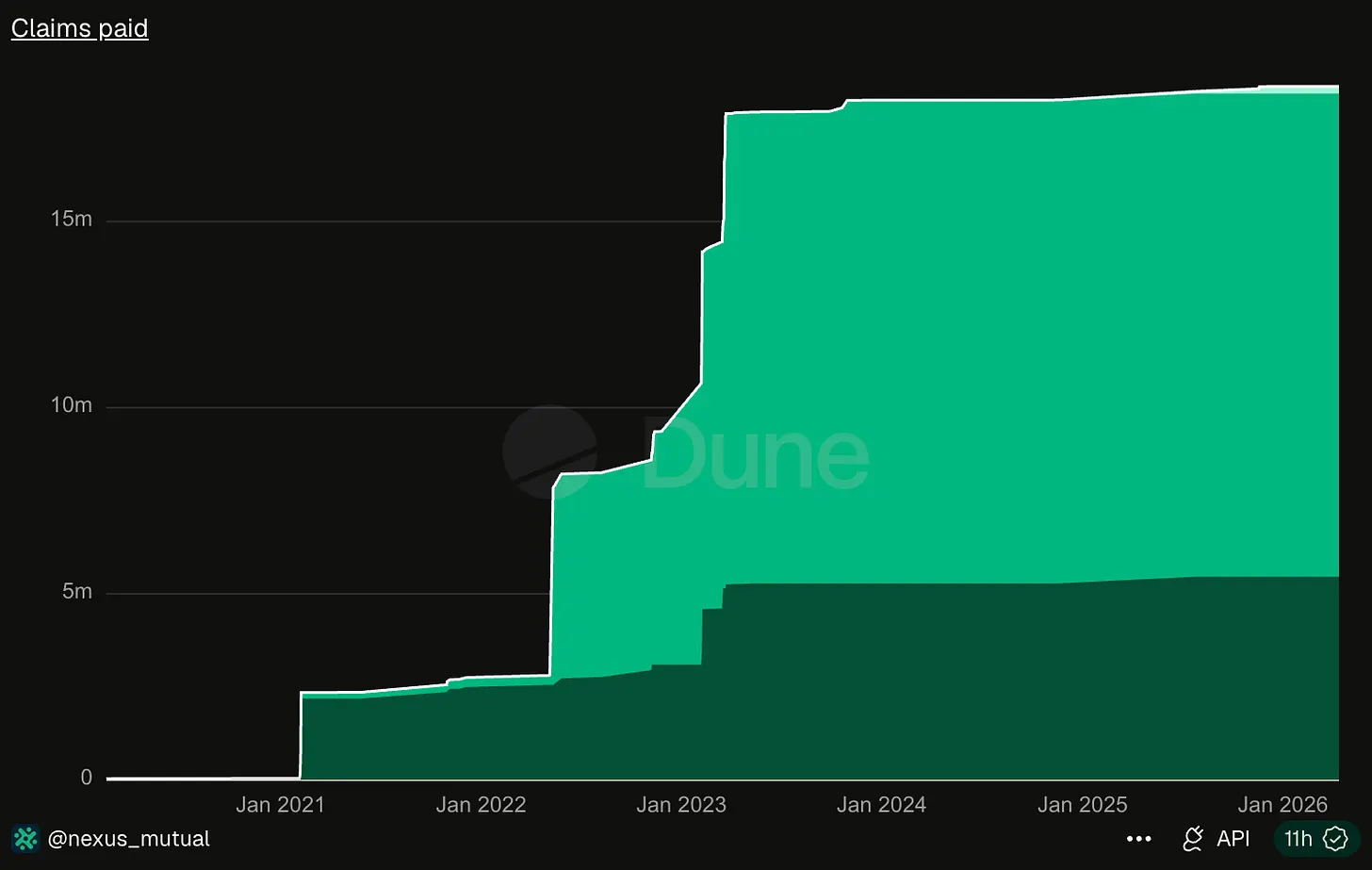
Nexus Mutual is currently the largest DeFi insurance provider. Since its launch in 2019, its total cumulative claims paid amount to just over $18 million.

Data source: Dune Analytics


In April 2026, Kelp DAO suffered a hack, resulting in losses of up to $292 million. The amount stolen in this single incident alone is equivalent to 16 times the total claims paid by this leading insurance institution over seven years.


This forms an extreme contrast with the current situation of traditional insurance's frantic claim denials. Traditional insurance collects high premiums but goes to great lengths to obstruct claims; DeFi insurance, however, generates meager premium income because almost no investors are willing to purchase coverage.


The stable operation of traditional insurance relies on the principle of uncorrelated risks. One house catching fire doesn't cause other houses to be damaged. An insurance company can sell policies to 1 million users, and a single fire claim can be covered by the premiums collected from all. However, DeFi lacks this risk isolation mechanism: security incidents like oracle failures or cross-chain bridge vulnerabilities can chain-react, impacting all lending protocols and liquidity pools built on that underlying asset. The USDC de-pegging event in March 2023 affected all protocols that used USDC as collateral on that day. For a DeFi insurance pool, risks are highly correlated. The underwriter can only bet that losses from security incidents are controllable and that the pool's funds are sufficient to cover them.


In March 2023, Euler Finance was hacked for $197 million, and the risk spread rapidly: Angle Protocol lost $17 million due to holding Euler liquidity tokens, Yield Protocol shut down operations urgently, and other platforms like Inverse Finance were also affected.


Once a protocol has a security vulnerability, it often affects multiple projects. A single extreme incident in one day could even directly deplete the entire claim reserve of an insurance pool.


I compiled the current premium rates for Nexus Mutual and InsurAce and compared them to the native annual percentage yield (APY) of the protocols they insure: Aave V3's USDC deposit APY is about 3.14%, while the insurance premium range is 1.5%–2.5%. After deducting premiums, the net yield is only 0.6%–1.6%. Investors bear on-chain security risks only to end up with returns slightly higher than ordinary bank savings.
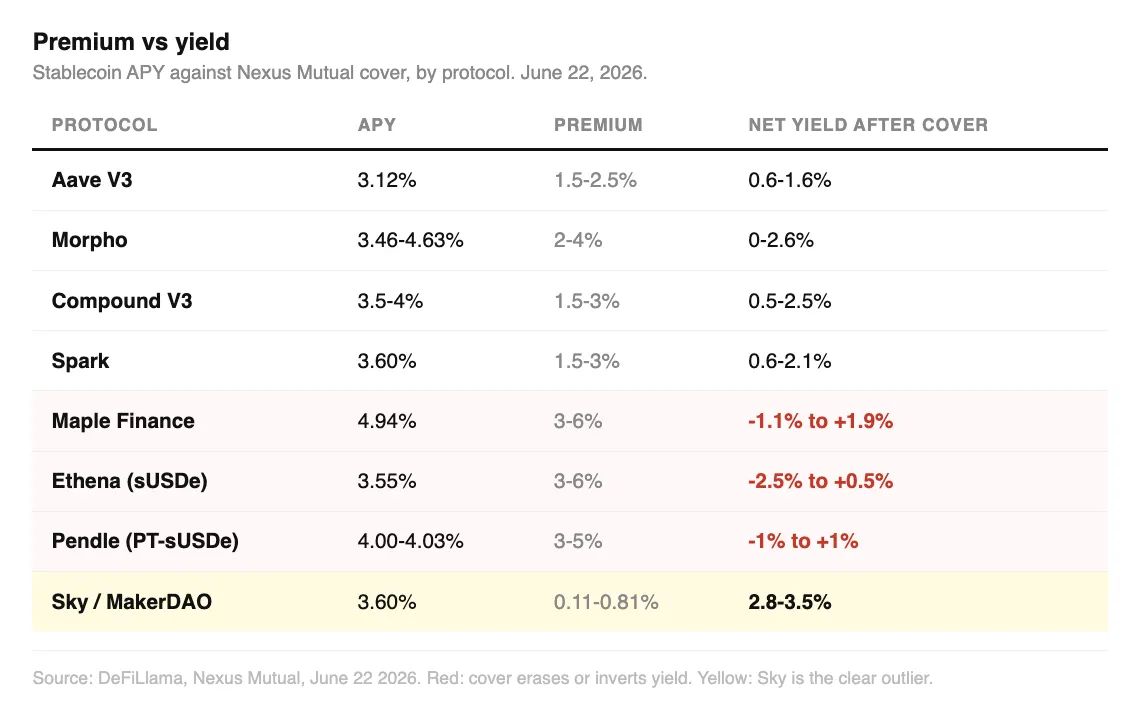


Morpho, Compound, and Spark show similar situations, with native APYs of 3.5%–4%. Premiums consume one-third to half of the yield, leaving minimal profits but with extremely low cost-effectiveness.


Maple Finance's institutional lending pools offer APYs of 4.77%–4.90%, but insurance premiums are as high as 3%–6%. The net yield after insurance ranges from -1.1% to 1.9%. Ethena staking offers APYs of 3.6%–4%, with premiums also at 3%–6%, resulting in net yields of -2.4% to 1%. Purchasing insurance on these two types of platforms can, in extreme cases, lead to losses on the principal for investors.


Only the original MakerDAO (Sky) stands out. Its savings product offers a 3.6% APY, with the lowest insurance premium being only 0.11%. It is widely recognized as the lowest-risk entity within DeFi, retaining a net yield of 2.8%–3.5% after insurance, preserving most of the returns.


Premium pricing strictly corresponds to risk levels, but premiums for emerging platforms are too high, directly consuming the high yields users seek when entering the market.


Crypto investors choose to forgo insurance not out of laziness or recklessness; they understand that in most cases, purchasing insurance equates to zero returns. Even if all DeFi depositors collectively chose full coverage tomorrow, the entire industry could not meet the demand: Nexus Mutual's total pool size is about $81.56 million, and the entire industry's effective coverage capacity is at most a few hundred million dollars. In contrast, the total value locked (TVL) in major protocols amounts to hundreds of billions, a gap of astronomical proportions.


A single large-scale security incident like Kelp DAO would directly drain the vast majority of the industry's insurance reserves.


The historical claims total of $18 million precisely exposes the fragility of the industry's capital pools; the market has never experienced a catastrophic risk event capable of breaching underwriting reserves.


After a user submits a claim to Nexus Mutual, all token-holding members of the platform must vote on whether to pay. Members who vote in favor of paying a claim risk having their own assets directly impaired if the claim ultimately fails to be paid. This mechanism naturally fosters a tendency to deny claims. Traditional insurance employs dedicated underwriters and claims adjusters to balance conflicts, whereas DeFi insurance design merges all responsibilities onto the same group.


Before the 2008 financial crisis, financial risk pricing agencies generally believed a nationwide U.S. housing price collapse was impossible, as they had never experienced it. Insurance giant AIG massively sold risk protection contracts but was completely unable to pay when the market crisis truly erupted.


Before the U.S. government introduced FDIC deposit insurance, ordinary savers had no asset safety net. The Great Depression forced the government to mandate bank insurance, making coverage a hard cost for banks to operate.


In the DeFi space, no one can force protocols like Aave or Morpho to purchase insurance. Smart contract deployment is completely permissionless; there is no entity that can mandate projects to configure risk protection. This also leads to a lack of a safety net to withstand extreme market conditions in the industry.


The three largest claims in Nexus Mutual's history are: the FTX collapse, paid in two installments totaling about $7.3 million; the TribeDAO hack, a $5 million payout; and the Euler Finance hack, a $3.4 million payout. The sum of these three amounts almost equals the platform's total cumulative claims of $18.6 million over seven years.


Now, this mutual insurance platform is shifting towards proactive risk prevention. It has partnered with security audit agencies like Immunefi, Cantina, and Sherlock to launch bug bounty protection products. The protocol only needs to bear 20% of the critical bug bounty cost, with Nexus Mutual covering the rest, pre-funding incentives for white-hat hackers to identify vulnerabilities and avoid theft incidents at the source. Meanwhile, Nexus Mutual is expanding into compliant insurance tranches, attempting to connect crypto risks to reinsurance capital pools and introduce larger external capital to supplement underwriting capacity.


In March 2025, Cantina took a step further by launching an independent native protocol protection product, ensuring users can still receive payouts even if a vulnerability is not discovered early by bounty hunters and the protocol is hacked.


Both of these strategic shifts essentially acknowledge a core reality: on-chain native capital is insufficient to cover on-chain risks. Three fundamental flaws are irreparable: the insurance pool size is too small, risks are highly correlated, and the claim adjudicators and capital providers are the same group.


Nexus Mutual has $81.56 million in Total Value Locked (TVL) according to DeFiLlama, capturing 85% of the DeFi insurance market share. Other players are continuously shrinking: InsurAce peaked at $150 million TVL and is now only $132,000, having completed only one major claim after the UST de-peg in 2022; Sherlock's pool shrank from $60 million to $505,000 within a year; Unslashed Finance has millions of dollars trapped in outdated, un-updated code since late 2024. Other insurance projects have either shut down completely or pivoted to different business models.


A lighthouse warns all ships of hidden reefs but cannot charge passing vessels a fee, making it difficult for anyone to voluntarily fund its construction. The benefits are shared by all, but the cost is borne by the builder alone.


The value of DeFi insurance lies in preventing the spread of chain-reaction liquidation stampedes. Crypto market assets are highly interconnected; only when everyone simultaneously obtains coverage can overall market stability be maintained. But if everyone expects others to buy insurance as a safety net while unwilling to bear the premium cost themselves, ultimately no one will configure insurance, and the risk protection system becomes useless. Protection that no one actively underpins ultimately safeguards no assets.

Trending Cryptos

Related Questions

QWhat is the core reason why DeFi insurance has low adoption, as explained in the article?

AThe core reason is that insurance premiums heavily erode user yields. After deducting premiums, the net returns often barely exceed or even fall below traditional savings rates, making insurance an unattractive cost for risk-seeking DeFi users.

QHow does the risk profile in DeFi differ from traditional insurance, and why is this a problem?

AIn traditional insurance, risks are largely uncorrelated (e.g., one house fire doesn't affect others). In DeFi, risks are highly correlated—a single oracle failure or bridge hack can impact multiple protocols and their underlying assets simultaneously, threatening to drain an entire insurance pool from one event.

QWhat specific example does the article use to illustrate the insufficiency of DeFi insurance pool sizes?

AThe article cites the Kelp DAO hack in April 2026, which resulted in a loss of $292 million. This single loss was 16 times greater than the total historical claims paid out by Nexus Mutual, the largest DeFi insurer, over seven years (~$18 million).

QWhat is a key structural flaw in the claims process for platforms like Nexus Mutual?

AA key flaw is that the same group of token holders who provide the capital for the insurance pool also vote on whether to pay out claims. Since their own assets are at risk if a claim is approved and paid, the system has a built-in incentive to deny claims.

QWhat fundamental economic dilemma does the 'lighthouse' analogy at the end of the article highlight for DeFi insurance?

AThe 'lighthouse' analogy highlights a public goods dilemma. DeFi insurance provides stability and prevents cascading liquidations for the entire ecosystem (a shared benefit), but the cost is borne individually by those who pay premiums. If everyone relies on others to buy insurance, no one will, and the protective system fails.

Related Reads

The Final Piece of Franklin Templeton's Crypto Ambition

Franklin Templeton Completes Crypto Ambition with Acquisition of 250 Digital On June 22, Franklin Templeton announced the acquisition of 250 Digital and established Franklin Crypto, a new division focused on actively managed cryptocurrency strategies for institutional investors. The unit is led by Christopher Perkins and Seth Ginns. This acquisition marks a key piece in Franklin Templeton's multi-year crypto strategy, which began in 2018 with a digital assets team. The firm's crypto product suite now spans three layers: tokenized funds like the blockchain-based money market fund BENJI (~$831M AUM); a series of passive ETFs including Bitcoin (EZBC, ~$368M), Ethereum (EZET), XRP (XRPZ, ~$252M), Solana (SOEZ), and a multi-crypto index fund (EZPZ); and the newly added active management strategies from Franklin Crypto. The company has also expanded its crypto ecosystem through investments in projects like Ethena and Crossmint, and collaborations with blockchains such as Aptos and Sui. With approximately $18B in digital asset AUM and a total firm AUM of ~$1.78T, Franklin Templeton is positioning itself as a comprehensive crypto asset manager for pensions and sovereign wealth funds. In contrast, competitor Fidelity Investments has taken a different path, focusing early on building its own custody and trading infrastructure. Fidelity's Bitcoin ETF (FBTC) holds over $11B, significantly larger than Franklin Templeton's equivalent offering. Both giants' moves underscore the deepening trend of traditional finance entering the crypto space.

Foresight News18m ago

The Final Piece of Franklin Templeton's Crypto Ambition

Foresight News18m ago

Black Tuesday in Japanese and Korean Stock Markets: South Korea Triggers Circuit Breaker, Nikkei Plummets, AI Boom Undergoes Phased Adjustment

"Black Tuesday" for Asian Markets: Korean Stocks Halted by Circuit Breaker, Nikkei Plunges as AI Rally Undergoes Correction Asian stock markets experienced severe turbulence on Tuesday, with South Korea's benchmark KOSPI index plummeting nearly 10% after triggering a market-wide trading halt when its losses exceeded 8%. Japan's Nikkei 225 index also fell sharply by approximately 3.5%, ending an eight-day winning streak. The sell-off was heavily concentrated in the technology and semiconductor sectors, with giants like Samsung Electronics and SK Hynix leading the declines. The plunge reflected a rapid reversal from recent highs, with the KOSPI having retreated over 12% from its mid-June peak. Analysts attribute the sharp correction to multiple converging factors. The direct trigger was weakness in U.S. tech stocks, which fueled profit-taking in overbought Asian markets. Furthermore, stronger-than-expected U.S. jobs data has reinforced expectations that the Federal Reserve will maintain or even raise interest rates, putting pressure on rate-sensitive growth stocks. Structural vulnerabilities also played a role, particularly in South Korea, where the market is highly concentrated in a few semiconductor heavyweights, making it susceptible to shifts in global AI demand and foreign capital outflows. Despite the short-term volatility, the long-term narrative for AI and semiconductors remains intact. Industry forecasts still point to massive growth in global AI capital expenditure over the coming years. South Korean firms like SK Hynix maintain a dominant position in critical segments like High Bandwidth Memory (HBM), with long-term orders secured well into 2027. While near-term fluctuations are expected to continue, driven by U.S. monetary policy signals and upcoming corporate earnings, the current correction may present a buying opportunity for quality assets tied to the enduring AI infrastructure build-out.

marsbit34m ago

Black Tuesday in Japanese and Korean Stock Markets: South Korea Triggers Circuit Breaker, Nikkei Plummets, AI Boom Undergoes Phased Adjustment

marsbit34m ago

Trading

Spot
Futures

Hot Articles

What is DOGE M

Doge Matrix ($doge m): The New Breed of Community-Driven Cryptocurrency Introduction In the ever-evolving landscape of cryptocurrency, new projects constantly emerge, each aiming to capture the interest of investors and enthusiasts alike. One of the latest entrants to this domain is Doge Matrix, represented by the ticker symbol $doge m. This project has attracted attention thanks to its roots in the popular meme culture surrounding Dogecoin, establishing its place within the web3 space. This article aims to provide a comprehensive analysis of Doge Matrix, covering its overview, creator, investors, functionality, timeline, and notable aspects. What is Doge Matrix ($doge m)? Doge Matrix is a community-driven cryptocurrency project that seemingly builds upon the widespread appeal of Dogecoin, a digital currency known for its Shiba Inu mascot and its meme origins. While the overarching objectives of Doge Matrix are not extensively defined, it is characterised by a commitment to harnessing community involvement and support. Unlike traditional cryptocurrencies that often emphasise utility or intrinsic value through underlying technologies, Doge Matrix positions itself within a space that embraces the cultural phenomenon of cryptocurrencies, particularly appealing to those who resonate with the ethos of meme-based assets. Drawing on the strengths of the Dogecoin community, Doge Matrix operates as part of a broader ecosystem, inviting participation and engagement from users who share an interest in cryptocurrency and the digital landscape. Who is the Creator of Doge Matrix ($doge m)? The identity of the creator of Doge Matrix remains unknown. This lack of transparency is not an uncommon occurrence in the cryptocurrency space, where some projects are launched without revealing the identities of their founders. The absence of information regarding the founding team can raise questions among potential investors about the project’s accountability and direction. Who are the Investors of Doge Matrix ($doge m)? As it stands, there is no publicly available information detailing the investors or investment foundations that back Doge Matrix. The project appears to rely primarily on community support rather than institutional investment. This model aligns with the community-driven nature of the initiative, fostering an environment where the direction of the project is shaped by its participants rather than being dictated by a select few financial backers. How Does Doge Matrix ($doge m) Work? The specifics regarding the operational mechanisms of Doge Matrix are somewhat vague, reflecting a broader trend of projects in the meme coin space where innovative functionalities are not always clearly articulated. Nonetheless, Doge Matrix seems designed to tap into the existing cryptocurrency ecosystem by encouraging user participation while tapping into the familiar cultural references associated with Dogecoin. Its potentially unique characteristics derive from community interactions rather than technological advancements, emphasising shared experiences and collaboration among token holders. While the exact innovations have not been explicitly outlined, the project appears to create a space where community members can engage, share ideas, and propel the project's potential forward. Timeline of Doge Matrix ($doge m) Reflecting on the project’s timeline reveals notable events that have defined its journey thus far: November 25, 2024: Doge Matrix reached its all-time high value, marking a significant milestone in its early history. January 1, 2025: Conversely, Doge Matrix hit its all-time low value, illustrating the volatility often associated with cryptocurrencies, especially in the early stages of a project's lifecycle. Ongoing: The project continues to be actively traded and supported by its community, although specific future milestones or objectives have yet to be disclosed. Key Points About Doge Matrix ($doge m) Community Focus At the heart of Doge Matrix is a commitment to community engagement. The project thrives on the premise of collaboration and shared objectives among its members, emphasising the importance of collective effort. Unlike centralised projects that often have a defined leadership structure, Doge Matrix at present showcases a more fluid approach to governance, where every community member's voice matters. Volatility The cryptocurrency market is notorious for its volatility, and Doge Matrix is no exception. Its price history reflects significant fluctuations between high and low values, which is typical of many new cryptocurrencies but underscores the risks associated with investment in emerging tokens. Lack of Detailed Information One of the most striking features about Doge Matrix is the scarcity of detailed information regarding its technological underpinnings and operational mechanisms. This ambiguity necessitates that potential investors conduct thorough due diligence before engaging with the project. Conclusion In summary, Doge Matrix ($doge m) illustrates a new wave of cryptocurrency projects that lean heavily on community engagement and cultural relevance. While lacking in certain specifics—such as clear leadership, defined objectives, and detailed functionality—the project has managed to generate interest within the crypto community, leveraging the established appeal of meme culture. As with any investment in the cryptocurrency space, understanding the inherent risks and conducting comprehensive research is essential for potential participants. Doge Matrix stands as a reminder of the dynamic, sometimes unpredictable nature of the crypto industry, marked by constant evolution and enthusiasm for community-driven initiatives.

526 Total ViewsPublished 2025.02.03Updated 2025.02.03

What is DOGE M

What is $M

Understanding Mantis ($M): A New Era in Cross-Chain Interoperability In the continually evolving landscape of Web3 and cryptocurrency, new projects strive to offer innovative solutions aimed at enhancing the user experience and expanding functional possibilities within the decentralised financial ecosystem. One such project garnering attention is Mantis ($M), a pioneering protocol founded on the principles of cross-chain interoperability and intent-based settlements. This article delves into the essential aspects of Mantis, including its core functionality, creators, investment backing, innovative features, and critical milestones. What is Mantis ($M)? Mantis is described as a multi-domain intent settlement protocol that simplifies cross-chain interactions, enabling users to execute complex financial transactions across various blockchain platforms seamlessly. The protocol operates through three primary layers: Intent Expression: Users can articulate their transaction goals using natural language facilitated by the DISE LLM, an advanced AI language model. For instance, a user might express a desire to swap Ethereum (ETH) for Solana (SOL) with a specific slippage tolerance of 1%. Execution: This layer employs a network of solvers that compete to fulfil user intents. Transactions are executed using mechanisms such as Coincidence of Wants (CoWs) and Order Flow Auctions (OFAs), which ensure that user demands are met optimally. Settlement: Leveraging the Inter-Blockchain Communication (IBC) protocol, Mantis enables atomic cross-chain transactions, allowing users to operate across various supported chains, including Ethereum, Solana, and Cosmos. Mantis is engineered to introduce native yield generation for idle assets, employing cryptographic proofs to maintain the integrity of transactions throughout the entire process. Creators & Development Team Mantis was conceived by the Composable Foundation, a research-driven organisation notable for its emphasis on blockchain interoperability solutions. This foundation collaborates with esteemed academic institutions, including Harvard University and the University of Lisbon, contributing to extensive research and development efforts that inform Mantis's architecture and functionality. The Composable Foundation’s commitment to fostering innovation in the blockchain space positions Mantis as a robust solution for the growing demand for interoperability among multiple blockchain networks. Investors & Backing While specific details about individual investors have not been publicly disclosed, Mantis enjoys substantial backing from various entities, including: Ecosystem grants from IBC-enabled chains, which support the protocol's growth and integration within decentralised finance ecosystems. Strategic partnerships with infrastructure providers that enhance Mantis's network capabilities and deployment strategies. Funding through the Composable Foundation's treasury, ensuring sustained financial support for ongoing development and operational costs. These collaborative efforts reflect a consensus among stakeholders about the importance of enhancing cross-chain functionality and the potential utility of Mantis's infrastructural innovations. Key Innovations Mantis sets itself apart through several pioneering innovations that enhance its functionality and utility: Chain-Agnostic Intents: Users can initiate transactions from any supported chain while settling on another. This flexibility empowers users, driving increased interaction among different platforms. AI-Powered Interface: The integration of DISE LLM allows users to conduct complex DeFi operations using natural language, thereby simplifying interactions and making blockchain technology accessible to a broader audience. Cross-Domain MEV Capture: Mantis creates an internal market for maximal extractable value (MEV) through competitions among solvers. This innovative approach allows for greater efficiency and value extraction in complex transactions. Modular Settlement Layer: The protocol supports various verification methods, including zero-knowledge proofs and optimistic rollups, providing a versatile framework that can adapt to emerging blockchain technologies. Historical Timeline Mantis's development is marked by several critical milestones that chart its trajectory and growth: | Year | Milestone | |————|————————————————————————-| | 2022 | Initial concept development within the Composable Foundation's research division. | | Q3 2024 | Launch of the testnet with bridging capabilities between Solana and Ethereum. | | Q1 2025 | Anticipated Token Generation Event (TGE) alongside the mainnet launch. | | Q2 2025 | Expected integration of DISE LLM and expansion of cross-chain capabilities. | | 2025 H2 | Planned support for over 15 chains through further IBC upgrades. | This timeline outlines Mantis's evolution, from conceptual discussions to active implementation and future growth phases. Ecosystem Growth Strategy Mantis's strategy for ecosystem growth includes several initiatives designed to encourage user participation and developer engagement: Credits System: Users can earn protocol credits by providing liquidity and engaging in referral programmes. These credits are redeemable for incentives in the future, fostering a robust user community. Modular Software Development Kit (SDK): This toolkit empowers developers to create applications based on intent-driven models utilising Mantis's infrastructure, thus promoting innovation within its ecosystem. Governance Model: As the protocol matures, $M token holders will have a voice in protocol governance, allowing them to vote on proposed upgrades and changes, thereby enhancing community engagement and decentralisation. Mantis represents a significant advancement in the realm of cross-chain architecture. By seamlessly integrating advanced AI algorithms with a robust settlement framework, Mantis seeks to tackle the problems of fragmentation within multi-chain ecosystems. Its innovative approach prioritises improved user experiences while adhering to the foundational principles of decentralisation and security, setting a new standard for the future interoperability of blockchain technologies. As Mantis continues its journey of growth and implementation, it promises to be a project to watch closely in the competitive landscape of Web3 and decentralised finance. With its focus on crossing boundaries and elevating user engagement, Mantis is poised to be an integral part of the future developments in the cryptocurrency space.

54 Total ViewsPublished 2025.03.18Updated 2025.03.18

What is $M

Discussions

Welcome to the HTX Community. Here, you can stay informed about the latest platform developments and gain access to professional market insights. Users' opinions on the price of M (M) are presented below.

活动图片