Grayscale: The Three Evolution Stages of Stock Tokenization and a Review of Core Beneficiary Public Blockchains

marsbitPublished on 2026-07-14Last updated on 2026-07-14

Abstract

Grayscale outlines three key phases in the adoption of tokenized stocks, each benefiting different blockchain infrastructures. Phase 1: The "Wrapper Model." Third-party platforms create tokens representing claims on an SPV that holds the underlying stocks. While not conferring direct ownership, these tokens enable DeFi use and retail access. This currently dominant model (~70% by market cap) primarily operates on Ethereum, Solana, and BNB Chain. Phase 2: The "Entitlement Model." Major financial institutions like DTCC tokenize existing, regulated securities through their post-trade infrastructure to enable on-chain settlement and movement. The upcoming DTCC pilot on Canton Network exemplifies this institutional-led approach. Phase 3: The "Issuer-Led Model." Companies natively issue securities directly on a blockchain, as recently demonstrated by Securitize. This model offers the greatest long-term potential but requires more regulatory clarity. It is expected to favor open-architecture blockchains like Ethereum and Solana, as well as hybrid networks like Avalanche. The report posits that all three models will coexist. The primary blockchain networks poised to benefit from tokenized equity growth are Ethereum, Solana, BNB Chain, Avalanche, and Canton Network.

Author| Zach Pandl, Head of Research at Grayscale

Compiled| WuBlockchain

The tokenization process of global stock markets is advancing. Tokenized stocks promise various benefits for users, including 24/7 trading. The next significant development will be DTCC's [1] launch of a tokenization pilot on the Canton Network [2]. This pilot will allow tokenized stocks and other assets to circulate within the regulated financial system via blockchain infrastructure.

We believe stock market tokenization will progress through three stages, each bringing value to different types of blockchain infrastructure (see Chart 1).

The first stage is the third-party "wrapper" model [3]. In this model, an issuer holds stocks through a special purpose vehicle (SPV) [4], and the tokenized stock represents a claim on that SPV. Currently, over 70% of tokenized stocks by market value use this model. Wrapper-type tokenized stocks do not represent true stock ownership but can be used in DeFi and may appeal to retail investors. These assets currently trade on networks such as Ethereum, Solana, and BNB Chain.

The second stage is the "entitlement" model [5], represented by DTCC's pilot. Instead of creating new versions of securities, DTCC will record existing eligible securities on-chain through its regulated post-trade infrastructure, with the Canton Network serving as the initial blockchain network for this pilot.

The third stage is the issuer-led model, where companies directly issue securities natively on-chain. Last week, Securitize [6] became the first publicly listed company to tokenize its own common stock upon listing on the New York Stock Exchange. We believe this model holds the greatest long-term potential but still requires further regulatory clarity. In our view, the issuer-led model will be more favorable to open-architecture blockchains like Ethereum and Solana, as well as hybrid networks like Avalanche.

These three tokenization models are likely to coexist for many years to come.

Core View: Multiple models exist for tokenized stocks. In our view, the blockchain networks most likely to benefit from tokenization growth include Ethereum, Solana, BNB Chain, Avalanche, and the Canton Network.
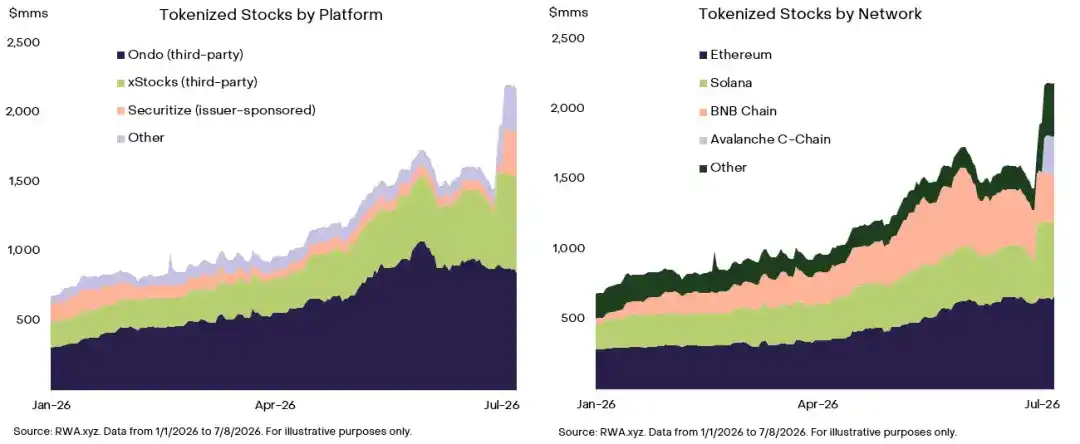
Chart 1: Third-party platforms currently dominate the tokenized stock market, while Ethereum, Solana, and BNB Chain hold the majority of on-chain assets.

Notes:

[1] DTCC: The Depository Trust & Clearing Corporation, a core U.S. post-trade securities infrastructure entity responsible for services such as clearing, settlement, and custody of securities transactions.

[2] Canton Network: A blockchain network for institutional financial assets, emphasizing privacy, compliance, and interoperability of assets among different financial institutions.

[3] Wrapper model: A model where a third-party platform holds underlying stocks through an intermediary structure and issues on-chain tokens representing claims on that structure. Investors hold claims on the structure rather than direct ownership of the stocks themselves.

[4] SPV: Special Purpose Vehicle. In the context of tokenized stocks, it typically refers to an entity established by the issuer to hold the underlying stock assets, with the investors' tokens representing claims on that entity.

[5] Entitlement model: A model that does not re-issue a new security but instead records or maps existing eligible securities onto a blockchain through a regulated post-trade system, enabling them to circulate on blockchain infrastructure.

[6] Securitize: A platform for digital securities and real-world asset tokenization. The article mentions its simultaneous tokenization of its own common stock upon listing on the NYSE.

Trending Cryptos

Related Questions

QWhat are the three evolutionary stages of stock tokenization as described in the article?

AThe three evolutionary stages are: 1) The third-party 'wrapper' model, 2) The 'entitlement' model, and 3) The issuer-led model, where companies natively issue securities on-chain.

QWhich blockchain networks are currently hosting most of the tokenized stock assets in the wrapper model stage?

AEthereum, Solana, and BNB Chain are currently hosting most of the tokenized stock assets in the wrapper model stage.

QWhat is the Canton Network, and what role does it play in the tokenization pilot mentioned?

ACanton Network is a blockchain network for institutional financial assets, emphasizing privacy, compliance, and interoperability between financial institutions. It is designated to be the first blockchain network for DTCC's tokenization pilot, which will allow tokenized stocks and other assets to flow within the regulated financial system via blockchain infrastructure.

QAccording to the article, which blockchain networks are seen as most likely to benefit from the growth of tokenized stocks in the long term?

AThe article suggests that Ethereum, Solana, BNB Chain, Avalanche, and Canton Network are the blockchain networks most likely to benefit from the growth of tokenized stocks.

QWhat is a key advantage of the 'entitlement model' of tokenization, as represented by the DTCC pilot?

AA key advantage of the 'entitlement model' is that instead of creating new versions of securities, it tokenizes existing, eligible securities through regulated post-trade infrastructure (like DTCC), enabling them to be transacted and settled on-chain while maintaining their established regulatory status and legal framework.

Related Reads

Wall Street Morning Report: U.S. Stocks Suffer Collective Setback, Apple Hits New High Against the Trend, Tonight's CPI and Waller's Hearing to Determine Interest Rate Path

Wall Street Morning Report: U.S. stocks fell collectively, while Apple hit a new record high. Key events including tonight's CPI data and Fed Chair Walsh's testimony will set the direction for interest rates. Markets experienced a sharp "risk-off" move due to escalating Middle East tensions and unexpected hawkish signals from the Federal Reserve. Major indices declined, with the Nasdaq Composite leading losses, down 1.55%. The VIX fear index surged over 14%. Geopolitical tensions spiked as the U.S. conducted consecutive airstrikes on Iran and announced a maritime blockade of Iranian ports, set to begin on July 15. This triggered a panic-driven rally in oil, with WTI crude soaring over 9% to breach $80 per barrel. Safe-haven flows bolstered the U.S. dollar and Treasury yields, while gold plunged nearly 3%, losing its $4,000 level. Rate markets now price a nearly 50% chance of a Fed rate hike in July, up significantly from prior expectations, following hawkish commentary from Fed Governor Waller. The tech sector, particularly AI-related stocks, faced intense selling pressure. The Philadelphia Semiconductor Index plunged 4%. Notable decliners included SK Hynix (down 9% on its second trading day as an ADR), Nvidia, AMD, and Intel. In contrast, Apple shares rose 0.63% to a record high, viewed as a stable haven away from the costly AI data center arms race. Key events to watch include the U.S. June CPI inflation data and Fed Chair Walsh's Congressional testimony tonight, which will critically influence the Fed's policy path. Major bank earnings also begin today. The formal implementation of the U.S. maritime blockade against Iran on July 15 and upcoming events like TSMC's Q2 earnings and a SpaceX Starship test flight remain in focus.

marsbit21m ago

Wall Street Morning Report: U.S. Stocks Suffer Collective Setback, Apple Hits New High Against the Trend, Tonight's CPI and Waller's Hearing to Determine Interest Rate Path

marsbit21m ago

Crude Oil Surges 10% in Intraday Trading! US Military Restores Blockade on Iran, Trump Warns of 'Heavy Blows' Tonight and Tomorrow, Imposes 20% Fee on Strait Shipping

Crude oil prices surged up to 10% intraday as tensions between the US and Iran escalated sharply. President Trump announced the reinstatement of a maritime blockade against Iran, targeting its ships and their customers, while stating the Strait of Hormuz would remain open to all other nations. He further declared that the US, as the "guardian" of the strait, would impose a 20% fee on all cargo transiting the strategic waterway to compensate for security costs. The US Central Command confirmed the naval blockade would commence on July 14 (GMT). Following Trump's statements, reports emerged of explosions near Iran's Larak Island and the port of Bandar Abbas, though Iranian authorities did not confirm their nature. Iran's Foreign Minister criticized the proposed 20% fee as excessive, asserting Iran's role as the guardian of the strait. An Iranian military spokesperson warned of a strong response to any unauthorized US interference in the waterway. The United Nations' International Maritime Organization (IMO) expressed opposition to charging tolls for passage through international straits, stating such measures lack legal foundation. Market reactions were pronounced, with Brent crude briefly surpassing $83 and WTI above $78. The situation intensified as Trump notified Congress of renewed hostilities with Iran, following US airstrikes on Iranian targets.

marsbit24m ago

Crude Oil Surges 10% in Intraday Trading! US Military Restores Blockade on Iran, Trump Warns of 'Heavy Blows' Tonight and Tomorrow, Imposes 20% Fee on Strait Shipping

marsbit24m ago

How to Regulate Single-Stock Leveraged ETFs? On Thursday, the Entire Market Is Watching This Korean Government Meeting

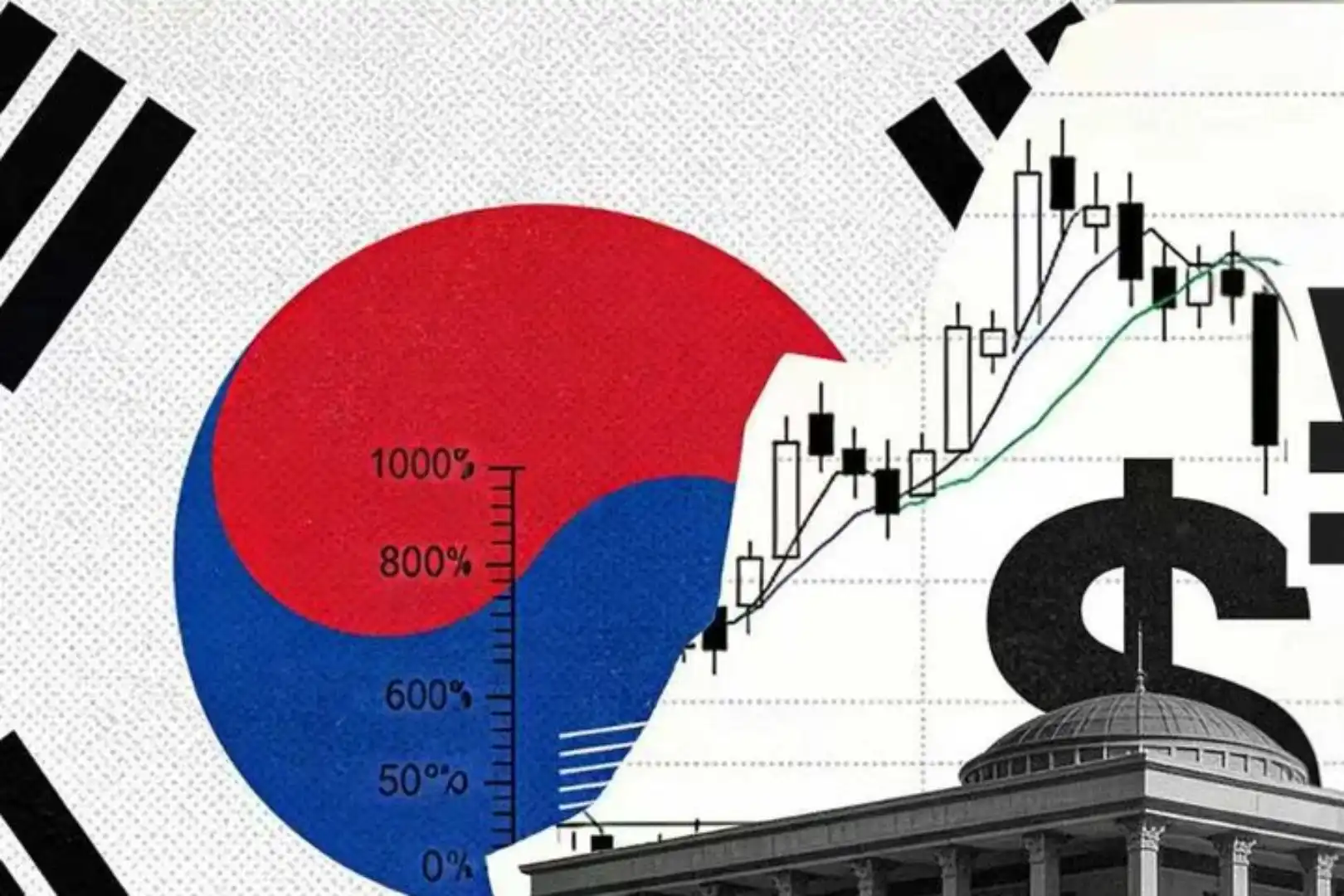
The highest-level economic coordination body in South Korea, the "F4" comprising the Ministry of Economy and Finance, the Financial Services Commission, the Bank of Korea, and the Financial Supervisory Service, will hold an emergency meeting on Thursday to discuss regulatory measures for single-stock leveraged ETFs. These products, launched just six weeks ago, have been widely blamed for exacerbating market volatility. The KOSPI's 8% plunge on Monday triggered the year's seventh trading halt, intensifying scrutiny. Regulators have expressed rare public regret over approving the products. FSS Governor Lee Bok-hyun stated he "regretted not doing everything possible to prevent" their introduction and acknowledged structural problems, citing massive retail investments and legal complications from a rushed rollout. Possible countermeasures under discussion include raising margin requirements, imposing daily price limits, and adjusting leverage caps. However, officials admit these may be temporary fixes. Data confirms the amplified volatility. Since the ETFs' launch, days with KOSPI moves exceeding 3% have nearly doubled. Trading halts have reached record levels, surpassing the 2008 financial crisis peak. The products allow 2x leveraged bets on giants like Samsung Electronics and SK Hynix. Their daily rebalancing to match returns is seen as mechanically fueling market swings. The outcome of Thursday's F4 meeting is highly anticipated, with expectations leaning towards stricter controls on leverage, investor access, or other structural constraints to curb the products' market impact.

marsbit40m ago

How to Regulate Single-Stock Leveraged ETFs? On Thursday, the Entire Market Is Watching This Korean Government Meeting

marsbit40m ago

AI Overhauled Terence Tao's 30-Year-Old Website, Uncovering Two Bugs Hidden for Over Two Decades in the Process

AI Revamps Terence Tao's 30-Year-Old Website, Unearthing Two 20-Year-Old Bugs in His Code Terence Tao, a renowned mathematician, has enlisted an AI agent to overhaul his personal academic website, which was built in 1997 with a static HTML, manually-maintained "Web 1.0" architecture. In just one day, the agent migrated 560 papers and preprints, 374 travel logs, 68 courses, 19 books, and 29 old math applets to a new system on GitHub Pages. The new site is structured around YAML files as the "single source of truth," with static HTML pages automatically generated from this data—a fundamental shift from maintaining individual documents to managing a centralized database. During the migration, the AI uncovered inconsistencies, outdated entries, and broken links that had accumulated over nearly three decades of manual updates. It also successfully ported a set of small educational Java 1.0 applets to JavaScript. Notably, while reviewing this translation, Tao found only one new bug introduced by the AI. Conversely, the AI identified two subtle bugs in his original Java code that he was previously unaware of. Tao emphasizes the project highlights AI's potential for automating tedious "digital housekeeping"—routine tasks like data migration and website maintenance that are costly and error-prone when done manually. He also revived a 27-year-old stalled project: a special relativity visualizer or "Minkowskian Inkscape." With AI assistance, a working alpha version was built in two hours. While AI still requires human oversight for critical work, Tao argues that for such structured, non-core tasks, "AI + human review" can result in lower error rates and drastically lower correction costs compared to purely manual maintenance over decades.

marsbit40m ago

AI Overhauled Terence Tao's 30-Year-Old Website, Uncovering Two Bugs Hidden for Over Two Decades in the Process

marsbit40m ago

Trading

Spot

Hot Articles

How to Buy CORE

Welcome to HTX.com! We've made purchasing CORE (CORE) simple and convenient. Follow our step-by-step guide to embark on your crypto journey.Step 1: Create Your HTX AccountUse your email or phone number to sign up for a free account on HTX. Experience a hassle-free registration journey and unlock all features.Get My AccountStep 2: Go to Buy Crypto and Choose Your Payment MethodCredit/Debit Card: Use your Visa or Mastercard to buy CORE (CORE) instantly.Balance: Use funds from your HTX account balance to trade seamlessly.Third Parties: We've added popular payment methods such as Google Pay and Apple Pay to enhance convenience.P2P: Trade directly with other users on HTX.Over-the-Counter (OTC): We offer tailor-made services and competitive exchange rates for traders.Step 3: Store Your CORE (CORE)After purchasing your CORE (CORE), store it in your HTX account. Alternatively, you can send it elsewhere via blockchain transfer or use it to trade other cryptocurrencies.Step 4: Trade CORE (CORE)Easily trade CORE (CORE) on HTX's spot market. Simply access your account, select your trading pair, execute your trades, and monitor in real-time. We offer a user-friendly experience for both beginners and seasoned traders.

5.8k Total ViewsPublished 2024.03.29Updated 2026.06.02

How to Buy CORE

Discussions

Welcome to the HTX Community. Here, you can stay informed about the latest platform developments and gain access to professional market insights. Users' opinions on the price of CORE (CORE) are presented below.

活动图片