Everyone thought AI should first help mathematicians prove theorems, but Terence Tao had it migrate his 30-year-old web pages. In one day, it moved 560 papers and preprints, 374 travel records, 68 courses, 19 books, and 29 math applets, even finding two bugs in code he wrote over twenty years ago that he was unaware of.
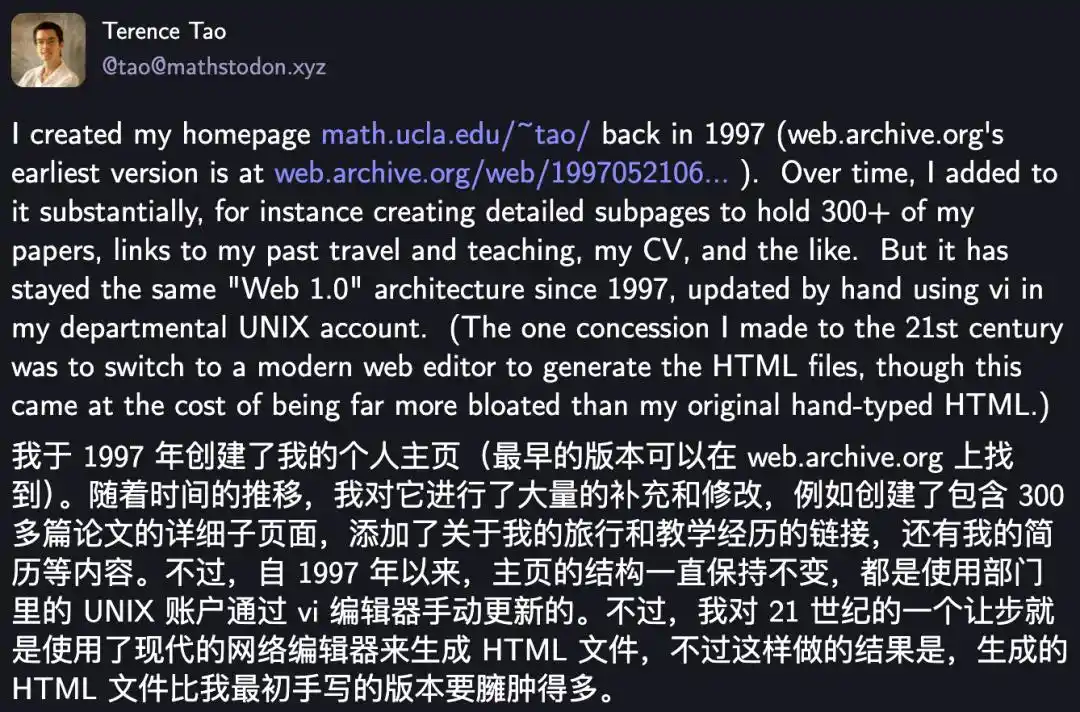
The website was built in 1997. Changing a single line meant opening a terminal and manually editing HTML, a maintenance task that persisted for nearly thirty years.
Recently, Terence Tao handed over his personal homepage to an AI agent.
In just one day, 560 papers and preprints, 374 travel logs, 68 courses, 19 books, and 29 small math programs were migrated en masse from a nearly 30-year-old architecture and given a new home on GitHub Pages.
More interesting than the migration itself were the discoveries along the way.
The AI sifted through the nearly three-decade-old site, uncovering a pile of contradictory information, outdated entries, and broken links. These were errors he himself had introduced piecemeal over the thirty years.
It also casually ported those old applets written in Java 1.0 to JavaScript and found two bugs in the code Tao wrote over two decades ago that he himself never knew existed.
This time, AI didn't go off to prove theorems. What it did for the mathematician was the "digital housekeeping" they least want to touch.
A Nearly 30-Year-Old Architecture, He Kept It Going Until 2026
Tao's homepage was built in 1997 when he was still a Hedrick Assistant Professor at UCLA. The page featured a long list of manually curated external links, ranging from the sci.math newsgroup to his favorite series, *The Wheel of Time*.
It was standard Web 1.0. One page per topic, a screen full of text links, all maintained manually.
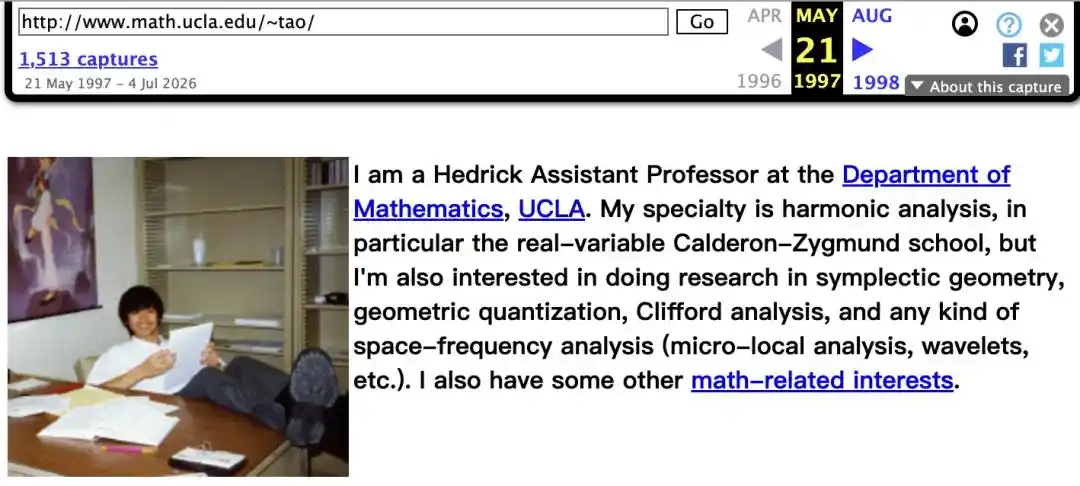
May 21, 1997: Terence Tao, then an assistant professor, and his newly built homepage.
For nearly thirty years, this architecture never changed.
Tao kept adding to it: detailed subpages for over three hundred papers, teaching records, travel schedules, CV, book errata. The method was always to edit page by page and upload manually, using vi in a Unix account in the early days.
His only concession to the 21st century was switching to a modern web editor to generate HTML, at the cost of code that was much more bloated than his original hand-typed version.
Content grew linearly, but maintenance costs grew exponentially. At one point, he moved book pages and career advice to a blog, offering some relief, but it was still cumbersome.
When content piled up and the cost of making changes soared past a certain threshold, you start to let those errors stay put.
Those Java applets died a more definitive death. Browsers abandoned Java 1.0, and he alone didn't have the energy to port over twenty programs to a new language, so the pages just hung there, for a decade.
YAML is the Truth; The Webpage is Just a 'Printout'
Tao said he only recently realized: with AI agents, migrating this nearly 30-year-old system should have been a routine matter.
So, he tried. The process was "fairly painless," he said.
The key was that he didn't ask the AI to rewrite a bunch of HTML. Instead, he had the AI rebuild a data pipeline.
This new repository is called tao-web, and its logic resembles a printing house.
The master copy is the YAML files in the data directory, with one folder for each of the eight content types; schema manages the format, dictating what each field should look like.
Two Python scripts: one for validation, one for printing. If validation fails, the code can't even be pushed. The printed webpages go into the site directory, not the version control.
A final push to the main branch triggers GitHub Actions to automatically validate, print, and deploy.
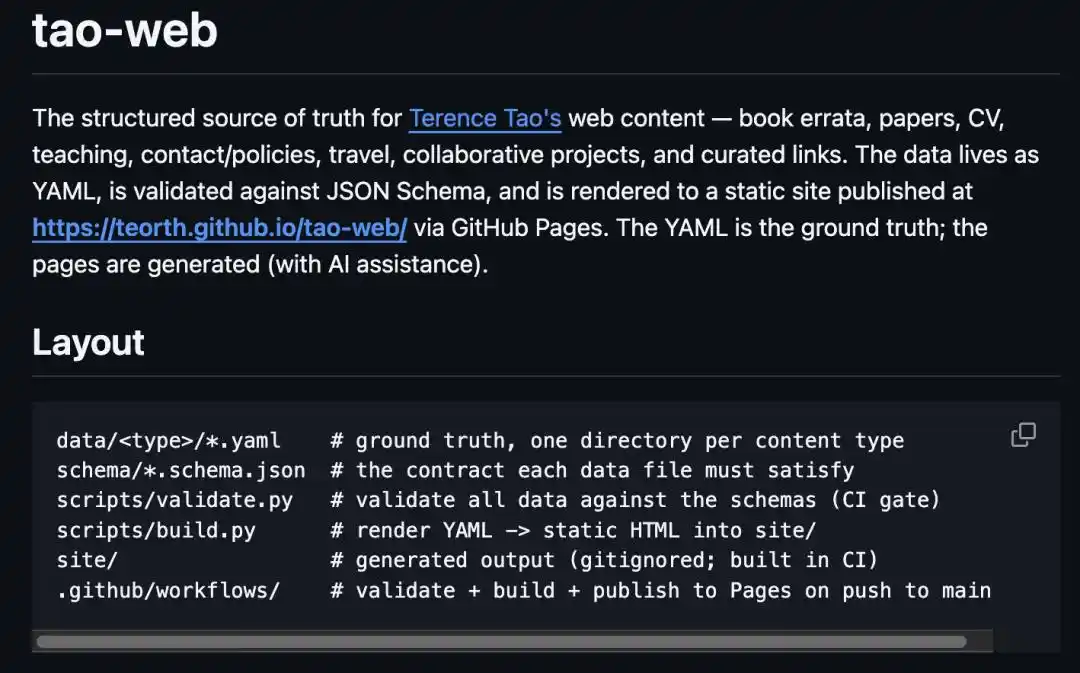
The tao-web repository. The README clearly states: YAML is the single source of truth; webpages are generated from it. (Image source: GitHub teorth/tao-web)
A line in the repository's README underpins the entire architecture: YAML is the single source of truth; webpages are generated from it.
It's followed by an operational rule: modify data, never modify the generated HTML in the site directory.
In the old system, each page was an independent fact. The same piece of information scattered across five pages; miss one when updating, and they start "fighting."
In the new system, a fact exists only in one place. Webpages are demoted to a display layer, like a sheet of paper that can be reprinted at any time.
Thus, a personal knowledge base transforms from a collection of documents into a database.
AI Found Two Bugs in His Old Code
After moving the data, Tao conducted a second experiment.
Starting in 1999, to visualize topics for his complex analysis and linear algebra classes, he wrote a series of small programs in Java 1.0. They were well-received back then.
Later, browsers stopped supporting that version of Java, rendering the whole collection obsolete.
Now, he had the agent port them to JavaScript. Around 20 small programs were revived in a few hours.
Large language models can introduce various obvious or subtle bugs when writing code. In this porting effort, Tao only found one: a complex analysis applet behaved oddly when dragged outside the main display frame.
Conversely, the agent found two bugs in his original code that he had never been aware of.
Weighing the gains and losses, his judgment was: net zero change in code quality.
A Fields Medalist had two errors pointed out by AI in code he wrote over two decades ago.
He immediately drew a boundary around this conclusion: these applets are auxiliary visual aids, not critical components of mathematical proofs, so the risk of bugs was inherently low.
Drag outside the box, and the user notices. Get a proof wrong, and that's a professional accident.
This boundary is precisely the key to Tao's methodology.
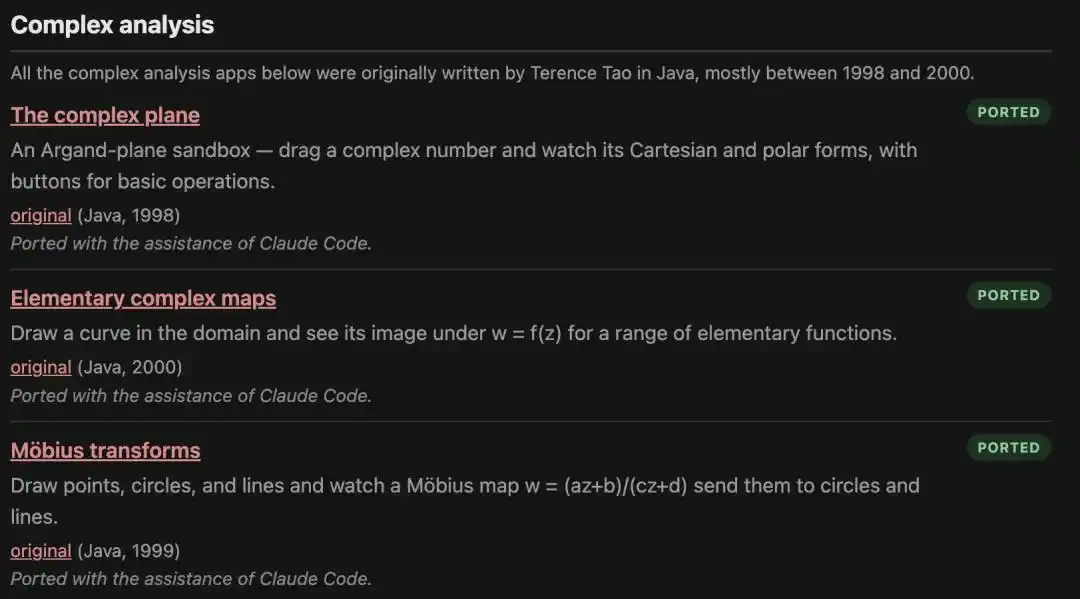
The complex analysis programs were originally written by Tao in Java between 1998 and 2000. Now, each is labeled: Ported with assistance from Claude Code. (Image source: teorth.github.io/tao-web)
Errors Aren't Scary; Being Unable to Fix Them Is
Tao didn't avoid the hallucination issue.
He explicitly stated that modern AI still has a tendency to hallucinate, potentially introducing new errors during the migration.
But after his personal review, the error rate "does indeed seem lower than before." More importantly, large-scale error correction has become much easier.
Of course, this is his impression after manual review, not a figure derived from running evaluations.
Tao isn't comparing AI to "perfection." He's comparing "AI plus human review" to his own "pure manual maintenance over thirty years."
Manual maintenance itself is a continuous error-generating machine; it's just that it's been generating errors for thirty years, and no one had the energy to check.
Most debates about AI get stuck on the single question of "will it make mistakes?" Tao's focus is on comparing which has a lower error rate and which has a smaller cost for correction.
Existing errors aren't terrifying; what's terrifying is being unable to fix them. In the old site, changing one piece of info required checking five pages. In the new site, change one line of YAML, and the entire site rebuilds automatically.
An Idea Shelved for 27 Years, Completed in Two Hours
After porting the old programs, he decided to take another step.
In 1999, he had an ambitious idea: create a visualization tool for special relativity.
He wanted a canvas for drawing relativity: place a worldline, switch to another observer's frame, and the entire diagram would warp according to the rules of relativity. In his words, "Inkscape in Minkowski space."
He even started writing Java code for it but was ultimately deterred by the code complexity, and the project stalled.
He vibe-coded with the agent for two hours, and the 1999 concept was brought to life.
On July 11, this spacetime diagram simulator went online, becoming the first original application on the new site. He marked it as an alpha version.
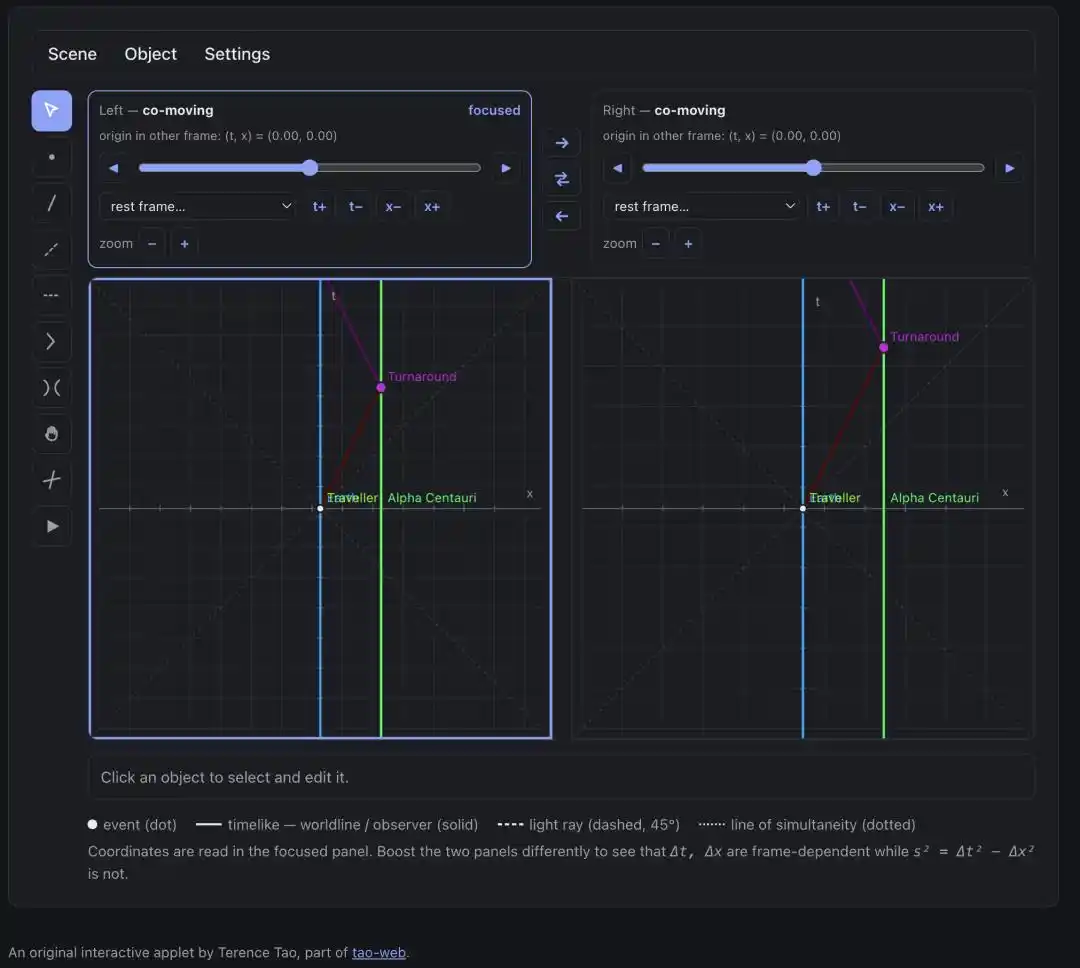
The spacetime diagram simulator, conceived in 1999 and launched 27 years later. The same interstellar journey drawn in two different reference frames. (Image source: teorth.github.io/tao-web)
What stopped him back then wasn't the math; it was the code complexity. Twenty-seven years later, that gap has been filled.
Tao offered a final footnote to the whole affair.
He said webpage maintenance is probably one of the least glamorous, least exciting parts of an academic workflow. And precisely this kind of tedious routine task is particularly suitable for modern platforms, like GitHub, and particularly suitable for automation tools, which include both modern AI and traditional deterministic scripts.
How many labs, journals, and research institutions are still burdened with decades of HTML, Excel, and local directories? The AI agent's first real-world job might be as a migration engineer for these "digital assets."
Of course, this demonstrates that AI is suitable for data migration, structuring, and automated maintenance. It doesn't mean AI can reliably handle all academic data yet, nor does it mean human verification can be omitted.
What's truly changed is the relationship between a mathematician and his three-decade accumulation of work: in the past, he personally managed and maintained this accumulation; now, he is the final gatekeeper.
References:
https://mathstodon.xyz/@tao/116893088594916122
https://terrytao.wordpress.com/2026/07/11/old-and-new-apps-via-modern-coding-agents/
https://github.com/teorth/tao-web
https://teorth.github.io/tao-web/https://news.ycombinator.com/item?id=48880170
This article is from WeChat public account "Xin Zhi Yuan," author: ASI Revelation.