Anthony Scaramucci Signals Bitcoin Bottom, Citing Low RSI And Retail Apathy

bitcoinistPublished on 2026-06-18Last updated on 2026-06-18

Abstract

Anthony Scaramucci, citing low retail interest, depressed sentiment, and weak momentum indicators like RSI, suggests Bitcoin may be nearing a cycle bottom. He remains a significant holder and bullish long-term, anticipating a stronger rally could begin in late 2026 or early 2027. His contrarian thesis posits that current market apathy and thin participation create conditions where even modest new demand could significantly move the price. However, the analysis notes that while weekly RSI is low, it may not be at historic bear-market lows, requiring a nuanced view. Ultimately, Scaramucci's argument frames the present weakness as a potential accumulation phase before the next bullish cycle, pending a future catalyst like ETF flows or improved macro conditions.

Anthony Scaramucci is leaning into a contrarian Bitcoin setup, arguing that weak retail attention and depressed sentiment could be closer to a cycle-bottom signal than a reason to walk away from the asset.

TL;DR

  • Scaramucci says he still owns a lot of Bitcoin and remains bullish.
  • He expects a stronger Bitcoin rally to begin in late Q4 2026 or early 2027.
  • His argument rests on low sentiment, thin demand, weak search interest, and low RSI conditions.
  • The RSI claim needs nuance: Bitcoin’s weekly RSI may be low, but not necessarily at an all-time low.

Scaramucci Points To Apathy As A Signal

In an interview shared by Altcoin Daily, Scaramucci said he still likes Bitcoin and owns a substantial amount of it. His broader point was not that the market feels strong now. It was that the current lack of excitement may be part of the bullish setup.

That is a familiar contrarian argument in crypto. When search interest is low, retail attention fades, and price action feels dull, the market can become thin. In thin markets, even a modest demand shock can move price more aggressively because fewer participants are positioned for upside.

Scaramucci tied that idea to a late-2026 or early-2027 rally window. The timeline is not a guarantee, and it should not be treated as one. It is an investor’s cycle view, based on sentiment and market structure rather than a hard catalyst.

The RSI Claim Needs Careful Framing

The most important caveat is the RSI discussion. Scaramucci’s comments point to unusually low momentum and weak market participation. However, the source packet for this batch notes that claims around an “all-time low” RSI should be treated carefully. Bitcoin’s weekly RSI may be low relative to stronger bull-market conditions, but historic cycle lows, including the 2018 bear market, have produced deeper readings.

That does not make the argument useless. It simply changes the framing. A low RSI can support a cycle-bottom thesis, but it is not enough on its own. Traders usually combine it with price structure, volume, realized volatility, liquidity, and on-chain accumulation before calling a durable bottom.

Why The Setup Is Still Clickable For Bitcoin Bulls

The appeal of Scaramucci’s argument is that it explains why Bitcoin can feel weak without necessarily being structurally broken. Apathy is uncomfortable for holders because it removes the constant excitement that usually surrounds crypto bull markets. But from a market-cycle perspective, apathy can also mean sellers are tired and expectations are low.

That is where the next demand impulse matters. A shift in ETF flows, a more supportive macro backdrop, a weaker dollar, or renewed institutional buying could all carry more weight if the market is under-positioned. The risk, of course, is that low interest can stay low for longer than bulls expect.

For now, Scaramucci’s call sits on the bullish side of a divided market. Some traders are watching prediction markets and macro risk for downside. Others see retail apathy and weak momentum as the conditions that usually appear before the next accumulation phase becomes obvious. Bitcoin may need time to prove which side is right.

This article was written by the News Desk and edited by Samuel Rae.

Originally published on Altcoin Daily X post with Anthony Scaramucci interview at Altcoin Daily X post with Anthony Scaramucci interview

Trending Cryptos

Related Questions

QWhat is the main contrarian argument Anthony Scaramucci makes regarding Bitcoin's current market state?

AAnthony Scaramucci argues that the current low retail attention, depressed sentiment, and dull price action (market apathy) are not reasons to walk away from Bitcoin. Instead, he suggests these conditions could signal that the market is nearing a cycle bottom, as thin markets are more susceptible to significant price moves from even modest demand shocks.

QAccording to Scaramucci, when does he expect a stronger Bitcoin rally to begin?

AAnthony Scaramucci expects a stronger Bitcoin rally to begin late in the fourth quarter of 2026 or early in 2027.

QWhat is a key nuance or caveat mentioned regarding Scaramucci's claim about Bitcoin's RSI?

AWhile Scaramucci points to low RSI as part of his argument, the article notes that claims of an 'all-time low' RSI should be treated carefully. Bitcoin's weekly RSI may be low relative to bull-market conditions, but historic cycle lows, like in the 2018 bear market, have produced deeper RSI readings.

QWhy can market apathy be considered a potentially bullish setup for Bitcoin?

AMarket apathy can be a potentially bullish setup because it often means sellers are exhausted and investor expectations are very low. In such a thin market, a shift in factors like ETF flows, a supportive macro backdrop, or renewed institutional buying can have a more pronounced impact on the price.

QWhat factors, besides low RSI, do traders typically consider before calling a durable market bottom?

ATraders typically combine RSI analysis with other factors before calling a durable bottom. These include price structure, trading volume, realized volatility, market liquidity, and on-chain accumulation patterns.

Related Reads

Ethereum 2026 Q1 Review: On-Chain Activity Hits Record Highs, Tokenized Assets Lead the Industry

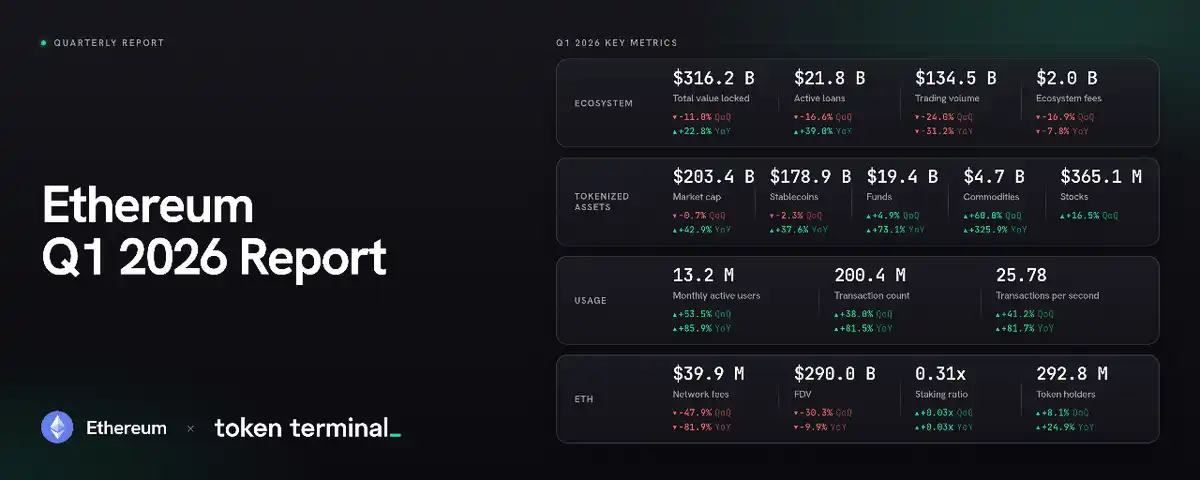
Ethereum Q1 2026 Review: Record On-Chain Activity, Tokenized Assets Lead the Industry. Despite a price correction impacting USD-denominated metrics, Ethereum's on-chain usage hit all-time highs in Q1 2026. Monthly active addresses surged 85.9% year-over-year to 13.2 million, while L1 transactions and throughput also set new records. This growth occurred alongside a significant 47.9% quarterly drop in L1 transaction fees, demonstrating the impact of network scaling via upgrades like the Blob Parameter Fork. The ecosystem maintained its dominance in decentralized finance (DeFi), holding 71% of the total value locked among top chains and 79.2% of active borrowing. Ethereum solidified its position as the primary platform for tokenized real-world assets (RWAs), with a total market cap of $203.4B. It holds leading shares in stablecoins (61.8%), tokenized funds (73%), and tokenized commodities (84%) across major chains. Key developments included the ERC-8004 standard for AI agents and heightened institutional engagement at forums. Major financial institutions like BlackRock, JPMorgan, and a European banking consortium announced new tokenized products on Ethereum throughout the period. The report draws parallels to the early internet, suggesting Ethereum is sacrificing short-term fee revenue for long-term network expansion and adoption. Its strategy focuses on becoming a neutral, open settlement layer for global finance, with scaling roadmaps aiming for tens of thousands of TPS by 2029.

marsbit53m ago

Ethereum 2026 Q1 Review: On-Chain Activity Hits Record Highs, Tokenized Assets Lead the Industry

marsbit53m ago

Matrixdock Featured Again in SBMA’s 《Crucible》: Discussing How Tokenisation Enhances Efficiency in the Precious Metals Market

Matrixdock's research article, titled "Why Tokenisation Matters for the Bullion Industry and How Carrying Costs Fit In," has been featured again in the SBMA's industry publication *Crucible*. Authored by Matrixdock lead Eva Meng, the piece examines how tokenisation enhances the efficiency and utility of the precious metals market. The article argues that tokenisation builds upon the accessibility improvements brought by gold ETFs, not by redefining gold's value but by enabling it to function within digital finance. It extends gold's role beyond a portfolio holding, potentially facilitating instant settlement, digital collateral, and operation in 24/7 markets. A key focus is transparently handling the unavoidable carrying costs (storage, insurance) of physical assets like gold and silver. Matrixdock introduces the Fungible Reserve Standard (FRS) framework, based on an "Economic Purity Principle," which aims to reflect these real-world economic costs clearly within the token mechanism, rather than bundling them opaquely. The platform's practical applications are highlighted, including its gold token XAUm and its silver token XAGm, the first built on the FRS framework. As the tokenised gold market surpassed $6 billion in February 2026, the industry's focus is shifting from initial proofs of reserves to broader concerns of market efficiency and capital utilization. Tokenisation is positioning gold and other precious metals to become active components within the evolving digital financial system.

marsbit1h ago

Matrixdock Featured Again in SBMA’s 《Crucible》: Discussing How Tokenisation Enhances Efficiency in the Precious Metals Market

marsbit1h ago

Trading

Spot
Futures

Hot Articles

What is $BITCOIN

DIGITAL GOLD ($BITCOIN): A Comprehensive Analysis Introduction to DIGITAL GOLD ($BITCOIN) DIGITAL GOLD ($BITCOIN) is a blockchain-based project operating on the Solana network, which aims to combine the characteristics of traditional precious metals with the innovation of decentralized technologies. While it shares a name with Bitcoin, often referred to as “digital gold” due to its perception as a store of value, DIGITAL GOLD is a separate token designed to create a unique ecosystem within the Web3 landscape. Its goal is to position itself as a viable alternative digital asset, although specifics regarding its applications and functionalities are still developing. What is DIGITAL GOLD ($BITCOIN)? DIGITAL GOLD ($BITCOIN) is a cryptocurrency token explicitly designed for use on the Solana blockchain. In contrast to Bitcoin, which provides a widely recognized value storage role, this token appears to focus on broader applications and characteristics. Notable aspects include: Blockchain Infrastructure: The token is built on the Solana blockchain, known for its capacity to handle high-speed and low-cost transactions. Supply Dynamics: DIGITAL GOLD has a maximum supply capped at 100 quadrillion tokens (100P $BITCOIN), although details regarding its circulating supply are currently undisclosed. Utility: While precise functionalities are not explicitly outlined, there are indications that the token could be utilized for various applications, potentially involving decentralized applications (dApps) or asset tokenization strategies. Who is the Creator of DIGITAL GOLD ($BITCOIN)? At present, the identity of the creators and development team behind DIGITAL GOLD ($BITCOIN) remains unknown. This situation is typical among many innovative projects within the blockchain space, particularly those aligning with decentralized finance and meme coin phenomena. While such anonymity may foster a community-driven culture, it intensifies concerns about governance and accountability. Who are the Investors of DIGITAL GOLD ($BITCOIN)? The available information indicates that DIGITAL GOLD ($BITCOIN) does not have any known institutional backers or prominent venture capital investments. The project seems to operate on a peer-to-peer model focused on community support and adoption rather than traditional funding routes. Its activity and liquidity are primarily situated on decentralized exchanges (DEXs), such as PumpSwap, rather than established centralized trading platforms, further highlighting its grassroots approach. How DIGITAL GOLD ($BITCOIN) Works The operational mechanics of DIGITAL GOLD ($BITCOIN) can be elaborated on based on its blockchain design and network attributes: Consensus Mechanism: By leveraging Solana’s unique proof-of-history (PoH) combined with a proof-of-stake (PoS) model, the project ensures efficient transaction validation contributing to the network's high performance. Tokenomics: While specific deflationary mechanisms have not been extensively detailed, the vast maximum token supply implies that it may cater to microtransactions or niche use cases that are still to be defined. Interoperability: There exists the potential for integration with Solana’s broader ecosystem, including various decentralized finance (DeFi) platforms. However, the details regarding specific integrations remain unspecified. Timeline of Key Events Here is a timeline that highlights significant milestones concerning DIGITAL GOLD ($BITCOIN): 2023: The initial deployment of the token occurs on the Solana blockchain, marked by its contract address. 2024: DIGITAL GOLD gains visibility as it becomes available for trading on decentralized exchanges like PumpSwap, allowing users to trade it against SOL. 2025: The project witnesses sporadic trading activity and potential interest in community-led engagements, although no noteworthy partnerships or technical advancements have been documented as of yet. Critical Analysis Strengths Scalability: The underlying Solana infrastructure supports high transaction volumes, which could enhance the utility of $BITCOIN in various transaction scenarios. Accessibility: The potential low trading price per token could attract retail investors, facilitating wider participation due to fractional ownership opportunities. Risks Lack of Transparency: The absence of publicly known backers, developers, or an audit process may yield skepticism regarding the project's sustainability and trustworthiness. Market Volatility: The trading activity is heavily reliant on speculative behavior, which can result in significant price volatility and uncertainty for investors. Conclusion DIGITAL GOLD ($BITCOIN) emerges as an intriguing yet ambiguous project within the rapidly evolving Solana ecosystem. While it attempts to leverage the “digital gold” narrative, its departure from Bitcoin's established role as a store of value underscores the need for a clearer differentiation of its intended utility and governance structure. Future acceptance and adoption will likely depend on addressing the current opacity and defining its operational and economic strategies more explicitly. Note: This report encompasses synthesised information available as of October 2023, and developments may have transpired beyond the research period.

388 Total ViewsPublished 2025.05.13Updated 2025.05.13

What is $BITCOIN

Discussions

Welcome to the HTX Community. Here, you can stay informed about the latest platform developments and gain access to professional market insights. Users' opinions on the price of BTC (BTC) are presented below.

活动图片