AI Bubble Warning: AI Investments Are Negative Returns for Most Tech Giants

marsbitPublished on 2026-05-31Last updated on 2026-05-31

Abstract

The article issues a stark warning about a potential AI investment bubble. It notes that while the AI boom shares similarities with the TMT bubble of the late 1990s, its scale is vastly larger, currently driving 93% of U.S. GDP growth. Major hyperscale cloud providers like Microsoft, Alphabet, Amazon, Meta, and Oracle are planning to invest trillions in AI data centers over the coming years. However, calculations based on analyst projections for 2025-2030 reveal a concerning math problem: expected capital expenditure growth far outpaces projected revenue growth. Even under an extremely optimistic scenario of zero costs, the implied return on investment for most of these tech giants (except Amazon) is deeply negative. This suggests that the current trajectory could lead to one of history's largest shareholder value destruction events. The piece outlines two potential escapes: AI generating vastly more revenue than currently anticipated—a near-impossible task—or a significant cutback in the planned investment splurge. The latter scenario could trigger a domino effect, severely impacting the entire tech supply chain (from Nvidia to TSMC), potentially pushing the U.S. economy into recession, and causing a major stock market downturn. The author suggests upcoming high-profile IPOs by companies like OpenAI and Anthropic might represent a transfer of risk from early investors to public market participants. While the peak of the hype cycle might sustain investment through 2026, th...

Editor's Note: The AI boom is entering a phase of financial scrutiny, moving beyond the technical narrative.

Over the past year, market discussions on AI have focused more on model capabilities, compute shortages, and application prospects. However, this article reminds us that what truly needs to be calculated is the return on capital behind this wave of prosperity. Hyperscale cloud providers like Microsoft, Alphabet, Amazon, Meta, and Oracle are investing hundreds of billions of dollars into AI data centers. Based on current analyst expectations for revenue and capital expenditure, the implied return on investment for most of these companies, except Amazon, is likely negative.

This means the similarity between the AI bubble and the previous internet bubble lies not only in market sentiment but also in the high degree to which capital expenditure is bound to macroeconomic growth and stock price expectations. The author points out that over the past four quarters, 93% of U.S. GDP growth can be explained by tech investment. If cloud providers cut back on data center, chip, and infrastructure spending, not only will companies along the supply chain like Nvidia, TSMC, and ASML be impacted, but the U.S. economy itself could quickly face pressure.

More importantly, if AI companies like OpenAI and Anthropic push for IPOs during a peak in market sentiment, it might not be just a fundraising event but a risk transfer: early capital and existing shareholders could be passing on the uncertainties within the AI narrative to retail investors, pension funds, and other investors willing to keep buying into the growth story.

The core question of this article is not whether AI has a future, but rather who will foot the bill for this expensive infrastructure race once the marketing hype subsides.

The following is the original text:

In December 1996, then Federal Reserve Chairman Alan Greenspan described the boom in technology, media, and telecom stocks as showing signs of 'irrational exuberance.' Nearly 30 years later, we can make the same judgment about today's AI boom.

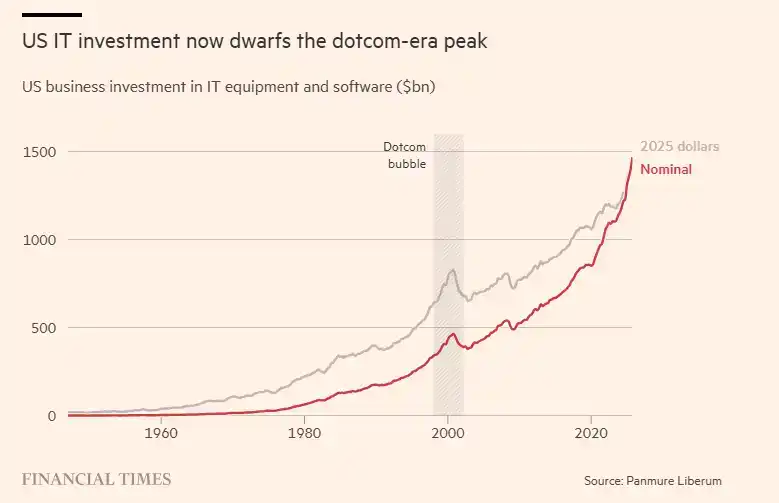
However, while the current tech boom shares similarities with the internet bubble of the previous generation, there is a crucial difference: a certain segment of today's boom has already far surpassed the scale of the TMT bubble. In 2025, U.S. corporate investment in IT equipment and software is nearing $1.5 trillion. At the peak of the TMT bubble, this figure was $466 billion, or just $829 billion after adjusting for inflation.

In fact, the U.S. economy is almost entirely growing on the back of the tech boom. According to my calculations, over the past four quarters, 93% of U.S. GDP growth can be explained by tech investment. Even at the absolute peak of the TMT bubble, this ratio barely reached 60%.

Large language model developers like OpenAI and Anthropic are preparing for high-profile IPOs later this year to capitalize on investors' optimism about their growth prospects. Meanwhile, hyperscale cloud providers like Microsoft, Alphabet, Amazon, Meta, and Oracle plan to invest hundreds of billions of dollars into data centers over the next five years to provide the compute power needed to run these models.

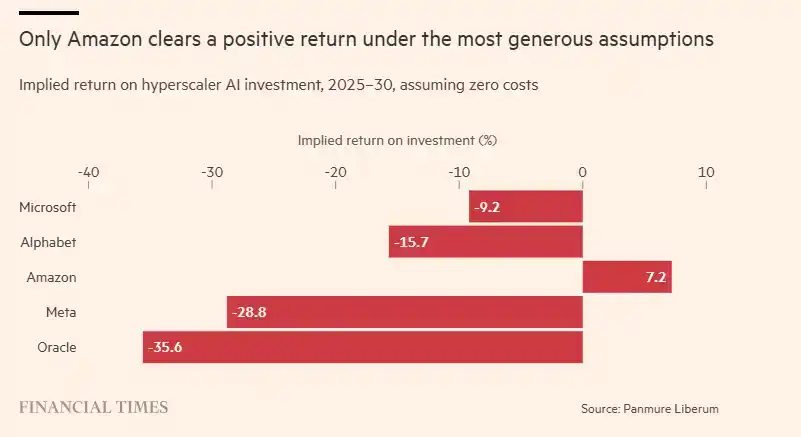
And that's precisely where the problem lies: the math behind the AI boom is starting to look tricky. For these hyperscale cloud providers, I gathered analyst consensus estimates for their capital expenditure and revenue from 2025 to 2030.
Over these five years, their capital investment is projected to grow at an annual rate of 20%, a pace never before seen in this industry. At the same time, revenue is expected to grow by 15% annually. If we make an extremely bold assumption—that these companies have no costs whatsoever—then the incremental revenue could be considered as profit from their new AI data center investments. However, even under this extremely optimistic assumption, my calculations show a highly negative implied return on investment for all companies except Amazon.

These numbers suggest that if hyperscale cloud providers continue on their current trajectory, the AI boom will evolve into one of the largest shareholder value destruction events in history. But they still have two ways out.
The first way out is that the rise of AI brings in far more revenue for these companies than currently expected. But this itself presents a mathematical challenge. Assuming these hyperscale cloud providers want to achieve a 10% return on investment, they would need to find an additional $2 trillion to $5 trillion in revenue annually. For a group of companies currently generating a total annual revenue of only $1.5 trillion, this is an almost impossible task.

The second way out is that the investments originally planned for data centers, chips, and other areas ultimately don't materialize. The reason could be that equity investors become more cautious about the industry, or debt financing for data centers becomes more difficult.

So, what happens if these companies announce cuts to their investment plans?

The stock prices of major companies across continents, from Nvidia to ASML, Samsung, and TSMC, are built on these investment plans and the demand expectations they create.

Let's not forget that current U.S. GDP growth is essentially entirely driven by rising tech spending. If this spending begins to decline, the U.S. economy will quickly fall into a recession. Even a modest decline in tech investment, say 4% to 6%, would have this effect. Historically, similar magnitudes of investment pullbacks occurred following the smaller-scale tech boom of the 1960s and during the 2009 recession.

Such a moderate correction in investment spending would still very likely push U.S., UK, and European stock markets into a new bear market. A repeat of the early 2000s tech stock crash is a real risk; back then, the market fell by 50% or more within the first year.

The next question is: when might we see these hyperscale cloud providers announce plans to cut investments?

I believe this scenario is unlikely to happen in 2026. Companies like OpenAI and Anthropic will still strive to maintain market hype, at least until their respective IPOs are completed, which may continue to support the boom in the short term. But what about after that? The 'impossible math' facing hyperscale cloud providers won't change, and marketing hype may eventually fade. In the end, reality will arrive.

Maybe not in 2026, but possibly in 2027 or 2028. After all, Greenspan spoke of 'irrational exuberance' in December 1996, and the bubble didn't truly burst until three years later in 2000.

From this perspective, the IPOs of these AI companies are likely just a massive transfer of investment risk: risk is being transferred from current owners to retail investors, pension funds, and other investors willing to pay for the narrative.

Related Questions

QWhat does the author argue about the relationship between current AI investment and the potential for shareholder value destruction?

AThe author argues that, based on analysts' projections for revenue and capital expenditures, the implied return on investment for most major cloud service providers investing in AI data centers is highly negative. If these companies continue on their current trajectory, the AI boom could become one of the largest shareholder value destruction events in history.

QAccording to the article, what two possible paths do hyperscale cloud providers have to avoid negative returns from their massive AI investments?

AThe two possible paths are: 1) AI generates far more revenue for these companies than analysts currently project, though the author calls this nearly impossible based on the scale of revenue needed. 2) The planned investments in data centers, chips, and other infrastructure are not actually made, potentially due to investor caution or difficulties in financing.

QHow does the author describe the role of tech investment in current US GDP growth, and what are the implications if this investment declines?

AThe author states that 93% of US GDP growth over the past four quarters can be explained by tech investment. If this investment declines, even by a moderate 4% to 6%, the US economy could quickly fall into recession. This level of dependence makes the broader economy highly vulnerable to a correction in tech spending.

QWhat comparison does the author make between the upcoming AI company IPOs and the concept of risk transfer?

AThe author suggests that IPOs for companies like OpenAI and Anthropic may not just be fundraising events, but a large-scale transfer of investment risk. The risk is transferred from early-stage investors and existing owners to retail investors, pension funds, and other investors who are willing to buy into the growth narrative at its peak.

QWhat historical parallel does the author draw when discussing the potential timeline for a correction in the AI investment boom?

AThe author draws a parallel to the dot-com bubble. Former Fed Chair Alan Greenspan warned of 'irrational exuberance' in December 1996, but the bubble did not burst until three years later in 2000. Similarly, while a correction might not happen in 2026, the author suggests it could occur in 2027 or 2028 after the marketing hype subsides and financial reality sets in.

Related Reads

Three Years Later: Looking Back at My Predictions About ChatGPT in 2023

Three Years Later: Revisiting My 2023 Predictions on ChatGPT In March 2023, shortly after ChatGPT's launch, I made 20 predictions about its future. Now, in mid-2026, I've used AI agents to fact-check each one against the latest data. Overall, most major directional forecasts were correct, with only one outright error (incorrectly stating GPT-4 had 100 trillion parameters). Key successes included predicting that RAG and retrieval architectures would become the standard for handling knowledge and hallucinations, that natural language interfaces (LUI) would create a massive new industry layer beyond the models themselves, and that China would develop viable large language models, significantly closing the performance gap with Western counterparts within about three years. Predictions about the absence of mass unemployment, the rise of a new "robot network" for agent communication, and ChatGPT not possessing consciousness also held true in their core arguments. However, the "devil was in the details." Errors frequently involved specific numbers, timelines, or overlooking distributional effects. I tended to overestimate the speed of adoption (e.g., for agent networks) while underestimating the ultimate scale of capabilities or costs (e.g., AI winning IMO gold without tools, or the extreme capital required for frontier models). Other misjudgments included: underestimating how AI would reinforce, not dissolve, information filter bubbles; incorrectly assuming AI-generated content would easily circumvent copyright (it has instead triggered record-breaking settlements); and misidentifying where value would be captured (it accrued overwhelmingly to the compute layer, like Nvidia, not just the application or model layers). Key lessons from reviewing these predictions are: 1) Directional and mechanistic insights are far more reliable than precise numbers or absolute statements. 2) There's a consistent bias to overestimate short-term speed but underestimate long-term magnitude. 3) Errors often lie in missing distributional impacts within a generally correct aggregate trend. 4) Predictions phrased with nuance and caveats aged the best. 5) Some fundamental debates (e.g., on machine consciousness or the ultimate value chain) remain unresolved even after three years. This exercise is less about scoring the past and more about establishing rules for clearer thinking about the next three years of AI.

marsbit3h ago

Three Years Later: Looking Back at My Predictions About ChatGPT in 2023

marsbit3h ago

Three Years Later: Looking Back on My 2023 Predictions for ChatGPT

Looking Back After Three Years: Revisiting My 2023 Predictions on ChatGPT In March 2023, shortly after ChatGPT's debut and before GPT-4's release, I made over twenty predictions about AI's future based on limited information and intuition. Now, in May 2026, I revisited those forecasts using an AI-driven analysis with 41 Opus 4.8 agents to cross-reference them with the latest data. The assessment used symbols: ✅ Correct, 🟢 Mostly Correct, 🟡 Partially Correct, ❌ Incorrect. Overall, the directional judgments held up well, with only one major factual error regarding GPT-4's rumored parameter size (incorrectly cited as 100T). However, nuances and degrees of accuracy revealed more. **What Was Largely Correct:** Predictions about mechanisms and directions proved accurate. The rise of RAG (Retrieval-Augmented Generation) as the standard architecture for combating AI hallucination was confirmed, as was the transformative potential of LUI (Language User Interface) in creating a new industry layer atop GUIs. The emergence of "robot networks" (agent-to-agent communication protocols) and China's rapid catch-up in developing capable large models (closing the performance gap with top models to ~2.7%) were also on point. The analysis affirmed that LLMs lack consciousness and that the Turing Test merely measures perceived intelligence. **What Was Off Target:** Errors often involved specific numbers, over-optimistic timelines, or misjudged distributions. The prediction that value would primarily accrue to the application layer was half-right but missed NVIDIA's dominance as the profitable infrastructure layer. Forecasts about AI circumventing copyright issues and fostering a "global common ground" by averaging human viewpoints were incorrect; instead, major copyright settlements occurred and AI personalization is increasing. Estimates for model training costs ("$5-10 billion cap") were significantly off, underestimating frontier costs and overestimating replication costs. The notion that LLMs could never do complex math without tools was disproven by later models winning IMO gold. **Key Patterns from the Review:** 1. **Direction over precision:** Judgments about mechanisms and trends were more reliable than specific numbers or definitive statements. 2. **Timing bias:** There was a tendency to overestimate short-term speed but underestimate long-term magnitude and transformation. 3. **The distribution blind spot:** Aggregate-level correctness often masked uneven impacts (e.g., on young professionals' employment). 4. **The value of qualifiers:** Predictions framed with caution (e.g., "reportedly," "for now," "prototype in 2-3 years") aged better. 5. **Some debates continue:** Issues like the nature of "emergent abilities" or machine consciousness remain unresolved. This three-year review highlights that while seeing the big picture is crucial, humility regarding specifics, timelines, and disparate impacts is essential for future forecasting.

链捕手5h ago

Three Years Later: Looking Back on My 2023 Predictions for ChatGPT

链捕手5h ago

From Tokens to Machine Labor: AI is Shifting from Tool to "Worker"

The article "From Token to Machine Labor: AI is Evolving from Tool to 'Worker'" argues that the business model for AI is shifting beyond simply selling computational resources (tokens, GPU hours) or model access. Instead, a new "machine labor market" is emerging, where the core economic transaction is the purchase of economically useful work directly performed by software. The central thesis is that AI pricing will evolve through four stages: 1) raw tokens, 2) standardized LLM capabilities (e.g., text generation), 3) industry-specific labor markets (e.g., legal review, radiology), and finally 4) a programmable results market where tasks like resolving a support ticket are bid on and priced based on outcome. In this future, buyers will care less about *which* model or GPU completes a task and more about whether the work meets specified standards for accuracy, latency, and cost. This transition reframes the impact of AI on human labor. Rather than simple replacement, it suggests a re-coordination where machines handle standardized, verifiable work, freeing humans for roles involving oversight, context management, responsibility, and final judgment. In some cases, this "last 1%" of human input becomes more valuable as it enables the other 99% to be automated. Furthermore, as AI reduces the cost of work, demand may expand, creating larger markets (e.g., 24/7 customer service) rather than just cheaper versions of existing ones. The article concludes that while infrastructure (GPUs, models, tokens) remains crucial upstream, the market is converging on a simpler, tradeable unit: machine labor that can be defined, measured, priced, and procured based on contractible specifications.

marsbit6h ago

From Tokens to Machine Labor: AI is Shifting from Tool to "Worker"

marsbit6h ago

Xiaomi MiMo's 99% Price Cut is Not Marketing! Luo Fuli Posts on X to Refute Critics

The price of Xiaomi's MiMo-V2.5 series API has been permanently reduced by up to 99%, specifically for the "Input (Cache Hit)" cost, which covers users re-reading historical context in long conversations. MiMo's head, Luo Fuli, published a detailed technical blog to clarify that this drastic price cut stems from genuine engineering breakthroughs, not a marketing stunt or a simple price war. The core of the achievement lies in six key engineering optimizations. First, the model architecture adopts a Hybrid Sliding Window Attention (SWA), reducing the memory footprint (KVCache) to 1/7th of a traditional model. Second, a dual-pool memory management system actually utilizes these savings, allowing a single GPU to handle over 5 times more concurrent users. Third, an upgraded prefix caching mechanism achieves a cache hit rate of 93-95% for repeated reads, meaning most such requests bypass GPU computation entirely. Fourth, a self-developed distributed cache (GCache) utilizes idle SSD space on existing GPU servers, eliminating additional storage costs. Fifth, an intelligent scheduling system (LLM-Router) efficiently routes requests to maximize cache reuse and performance. Sixth, Multi-Token Prediction (MTP) accelerates the model's text generation ("output") side. Together, these systemic optimizations dramatically lower the real computational cost per request, enabling the 99% price reduction for cached inputs while reportedly maintaining positive gross margins. Luo Fuli's disclosure aims to shift the narrative from "price war" to a demonstration of substantive AI engineering progress.

marsbit8h ago

Xiaomi MiMo's 99% Price Cut is Not Marketing! Luo Fuli Posts on X to Refute Critics

marsbit8h ago

$26 Billion: An 'All-Chinese Team' Backs the World's Highest-Valued AI Programming Company

Cognition AI, the company behind the AI programmer "Devin," has raised over $1 billion in new funding at a valuation of $26 billion, just eight months after reaching a $10.2 billion valuation. The round was led by Lux Capital, General Catalyst, and 8VC. Founded by three young Chinese entrepreneurs with strong competitive programming backgrounds, Cognition initially gained fame with Devin, marketed as the world's first AI software engineer capable of handling tasks from start to finish. While its early demos were impressive, real-world usage revealed reliability and cost-effectiveness issues, leading to a significant price cut for Devin in 2025. A pivotal moment came when Cognition acquired the assets of AI IDE company Windsurf after a failed acquisition by OpenAI. This move gave Cognition a crucial developer-facing tool, allowing it to pursue a two-pronged strategy: Devin for autonomous task execution and Windsurf for integrated, collaborative coding within an IDE. This shift helped the company move away from the controversial "AI replacement" narrative towards a model of augmenting human engineers, particularly for repetitive or maintenance tasks. This strategic pivot is backed by strong commercial metrics. The company reports a 10x increase in enterprise usage this year, with an annual revenue run-rate of $492 million and a 50% month-over-month growth in enterprise Devin usage over the past six months. Its client list now includes major corporations like Goldman Sachs and Mercedes-Benz, as well as government agencies like NASA and the U.S. Army. Investors are betting on Cognition becoming a foundational piece of next-generation software engineering infrastructure, positioning it at the center of a hybrid future where AI agents and human developers work in tandem.

marsbit8h ago

$26 Billion: An 'All-Chinese Team' Backs the World's Highest-Valued AI Programming Company

marsbit8h ago

Trading

Spot
Futures

Hot Articles

Discussions

Welcome to the HTX Community. Here, you can stay informed about the latest platform developments and gain access to professional market insights. Users' opinions on the price of AI (AI) are presented below.

活动图片