Prediction Markets Advise Holding Positions, While Citadel Securities Forecasts Fed Rate Hike Amid Trump Pressure on Central Bank

cryptonews.ruPublished on 2026-07-28Last updated on 2026-07-28

Abstract

The U.S. Federal Reserve's FOMC meeting on July 28-29 is the main focus, with markets largely expecting interest rates to hold steady at 3.50-3.75%. CME's FedWatch tool gives a 66.3% probability for no change, while prediction markets like Kalshi and Polymarket show ~73% odds for unchanged rates. However, Citadel Securities' head of macro strategy, Frank Flight, predicts a surprise 25-basis-point hike to reinforce the Fed's inflation-fighting credibility under Chair Warsch. This meeting occurs amid political pressure, as former President Trump again called for rate cuts. Persistent inflation, driven partly by energy costs, and Middle East-related oil price volatility add uncertainty. The outcome is significant for Bitcoin and risk assets, which typically see larger moves when the Fed acts against consensus expectations. An unexpected hike could strengthen the dollar and pressure crypto prices, while a hold would shift market focus to the September meeting.

The Federal Open Market Committee (FOMC) meeting is scheduled for July 28 and 29, with the rate announcement expected on Wednesday afternoon. The current target range stands at 3.50-3.75% and has remained unchanged since the June meeting, which was the first for Warsh as Chairman. The CME Group's Fedwatch tool, which calculates probabilities based on 30-day federal funds futures prices, estimates a 66.3% probability of rates remaining unchanged.
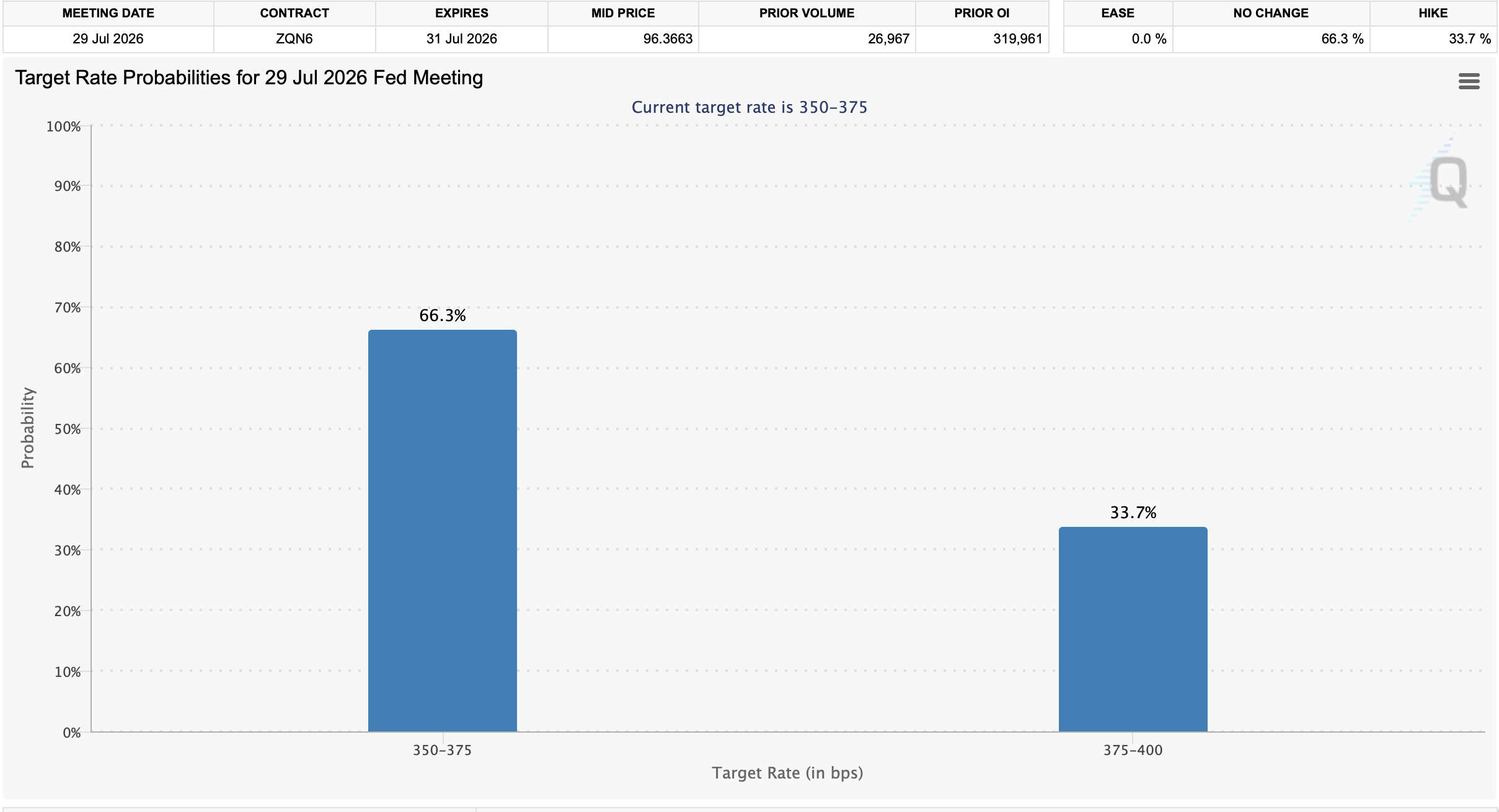
Thus, the market is pricing in a 33.7% chance of a quarter-percentage-point rate hike. According to the tool's current data, the probability of a rate cut is zero. Looking further ahead, Fedwatch shows a 54.3% probability of a rate hike by the September 16 meeting, with most market participants expecting at least one more hike by year-end.

Prediction Markets Lean Toward Unchanged Rates

Prediction markets show a similar picture with slightly different figures. The Kalshi contract on the Fed's decision, with trading volume exceeding $42 million, indicates a 73% probability of unchanged rates—this figure has surged after a 10-percentage-point shift toward this outcome in recent days. The probability of a 25-basis-point hike is 26%, while the likelihood of a more significant hike is less than 1%.
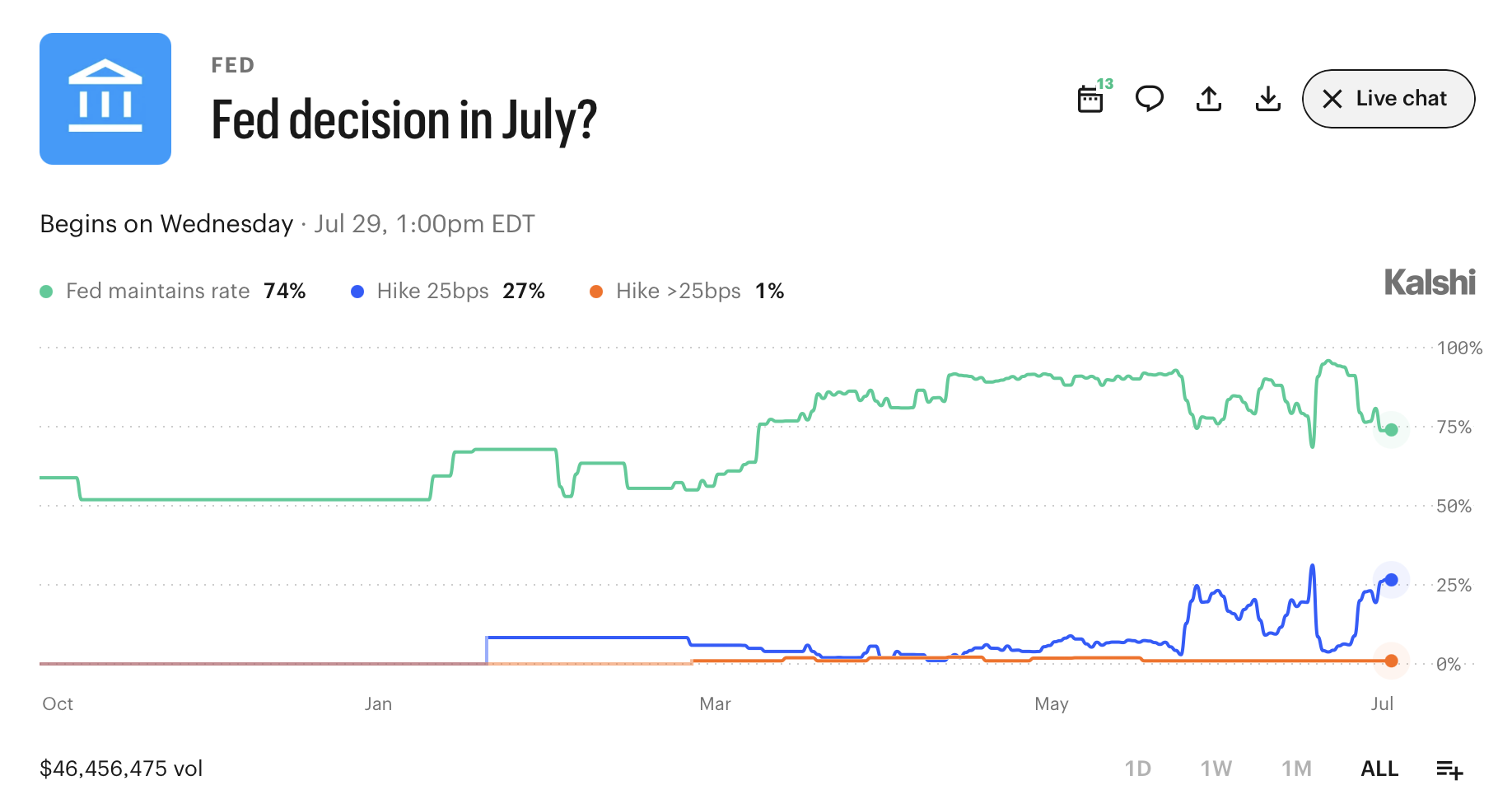
Traders on Polymarket have placed nearly $100 million on this outcome, spreading bets across five possible ranges. This market shows a 73% probability for unchanged rates and 26.5% for a quarter-point hike, with the likelihood of a more significant hike or a cut assessed at below 1%. The narrowing gap between the two leading outcomes reflects what typically happens ahead of major Fed decisions: confidence wanes as traders hedge risks on both sides rather than holding a single consensus view.

Citadel Securities' Unconventional Forecast

Frank Flight, Head of Macro Strategy at Citadel Securities, has broken from this consensus. In a client note reported by Bloomberg on July 27, Flight expressed the view that the Fed could unexpectedly raise rates by a quarter percentage point this week, although most analysts still expect rates to remain unchanged.

Flight joined Citadel Securities in late 2025 after seven years at Goldman Sachs, where he rose to Vice President for Interest Rates and Macro Strategy, and later held portfolio manager roles at Brevan Howard and Soros Fund Management. In April, Financial News included him in its "Rising Stars of European Finance" list, highlighting his work across asset class valuations.

Frank Flight, Head of Macro Strategy at Citadel Securities. Flight believes a surprise quarter-point rate hike awaits on Wednesday.

His reasoning is based more on a question of credibility than on any single inflation indicator. This line of argument holds weight because central bank communication is often assessed over several meetings, not one. Raising rates now, he wrote, would reinforce Warsh's stated commitment to price stability and signal that the Fed no longer needs to announce each move well in advance.

Flight has held this stance for several months. In a note dated June 19, he described the Warsh-led Fed as transitioning from an inertial, data-dependent stance to an adaptive one that reacts quickly to inflation deviations. He then pointed to the July meeting as the immediate opportunity and maintained rate hike forecasts for September, December, and March 2027 in his outlook. Consistency has been a defining feature of this forecast: the July meeting remained central to this concept, not adjusted to align with shifting market expectations.

Trump Again Pressures for Lower Rates

On July 27, President Trump spoke with journalists aboard Air Force One, calling Warsh "fantastic" while simultaneously insisting on lowering borrowing costs. He stated that Warsh wants to do the right thing but characterized other Fed board members as politicized, adding that some of them might have bad intentions.

Trump asserted that rates should come down and that with lower rates, the country's economy could grow at an annual pace of 8% to 12%. He reiterated his long-standing view that the U.S. should have the world's lowest interest rates, adding that rates here are higher than in the Eurozone, Japan, and China.

Trump insisted that the Fed must lower rates and that other countries pay much less to borrow. He noted that Warsh would still have to work with the rest of the board, reminding that the Chair sets the tone for discussion but does not set policy alone.

Trump has been pressuring the Fed to lower rates since his return to office in January 2025 and previously called for cuts to 1% or below. Some Fed officials, including Dallas Fed President Lorie Logan, have recently expressed concerns about persistent inflation and a willingness to, on the contrary, raise rates.

Inflation and Oil Offer No Clear Forecast

May Consumer Price Index (CPI) data, showing a 4.2% year-over-year increase primarily driven by energy costs, keeps the possibility of a rate hike alive, even though most market participants lean toward unchanged rates. Volatility in oil prices related to Middle East events adds another layer of uncertainty ahead of Wednesday's meeting. Sentiment in interest rate markets has gradually shifted: where the meeting was once seen as routine, it is now acknowledged that enough uncertainty remains to justify hedging both outcomes.

What This Means for Bitcoin and Risk Assets

Bitcoin tends to react more sharply precisely when the Fed deviates from expectations, rather than when it delivers a consensus-aligned decision. Unchanged rates, still the market's baseline scenario, are likely to leave crypto traders' positions largely unchanged heading into the announcement. An unexpected rate hike, which Flight continues to highlight, would likely have broader repercussions.

A rate hike typically strengthens the dollar and redirects capital to fixed-income assets—a trend that has repeatedly pressured Bitcoin and altcoins during previous monetary tightening cycles. Traders tracking ETF flows and derivatives positioning ahead of Wednesday will look for signs that institutional investors are quietly building downside protection, rather than opening outright bearish positions.

This distinction often matters more than the headline probabilities, as hedging often begins before expectations shift on futures or prediction markets. For traders assessing their positions ahead of the decision, the situation resembles previous weeks leading up to Fed meetings. When policy aligns with expectations, the initial price move in Bitcoin and major altcoins often fades quickly as traders unwind event-driven positions.

When the Fed surprises markets, liquidity can dry up within seconds, allowing prices to move much further than consensus forecasts anticipate.

What Comes Next

Keeping rates unchanged would extend the current range for a third consecutive meeting and shift focus to September, where the probability of a quarter-point hike already stands at 54.3% according to CME Fedwatch. A hike this week would mark the first move under Warsh's tenure and likely lead to rising short-term bond yields and a stronger dollar heading into the fall.

After the decision on Wednesday, Warsh will take questions from journalists. This press conference, along with the statement itself, will show whether the committee continues to signal a measured course or begins to lay the groundwork for the more nimble monetary policy response that Flight has been discussing since June.

end-content

Trending Cryptos

Related Questions

QWhat is the consensus view from prediction markets on the upcoming Fed rate decision as per the article?

AAccording to the article, prediction markets lean heavily toward the Federal Reserve holding interest rates steady. Specifically, contracts on Kalshi indicate a 73% probability of no change, while Polymarket traders show a similar 73% probability for unchanged rates, with about a 26-27% chance of a 25 basis point hike.

QWho is Frank Flight and what is his contrarian forecast regarding the Fed's upcoming meeting?

AFrank Flight is the head of macro strategy at Citadel Securities. He holds a contrarian view that the Fed could surprise markets by raising interest rates by a quarter percentage point at the July meeting, diverging from the prevailing market consensus which expects rates to remain unchanged.

QWhat is President Trump's stated position on Federal Reserve policy according to the article?

APresident Trump is pressuring the Federal Reserve to lower interest rates. He argues that the U.S. should have the world's lowest rates and claims the economy could grow at 8-12% annually with lower borrowing costs. He has been advocating for rate cuts since returning to office in January 2025, previously calling for rates as low as 1% or below.

QHow does the article describe Bitcoin's typical reaction to Fed policy decisions?

AThe article states that Bitcoin tends to react more strongly when the Fed deviates from market expectations rather than when its decision aligns with the consensus. An unexpected rate hike would likely strengthen the dollar and divert capital to fixed-income assets, putting pressure on Bitcoin and altcoins, similar to past tightening cycles.

QWhat key data point maintains the possibility of a rate hike despite market expectations for a pause?

AThe key data point is the May Consumer Price Index (CPI) data, which showed an annual increase of 4.2%, largely driven by energy costs. This persistent inflation, along with volatility in oil prices due to events in the Middle East, contributes to the uncertainty and maintains the possibility of a rate hike.

Related Reads

Luno Cuts 20% of Global Workforce as Cryptocurrency Exchange Shifts Priorities Towards Automation

Luno, a global cryptocurrency exchange owned by Digital Currency Group, is reducing its global workforce by 20% as part of a major operational restructuring driven by a downturn in retail crypto activity and increased automation. CEO James Lanigan announced the layoffs on July 28, stating it was a difficult but necessary decision to build a more sustainable structure for the long term. The company did not disclose the total number of affected employees, though South African staff are among those impacted, with formal consultations initiated there in line with local labor laws. This marks the second major round of layoffs in three and a half years, following a 35% staff reduction in January 2023. The company cites cyclical declines in retail user activity and ongoing investment in automated tools as key factors behind the restructuring, which has fundamentally changed the firm's resource needs. Concurrently, Luno is reorganizing into three unified divisions built on a single core platform: 1) a consolidated consumer and API platform serving over 16 million users in Africa and Asia-Pacific, 2) a stablecoin solutions unit focused on the zar-backed 'Zaru' stablecoin launched in February 2026, and 3) an institutional arm offering OTC services and cross-border settlement networks. This restructuring follows recent market withdrawals, with Luno discontinuing services in certain markets from September 1, 2026.

cryptonews.ru10m ago

Luno Cuts 20% of Global Workforce as Cryptocurrency Exchange Shifts Priorities Towards Automation

cryptonews.ru10m ago

Turkey blocked 47,493 illegal betting sites amid expanded measures targeting cryptocurrency accounts

Turkey has blocked access to 47,493 illegal betting websites since January 1st as part of a nationwide crackdown on online gambling operators and their payment networks. Police and gendarmerie conducted 680 operations, detaining 5,629 suspects, with 3,231 placed in pre-trial detention and 1,515 placed under judicial supervision. Cybercrime units are conducting 24/7 monitoring of illegal betting sites, social media ads, and digital payment channels. Investigators are tracking bank accounts, e-money services, and crypto asset wallets suspected of facilitating betting operations or laundering criminal proceeds. The actions follow earlier raids in May targeting over 670 suspects, with one investigation in Adana uncovering cryptocurrency platforms used for laundering betting revenues. Authorities highlighted a specific case involving a network allegedly coordinated by a suspect with initials İ.Ö.Ö., which reportedly generated revenue from illegal betting and match-fixing. Prosecutors identified seven overseas crypto wallets that received transfers from this network, estimating total transaction volume at $4 billion. All related bank and crypto accounts were frozen. The network allegedly recruited individuals to act as "common accounts" for processing bets in exchange for a 1% commission. In separate operations, authorities blocked 4,742 bank accounts and six crypto accounts in Adana, and identified transactional activity worth approximately $104 million across 47 suspects. Assets including companies, vehicles, and properties were seized. The crackdown includes real-time disruption. During the 2022 World Cup final, prosecutors identified and ordered the freezing of 6,314 bank accounts used for illegal betting, aided by an AI analysis system called AVCI. They project illegal betting volume for the 2026 World Cup could reach $50 billion. Justice Minister Yılmaz Tunç stated that 19 offshore "financial companies" managing panel systems for illegal betting sites were identified, with legal proceedings initiated against 23 suspects. He emphasized a strategic shift towards "draining the swamp" through coordinated asset seizures and digital evidence collection, rather than relying on individual prosecutions.

cryptonews.ru15m ago

Turkey blocked 47,493 illegal betting sites amid expanded measures targeting cryptocurrency accounts

cryptonews.ru15m ago

Trading

Spot

Hot Articles

What is $BANK

Bank AI: A Revolutionary Step in the Future of Banking Introduction In an era marked by rapid advancements in technology, Bank AI stands at the intersection of artificial intelligence (AI) and banking services. This innovative project seeks to redefine the financial landscape, enhancing operational efficiency, security measures, and customer experiences through the power of AI. As we embark on this exploration of Bank AI, we will delve into what the project entails, its operational dynamics, its historical context, and significant milestones. What is Bank AI? At its core, Bank AI represents a transformative initiative aimed at integrating artificial intelligence into various banking operations. This project harnesses the capabilities of AI to automate processes, improve risk management protocols, and enhance customer interaction through personalised services. The primary objectives of Bank AI include: Automation of Banking Functions: By leveraging AI technologies, Bank AI aims to automate routine tasks, reducing the burden on human resources and enhancing efficiency. Enhanced Risk Management: The project utilises AI algorithms to predict and identify risks, thereby fortifying security measures against fraud and other threats. Personalisation of Banking Services: Bank AI focuses on offering tailored financial products and services by analysing customer data and behaviours. Improving Customer Experience: The implementation of AI-driven solutions, such as chatbots and virtual assistants, aims to provide users with more human-like interactions, revolutionising the way customers engage with banks. With these goals, Bank AI positions itself as a crucial player in rendering banking more efficient, secure, and user-centric. Who is the Creator of Bank AI? Details regarding the creator of Bank AI remain unknown. As such, no specific individual or organisation has been identified in the available information. The anonymity surrounding the project's inception raises questions but does not detract from its ambitious vision and objectives. Who are the Investors of Bank AI? Similar to the project's creator, specific information regarding the investors or supporting organisations of Bank AI has not been disclosed. Without this information, it is challenging to outline the financial backing and institutional support that might be propelling the project forward. Nevertheless, the importance of having a robust investment foundation is pivotal for sustaining development in such an innovative field. How Does Bank AI Work? Bank AI operates on several innovative fronts, focusing on unique factors that differentiate it from traditional banking frameworks. Below are key operational features: Automation: By applying machine learning algorithms, Bank AI automates various manual processes within banks. This results in reduced operational costs and allows human workers to redirect their efforts towards more strategic activities. Advanced Risk Management: The integration of AI into risk management practices equips banks with tools to accurately predict potential threats such as fraud, ensuring that customer information and assets remain secure. Tailored Financial Recommendations: Through continuous learning from customer interactions, the AI systems develop a nuanced understanding of user needs, enabling them to offer tailored advice on financial decisions. Enhanced Customer Interactions: Utilizing chatbots and virtual assistants powered by AI, Bank AI enables a more engaging customer experience, allowing users to have their queries resolved quickly, thus reducing wait times and improving satisfaction levels. Together, these operational features position Bank AI as a pioneer in the banking sector, establishing new benchmarks for service delivery and operational excellence. Timeline of Bank AI Understanding the trajectory of Bank AI requires a look at its historical context. Below is a timeline highlighting important milestones and developments: Early 2010s: The conceptualisation of AI integration into banking services began to gain attention as banking institutions recognised the potential benefits. 2018: A marked increase in the implementation of AI technologies occurred when banks started using AI tools like chatbots for basic customer service and risk management systems for improved security handling. 2023: The sophistication of AI continued to advance, with generative AI being introduced for more complex tasks such as document processing and real-time investment analysis. This year marked a significant leap in the capabilities afforded to banks by AI technology. 2024-Current Status: As of this year, Bank AI is on an upward trajectory, with ongoing research and developments poised to further enhance capabilities in banking operations. Continued exploration of AI applications hints at exciting developments yet to come. Key Points About Bank AI Integration of AI in Banking: Bank AI focuses on adopting artificial intelligence to streamline banking processes and improve user experiences. Automation and Risk Management Focus: The project strongly emphasises these areas, aiming to shift the burden of routine tasks while enhancing security frameworks through predictive analytics. Personalised Banking Solutions: By harnessing customer data, Bank AI enables tailored banking services that cater to individual user needs. Commitment to Development: Bank AI remains committed to ongoing research and development efforts, ensuring its adaptability and ongoing relevance as technology continues to evolve. Conclusion In summary, Bank AI exemplifies a crucial step forward in the banking industry, leveraging artificial intelligence to reshape operational paradigms, enhance security, and promote customer satisfaction. Despite gaps in information surrounding the creator and investors, the clear objectives and functional mechanisms of Bank AI provide a strong foundation for its ongoing evolution. As AI technology continues to advance and merge with the banking sector, Bank AI is well-positioned to significantly impact the future of financial services, enhancing the way we understand and interact with banking.

218 Total ViewsPublished 2024.04.06Updated 2024.12.03

What is $BANK

Discussions

Welcome to the HTX Community. Here, you can stay informed about the latest platform developments and gain access to professional market insights. Users' opinions on the price of BANK (BANK) are presented below.

活动图片