Luno Cuts 20% of Global Workforce as Cryptocurrency Exchange Shifts Priorities Towards Automation

cryptonews.ruPublished on 2026-07-30Last updated on 2026-07-30

Abstract

Luno, a global cryptocurrency exchange owned by Digital Currency Group, is reducing its global workforce by 20% as part of a major operational restructuring driven by a downturn in retail crypto activity and increased automation. CEO James Lanigan announced the layoffs on July 28, stating it was a difficult but necessary decision to build a more sustainable structure for the long term. The company did not disclose the total number of affected employees, though South African staff are among those impacted, with formal consultations initiated there in line with local labor laws. This marks the second major round of layoffs in three and a half years, following a 35% staff reduction in January 2023. The company cites cyclical declines in retail user activity and ongoing investment in automated tools as key factors behind the restructuring, which has fundamentally changed the firm's resource needs. Concurrently, Luno is reorganizing into three unified divisions built on a single core platform: 1) a consolidated consumer and API platform serving over 16 million users in Africa and Asia-Pacific, 2) a stablecoin solutions unit focused on the zar-backed 'Zaru' stablecoin launched in February 2026, and 3) an institutional arm offering OTC services and cross-border settlement networks. This restructuring follows recent market withdrawals, with Luno discontinuing services in certain markets from September 1, 2026.

On July 28th, CEO James Lanigan announced that cryptocurrency exchange Luno is cutting 20% of its global workforce and restructuring its operations into three separate divisions, citing a downturn in retail trading and a growing trend towards automation. However, the company did not disclose the total number of employees affected by the layoffs.

Among the staff being laid off are South Africans, though specific regional figures were not confirmed. Luno, which is headquartered in London and operates in Africa and Asia, is owned by the American firm Digital Currency Group.

"This was an incredibly difficult decision, and we did not take it lightly," Lanigan stated. "Our organization is filled with incredible people, and saying goodbye to colleagues who have contributed so much is extremely hard. But this was a decision we had to make — for our customers, our remaining team, and our long-term mission to build a sustainable and focused structure."

This wave of layoffs marks the second major round of cuts on the platform in three and a half years. In January 2023, during a sharp downturn in the digital asset market, Luno cut 35% of its workforce, which at the time numbered around 960 employees.

In South Africa, where Luno was founded in 2013, formal consultations with affected employees have begun in accordance with the requirements of Section 189 of the country's Labour Relations Act.

The company's leadership cited a cyclical downturn in retail user activity in the cryptocurrency space and ongoing investments in automated tools as the primary factors behind the restructuring. Luno stated that the integration of automated systems has fundamentally changed the company's resource needs, making a more streamlined operational structure necessary.

Alongside the staff reductions, Luno is restructuring its operational framework by splitting it into three unified divisions built on a single foundational platform. Firstly, the company is consolidating its consumer platform—which serves over 16 million users in Africa and the Asia-Pacific region—with an API integration for business-to-business operations. This service allows institutional partners to offer cryptocurrency trading, asset custody, and regulatory compliance under their own brand, utilizing Luno's backend infrastructure.

The second division specializes in local currency-pegged stablecoin solutions for emerging markets. The focus of this division is Zaru—a rand-backed stablecoin launched in February 2026, designed for low-cost, same-day, round-the-clock settlements. The third division represents the institutional arm, offering an over-the-counter (OTC) desk for large-volume asset conversion and cross-border currency settlement networks.

According to reports, this latest restructuring follows a recent scaling back of Luno's global presence. The platform notified users in certain markets that it would discontinue its services effective September 1, 2026. The ability to deposit funds and purchase cryptocurrency was disabled on June 1, with customers given time until August 31 to liquidate assets and withdraw funds to local bank accounts.

Related Questions

QWhat are the main reasons behind Luno's decision to cut 20% of its global workforce?

AThe primary reasons cited are a cyclical decline in retail cryptocurrency activity and increased investments in automation. The integration of automated systems has fundamentally changed the company's resourcing needs, necessitating a more streamlined operational structure.

QWhen was Luno's previous major round of layoffs, and how many employees were affected then?

ALuno's previous major round of layoffs occurred in January 2023. At that time, the company cut 35% of its workforce, which then numbered around 960 employees.

QHow is Luno reorganizing its operational structure alongside the layoffs?

ALuno is reorganizing its operations into three unified divisions built on a single platform: 1) A combined consumer platform and B2B API service, 2) A stablecoin solutions division focused on ZAR stablecoins, and 3) An institutional division offering OTC trading and cross-border settlement networks.

QWhich country's specific labor law is mentioned in the article regarding consultations with affected employees in South Africa?

AThe article mentions Section 189 of South Africa's Labour Relations Act, under which formal consultations with affected employees have been initiated.

QWhat is the fate of Luno's services on certain markets, and what deadlines were given to users?

ALuno is discontinuing services on select markets as of September 1, 2026. Deposit and buy functions were disabled on June 1, and users have until August 31 to liquidate assets and withdraw funds to local bank accounts.
Related Reads

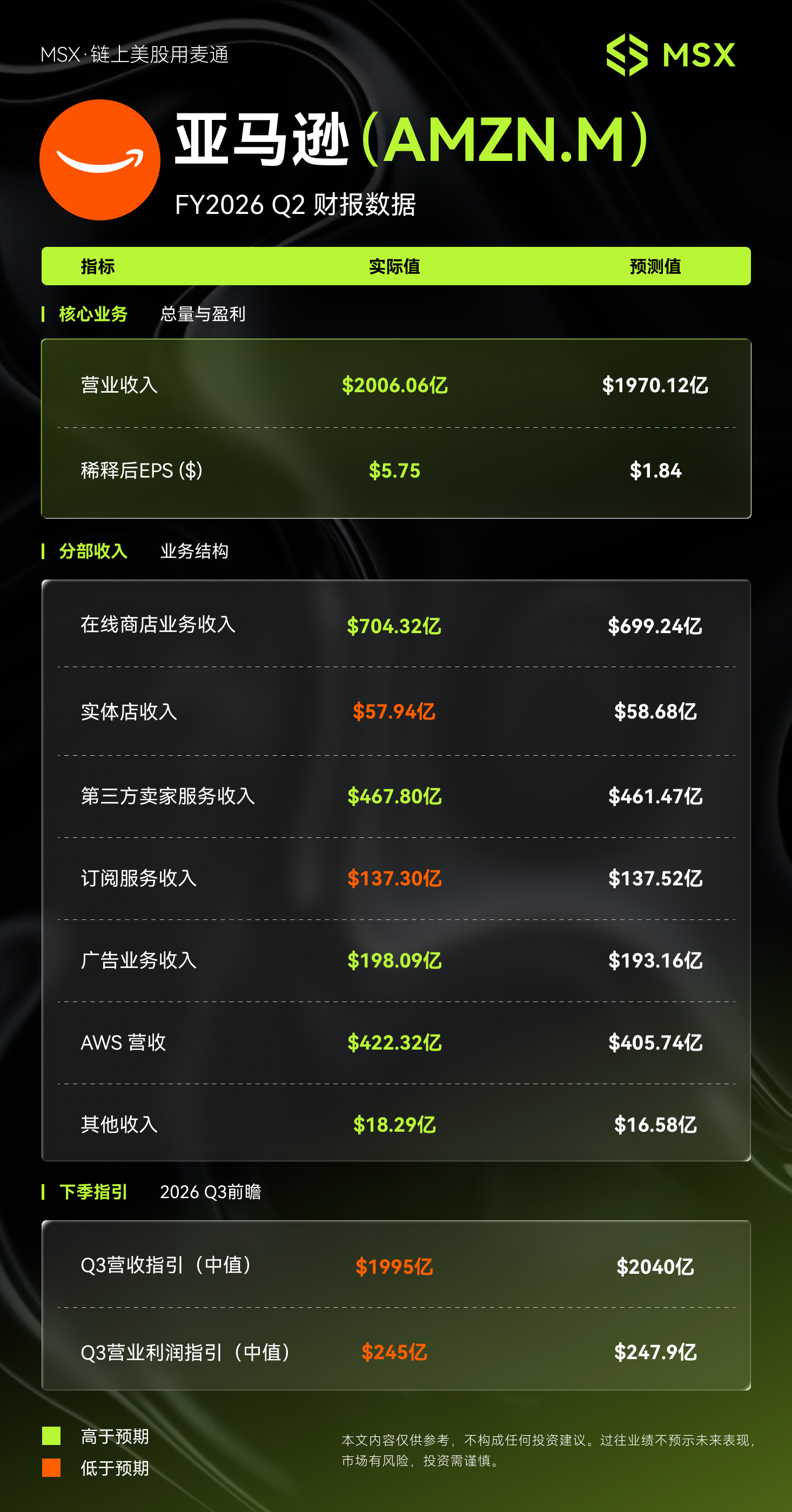
MSX US Stock Daily Insight: Amazon 2026 Q2 Earnings: AWS Records Fastest Growth in Five Years

**MSX Daily US Stock Observation: Amazon's Q2 2026 Earnings: AWS Achieves Fastest Growth in Five Years** Amazon's latest quarterly results exceeded expectations, driven by a strong performance from its cloud computing unit. The company reported revenue of $200.66 billion, surpassing estimates of approximately $197 billion. The key highlight was Amazon Web Services (AWS), which generated $42.232 billion in revenue, surging 37% year-over-year. This marked the segment's fastest growth pace in 18 quarters, indicating robust demand for cloud services. Reported Earnings Per Share (EPS) of $5.75 significantly exceeded the $1.84 forecast. However, this figure included a substantial one-time, non-operating gain of $53.4 billion, primarily from the revaluation of Amazon's investment in AI company Anthropic. Excluding this item, core operating profit was $27.461 billion, a strong increase of 43% compared to the same period last year. Despite the positive results, Amazon provided guidance for the upcoming third quarter that fell short of market expectations. The company's revenue guidance midpoint is $199.5 billion, below the consensus estimate of around $204 billion. Operating profit guidance of $24.5 billion also slightly missed expectations of approximately $247.9 billion. Furthermore, Amazon raised its forecast for full-year capital expenditures to $220 billion, citing rising memory chip costs, which weighed on investor sentiment regarding future profitability. In summary, Amazon's quarter showcased accelerating momentum in its core AWS business. The underlying operational profit growth remains solid. However, cautious forward guidance and increased investment spending present key areas for monitoring in the coming quarters, as the market assesses whether the current growth phase will translate into sustained profit margin expansion.

Odaily星球日报6m ago

MSX US Stock Daily Insight: Amazon 2026 Q2 Earnings: AWS Records Fastest Growth in Five Years

Odaily星球日报6m ago

Cyclical Stock or Growth Stock? Coinbase's Q2 Earnings Report Reveals 'Valuation Disagreement'

Coinbase's Q2 2026 financial results revealed a mixed performance, reigniting debate over whether the company should be valued as a cyclical stock tied to crypto markets or a growth stock with future potential. Total revenue missed expectations at $1.22 billion, down 19% year-over-year. Transaction revenue fell to $599 million, with retail crypto spot trading revenue dropping 30% to $452 million, back to 2023 levels. The company reported a net loss of $359 million, marking its third consecutive quarterly loss. Despite CEO Brian Armstrong's positive commentary on metrics like a 10.3% overall crypto trading market share and 106% growth in prediction markets, the market reacted negatively, with shares dropping over 5% after-hours. A key issue is the decline in core retail trading. While Coinbase touted record market share, this figure includes derivatives and new products. Its traditional crypto spot trading share is likely shrinking. New ventures like prediction markets, while growing, contributed less than $30 million, insufficient to offset the core revenue decline. The valuation debate hinges on perspective. As a cyclical stock, Coinbase remains deeply tied to the crypto bear market, with user attrition and competitive pressures justifying a lower valuation. The company's strategy appears focused on surviving until the next bull cycle. Viewed as a growth stock, however, Coinbase shows promising diversification. Subscription and service revenue reached $555 million, nearly matching transaction revenue. Stablecoin revenue, its second-largest source at $292 million, remains strong through its partnership with Circle. Critically, Coinbase is positioning itself as a leader in the emerging on-chain "agent economy." Over 90% of agent-based stablecoin transactions occur on its Base network, which it believes could handle trillions in future agent transactions. The recent acquisition of Deribit also aims to boost its international derivatives offering. In summary, Coinbase's present struggles are clear, but its future hinges on whether its investments in revenue diversification, stablecoins, and the agent economy can ultimately transform its business model and justify a growth premium.

Odaily星球日报26m ago

Cyclical Stock or Growth Stock? Coinbase's Q2 Earnings Report Reveals 'Valuation Disagreement'

Odaily星球日报26m ago

Global Market Share Survey: Japanese Firms Lead in Semiconductor Materials

Global Market Share Survey: Japanese Firms Lead in Semiconductor Materials According to the 2025 "Major Goods and Services Market Share Survey" by Nikkei, Japanese companies maintain strong positions in semiconductor-related materials. In silicon wafers, Shin-Etsu Chemical ranks first with a 26.3% share, followed by SUMCO at 17.8%. Together, they hold 44.1% of the market, widening their lead over competitors from Taiwan, Germany, and South Korea. In photoresists, Tokyo Ohka Kogyo, JSR, and Shin-Etsu Chemical occupy the top three spots, with a combined share of 60.5%. Despite their strength in materials, Japanese firms have a weaker presence in core semiconductor segments like DRAM and NAND flash memory, where South Korean and U.S. companies dominate. For instance, SK Hynix and Samsung lead in DRAM, while China’s CXMT doubled its share to 6% in 2025. The semiconductor market is projected to grow rapidly, with WSTS forecasting a 90% increase to $1.5112 trillion by 2026. Major players like Samsung, SK Hynix, and Micron are making massive investments to expand capacity. To maintain their edge in materials, Japanese companies must similarly commit to large-scale, risk-taking investments. In contrast, Japan’s automotive sector shows stagnation. Toyota remains the global leader but with only a slight share increase to 12.3%, while Japanese brands are absent from the top five in the EV market. In shipbuilding, Imabari Shipbuilding rose to third place globally with a 7.2% share, benefiting from large container ship deliveries. However, Chinese and South Korean firms dominate the sector, holding the top two positions. Japan aims to revitalize its shipbuilding industry through government and corporate efforts, targeting a near doubling of output by 2035. Addressing labor shortages and adopting advanced technologies like physical AI will be critical for competitiveness.

marsbit51m ago

Global Market Share Survey: Japanese Firms Lead in Semiconductor Materials

marsbit51m ago

Trading

Spot
活动图片