Solana Processes 169.9 Million Transactions in a Single Day

cryptonews.ruPublished on 2026-08-06Last updated on 2026-08-06

Abstract

Solana set a new daily transaction record with 169.9 million user/application transactions processed, indicating real network activity. This followed a 66% capacity increase from a July 29th network upgrade (SIMD-0286), which raised the computational unit limit per block. Within six days, this new capacity was reportedly filled. Much of the increased transaction flow comes from market makers and arbitrage bots, which provide liquidity and maintain low spreads with frequent, low-fee trades. The launch of Western Union's 'Stablecard' on Solana highlights growing payments use. However, while transaction counts are at all-time highs, the fees and revenue generated are at multi-year lows, as high-volume speculative trading (e.g., memecoins) has been replaced by higher-frequency, lower-value transactions. Future planned upgrades, like Alpenglow and 200-millisecond slots, aim to further scale the network's throughput.

According to data from Blockworks, Solana processed a record 169.9 million transactions on August 13. This is a record number of transactions for a single day in the network's history. Non-vote transactions filter out messages validators send to each other to agree on blocks, so this number reflects actual user and application activity, not consensus overhead.
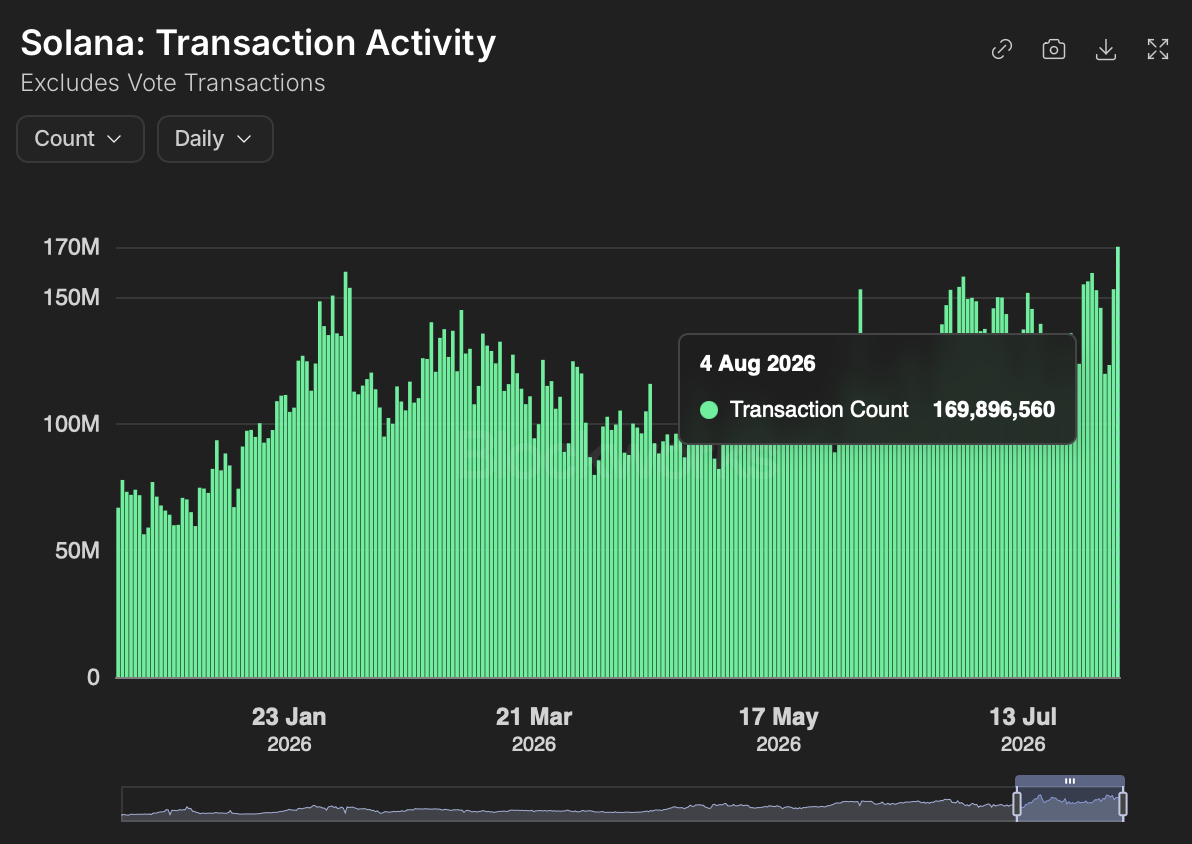
Source: Blockworks

On a weekly basis, the transaction count surpassed the highs set in early February and is up about 55% from this year's lows in April.

Capacity Increased by 66%, Filled in Six Days

On July 29, Solana activated the SIMD-0286 network upgrade at the beginning of a new epoch—the roughly two-day cycle Solana uses to rotate validator duties. The update increased the maximum compute resource limit per block from 60 million to 100 million compute units, representing a 66% increase. Compute units essentially measure the amount of work processed, so a higher limit can accommodate more transactions in a block.

This upgrade, developed by Jito Labs engineer Lukas Bruder, is the most significant throughput increase for Solana since its launch. The block creation time remained at 400 milliseconds, with no impact on speed. This was only possible after XDP kernel-bypass networking technology, which allows validators to transmit data faster by bypassing parts of the operating system, processed 70% of staked SOL.

The 60 Million Limit Was Tested Under Real Traffic

Data from the Solana Foundation shows that 11.2% of blocks reached 56 million compute units or higher, approaching the previous 60 million limit. The limit was stress-tested during periods of volatility, precisely when traders need their orders executed. In this sense, block space wasn't sitting idle waiting for users. Demand was pushing against the limit.

Most New Flow Comes From Trading Mechanisms

Market makers, using their own automated market makers (AMMs), constantly update their quotes on the blockchain, and according to Blockworks Research estimates, this flow could account for roughly 20% of all Solana transactions by the end of 2025. On top of this are arbitrage and order book maintenance. This kind of traffic expands to fill available block space, as this is how providing liquidity works on a platform with 400ms blocks and sub-cent fees. This traffic also keeps spreads low for everyone else.

The payment aspect emerged on the same day. Western Union's Stablecard launched on August 4 on the Solana platform via Rain, covering 37 markets and running on the USDPT stablecoin. The circulation volume is still around 7.4 million tokens, which is not yet impacting transaction counts. But the reason Western Union chose Solana is the same reason the record was set, and there is now potential to scale this flow.

UrgentKIN: Western Union Stablecard is live. Instant payments anywhere Visa works, across 175 million merchant locations in 37 markets at launch. The card runs on USDPT, a native stablecoin on Solana and backed by @WesternUnion, issued on-chain by @raincards . https://t.co/A0ycTQP68X pic.twitter.com/01NajGWGPe


— Solana (@solana) August 4, 2026

Record Throughput, Lowest Fees Since 2023

The issue lies in revenue metrics. Network usage fees in Q2 were $51 million, making it the weakest quarter for Solana since Q3 2023, while decentralized exchange (DEX) trading volumes are at their lowest since September 2024. Transaction counts are breaking records while associated monetary volumes are shrinking.

The mix has changed. Memecoin speculation generated good revenue per transaction. Market maker quote updates and stablecoin payments do not. This is healthier for infrastructure and less costly for business, and it's a real trade-off, not a side effect.

Next up are Alpenglow and 200-millisecond slots. Solana is building towards throughput it has yet to fully realize.


Trending Cryptos

Related Questions

QWhat record did the Solana network achieve according to the article?

AThe Solana network processed 169.9 million transactions in a single day, a record high in the network's history.

QWhat was the purpose and impact of the SIMD-0286 network update activated on July 29?

AThe SIMD-0286 update increased the maximum computational unit limit per block from 60 million to 100 million, a 66% increase. This allowed more transactions to be included in a block without affecting the 400-millisecond block creation time.

QWhat is the main source of the new transaction flow filling the increased block capacity, according to the article?

AA significant portion of the new transaction flow comes from trading mechanisms, specifically market makers using their own Automated Market Makers (AMMs) to constantly update quotes on the blockchain. This is estimated to account for roughly 20% of all Solana transactions by the end of 2025.

QDespite record transaction numbers, what financial challenge for the Solana network is highlighted in the article?

AThe article highlights that while transaction numbers are at record highs, network fee revenue is weak. Q2 fee revenue was $51 million, the lowest quarter since Q3 2023, and DEX volumes are at their lowest since September 2024.

QWhat recent major partnership is mentioned as a potential source for future transaction scaling on Solana?

AThe article mentions the launch of the Western Union Stablecard on the Solana network via Rain on August 4th. It operates on the USDPT stablecoin and is available across 37 markets, representing a significant potential payment flow for the network.

Related Reads

Report: Warsh Prepared to Raise Interest Rates in September if Inflation Data Remains Strong in Coming Weeks

Report: Fed Chair Walsh Prepared to Hike Rates in September If Upcoming Inflation Data Stays Strong According to a Financial Times report, Federal Reserve Chair Walsh is prepared to raise interest rates at the September policy meeting if inflation data in the coming weeks remains hot and market expectations for a hike increase. Following this news, short-term US Treasury yields rose. Walsh has adhered to a pared-back communication strategy despite recent market volatility and criticism that his limited guidance has weakened the Fed's inflation-fighting credibility. Sources close to his thinking acknowledge some communication missteps since he took office but insist these won't derail his overall reform agenda. His most significant policy shift has been drastically reducing forward guidance, a practice he has long criticized for boxing in policymakers. Futures markets now price in roughly a 55% chance of a 25-basis-point rate increase in September. Sources indicate that while Walsh has raised the possibility of using balance sheet reduction to tighten policy, interest rates remain the primary tool for now. The Fed's preferred inflation gauge was at 3.7% in June. Walsh is expected to deliver his first major speech at the upcoming Jackson Hole symposium, seen as a key opportunity to clarify his policy framework and address perceived shortcomings in his messaging.

marsbit9m ago

Report: Warsh Prepared to Raise Interest Rates in September if Inflation Data Remains Strong in Coming Weeks

marsbit9m ago

Chainalysis: Robbery of Crypto Investors Using a 'Soldering Iron' Nets $30 Million in Half a Year

According to a report from Chainalysis, criminals have stolen over $30 million from cryptocurrency investors through violent physical attacks, known as "wrench attacks," in the first half of 2026. This puts the year on track to surpass the record $58 million stolen via such methods in all of 2025. There were 46 documented violent incidents globally by the end of June, up from 40 in the same period of 2025. These attacks, which include kidnappings, home invasions, and hostage-taking, increasingly threaten the personal safety of crypto holders and their families. Only about 26% of these attacks resulted in a ransom being paid, a significant drop from a 49% success rate in 2025. Chainalysis notes the true scale of the problem is likely underreported. The criminals often identify targets in advance through data leaks, social media, or insider information before using low-skilled enforcers for the physical assault. France is a major hotspot, with 30 publicly known incidents by mid-2026, compared to 19 in all of 2025. French authorities have reported over 70 cases, suggesting the real number is even higher. A suspected leak of taxpayer data from the French tax service and a separate breach at crypto tax firm Waltio are considered key factors enabling criminals to find targets. Stolen funds are moved using various methods, from direct transfers to centralized exchanges to more sophisticated techniques involving blockchain bridges, decentralized exchanges, and money-mixing services. The report highlights a lack of a unified industry methodology for tracking these incidents, as evidenced by a different count (52 cases) from analytics firm CertiK for the same period.

cryptonews.ru9m ago

Chainalysis: Robbery of Crypto Investors Using a 'Soldering Iron' Nets $30 Million in Half a Year

cryptonews.ru9m ago

Shareholders' Accurate Reduction of 1.4 Billion Shares, Under Heavy Performance Pressure, Meish Technology Makes an Emergency Cross-Border Move into Indium Phosphide

Domestic distributed audio-visual and AI vision solutions provider Meish Technology (001229.SZ), despite its AI concept, has shown signs of fatigue shortly after listing, with consecutive declines in revenue and net profit. Amid this pressure, the company is making an urgent foray into the hot "indium phosphide" semiconductor concept. The company moved swiftly, establishing a wholly-owned subsidiary in July and holding an extraordinary shareholders' meeting in August to authorize management to advance the project. This rapid capital operation is seen as a move to tap into the AI computing power industry chain. However, behind this "cross-border self-rescue" lies deep pressure on fundamental performance, precise high-level减持 by a major shareholder who cashed out approximately 142 million yuan just before the stock price peaked, and the new business remaining at a very preliminary "blueprint" stage with no substantive impact on performance yet. Meish Tech's core business of "distributed audio-video control systems" faces intense competition. While maintaining high gross margins, its revenue growth and profit growth have seriously diverged. Although its AI business revenue surged in 2025, it failed to halt the overall profit decline. Since its 2022 IPO, the company's performance has declined, with 2026 first-quarter results even showing a loss. The half-year 2026 forecast predicts a profit plunge of over 70% year-on-year. In this context, the跨界 into the high-tech barrier, capital-intensive indium phosphide field appears more like a gamble driven by market valuation concerns than a strategy based on deep technical积累.

marsbit19m ago

Shareholders' Accurate Reduction of 1.4 Billion Shares, Under Heavy Performance Pressure, Meish Technology Makes an Emergency Cross-Border Move into Indium Phosphide

marsbit19m ago

Just 3.5 Months After Its Founding, It Started Making External Investments: The Embodied AI Sector Is Collectively 'Investing While Fundraising'

A counterintuitive trend is emerging in China's embodied AI sector: numerous startups that are still actively raising capital themselves are now making strategic investments in other companies. An analysis of 29 such enterprises reveals a pattern of "fundraising while investing," where companies, often still in early funding rounds, rapidly deploy capital into the ecosystem. These 29 investment entities, primarily based in the Pearl River Delta and Yangtze River Delta regions, have executed over 125 investment deals. Notably, 17 of them (59%) are humanoid robot manufacturers, making them the most active investors. The trend shows that newer companies are investing faster; firms founded after 2023 made their first external investment in an average of just 22.8 months, with one company, Poke Robotics, doing so within 3.8 months of its founding. Zhiyuan Robot (智元机器人) stands out as the most active corporate venture capital (CVC) player, completing 37 investments in 23 months. A more complex, networked investment structure is also forming, where companies like Lingchu Intelligent (灵初智能) and Lingxin Qiaoshou (灵心巧手), which received investments from larger players, have themselves become active investors, extending the strategic reach of capital down the supply chain. This collective shift from a few large players to widespread participation signals a strategic move to use capital as a lever to accelerate industry consolidation. Companies are seeking to quickly integrate critical supply chain elements—such as dexterous hands, joint motors, and AI data platforms—into their ecosystems to gain a competitive edge in a rapidly evolving, highly contested market window. The strategy aims to compress the decade-long process of traditional supply chain integration into just a few years, though it carries risks related to technology bets and ongoing capital burn. As the sector's IPO pipeline grows, this "fundraise and invest" model may soon become a standard industry practice.

marsbit23m ago

Just 3.5 Months After Its Founding, It Started Making External Investments: The Embodied AI Sector Is Collectively 'Investing While Fundraising'

marsbit23m ago

Trading

Spot

Hot Articles

Discussions

Welcome to the HTX Community. Here, you can stay informed about the latest platform developments and gain access to professional market insights. Users' opinions on the price of SOL (SOL) are presented below.

活动图片