"I Don't Need a Better Model Anymore": A Panorama of AI Users Under a Reddit Hot Post

marsbitPublished on 2026-06-12Last updated on 2026-06-12

Abstract

Titled "I Don't Need a Better Model Anymore": AI User Reactions on Reddit Anthropic recently released Claude Fable 5, its first publicly available 'Mythos'-tier model, achieving 80.3% on the SWE-Bench Pro benchmark and significantly outperforming its predecessor and competitors. However, a viral Reddit post titled "Claude Fable made me realize I don't need better models anymore" highlighted a growing user sentiment of "good enough." Top comments expressed "model fatigue," with users stating that earlier models like Opus 4.5/4.8 already sufficed for their workflows. High cost was a key concern, as Fable 5's API is nearly twice the price of Opus 4.8, with users questioning the return on investment and suggesting the field has hit a plateau. The most frequent complaint targeted Fable 5's stringent safety filters. Designed to intercept high-risk requests (e.g., cybersecurity), the system was perceived as overly conservative. Users reported frequent rejections for routine security-related tasks, leading to automatic fallbacks to the older Opus model. Paying users were particularly frustrated, feeling they paid a premium for a less usable product. Dissenting voices came from users with heavy, complex tasks. For workloads like high-energy physics simulations with thousands of code lines, Fable 5's improved long-context understanding and error detection represented a significant, worthwhile leap—described as moving from a "college player to an NBA starter." The debate underscore...

Author: Friday, Shenchao TechFlow

Anthropic just delivered a performance report that is impeccable on paper.

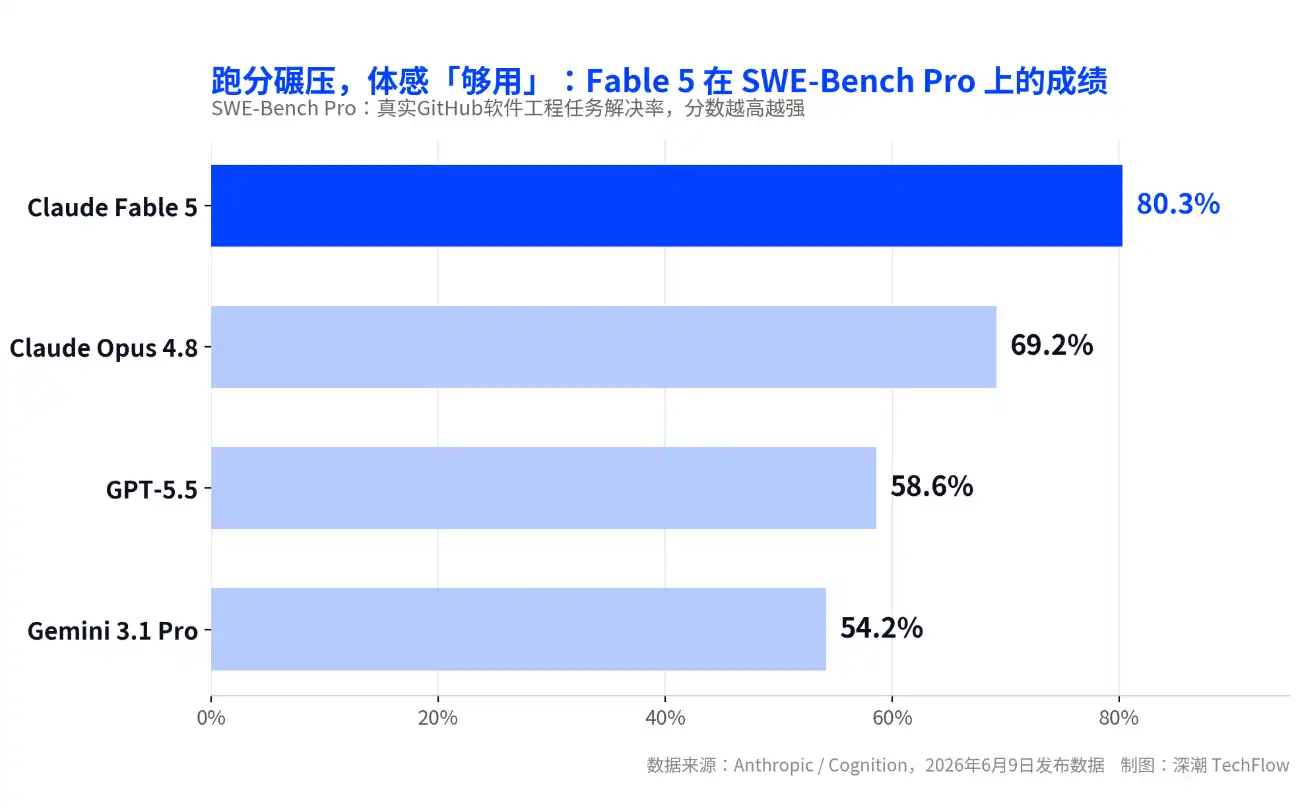
Claude Fable 5, released on June 9th, is the company's first publicly available Mythos-tier model. It scored 80.3% on the real-world software engineering benchmark SWE-Bench Pro, leading its own previous flagship Opus 4.8 by about 11 percentage points and surpassing GPT-5.5 by over 20 percentage points.

But user reactions poured cold water on the excitement.

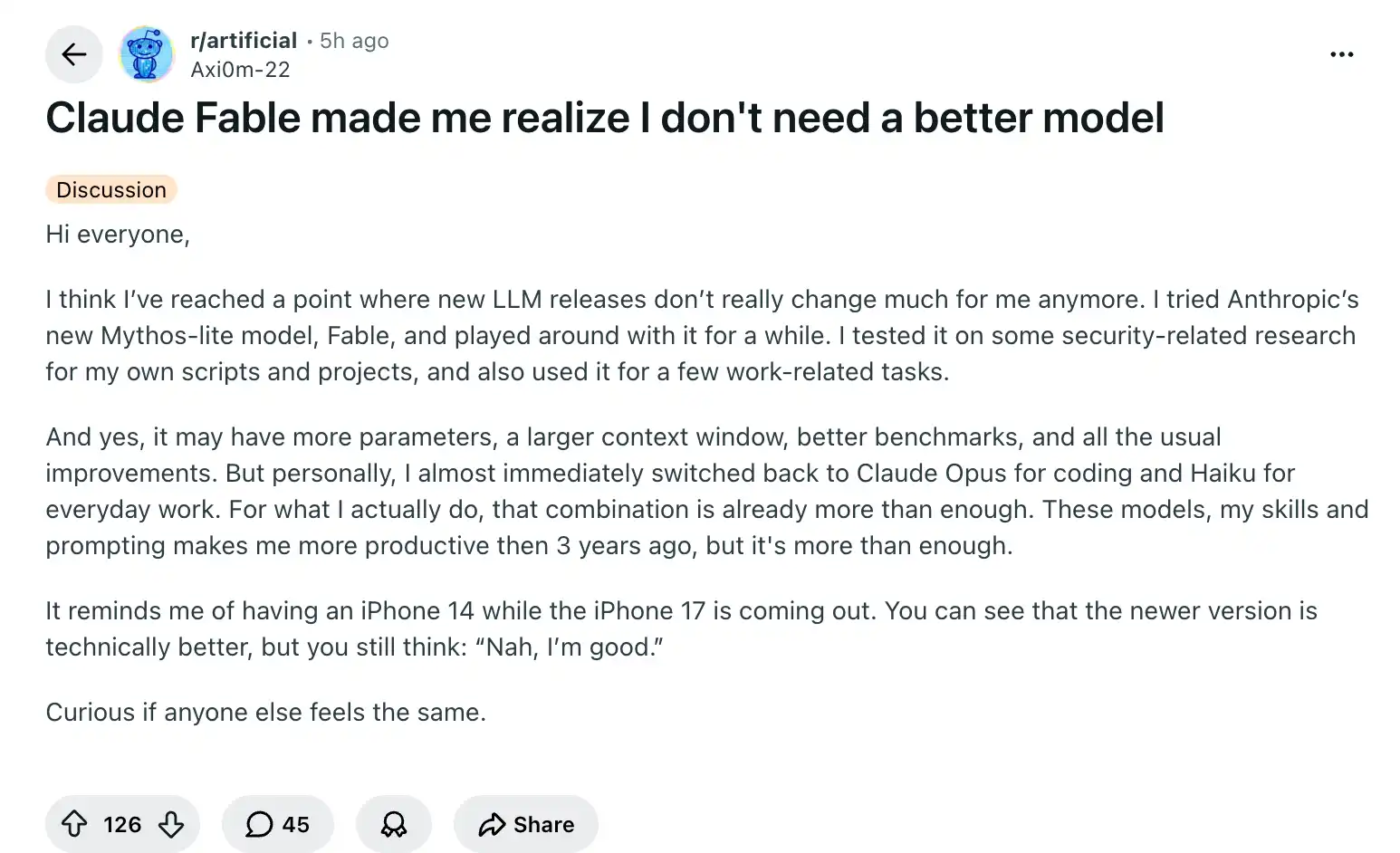
Three days after the release, a hot post on the r/artificial subreddit (weekly traffic 305k) was titled: "Claude Fable made me realize I don't need a better model anymore." The poster, Axi0m-22, said he used Fable for a while for security research and daily tasks, then almost immediately switched back to Opus for coding and Haiku for miscellaneous jobs. He made an analogy: It's like watching the iPhone 17 launch while holding an iPhone 14. "You know the new one is better, but you think: Nah, mine is fine."
The High-Vote Zone is Occupied by the "Good Enough" Camp: Model Fatigue Becomes the Prevailing Sentiment

The top comment with 42 upvotes states: "Other than the larger context window, I haven't felt the need for a stronger model since Opus 4.5."

Another user, hyprlab, received 13 upvotes for this statement: "I don't see any benefit to my workflow from switching to a model that burns tokens even faster. Opus 4.8 high-intensity mode is already comfortable enough."

There's a common cost calculation behind such remarks.

Fable 5's API is priced at $10 per million input tokens, nearly double that of Opus 4.8. User siromega37 was blunt: "Higher token consumption, but no return on investment. I think we're seeing the plateau, the bubble will eventually burst."

User hobopwnzor gave a more systematic interpretation: "We've been near the top of the S-curve for a while. Recent improvements mainly come from tool use and peripheral engineering, not the core model capability itself."

Safety Guardrails Become the Biggest Complaint: "90% of Intended Uses Get Rejected"

If "good enough" is just sentiment, then complaints about safety guardrails are a concrete product issue.

According to Anthropic's official description, Fable 5 shares the same underlying model as the Mythos 5, which is only available to a select few institutions. The difference is that Fable has a safety classifier installed: requests involving high-risk fields like cybersecurity are intercepted and handed off to Opus 4.8 to answer. The company states this mechanism is tuned conservatively, triggering in less than 5% of sessions on average, and may mistakenly block harmless requests.

In this Reddit thread, the perceived trigger rate is clearly much higher than 5%. User jradoff, whose comment got 17 upvotes, said he asked Fable to review the security of his code, and "basically any mention of security-related stuff gets rejected," then it falls back to Opus. Another comment with 12 upvotes was even harsher: "90% of what you want to use it for gets rejected, which makes it useless."

Paid users are even more aggrieved. User kaitava, who subscribes to the $200 tier, wrote: "I'm paying double the usage fee, I ask it to do a security review, and I get downgraded to Opus. Now I dislike everything about it, just waiting for OpenAI to catch up."

For a flagship product touting a leap in capability, "the usability cost paid for safety" is becoming a core variable in users' decisions to pay.

Opposing Voices: Heavy-Duty Task Users Feel the Difference is "Night and Day"

The hot post isn't without opponents, and the opposing camp's profile is quite clear: the heavier the task, the higher the praise.

User Phylaras's comment received 15 upvotes: "Fable made a substantial difference for me. On those massive, complex tasks demanding huge context windows, it caught errors that weren't spotted before." A user claiming to work on high-energy physics simulations said that a single simulation model can easily be 8,000 to 10,000 lines of code with hundreds of interacting models. "Having a model that can work independently and continuously, understanding environmental details, is something I eagerly anticipate."
The fiercest rebuttal came from user Navetz: "Honestly, people who have used this model think posts like this are insane. To me, it feels like a different, smarter person. I've been using it non-stop. I explained it to non-technical friends: it's like going from a college basketball player directly to an NBA starter."

Some offered compromise usage patterns. User ready-eddy suggested using Fable as a "planner and fixer," not as the daily "builder," unless you don't mind burning money. Another comment summed it up more like a user manual: Using Fable for spreadsheet calculations is choosing the wrong model; using Haiku to run a complex task with 16 agents is also choosing the wrong model. "There's no inherently bad model, only models used for the wrong scenario."

After the Disconnect Between Benchmarks and User Experience, Will Public AI Get Stronger?

The most interesting comment in this debate shifted the topic from product to industry structure.

User KedMcKenna proposed a "Public AI Freeze Theory": the models accessible to ordinary people might forever remain near the current level, while corporate and governmental elites will continuously get access to stronger private models. "We know of at least Mythos, and there are likely even stronger models we'll never hear about."

This comment points to a fact: Mythos 5 is indeed not open to the public and is currently only available to cyber defense agencies and critical infrastructure companies through the Project Glasswing program.

Looking at benchmark scores and public sentiment together, the conclusions aren't contradictory.

Benchmarks measure the ceiling of capability, while the Reddit high-vote zone reflects the ceiling of daily needs. When most users' tasks were already satisfied in the Opus 4.6 era, stronger models can only prove themselves in extreme scenarios like physics simulations or ultra-long context tasks. Model vendors no longer face a "can it be done" problem, but rather a "who needs it, how much are they willing to pay, and how much safety friction can they tolerate" problem.

Three days after release, Fable 5 received two completely different report cards: one on the benchmark charts, and another in the court of public opinion. Which one is closer to the truth depends on how quickly Anthropic adjusts its safety classifier and how heavily reliant users vote with their wallets.

Related Questions

QWhat is the main point of the Reddit post titled 'I don't need a better model anymore' regarding Claude Fable 5?

AThe main point is that despite Claude Fable 5's impressive benchmark scores, many users feel the new model's improvements are not necessary for their daily workflows. The post author and many commenters express 'model fatigue,' stating that previous models like Opus 4.8 are already 'good enough' for their needs, and the higher cost and restrictive safety features of Fable 5 don't provide sufficient added value for them.

QAccording to the article, what are the two primary user criticisms of Claude Fable 5?

AThe two primary criticisms are: 1) High cost with insufficient return on investment (ROI), as its API price is nearly double that of Opus 4.8. 2) Overly restrictive safety 'guardrails.' Users report a much higher rate of request denials for security-related tasks than the official 5% estimate, often downgrading them to Opus, which diminishes Fable 5's usability for its intended purpose.

QWho are the users that reported a positive, substantial difference when using Claude Fable 5?

AThe positive feedback comes from users with extremely heavy and complex computational tasks. Examples given include users working on high-energy physics simulations involving thousands of lines of code and hundreds of interacting models, or those needing to process very long context windows for complex tasks. For them, Fable 5's advanced capabilities provide a tangible, 'night and day' difference in performance.

QWhat is the 'public AI freeze theory' mentioned by a commenter in the article?

AThe 'public AI freeze theory' suggests that the capability of AI models available to the general public may plateau around the current level (like Opus 4.8). Meanwhile, significantly more powerful private models (like the non-public Mythos 5) will continue to be developed exclusively for elite entities such as corporations and government agencies, creating a growing capability gap between public and private AI.

QWhat final conclusion does the article draw about the disconnect between Claude Fable 5's benchmark scores and user sentiment?

AThe article concludes that the disconnect is not contradictory. Benchmark scores measure the peak capability of a model, while user sentiment reflects the 'ceiling' of everyday needs. For most users, their tasks were already satisfied by earlier models. Therefore, new, more powerful models must now justify themselves not just on raw ability, but on cost, specific niche use-cases, and how much usability is sacrificed for safety features. The 'true' performance of Fable 5 will depend on Anthropic's adjustments to its safety filters and adoption by heavy-duty, paying users.

Related Reads

Crypto Market Makers Are Collectively Seeking Change as Money Becomes Harder to Earn

**Summary: Crypto Market Makers Adapt as Margins Shrink** Leading crypto market maker GSR exemplifies a broader industry shift, moving beyond traditional market-making to become a full-service "Web3 investment bank." Its recent strategic acquisitions—including an SEC-registered broker-dealer, rebranded as GSR Securities—and purchases of token advisory firms aim to create an integrated platform covering token design, fundraising, listing, liquidity provision, and asset management. This includes launching an ETF and investing in tokenization platforms like Libeara, backed by a strategic investment from Standard Chartered's SC Ventures. This transformation is not unique to GSR. Other major players like Keyrock, B2C2, Wintermute, and DWF Labs are also expanding geographically, pursuing regulatory licenses (especially under frameworks like MiCA in the EU), and diversifying into over-the-counter (OTC) trading, asset management, and real-world asset tokenization. The driving force behind this collective pivot is a rapidly changing market. Profits from traditional altcoin market-making are declining due to fewer viable projects, reduced client budgets, increased competition, and smarter, more demanding clients. Simultaneously, regulatory pressures are mounting, making compliance a baseline cost. Extreme market events further expose teams lacking robust risk controls. Consequently, the crypto market-making business model is evolving from one reliant on information asymmetry and volatility to a more institutionalized, regulated, and service-diverse industry. Survival now depends on building systemic capabilities beyond mere liquidity provision.

marsbit33m ago

Crypto Market Makers Are Collectively Seeking Change as Money Becomes Harder to Earn

marsbit33m ago

Market Adjusts Following Google's $84.7 Billion Fundraising, AI Valuations Now Focus on Payback Speed

After Alphabet's announcement of an $84.75 billion equity financing round, market focus for AI investment is shifting from pure growth narratives to capital efficiency and payback periods. The core argument is that AI is being re-priced from a software-like growth story into a heavy-asset infrastructure cycle, requiring massive capital expenditure (CapEx) on chips, data centers, and power grids. While Alphabet's financing itself is not a distress signal—part of it is for administrative purposes like tax obligations on stock compensation—it highlights the enormous capital demands of AI infrastructure. This demand extends beyond tech giants to pure-play AI model companies (like OpenAI, Anthropic), data center REITs, and utilities. Major tech firms are projected to spend heavily on AI data centers in 2026, signaling a broad-based capital cycle the market must absorb. Consequently, valuation logic is changing. Investors are moving away from questions about who has the strongest AI narrative and are now prioritizing clear visibility into orders, stable cash flows, and the cost of capital. This has led to recent pressure on high-multiple AI software and semiconductor stocks, while "picks-and-shovels" hardware, data center, and power assets with firmer near-term demand may see relative support. The key going forward will be monitoring whether rising CapEx guidance across companies is matched by a timely monetization of AI investments into revenue and cash flow. The market's tolerance for high spending depends on demonstrable returns. While the long-term AI thesis remains intact, the valuation framework has fundamentally shifted to emphasize capital discipline and payback speed.

marsbit40m ago

Market Adjusts Following Google's $84.7 Billion Fundraising, AI Valuations Now Focus on Payback Speed

marsbit40m ago

Trading

Spot
Futures

Hot Articles

Discussions

Welcome to the HTX Community. Here, you can stay informed about the latest platform developments and gain access to professional market insights. Users' opinions on the price of AI (AI) are presented below.

活动图片