Author: Syed Armani
Compiled by: Felix, PANews
AI is no longer confined to screens and software. As AI integrates with robotics, machines are gradually acquiring the ability to perceive the world, interpret changing conditions, and take action in real-time. This shift towards intelligent physical systems, known as Physical AI, is beginning to reshape various industries and promises to impact daily household life as the technology matures.
Innovation in robotics is surging at an unprecedented rate. Figure recently unveiled the Figure 03 humanoid robot, designed for home and commercial applications. It can perform chores like folding clothes and loading dishwashers, though not yet perfectly. Tesla is running its Optimus humanoid robot in limited internal pilot projects on factory floors. Autonomous drones and legged robots are increasingly being used for dangerous inspection tasks. Meanwhile, companies like Unitree and technologies like FlexiTac are working on enabling robots to navigate cluttered home environments, ensure safe movement around pets and children, and assist with daily chores. Once ready, intelligent robots will focus on general intelligence and situational awareness, such as recognizing that a spilled glass of water needs to be cleaned up without explicit instruction.
Investors are pouring significant capital into the technology stack expected to underpin the next generation of robotic hardware. In January 2026, Skild AI raised $14 billion in a Series C round, reaching a valuation of $14 billion, to scale its general-purpose robotics foundation model; while Figure AI raised over $10 billion in its 2025 Series C round, achieving a post-money valuation of $39 billion, to expand human manufacturing capabilities and industrial deployment. Apptronik expanded its Series A to $935 million, and NEURA Robotics added €120 million in its Series B round. These highlight a growing consensus: Physical AI is becoming a strategic foundation for consumer and industrial robots.
Has the Tipping Point for Intelligent Robot Adoption Arrived?
The acceleration currently seen in the field is the result of the convergence of multiple technologies. For decades, the various modules that constitute intelligent robots were developed independently, such as advanced AI algorithms, high-fidelity sensors, robotic arms, and real-time control systems. It is only recently that these modules have begun to merge, enabling robots to effectively perceive, reason, and act in real-world environments. The following are the key factors driving this "robotics tipping point":
Economic Factors: Hardware has finally become commoditized. In the past, robots were expensive because every component was custom-made. Now, they benefit from the supply chains of consumer electronics and electric vehicles.
-
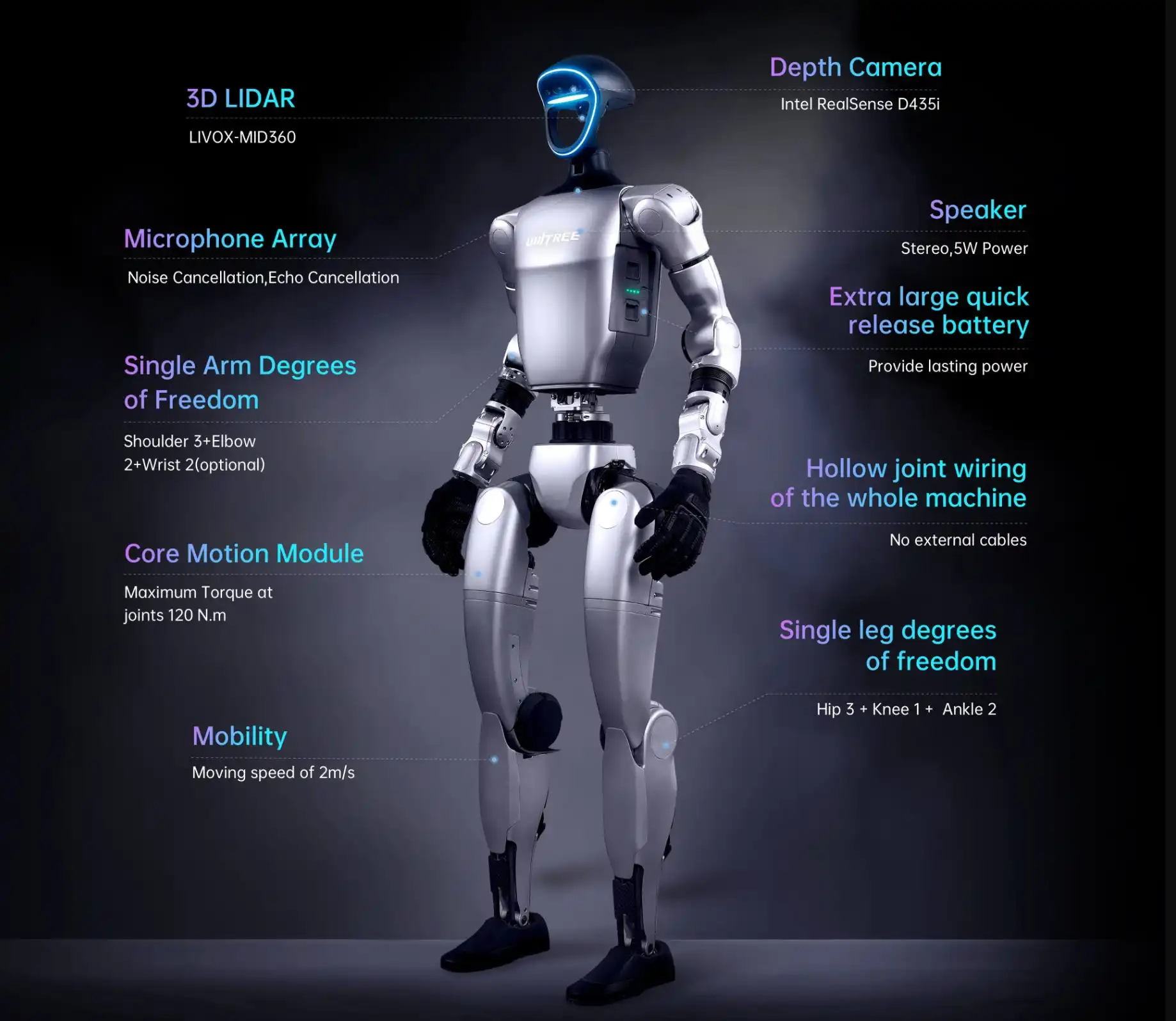
Actuators: Actuators for high-torque humanoid robots have historically been expensive, often costing over $1,000 per joint in small-batch industrial systems. New vertically integrated designs from companies like Tesla and Unitree are driving down the cost of some actuator components to a few hundred dollars.
-
Sensors: The cost of LiDAR and depth cameras has dropped significantly over the past decade. High-end devices that once cost around $10,000 are now available for a few hundred dollars. This is thanks to advancements in solid-state designs, mass production, and applications in the automotive and mobile device sectors.
-
Batteries: Massive global investment in electric vehicles has reduced the cost and improved the reliability of high-density lithium-ion batteries, enabling many robots to operate for 2-4 hours on a single charge.
Edge Computing: Robots must process information locally because real-time control tasks, such as balancing or grasping objects, do not tolerate network latency. Chips like NVIDIA's Jetson Thor are designed to run AI inference onboard while processing multiple sensor data streams. This allows robots to process and track their environment locally, responding quickly to changing conditions without relying on a network connection.
"Brain" Breakthroughs (AI Models): This is the biggest change. The shift is from "if/then" programming to "World Models." A World Model is a type of AI model that learns how the real world works by watching videos. Instead of programming a robot to "turn a doorknob," it is shown 10,000 videos of doors opening. The AI, just by observing the videos, builds a mental model of how physics works, developing a physical intuition and mentally simulating scenarios before taking action. Google Deepmind's Genie 3 and NVIDIA's Cosmos are examples of these new types of World Models.
As machines become smarter, costs continue to fall. For example, the Noetix Bumi robot (priced at $1,400) now costs roughly the same as an iPhone 17 Pro Max. The combination of falling hardware costs, improved AI chip performance, and enhanced World Model capabilities makes intelligent robots more accessible to the masses and expands the scope of R&D from cutting-edge tech labs to a broader field.
If the "ChatGPT moment" for robotics arrives soon, it will likely first see applications in industry and logistics, before truly domestic humanoid robots become a reality. Although many challenges remain before intelligent robots become truly widespread, rational optimists realize that current trends point towards a future where the widespread application of intelligent robots is increasingly likely.
Major software breakthroughs often accompany hardware breakthroughs. The emergence of Instagram and TikTok was made possible by the necessary hardware. If intelligent robot hardware becomes widely available in the near future, an interesting question arises: will robot applications be the next wave?
What Challenges Currently Hinder This Momentum?
Robot Training Data: This is the biggest bottleneck for the development of general-purpose intelligent robots. Unlike text AI, which can scrape the entire internet, robots need real-world experience, such as feeling force, maintaining balance, and interacting with objects. Collecting this data is slow, expensive, and very labor-intensive.
The "Physicality" Problem: Watching videos cannot fully teach a robot how to manipulate objects or move safely; it must physically feel force and contact. Teleoperation, where a human guides the robot in real-time, captures both intent and force simultaneously, and is the gold standard for data collection. Generating hundreds of hours of high-quality data requires the operator's presence throughout, making it far less scalable than digital data collection.
The Simulation-to-Reality Gap: Simulation can generate large amounts of data at low cost, but robots often fail to transfer skills to the real world due to unmodeled physical phenomena or unpredictable environments.
On-Chain Machine Economy
The combination of blockchain and robotics offers a practical solution to the current challenges in robotics. Token incentive mechanisms can help coordinate millions of robots and reward contributors of teleoperated devices or sensor data. Every interaction becomes a valuable data asset, building a rapidly growing, community-owned robot dataset on a scale far beyond any single company.
Tokenization of Data Collection
Robotic data is extremely valuable, but real-world sensing and interaction data is scarce. Large companies collect vast amounts of driving and industrial data through their fleets, giving them a scale advantage unattainable by independent developers.
Decentralized Physical AI allows users to remotely operate robots or contribute sensor data and receive token incentives. Decentralized networks can coordinate thousands of enthusiasts worldwide to help robots navigate complex terrain, or contributors in special environments can upload data and receive rewards. Although these platforms are still in their early stages, they herald a future where robot data can be shared more widely, weakening the monopoly of a few large enterprises.
Robots as Economic Agents
In the "Robot-as-a-Service" model, intelligent robots themselves can become "tokenized" assets. Each robot (or usage right) can be represented by a digital token, allowing multiple users to own or lease it. Service fees paid to the robot can be sent directly to the robot's wallet via tokens or stablecoins. This setup enables autonomous revenue generation: the robot earns money through work, pays its own operating costs, and automatically distributes profits to token holders. Essentially, this is a Web3 protocol that turns robots into programmable, self-sufficient service providers with transparent and traceable earnings.
The Physical AI Market Landscape
As a new generation of intelligent machines learns and understands the complex realities of the three-dimensional world, the boundary between digital intelligence and physical behavior is blurring.
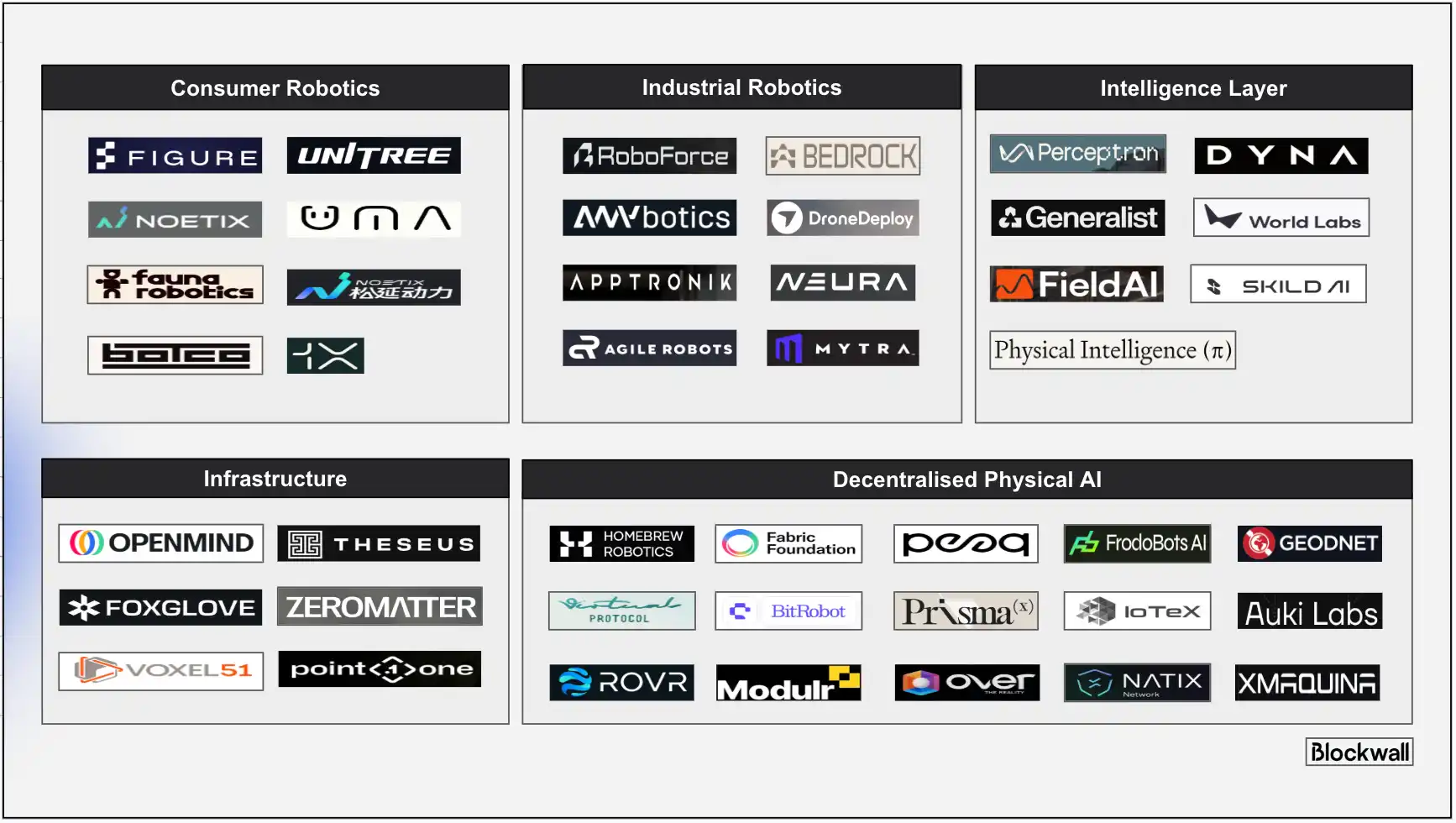
At the core of this revolution are AI models. Sophisticated "brains" developed by companies like Physical Intelligence and Skild AI go beyond static code, providing general intelligence for various physical forms. These models treat agility and mobility as software problems, enabling a single unified "brain" to adapt to multiple robot bodies. This intelligence layer is supported by simulation platforms and data pipelines (such as those provided by Zeromatter), allowing systems to train safely in virtual environments before deployment in the real world.
Evolving alongside the robot brains is Decentralized Physical AI. For example, the decentralized infrastructure network Fabric Protocol provides on-chain identities and crypto wallets for autonomous robots and uses cryptography to verify machine work. Companies like Auki, Peaq, and IoTeX are building a "machine economy" where robots can share 3D maps, verify data, and transact autonomously. This decentralized approach ensures the coordination layer is not controlled by a single enterprise.
In the industrial sector, Bedrock Robotics' autonomous construction equipment and Mytra's warehouse automation are redefining labor, while ANYbotics handles routine maintenance in hazardous environments. Meanwhile, breakthroughs in the consumer market for home assistants are imminent as companies like Figure and Unitree advance.
2030 Outlook
From a rational optimist's perspective, the robotics renaissance is already here. Four unstoppable forces are converging: hardware costs are plummeting, AI model intelligence is rising, edge computing chips provide unprecedented processing power, and a global workforce of contributors promises to solve the data problem. By 2030, this synergy will push Physical AI into every corner of the world, from autonomous agriculture to high-risk areas like firefighting and elderly care.
History shows that transformative software innovation often occurs after hardware stabilizes. We may usher in an era of "intelligence rentals," where standardized humanoid robots run standard operating systems and integrate app stores. Much like the previous smartphone revolution, the coming years could be defined by the "robot app store," where users don't buy dedicated devices but subscribe to a robot's skills. In this model, value shifts from the machine itself to the specific "skills" it can perform. You wouldn't buy a dedicated French tutoring robot; you'd simply download a "French Skill App" on your general-purpose humanoid robot, and it becomes your French teacher. By 2030, for affluent individuals, the preferred holiday gift might no longer be a flagship foldable phone but an intelligent assistant that can genuinely help manage household chores.
This prediction is built on rational optimism. Although the path to the future is rarely smooth, the convergence of technologies is预示着一场深刻的机器技术变革 (hinting at a profound machine technology transformation).
Related reading: When Robots Learn to Think, Earn, and Collaborate: Analyzing 15 Types of Robotic Technologies and Application Cases